
Pitch Deck and Business Plan Guide in Australia
Table of Contents
- 01 Introduction
- 02What Is a Pitch Deck?
- 03 What Is a Business Plan?
- 04 Why Do Businesses Need Both?
- 05 Key Components of a Pitch Deck
- 06Key Components of a Business Plan
- 07Pitch Deck vs Business Plan — Key Differences
- 08Common Mistakes Businesses Make
- 09Five Key Steps: Building Your Pitch Deck and Business Plan
- 10Real-World Examples and Lessons from the Field
- 11 Our Process
- 12Indicative Timeline and Frequently Asked Questions
- 13 Challenges and Lessons Learned
- 14Conclusion and Actionable Insights
Table of Contents
- 01 Introduction
- 02 What Is a Pitch Deck?
- 03 What Is a Business Plan?
- 04 Why Do Businesses Need Both?
- 05Key Components of a Pitch Deck
- 06 Key Components of a Business Plan
- 07 Pitch Deck vs Business Plan — Key Differences
- 08Common Mistakes Businesses Make
- 09Five Key Steps: Building Your Pitch Deck and Business Plan
- 10Real-World Examples and Lessons from the Field
- 11Our Process: Pitch Deck and Business Plan Guide in Australia
- 12 Indicative Timeline and Frequently Asked Questions
- 13 Challenges and Lessons Learned
- 14Conclusion and Actionable Insights
01 Introduction
The Importance of Documentation in Fundraising
Pitch deck and business plans are critical for raising capital, communicating with investors, and developing business strategy in Australia. When founders choose to raise funds from outside sources, whether that be angel investors, venture capital, private equity or a bank, they are entering a competitive market where the effectiveness of their documentation is just as critical as their product.
- Every year, investors are presented with hundreds of opportunities.
- Companies that attract meetings are not necessarily the ones with the best products - they are the ones that tell their story clearly, concisely, and with compelling evidence.
- Businesses that raise funds are those that pass the credibility test through a more detailed due diligence process requiring a business plan to back up the pitch deck.
What These Documents Must Achieve
They assist founders and management teams in effectively communicating their business model, growth plan, financial forecast, and value proposition to investors, banks, and other stakeholders. This is no easy task:
- To present a business model, you need to understand how the business makes money, spends money, and provides value to customers.
- Presenting a growth strategy convincingly requires a realistic analysis of the market, the competition, and the capabilities the business will need to develop.
- Presenting financial projections credibly requires a model built on realistic assumptions, linked to operational metrics, and that considers alternative pessimistic scenarios.
- None of this is instinctive - it takes effort, discipline and sometimes outside help.
Understanding the Distinction
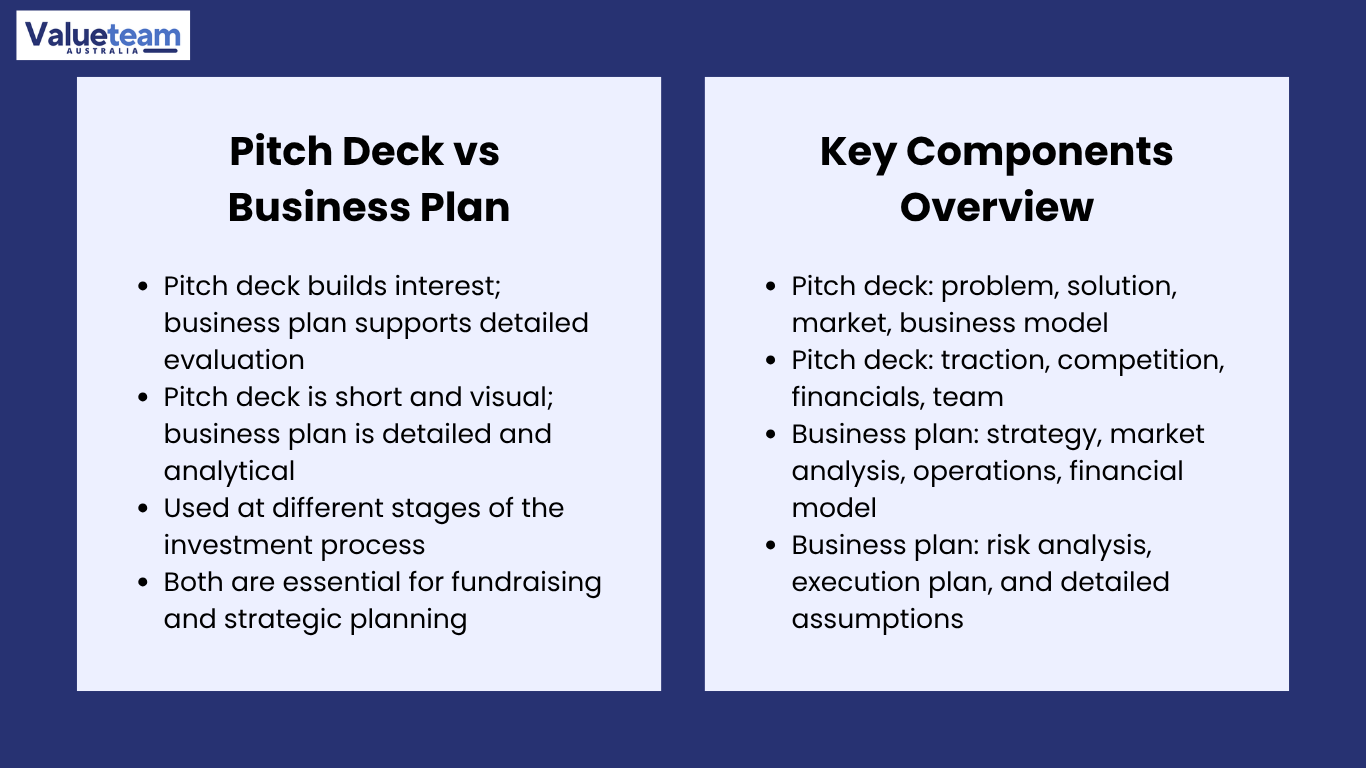
A pitch deck is designed to generate interest, while a business plan is designed to support financial and operational due diligence. This is a key lesson for founders and corporate practitioners:
- The pitch deck is a marketing tool: its purpose is to generate interest in 20 minutes.
- The business plan is an analytical tool: its purpose is to withstand scrutiny over days or weeks.
- They are written for different people at different times in the investment process and should be constructed with different goals in mind.
A pitch deck opens doors. A business plan keeps them open. Both need rigorous thought, objective evaluation and a narrative – not on where you want to be, but why you can be. |
02 What Is a Pitch Deck?
Definition and Purpose
A pitch deck is a brief presentation that outlines the key aspects of a business to investors or other stakeholders. It is usually a slide presentation (10-15 slides) intended for an investor meeting or for review as a document.
- The pitch deck is not a complete document - it is a carefully crafted introduction, and the purpose is to provide enough information to the investor to take the next step in the process.
- It is not meant to be a comprehensive document, but rather to create interest in the investment.
The Narrative Arc Investors Expect
The structure of a successful pitch deck is built around a narrative arc that investors – especially early stage investors – have come to expect:
- Problem: What is the problem in the market, how many people experience it, and why is it not well-solved?
- Product: What is the business, and how does it address the problem, and why is it best positioned to capture the market?
- Market Opportunity: What is the target market size, growth rate and capture rate?
- Business Model: How will the business make money, what are the unit economics, and how will it scale?
- Credibility: What progress has been made, who is on the team, and what is the amount and purpose of the funds required?
What Separates Exceptional from Adequate
What sets a great pitch deck apart from an adequate one is not the design (although that is important) but the thinking behind it:
- Investors who review hundreds of decks each year have a keen nose for separating founders who really know their market from those who have put together pretty decks based on limited research.
- It is not the presentation; it is the story that matters when the investor begins to drill down.
- A deck based on real market research, realistic competitive analysis, and credible financial projections will hold up. One built on optimism and hope won't.
03What Is a Business Plan?
Definition and Scope
A business plan is a formal written statement of a business’s goals and how it intends to achieve them. While the pitch deck is a low-resolution image – a compelling overview for initial investor interest – the business plan is a high-resolution image:
- It is a systematic, in-depth assessment of all aspects of the business.
- It includes strategy, market, business model, financial model and risk analysis.
- It is the document an investor or lender will scrutinise before making an investment decision, and the governance document that management will use to make decisions.
Multiple Audiences, Different Needs
The business plan meets the needs of different audiences:
- For investors doing due diligence, it provides the information to back up the claims made in the pitch deck - market studies, operational details on cost structure, assumptions behind the financial forecasts, and risk assessment.
- For bank lenders considering a loan application, it provides financial history, cash flow projections, collateral and security analysis, and a risk analysis that determines whether the loan will be repaid.
- For the management team, it provides the game plan against which the team assesses its performance and makes decisions.
The Business Plan as a Discipline
The business plan is also a discipline. The act of putting together a full business plan challenges management to answer questions they might otherwise put off:
- How exactly do we intend to acquire customers, and at what cost?
- What resources are required to scale 10x the current level?
- What will our cash flow look like if we only grow revenue by 30%?
- The planning process itself is a planning exercise that invariably leads to better decision-making - and for startups, this is one of the most important outcomes of the process.
04 Why Do Businesses Need Both?
A pitch deck and a business plan together offer a full suite of fundraising and planning tools – each with a specific role in the investor pitch and the internal management of the business.
Fundraising and Investment
In the venture capital and angel investment world, the pitch deck is always the first point of contact for the founder and the investor:
- It is designed to create sufficient interest for the investor to want to explore the opportunity further - to make an appointment for a further meeting, to nominate the deal for partner review, or to request the business plan.
- In the private equity context, where the investment process tends to be more formalised, the business plan is the central document that forms the basis for the investment committee's analysis.
- For bank loans, the business plan is the whole show: banks are less interested in the story than in specific proof that the borrower can repay the loan.
Strategic Planning
The business plan is a cornerstone of strategic planning beyond fundraising, throughout the life of a business:
- Business expansion plans - new market entry, new product development, new business acquisition - benefit from the analysis structure provided by the business plan.
- The business plan framework is especially useful for new market entry planning, by forcing management to consider customer acquisition, pricing, regulatory, and capital plans.
- Planning for long-term growth strategy - the three-to-five-year plan that outlines how the business will make money over that period - demands the financial modelling and scenario testing capability of the business plan.
Stakeholder Communication
The pitch deck format (or a variation of it) is highly effective for a variety of stakeholder communications:
- The pitch deck format (or a variation thereof) provides a clear, visual summary of performance, strategy and decisions for board meetings and investor updates.
- Negotiations with potential partners (distributors, technology providers, strategic investors) benefit from a pitch deck that highlights the business opportunity.
- Having an up-to-date, accurate pitch deck and business plan that reflects the most recent trading results, market events, and management decisions demonstrates that management is of high quality, which sophisticated investors appreciate.
Financial Planning
The financial projections that underpin the pitch deck and business plan are key analytical deliverables of the planning process:
- Revenue and cost forecasts require an understanding of the business's operational levers: customer acquisition strategy, pricing, costs, working capital cycle, and capital expenditure.
- Planning and budgeting against the plan provides the internal discipline to link financial planning to operational management.
- Scenario analysis - modelling the financials of best, base and worst case scenarios - offers the board and investors the realism of range outcomes that savvy stakeholders demand and appreciate.
05 Key Components of a Pitch Deck
The Industry-Standard Architecture
The 10-slide deck below follows the industry-standard structure for an early-stage investor pitch deck. The structure and content of the deck will differ depending on the type of business, stage of development, and target investor audience. Still, the narrative arc (problem, solution, market, model, traction, team, funding ask) is common to the best investor decks.
The Opening Slides — Establishing Context and Opportunity
The first few slides set the stage and opportunity:
- Company Overview: Offers the brief human context - name, story and mission - that personalises the business.
- Problem Statement: Possibly the most critical slide. If investors believe there is a large, legitimate and unmet problem, they are more likely to be open to the solution. The most effective problem slides are specific - they articulate the problem from the point of view of a specific customer type, with some indication of the ubiquity and severity of the problem.
- Solution: Describes the product or service offering as a solution to the problem that has been described - the functionality of the product, the value proposition and the distinctive features that make the solution better than any other.
The Middle Slides — Building the Commercial Case
The middle slides build the commercial case:
- Market Opportunity: Explains the Total Addressable Market (TAM), Serviceable Addressable Market (SAM) and Serviceable Obtainable Market (SOM) - that the business is operating in a market large enough to be worth investing in.
- Business Model: Presents the revenue model - the pricing model, the revenue streams, the transaction economics - and how the economics scale as the business grows.
- Traction: Show the business has been validated in the marketplace by demonstrating a customer base, revenue, milestones, partnerships, or other signs of success.
- Competition: Shows that management has a good grasp on the competitive landscape and a defensible differentiation strategy.
The Closing Slides — Completing the Investor Case
The final slides close out the investor case:
- Financials: Projections, costs, and unit economics should be reasonable and consistent, with the top-line numbers backed by the assumptions.
- Funding Requirement: Clearly outlines how much money is being raised, in what form, and for what purpose.
- Team: Introduces the management team and founders, their relevant experience, and explains why this team is best positioned to execute the plan.
Table 1: Pitch Deck Components — Structure, Purpose and Common Errors
Slide | Core Purpose | What Investors Look For | Common Error to Avoid |
|---|---|---|---|
1. Company Overview | Introduce the business and create a memorable first impression | Clear mission; compelling founding story; credible team context | Generic elevator pitch with no differentiation or memorability |
2. Problem Statement | Establish that a real, large, and underserved problem exists | Specific, evidence-backed problem; named customer type; quantified pain intensity | Vague assertion of a ‘gap in the market’ without evidence |
3. Solution | Present the product/service as a direct, compelling response to the problem | Clear value proposition; specific feature-to-pain mapping; demo or screenshot | Technology-heavy description that loses the commercial story |
4. Market Opportunity | Demonstrate the size of the prize and the credibility of the market share target | Credible TAM/SAM/SOM methodology; growth rate evidence; specific target segment | Unrealistic top-down TAM with no credible path to capturing it |
5. Business Model | Explain how the business generates revenue and scales profitably | Clear pricing strategy; revenue stream structure; unit economics at scale | Overly complex model; missing unit economics; no path to profitability |
6. Traction | Provide real-world validation of the concept and growth trajectory | Revenue growth, customer logos, NPS or retention data, key milestones | No traction claimed without explaining what validation has been achieved |
7. Competitive Landscape | Demonstrate awareness of competition and a defensible differentiation strategy | Honest competitor mapping, specific differentiation, barriers to entry | A 2×2 matrix that conveniently places you in the top right with no justification |
8. Financial Overview | Present credible financial projections and unit economics | Internally consistent projections; defensible assumptions; realistic growth curve | Unrealistic hockey-stick projections with no explanatory assumptions |
9. Funding Requirement | State clearly what capital is needed and how it will be deployed | Specific amount; clear use of funds; timeline to next milestone | Vague funding ask; no use-of-funds breakdown; no milestones linked to capital |
10. Team | Establish that this team can execute on this opportunity | Relevant domain expertise; execution track record; complementary skills | Generic bio with no connection to why this team wins in this market |
06Key Components of a Business Plan
A Structured, Comprehensive Architecture
A business plan is built on an architecture that encompasses all the key aspects of the business – its strategy and market analysis, its operations, financial plan and risk analysis. Knowing what to include in each section and how the sections fit together to provide an integrated analysis is critical for both writers and readers of business plans.
The Executive Summary and Company Foundation
The first sections establish the nature of the business and what it seeks to do:
- Executive Summary: The most critical section for managing the reader - it is the only section that all stakeholders will read. It needs to convey the nature of the business, opportunity, strategy and capital needs in two to three pages. It is the last section written and first read, and it sets the bar for the quality of the analysis that follows.
- Company Description: Establishes the legal and structural framework - ownership, corporate form, registration and background of founders - of the entity being assessed.
Market and Competitive Analysis
The market analysis is where the market opportunity claims in the pitch deck are backed up:
- Market overview to establish the big-picture market context and dynamics.
- Market segmentation analysis that defines customer types, their needs, and price points.
- Identification of the key trends that are impacting the market.
- Competition analysis, which defines the organisation's position against key competitors.
Products, Operations and Marketing
These sections describe the business and how it will operate:
- Products and Services: How the business will do what it does - the features, pricing, intellectual property landscape and product roadmap.
- Operational Plan: Explains how the business will execute on the delivery of its products or services - the processes, systems, suppliers, facilities and human resource capabilities needed.
- Marketing Strategy: How customers will be won - the channels, the unit economics of acquiring a customer, and the retention strategy that leads to lifetime customer value.
Financial Plan and Risk Analysis
The financial plan and risk analysis are the quantitative core of the plan:
- Financial Plan: The quantitative core - sales, expenses, profits, cash flows and capital - all modelled with assumptions and presented with sensitivity analysis on the key variables.
- Risk Analysis: Shows that management has not only identified the major risks to the business plan but also developed strategies to address each.
07Pitch Deck vs Business Plan — Key Differences
Table 2: Business Plan vs Pitch Deck — Key Differences at a Glance
Dimension | Pitch Deck | Business Plan |
|---|---|---|
Format | Visual slide presentation (10–15 slides) | Detailed written document (20–60+ pages) |
Length | Designed for a 15–20 minute review or presentation | Designed for thorough reading over hours or days |
Primary audience | Investors in initial meetings, board for strategic updates | Investors in due diligence, lenders, and the management team |
Depth of analysis | High-level summary with key evidence points | In-depth analysis with full supporting data and assumptions |
Financial detail | Revenue projections and unit economics at the headline level | Full 3-year or 5-year model with P&L, balance sheet, and cash flow |
Market analysis | TAM/SAM/SOM overview with growth rate | Full market segmentation, customer research, and competitive analysis |
Risk treatment | Implicit acknowledgement through competitive and scenario framing | Explicit risk identification, assessment, and mitigation planning |
Primary purpose | Create interest; open the door to further engagement | Support detailed evaluation; provide basis for investment decision |
Update frequency | Before each significant investor meeting or fundraise | Annually or when major strategic decisions require revalidation |
08Common Mistakes Businesses Make
Why Mistakes Are Consistent Across Businesses
The errors that tend to plague pitch deck and business plans – and therefore the fundraising and planning processes they support – are strikingly similar regardless of industry, stage, or founder background. They are as useful for creators of these documents as they are for their reviewers.
Unrealistic Financial Projections
Unrealistic financial projections are the most widely cited shortcoming of founder-prepared business plans and pitch decks, and for good reason:
- It is easy to see why founders would be tempted to project very high revenue growth - the 'hockey stick' - for their businesses: founders are optimists, and the discounted cash flow (DCF) calculations of high growth rates yield high valuations.
- Seasoned investors who have seen hundreds of business models know that few businesses grow at 300% annually.
- Financial projections that are not linked to operational assumptions (a certain number of sales persons, a certain cost to acquire a customer, a certain pipeline of contracts) are seen as wishful thinking.
- The discipline is to construct financial projections from the bottom up: what is the number of customers that can be acquired per month through the identified channels, given the unit cost of customer acquisition, and what is the resulting revenue?
- This discipline results in projections that are more realistic and more valuable to the business.
Unclear Business Model
The second most frequent weakness is an unclear business model – and it is more dangerous than you might think:
- If investors cannot understand how the company will earn money, or if they cannot envision a scenario in which the business will have positive unit economics at scale, they won't invest, no matter how large the market opportunity.
- The business model needs to be articulated clearly: how will the company make money, what will it cost to generate that revenue (the gross margin), and how will the economics change as the company grows?
- A business model that is well explained and well understood - including the current unit economics and why they will improve - is much more compelling than one that is obfuscated with talk of market opportunity.
Lack of Market Validation
Market validation – the lack of customer discovery interviews, pilot programs, letters of intent, or other evidence that customers will pay for the solution – is the most likely reason early-stage investors will not invest in a promising opportunity:
- Early market research and feedback indicate that founders have a deep understanding of the market from the customer's perspective.
- Beta testing and pilot programs offer quantitative data about usage and payment intent.
- Letters of intent from potential customers indicate the market opportunity is more than a hypothesis.
- Alliances with respected industry partners lend support for the market opportunity and business.
09Five Key Steps: Building Your Pitch Deck and Business Plan
Overview of the Process
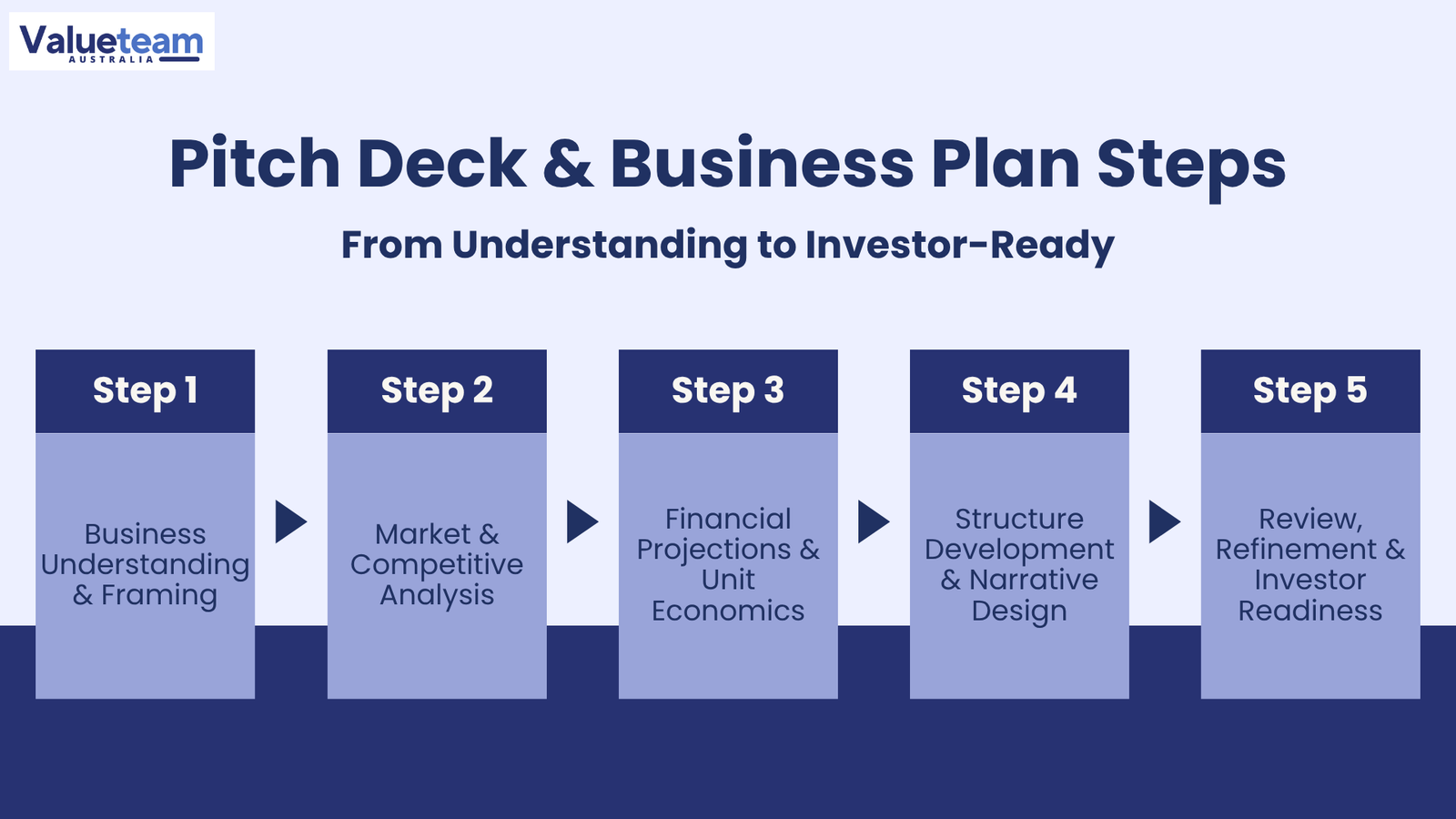
Creating a high-quality pitch deck and business plan involves five steps that guide the founder from business understanding to an investor-ready presentation. Knowing about this process helps entrepreneurs prioritise their time and effort, and helps advisers and corporate development professionals organise their efforts to add the most value at each step.
Step 1 — Business Understanding and Framing
The first step is to achieve clarity about the business itself – its value proposition, its customer, its business model and its strategy:
- This may seem self-evident, but it is shocking how often basic clarity is not achieved.
- The act of framing the business in detail - who is the customer, what is the problem that the product solves, why will the customer pay for the solution, and why will this business be successful at capturing this opportunity - often uncovers inconsistencies and questions.
- The framing that emerges from this step drives all the design choices that follow: the structure of the pitch deck, the structure of the market analysis, and the assumptions that underlie the financial projections.
Step 2 — Market and Competitive Analysis
The market analysis is the analytical underpinning that provides credibility to the financial and strategic assertions in the business plan and pitch deck:
- This involves primary and secondary research into the target market: its size, growth, segmentation, customer types, and how much they are willing to pay.
- The competitor analysis should be objective: investors and lenders can spot a self-serving competitor map on the first slide.
- The best competitive analysis recognises competitors' real advantages and makes a specific, substantiated argument for the target business's unique selling proposition.
- The work informs the market opportunity slides of the pitch deck and the market analysis chapter of the business plan.
Step 3 — Financial Projections and Unit Economics
The financial projections are the quantitative foundation of the two documents – and they are one of the most technically challenging parts of the process:
- The model needs to be constructed bottom-up from operational assumptions: the rate of new customer acquisition (by channel), the average contract size (by customer segment), the rate of attrition, the gross margin, the number of employees required, and the capital expenditure required.
- All assumptions need to be documented and, if possible, benchmarked against similar businesses or industry statistics.
- The unit economics (the Customer Acquisition Cost (CAC) and the Customer Lifetime Value (LTV) and their relationship, CAC/LTV) are the most heavily analysed financial metrics in early-stage investment.
- The cash flow analysis - which includes the monthly cash burn, the time until the next investment round is needed, and the capital efficiency of the business - is usually the most relevant financial output for early-stage investors.
Step 4 — Structure Development and Narrative Design
With the analysis done, the fourth step is the document design – turning the analytical results into the structures and narratives that are appropriate for each document:
- For the pitch deck: narrowing the list to the 10 to 15 most important and persuasive elements of the story, structuring them in a narrative sequence that maximises the investor's attention, and designing the visuals to be clear, professional, and on brand.
- For the business plan: organise the textual document in the appropriate sequence that takes the reader from background to analysis to strategy to execution and risk, with the executive summary setting the narrative.
- The trick here is to prioritise: the most frequent mistake in the structure of both documents is to include too much.
- Each slide and section should be included because they help the investor or lender make a decision.
Step 5 — Review, Refinement and Investor Readiness
The last step is the most iterative – and most underinvested. The initial draft of a pitch deck and business plan will have flaws:
- Holes in the argument or in financial projections that don't align with the narrative.
- Competitive assertions that are not backed up, or decks that are not well designed or produced.
- The review process needs to be done through the lens of the intended reader: a seasoned investor or lender who is a sceptic and looking for reasons to reject.
- The best preparation for a pitch meeting is to practice delivering the pitch deck with a truste,t tough-minded mentor who will ask tough questions.
- The purpose of review and refinement is not to make the pitch deck perfect; it is to make it investor-ready - by being able to confidently present the business, and to answer difficult questions without wavering.
10Real-World Examples and Lessons from the Field
Learning from What Works and What Does Not
The record of venture capital and startup funding is full of examples of successful and unsuccessful investor pitches and business plans. Looking at the factors that have led to successful fundraising campaigns (and those that have led to avoidable failure) offers the best advice for entrepreneurs and their teams.
Lesson 1: The Airbnb Pitch Deck — The Power of a Well-Defined Problem
Perhaps the most well-known example of a successful pitch deck is the original Airbnb deck, which has been published and analysed extensively in the startup world. It was not a great design or fancy financial projections that made it successful, but rather the specificity of the problem definition:
- Rather than a generic "accommodation problem", the deck started with a specific problem statement: hotel rooms were sold out, business travellers couldn't find cheap accommodation near the conference, and there was a vast supply of under-supplied residential rooms.
- The specificity of the problem statement made the market opportunity specific and the solution inevitable.
- The lesson: The problem sets the context for the rest of the pitch deck.
Lesson 2: The European Clean Technology Company — The Cost of Top-Down Projections
The following example from the business plan side demonstrates the pitfalls of top-down financial projections:
- A European clean-tech company looking for Series B funding developed a comprehensive, well-organised business plan - but the financial model was developed top-down from the market size rather than bottom-up from operational facts.
- The financial model showed the company capturing 5% of the European market in Year 3, a nice number but unrealistic in terms of the company's sales team capacity, distribution channels and cost of acquiring customers.
- When the lead investor's due diligence team reconstructed the model bottom-up from the company's sales team size and documented channel economics, the Year 3 revenue was about 25% of the forecasted number.
- The funding round was restructured to reflect a lower valuation, and the company spent a year recovering and not growing.
- The lesson: projections that are not rooted in reality are not only inaccurate but also devastating to investor confidence.
Lesson 3: The Professional Services Firm — The Business Plan as an Internal Planning Tool
The third lesson is from the business plan as an internal management tool:
- A mid-sized professional services company embarking on its first major expansion (from a single market to three new markets in parallel) developed a business plan.
- The plan outlined the precise numbers of staff required, the time needed to develop the local markets, the working capital needs during the expansion period, and the cash flow effects of staffing up in advance of revenue.
- The plan identified that the current working capital facility would be consumed nine months into the expansion (before the new markets become profitable) and that an additional credit facility would be needed.
- Since this was discovered in the business plan six months before the expansion, the company easily secured the new facility.
- In the absence of the plan, the company would have faced a cash crunch and its expansion would have been jeopardised.
- The lesson: the best business plan is not the one that raises money - it is the one that keeps the management team from running out of money.
11 Our Process: Pitch Deck and Business Plan Guide in Australia
A Structured, Repeatable Engagement Workflow
A structured engagement process underpins the delivery of quality pitch deck and business plans. The process below is the typical engagement process for a professional advisory engagement, from understanding the business to delivering investor-ready materials.
- The process involves six distinct steps, each with its own inputs, activities and outputs.
- Each builds on the previous step, so that the final investor-ready outputs are based on a solid process of analysis and narrative.
- The process is a partnership - leveraging the founder's or management team's expertise of the business while applying the discipline of the advisor to the organisation, analysis and presentation of the knowledge.
Table 3: Pitch Deck and Business Plan Engagement Process Flow
Step | Activity | Key Inputs | Output |
|---|---|---|---|
Step 1 — Business Understanding | Conduct in-depth sessions with founders and management; understand business model, strategic objectives, target investors, and fundraising context | Founder interviews; existing materials; strategic objectives; current financials | Business framing document; narrative outline; engagement scope memo |
Step 2 — Market and Competitive Research | Conduct primary and secondary market research; build competitive landscape analysis; validate market size and segmentation | Industry reports, customer data, competitor information, and management’s market knowledge | Market analysis; competitive positioning map; TAM/SAM/SOM derivation |
Step 3 — Financial Model Build | Build bottom-up financial projections; document assumptions; model three scenarios; calculate unit economics; analyse cash flow and runway | Operational assumptions; current financials; pricing model; headcount plan; capex requirements | Integrated financial model (P&L, balance sheet, cash flow); unit economics analysis; scenario analysis |
Step 4 — Pitch Deck Structure and Design | Design the 10-15 slide narrative arc; create slide content; develop visual design; integrate financial highlights | Market analysis; competitive positioning; financial model; founder profile | Draft pitch deck (content complete); design review iteration |
Step 5 — Business Plan Preparation | Write all business plan sections; integrate financial model; conduct risk analysis; prepare executive summary | All prior outputs, operational details from management, and risk identification workshops | Draft business plan (complete document) |
Step 6 — Review, Refinement and Finalisation | Conduct an investor simulation session; address critical questions; refine the narrative and financials; finalise the design. | Draft pitch deck; draft business plan; investor feedback or simulation session | Final investor-ready pitch deck; final business plan; Q&A preparation guide |
12 Indicative Timeline and Frequently Asked Questions
Realistic Engagement Durations
For founders and corporate teams planning fundraising and other capital market activities, it is essential to understand the expected engagement time for preparing pitch deck and business plans to avoid the “crunch-time” approach, which has been shown to result in inferior quality.
- Engagement durations vary depending on the nature of the engagement, the complexity of the business, and the availability of existing documents.
- One of the most common and damaging mistakes founders make in the fundraising process is rushing the preparation.
- Time to review and refine the documents is essential to producing a quality product for investors.
Table 4: Indicative Pitch Deck and Business Plan Engagement Timelines
Engagement Type | Typical Timeline | Primary Determinant | Notes |
|---|---|---|---|
Pitch deck only (pre-seed / seed) | 2–3 weeks | Clarity of business concept; existing materials available | Assumes market research and financial model available or being built in parallel |
Pitch deck and financial model | 3–4 weeks | Complexity of business model; data availability for bottom-up projections | Most common early-stage engagement type |
Business plan only | 3–5 weeks | Depth of market analysis required; operational complexity | Typically for bank lending applications or internal strategic planning |
Full package (pitch deck + business plan + financial model) | 4–8 weeks | Business complexity, founder availability for input sessions, and iteration cycles | Recommended for Series A and above; larger capital raises; complex business models |
Refresh and update (existing materials) | 1–2 weeks | Currency of existing analysis; extent of strategic or financial changes | Assumes prior professional-quality materials as the starting point |
Do I Need Both a Pitch Deck and a Business Plan?
In most fundraising situations – especially Series A and beyond – yes:
- A good pitch deck generates interest, and a business plan facilitates financial and operational analysis.
- The pitch deck is used in initial meetings with investors to pique their interest and build momentum; the business plan is used during due diligence to support the assertions made in the pitch deck.
- For seed or pre-seed financing rounds, where investors are focused on the team and the idea, a pitch deck with a financial model may be all that is needed.
- For bank loans, a business plan is always required, regardless of the business's stage.
What Makes a Strong Pitch Deck?
There are four pillars to a good pitch deck:
- A well-articulated problem backed by evidence.
- A plausible and convincing market opportunity.
- A business model with clear unit economics and a credible strategy for growth.
- Financial model that is based on operational assumptions, not market share.
- Design counts - a poor presentation indicates poor attention to detail - but it is not everything. The proof of a good pitch deck is not how it looks on the screen, but how it stands up under investor scrutiny in the room.
Can Startups Without Revenue Create a Pitch Deck?
Yes – many early-stage fundraisings have been made based on pitch decks created before revenue has been generated. For startups without revenue, the traction section of the pitch deck is about leading indicators:
- Letters of intent from prospective customers.
- Pilot program or beta test results.
- Sign-ups to a waitlist, user engagement, or collaborations with respected industry players.
- The financials must be clearly marked as projections based on assumptions, not actual figures.
- And the team slide is more critical - without revenue, investors are looking to assess whether the founders have the particular mix of industry knowledge, execution skills, and market connections to grow the business they are pitching.
13Challenges and Lessons Learned
Why the Process Is More Demanding Than Expected
The development of a pitch deck and business plan for fundraising is more complex than most entrepreneurs expect – and the most common challenges are valuable lessons for both the consultants who create these documents and the companies that commission them.
The Tacit Knowledge Gap
The most common problem is the disconnect between the founder’s internal knowledge of the business and the degree of external scrutiny that the business plan and pitch deck undergo:
- Founders who have been running their business for some time have a lot of tacit knowledge - about why customers choose their product, how it works, why their competitive position is defensible - that is clear to them, but that does not make it into the documents.
- The development of a business plan and/or a pitch deck with the help of an external professional serves to externalise this knowledge and put it through the rigour of an investor's sceptical eye.
- It is better to realise that a key competitive advantage is not supported by evidence, or that the financial model is based on an unrealistic customer acquisition cost that is not supported by the economics of the sales channel, in the process of writing the document, rather than in a meeting with an investor.
The Storytelling Challenge
The storytelling challenge is worth mentioning because technical or financial professionals often underestimate it:
- A pitch deck is not a data dump; it is a storytelling tool that needs to build trust, interest and enthusiasm in 20 minutes.
- The order of the story matters: the mistake of putting the funding ask first rather than the problem and opportunity is one that seasoned investors spot from a mile away.
- The words matter: the difference between an abstract value proposition ('we use AI to optimise supply chain performance') and a specific one ('we lower the cost of last-mile delivery for mid-market retailers by an average of 18%, with payback in eight months') is the difference between a slide an investor forgets and a slide they remember in the follow-up meeting.
- Cultivating the ability to translate business models into specific, relevant, and compelling stories is one of the most important skills that can be learned by those working at the junction of finance, strategy, and communication.
The Iteration Challenge
The initial draft of a pitch deck and business plan is not the final draft – it is the first draft:
- Ideally, iteration includes one or more rounds of feedback from investors, advisers, and experts.
- The most successful founders of all types of businesses are those who have put in the time to practice their pitches, run tests on their financial models and make revisions to their documents based on the questions they received from investors in their early meetings.
- The ability to view early meetings not as "do or die" events but as opportunities to learn and to use that learning to refine documents for future meetings is one of the most useful ways a founder can approach the fundraising process.
14Conclusion and Actionable Insights
Summary
In Australia, a good pitch deck and business plan are critical for raising funds, communicating with investors and planning a business. The time spent crafting them well is one of the best uses of time for any founder or management team preparing for a capital raise or planning session.
- The pitch deck sparks interest, and the business plan facilitates financial and operational analysis.
- When well prepared, both showcase the thoughtfulness and discipline that characterise a management team capable of implementing its vision.
- The effectiveness of the presentation matters: the type of investors attracted, the value placed on the business, the speed with which capital can be raised, and the reputation of the management team.
Key Principles to Remember
- Analysis first, design second: the biggest and most frequent mistake is to start designing slides or documents before the analysis is fully developed.
- Project financials from the bottom up, not the top down.
- Analyse the market and be realistic about the competition before designing documents.
- Then design the documents to convey these insights - the analysis generates the content; the design generates the communication.
Actionable Development Path for Professionals
For early- and mid-career professionals looking to develop their skills in pitch deck and business plan creation:
- Build real expertise in financial modelling - how to build a revenue forecast bottom up from operational drivers, the unit economics model (CAC, LTV, gross margin) and the three-statement financial model.
- Develop market analysis skills - how to size a market realistically, how to segment it for targeted marketing, and how to position a business in a competitive environment with realism and detail.
- Build strong storytelling skills - learn how to turn complex business models into specific, compelling, commercial stories that can be told in 20 minutes as easily as in 60 pages.
- Get experience with investors - attend pitch events, help clients with fundraises, or study publicly available pitch decks from successful fundraises.
- Learn from every interaction: the questions investors ask are the best test of what is missing, confusing, or unconvincing in the materials.
The best pitch deck doesn’t just explain to investors what you are doing – it explains why you are the right people to do it, why now is the right time, and why it is worth investing in. That conviction, backed by analysis, is what investors back. |