

What Types of Business Valuation Do Companies Need?
Business valuation isn’t a single technique, but a family of techniques, developed with a specific function in mind. If the math is right, but the wrong framework is used, a company preparing for a merger can have to rework weeks of work just to use the proper valuation. Whether it’s within a company or as a junior or mid-level finance professional supporting clients from an advisory firm, knowing the types of business valuations available and when they apply is one of the most useful skills to have in your toolbox. Business valuation companies use the following types of valuation the most, which are explained in this article: purchase price allocation valuation, intangible assets valuation, IP (intellectual property) valuation, employee stock valuation, and brand equity valuation. It walks the reader through the process as well as the pitfalls and insights business valuation experts have gained from actual engagements, and offers plenty of practical tips for those seeking to launch their career in business valuation or transition into more advanced advisory roles.
What Types of Business Valuation Do Companies Need for Growth and Compliance?
At some point, all companies will require more than one valuation, as various events may require various frameworks. Accountants must perform a purchase price allocation valuation when a company is acquired or merged with another, allocating the purchase price between tangible assets, intangible assets and goodwill in accordance with the standards, such as ASC 805 and IFRS 3. If a company gives away shares or options to employees, it must have an employee stock valuation to establish a defensible exercise price for those options and comply with U.S. tax laws, including Section 409A. Businesses that license a patent, sell a product line or defend a trademark must have an intellectual property valuation to set royalty rates or damages. When a company with a consumer-focus wants to know the value of its brand and reputation by itself, apart from all other valuations, it is time to consider brand equity valuation. These are just some of the types of business valuation that a blossoming company will face at some point in its life, and few entrepreneurs and financial managers are aware of how frequently there’s an overlap in the same year — often for unrelated reasons that somehow end up being dovetailed. For instance, a company that is raising MC capital in its series C round can find itself with three different valuation workstreams going to the same finance team in the same quarter as a patent license round and a push to exercise option grants.
A formalization of what’s going on internally, typically as a result of compliance is what usually puts a company on the ball. Auditors will not accept a “rough” number for goodwill impairment testing and tax authorities will not accept an unsupported number for an “intellectual property related-party transfer”. This is why many companies hire business valuation experts instead of trying to perform such calculations themselves, as a business valuation needs technical modeling expertise, and knowledge of the standard that would be used by the regulator or auditor in question. This is a key difference for the junior professional to grasp early, as the internal forecast developed for a board presentation may use similar underlying data as the valuation developed for an audit file, but the rigor and level of documentation and independence expected of the forecast and of the valuation are different. The same board deck forecast might be used as an optimistic management assumption in a light footnote, and then be traced to source documents and be audited in the same manner as a forecast in an audit file. Knowing what kind of valuation a situation is looking for, prior to any modeling, is often more valuable to an employer than the speed at which they can model it; it may take days to get the modeling right, and the wrong kind of modeling may not meet the party’s initial expectations. When employers assess candidates for a job in their first or second valuation role, this is the kind of judgement they seek more than the speed at which they can select data and apply a formula.
How Do Purchase Price Allocation Valuation and Intangible Assets Valuation Work in Practice?
Purchase price allocation valuation bridges the accounting and valuation worlds and can first be a place where many analysts have to deal with a variety of business valuation types in the same engagement. Once the acquisition is completed, the buyer then is responsible for identifying each asset acquired, tangible and intangible, and assigning its fair value, which leaves the buyer with the value of the goodwill. Intangible assets valuation includes the valuation of customer relationships, non-compete agreements, developed technology, trademarks and the like, all of which may have a different method. A customer relationship may be valued in a manner similar to an income approach, which estimates retained revenue, and may involve applying an “attrition rate” to that estimated retained revenue, and a trademark or trade name is often valued using a relief-from-royalty approach in which the value of the company to the owner is compared to what the company would have spent if the name had been obtained from an outside party. Developed software and other technology can be closer to valuing the IP than to simply estimating the replacement cost, because the competitive advantage of the technology is typically the value that the buyer has paid for. By contrast, non-compete agreements are often valued using a with-and-without analysis that compares projected cash flows if the seller could compete with projected cash flows under the non-compete, which can come as a shock to many analysts the first time they hear of it, as it is more about competitive strategy than about accounting formulas.
The technical part of a job is a small part of the difficulty, the other part is the defending of the assumptions used in the technical part. The valuation of intangible assets using a too low of a discount rate will lead to an overvaluation, which will raise eyebrows at the auditor’s table, and the valuation of intangible assets using a royalty rate from an unrelated industry will be subject to audit (or a transfer pricing review). As the acquired company may have patents or proprietary technology, valuation of IP can often be part of the process, and patents must also be analyzed, and their litigation risk, competitive position and remaining legal life determined, before a value can be confidently assigned based on royalties or income. Many teams realize that intangible assets valuation and intellectual property valuation should be performed early in the deal timeline, not as an afterthought tacked onto the end before accounting close, as necessary information can be difficult to obtain and can be time consuming to collect and validate. The same engagement often involves finance colleagues engaging with patent attorneys or technical colleagues elsewhere in the organisation, and the sooner the finance people engage with them, the more time they will save in navigating a patent portfolio without assistance. When teams don’t take this coordination step, their lawyers will typically find that there’s a problem with ownership or scope, and the result is that they will have to go back to the drawing board—after the intangible assets valuation has been drafted and shared with the auditors—and revisit the process is a much more costly afterthought.
What Are the Five Key Steps in a Types of Business Valuation Engagement?
Whether or not the applicable framework is the one described below, most engagements of the type described above proceed in much the same way, and if you know what you are expecting, you can ask more questions from the get-go:
- Before any work is done the team confirms the purpose and standard of value of the assignment, for example, it could be for financial reporting, tax, litigation or an internal decision – this will dictate which rules and assumptions will be applied.
- Gather and standardize data — analysts compile data from financial statements, contracts, and, in the case of an IP valuation, patent files or licensing agreements, then normalize the data for any non-recurring events.
- Determine the approaches to valuation — the team decides to use the income, market, or cost approaches (and in the case of employee stock, customizes the option-pricing models to a particular award design).
- Construct and test the model — change the values of the assumptions within a reasonable range to determine how sensitive the conclusion is to the values of the assumptions, which can sometimes show which of the assumptions need additional support before the report is completed and which only have a marginal effect on the final number.
- Document, review and deliver the report — a second qualified reviewer, typically one of the firm’s senior business valuation professionals, reviews the model and the narrative before the valuation is shared with the client or submitted to a regulator, which may enable him to see what is missing from the model that would have been easy to overlook after weeks in that same spreadsheet.
How Do Business Valuation Experts Apply Types of Business Valuation in Real Cases?
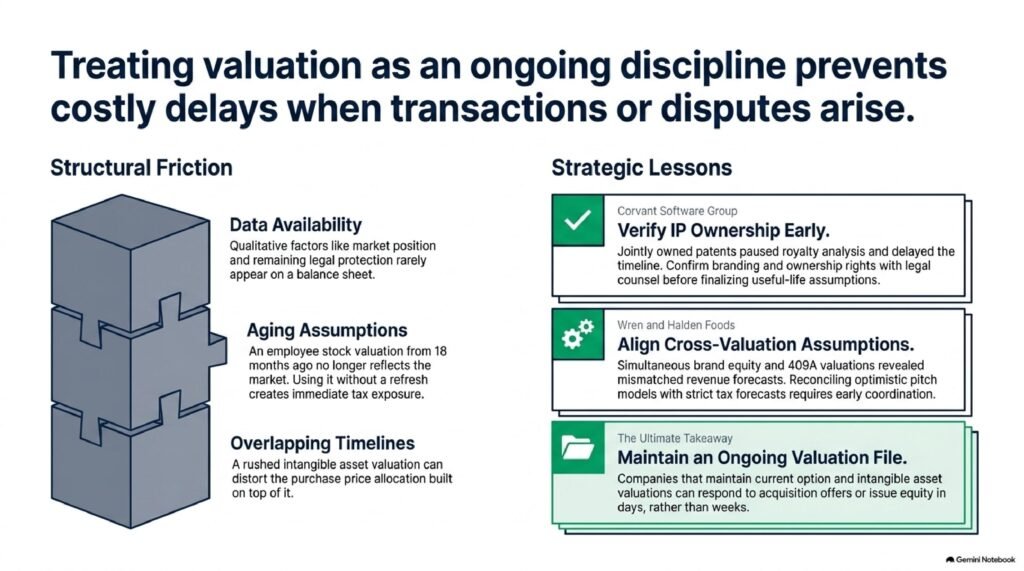
Let’s consider a mid-size software company, called Corvant Software Group, that’s acquired by a bigger software company that’s targeting a new vertical. The valuation involved a complete purchase price allocation valuation, and due to Corvant’s algorithms being patented as part of its core portfolio, a separate intellectual property valuation was required. Business valuation professionals have divided the purchase price into technology, customer contracts, assembled workforce, a secondary business product trademark and goodwill. Valuation of the acquired technology and patents was performed by applying a relief from royalty approach based on a comparison with licences in technology parks of a similar nature in software categories, and customer contracts were valued using a projected-revenue income approach. One difficulty arose because the acquiring company decided to abandon the Corvant product name and incorporate it into its own product line, so the trademark valuation of the intangibles was to be based on a limited useful life, not an unlimited one, because the name would not last beyond the period of integration. One other wrinkle emerged when two of Corvant’s patents were shared, among two previous research partners, and the team had to slow the process down and figure out who owned what before completing the royalty analysis, which added nearly a week to the timeline. One of the biggest things the team learned from the deal was to not make useful-life assumptions without confirmation from legal counsel and the integration team of the acquirer as to trademark and patent ownership.
The second is a case study of a growing consumer goods business, Wren and Halden Foods, gearing up for a new funding round. Prior to the raise, the company was required to obtain an employee stock valuation to establish a reasonable strike price for new hire option grants, in case an invalid valuation were questioned in the future because of tax penalties. Meanwhile, investors had a desire to gain a better understanding of where the value of the company resided—whether it was in its product recipes and operations, or in its growing brand recognition, the team worked on a parallel brand equity valuation, employing a relief-from-royalty approach similar to the one used for valuation of trademarks during acquisitions. Both exercises were designed for different audiences and used the same data in different ways: The employee stock valuation was designed to meet the strict criteria set forth in the valuation standard, and the brand equity valuation was designed to be used in a negotiating process with investors, not a regulatory process. As the battle went on, the finance team discovered that their revenue projection had proven to be higher than the one they had used for fund-raising purposes, and they found it required as much effort as the valuations to reconcile the two — or to explain why they were different. As with many cases, the lesson that junior analysts learn from it is that they can be required to perform multiple kinds of business valuations in a single month (or in a few months), each with its own standard of value, and the common pitfall is assuming the same standard of value in each of these types of valuations.
Table: Types of Business Valuation and Their Common Applications
| Valuation Type | Common Method | Typical Trigger |
|---|---|---|
| Purchase Price Allocation Valuation | Income, Cost, Market | M&A accounting (ASC 805 / IFRS 3) |
| Intangible Assets Valuation | Income (relief-from-royalty, MPEEM) | Financial reporting, impairment testing |
| Intellectual Property Valuation | Income, Market (royalty benchmarking) | Licensing, litigation, patent transfer |
| Employee Stock Valuation | Option-pricing models | 409A compliance, equity grants |
| Brand Equity Valuation | Relief-from-royalty | Fundraising, brand licensing, M&A |
What Are the Benefits and Challenges of the Different Types of Business Valuation?
Finance professionals have a distinct advantage in grasping the different types of business valuations since each one fosters a unique, transferable skill. Financial reporting valuation skills can be readily acquired by someone who’s comfortable with purchase price allocation valuation, and an IP valuation expert can readily transfer to the licensing side of the business or to litigations support. It’s not just about the individuals; companies can also benefit: If a business maintains the valuation of its intangible assets and employee stock value up-to-date, then it won’t be surprised during due diligence, audits or option repricing, and if the company knows its own brand equity valuation, then it will have a better negotiating position when it comes to licensing deals or partnerships. Business valuation experts always emphasize that firms that view business valuation as a continuous discipline, instead of a one-time event related to a transaction, tend to accelerate when events and opportunities occur out of the blue. The payoff is very real – a company with a timely valuation file can accept an acquisition offer in days, and a startup with an updated option valuation can make a job offer without having to wait for a new valuation to be commissioned.
The difficulties are similar for nearly all types, though. The most common problem is the lack of data, especially in valuation of intellectual property and brand equity, where the value is determined largely by qualitative factors such as market position and remaining legal protection which cannot be directly recorded on a balance sheet. Assumptions do not last long either: an employee valuation from 18 months ago may not be applicable to current market conditions and relying on the old valuation without a refresh can lead to real compliance risk. The coordination between various types of business valuation in the same transaction is further complicated as the valuation of intangible assets is often rushed and can lead to the purchase price allocation valuation to be misvalued. The smaller companies have an additional problem in resourcing; they generally do not have an in-house valuation specialist and have to determine what to do about including outside advisors to perform the valuation task, or trying to do it themselves, which often depends on the amount of regulatory or investor pressure that the resulting number will be subject to. The most obvious takeaway from all these experiences, as business valuation experts across all sectors have been saying over the past few years, is that good documentation and double-checking between valuation methods are the difference between a valuation that passes muster and one that falls apart when asked a tough question.
Conclusion: Matching the Right Types of Business Valuation to the Right Purpose
Business valuations are not a single-time event; most companies will have multiple occasions for valuing the business, such as having to perform a brand equity valuation before embarking on a fundraise, a purchase price allocation valuation when they’re engaged in an acquisition, an IP valuation to defend a patent or a valuation for use in a hiring round. The best approach for professionals wishing to advance their careers in this area is to understand the rationale behind each method instead of simply memorizing the formulas one-by-one, find a mentor to work on actual business valuations, and view documentation as an integral component of the project, not an extra add-on under deadline pressure. It also helps to develop basic fluency in all of these areas early, and not become too narrowly focused too quickly, as job opportunities may go to the analyst who can get on-board with the job of the quarter that comes across the desk. The same discipline applies to companies: If intangible assets valuation, employee stock valuation and other specialised tasks are kept up to date and well documented, then risk is minimised and decisions are therefore made quickly when a transaction, an audit or a dispute comes up out of the blue. As a business grows, the kinds of business valuation a company will require its methods of valuations will change, yet the practice of matching the proper business valuation to the appropriate purpose won’t.