
Convertible Instrument Valuation Guide in Australia
Table of Contents
- 01 Introduction
- 02 What Is a Convertible Instrument?
- 03 Why Do Clients Need Convertible Instrument Valuation?
- 04 Key Features That Affect Valuation
- 05 Key Valuation Approaches
- 06 Key Value Drivers — What Increases or Reduces Instrument Value
- 07 Common Mistakes in Convertible Instrument Valuation
- 08Five Key Steps: The Engagement Process
- 09 Our Valuation Process
- 10 Indicative Timeline and Frequently Asked Questions
- 11 Challenges and Lessons Learned
- 12 Conclusion and Actionable Insights
Table of Contents
- 01 Introduction
- 02 What Is a Convertible Instrument?
- 03 Why Clients Need Convertible Instrument Valuation Guide?
- 04 Key Features That Affect Valuation
- 05 Key Valuation Approaches
- 06 Key Value Drivers — What Increases or Reduces Instrument Value
- 07 Common Mistakes in Convertible Instrument Valuation
- 08 Five Key Steps: The Engagement Process
- 09 Our Valuation Process
- 10Indicative Timeline and Frequently Asked Questions
- 11 Challenges and Lessons Learned
- 12 Conclusion and Actionable Insights
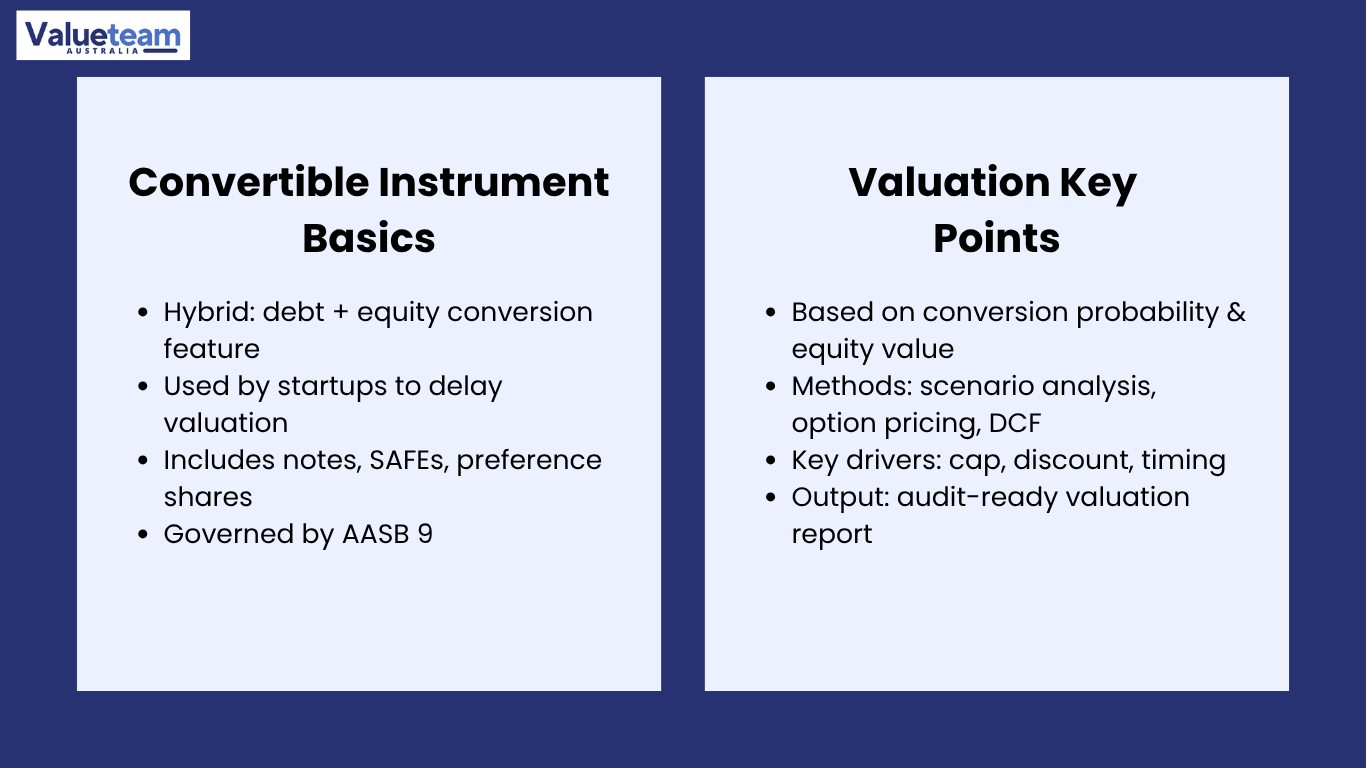
01 Introduction
Why Convertible Instruments Exist
Convertible instruments are a common financing tool for startups and companies in the growth stage. In the risky, uncertain world of early-stage capital raising, founders and early investors face the problem that the price of equity in a company is uncertain.
- The convertible instrument is the answer - a capital-raising structure that allows the pricing decision to be deferred until a subsequent round when more information is known, while giving the company the capital it needs to get to the next stage of development.
- For investors, it offers the downside protection of debt and the upside of conversion.
- For the founders, it prevents dilution from an immediate equity offering at a potentially discounted price.
The Hybrid Nature and Its Implications
These securities are hybrids that usually convert to equity at a subsequent financing round, exit or maturity. The convertible nature of these instruments makes them interesting from an analytical perspective, important from a commercial point of view, and difficult to value.
- Unlike a conventional bank loan, a convertible note includes an option that can be valued above the face value of the debt, especially for companies with high growth prospects.
- Unlike a traditional equity investment, it doesn't immediately dilute the existing shareholders or set a price point for the company.
- This flexibility comes with a trade-off: the accounting, tax, and regulatory treatment of convertible instruments is much more complicated than that of either debt or equity.
The AASB 9 Framework and Why Valuation Matters
The valuation of convertible instruments is significant for financial reporting, investor decision-making, and assessing the economic effect on equity holders. According to AASB 9 – the Australian Accounting Standard on financial instruments – the classification and measurement of convertible instruments is determined by the terms of the instrument and the contractual cash flow characteristics test.
- It's not a convention but a technical issue that involves legal and financial considerations, with significant implications for the balance sheet, income statement and financial statement disclosures.
- The classification of an instrument as a financial liability, an equity instrument, or both affects initial recognition, subsequent measurement, and the accounting treatment upon conversion.
- It is essential for professionals who advise startups, prepare their financial statements, or perform due diligence on growth-stage investments to understand how to value convertible instruments.
A convertible instrument is not just debt with an embedded conversion option; it is an economically unique hybrid security whose value is based on the likelihood of conversion, the expected value of the underlying equity at conversion, and the economic characteristics of the various possible outcomes. It is not debt, and thinking it is can be costly. |
02 What Is a Convertible Instrument?
Definition and Conversion Mechanics
A convertible instrument is a security that behaves like debt or a hybrid security but can convert into equity. Conversion is not mandatory; events trigger it.
- The typical triggers are: a future equity financing event of a certain size, an exit event (acquisition or IPO), or the instrument's maturity date if no conversion trigger event has taken place.
- The amount received on conversion is determined by the terms of the instrument - the conversion discount, the valuation cap, the amount of interest accrued, and the price of the equity established at the conversion trigger event.
The Range of Instrument Types
The breadth of instruments included in the category of convertible instruments has grown as startup financing has developed.
- Convertible notes: legally a loan with a conversion feature and an interest rate, usually with a maturity date and interest rate that can accumulate as principal or be paid out.
- Convertible loans: similar to convertible notes but more often used in commercial or institutional settings.
- SAFE notes (Simple Agreement for Future Equity): created by Y Combinator as a more founder-friendly version, with no interest rate and no maturity date, and a commitment to issue equity at a future qualifying financing event.
- Convertible preference shares: preference shares that also include the right to convert to common shares.
- Equity-linked debentures: debt with conversion features, usually in a more institutional capital market setting.
The Embedded Features That Create Complexity
The common feature of all these instruments, which sets their valuation apart from pure debt and pure equity, is that they contain conversion features, discounts, valuation caps, or interest that generate embedded optionality.
- Conversion discount (usually 10-30%): enables the holder to convert at a price lower than the price paid by the new investors in the qualifying round, compensating them for the risk of investing early.
- Valuation cap: creates an upper bound on the pre-money valuation at which the instrument will convert - meaning the holder gets proportionately more equity if the company raises at a higher valuation than the cap.
- For example, a note with a $10 million cap that invests in a company raising at a $50 million pre-money valuation will allow conversion at $40 million (a 20% discount) and at $10 million (the cap), resulting in much more equity.
- These features all represent components of economic value that need to be explicitly modelled in the valuation.
03Why Clients Need Convertible Instrument Valuation Guide?
The triggers for professional convertible instrument valuation cover the entire lifespan of the instrument – from its inception to its final disposition at conversion, redemption or exit. Understanding the various valuation triggers is important for practitioners to appropriately scope engagements and for companies to appreciate their ongoing measurement and disclosure requirements.
Financial Reporting
The primary driver of the need to value convertible instruments is the requirement to measure fair value under AASB 9 and AASB 13. The accounting standard AASB 9 requires the remeasurement of financial instruments classified as fair value through profit or loss (FVTPL) to fair value at each reporting period, with gains and losses recorded in the income statement.
- For financial liabilities with embedded derivatives, the embedded derivative may need to be separated and accounted for at fair value.
- Derivative liability determination (whether a conversion feature is an embedded derivative that needs to be bifurcated and accounted for separately) is a complex area of convertible instruments accounting.
- Classification - whether the instrument or parts of it should be classified as a financial liability or equity - impacts leverage ratios and reported financial position.
- Auditor support for the audit of these classifications and measurements is a common engagement task for companies that have outstanding convertible instruments on the reporting date.
Fundraising and Investor Reporting
The typical business use case for valuations of convertible instruments is fundraising. When a company is raising funds for a new round with outstanding convertible notes or SAFE notes, both the company and its new investors want to understand the cap table impact.
- Cap table impact analysis: Knowing how the conversion of outstanding instruments will impact the post-money equity ownership of all parties is essential to negotiating the new round.
- New investors need to know what fully diluted equity they are buying; founders need to know the ownership consequences of the conversion mechanics to accept the terms of the new round.
- Negotiations between investors regarding the terms of the instruments - the conversion discount, the valuation cap, the maturity provisions - also rely on independent valuations of the economic features.
Mergers, Acquisitions and Exit Events
Acquisitions and IPOs are the most significant events for converting any convertible instrument. Exit conversion impact analysis involves modelling the conversion terms for each exit scenario.
- The waterfall for consideration must be modelled, including the allocation of exit proceeds between ordinary shares, preference shares, and converted instruments.
- The interplay between liquidation preference and conversion terms must be considered, as well as the choice sophisticated investors make between conversion and a liquidation preference.
- Structuring considerations for acquisitions of targets with outstanding convertible instruments must take account of these factors - especially where conversion rights result in unexpected consequences for the acquirer's consideration allocation.
- An exit proceeds allocation analysis is thus an essential pre-sale advisory service for companies and their advisers.
Tax and Regulatory Compliance
The taxation of convertible instruments in Australia is covered by the TOFA (Taxation of Financial Arrangements) and general capital gains tax rules – a complex area where the accounting classification and tax treatment may be different.
- Compliance reporting obligations include the annual TOFA elections, the tax return treatment of interest accruals, discounts, and gains on conversion - all of which depend on the instrument's tax classification.
- Classifications of financial instruments for regulatory purposes, such as ASIC disclosure requirements for financial products under the Corporations Act, also add to the compliance burden.
- Financial statement disclosure requirements need valuation and legal expertise.
04 Key Features That Affect Valuation
Convertible Instruments Are Not Simple Debt or Equity
Convertible instruments are not simple debt or equity – their value is based on features. Each feature gives rise to a different economic right or obligation that must be valued. How these features interact – and how the value of the instrument changes with the value of one or more features – is the substance of convertible instrument valuation.
The Conversion Discount
The conversion discount is the most obvious value driver for the holder. A 20% discount on a convertible instrument means that if the instrument converts in a qualifying round, the holder gets shares at 80% of the price paid by new investors – a 25% premium in equity terms compared to new investors.
- The discount value is a function of the probability of a qualifying conversion, the expected equity value at conversion, and the timing of conversion relative to the issuance of the instrument.
- The value of a conversion discount on a note that is extremely unlikely to convert is low - the discount is only valuable if conversion takes place.
- This is why scenario analysis that weights each scenario's probability is so important in valuing convertible instruments: all of the instrument's features have a probability-weighted value contingent on the scenario in which they are triggered.
The Valuation Cap and Other Key Terms
The valuation cap plays with the conversion discount in interesting ways. The cap sets the pre-money value at which the instrument will convert – and for instruments on very successful companies, the cap may be much more valuable than the discount.
- For high growth scenarios: a note with a $10 million cap and 20% discount on a company raising at $50 million pre-money - the discount entitles to conversion at $40 million; the cap entitles to conversion at $10 million, which is much better.
- Interest rate (typically 5-10% p.a.): accrues to the principal balance and converts with it, resulting in slightly more equity at conversion.
- Maturity date: establishes a time limit - if no conversion trigger happens before maturity, the holder receives the principal and interest accrued, and the company needs to find liquidity unless it can extend the debt.
- Conversion triggers, liquidation preferences, redemption rights, and early conversion options add layers of economic complexity that a valuator needs to understand before determining the most appropriate valuation approach.
05Key Valuation Approaches
The choice of valuation approach for a convertible instrument depends on the instrument’s conversion features, the type of business, and the reason for the valuation. While business valuation approaches (income, market, and cost) are fairly generic, convertible instrument valuation approaches are more specialised, capturing the probability-weighted economic consequences of multiple conversion scenarios.
Probability-Weighted Scenario Analysis
The probability-weighted scenario analysis is the most common method for valuing convertible instruments in the startup environment, and is the one that most closely reflects their economic nature.
- This approach involves identifying a series of mutually exclusive future scenarios (usually a successful equity financing, an early exit/acquisition, a maturity repayment scenario, and, possibly, a liquidation scenario), and determining the probability and present value of each.
- The probability-weighted value of the instrument is the present value (at a discount rate equal to the risk of the instrument) of the expected payoff from each scenario.
- For SAFE notes, the model will only consider conversion scenarios (qualifying financing and exit), as there is no maturity repayment. For convertible notes, the maturity repayment scenario must also be modelled.
- The effectiveness of this analysis depends largely on the scenarios' effectiveness and the defensibility of the probability estimates; probabilities should be derived from or compared to empirical data on startup outcomes and documented in a manner that supports the auditor's evidence review.
Option Pricing Approach (Hybrid Model)
The option-pricing approach values the conversion feature of a convertible instrument as an embedded option on the issuing company’s equity value and applies option-pricing theory.
- This is particularly suitable for instruments where the exercise of conversion is driven by the equity value of the issuing company at conversion (rather than by specific financing or exit events) and by the equity value's volatility.
- The upside participation in the equity value of the issuing company embedded in the conversion feature - the right to participate in the upside in equity value above the exercise price (defined by the cap and discount) - is similar to a call option and can be valued by adapting Black-Scholes or binomial models.
- The hybrid valuation model combines both approaches: valuing the debt component with a discounted cash flow model and the embedded option with an option pricing model.
Discounted Cash Flow (Adjusted)
The discounted cash flow (adjusted) approach is most suitable for valuing convertible instruments where the debt characteristics are dominant – instruments where the probability of repayment at maturity is high or where the conversion terms are so restrictive that the value of the option is very low.
- It is based on valuing the instrument as the present value of its expected contractual cash flows: coupon/interest payments over the life of the instrument and repayment at maturity, discounted at a credit risk-adjusted rate.
- For most early-stage convertible notes issued by startups, the pure DCF approach will be a conservative estimate of fair value, as it fails to account for the conversion optionality. It is best used as a floor check or as part of the hybrid model.
Binomial / Simulation Models
Binomial/simulation models are the most robust and flexible approach to valuing convertible instruments with complex features that cannot be accurately modelled in either a scenario-based or a simple option-pricing approach.
- Multiple conversion triggers - where different conversion rules apply in different scenarios (e.g., a different cap applies if a qualified financing occurs within twelve months versus after) - are best captured in a lattice/simulation framework that models the path dependency of the instrument's payoff.
- Valuation caps that vary with the timing or size of the qualified financing require a simulation approach that produces an outcome distribution.
- Uncertain exit timing - where the company's prospects are uncertain to the extent that it is not possible to identify a most likely exit date - is best modelled by a Monte Carlo simulation that produces a distribution of possible exit dates and weights them by their likelihood.
06 Key Value Drivers — What Increases or Reduces Instrument Value
The Three Interacting Dimensions of Instrument Value
The value of a convertible instrument ultimately depends on three interacting factors: the likelihood of conversion, the value of the equity at conversion, and the economic terms that determine what the investor receives in each scenario. A good understanding of the interaction among these dimensions and the factors that influence them is crucial for practitioners who value these instruments, for investors negotiating the terms, and for founders in understanding the economic consequences of the capital they are raising.
Factors That Increase Instrument Value
Factors that increase the value of a convertible instrument to the holder are those that increase the expected value of the instrument across the conversion and non-conversion scenarios.
- The increased likelihood of equity conversion (driven by strong firm performance, a financing pipeline, and favourable investor sentiment) is the main value driver for instruments intended to be converted into equity.
- Higher expected equity value at the time of the qualifying round increases the value of the conversion discount and, for capped convertibles, increases the likelihood that the valuation cap will be triggered - meaning more equity than the discount alone.
- Hence, favourable prospects for the startup's growth and absence of barriers to successful future financing are value drivers, not just narratives.
- Favourable valuation cap provisions - a conservative valuation cap relative to the company's future expected valuation - increase the economic value of the conversion right by delivering a greater equity stake compared to investors that do not convert their instruments.
Factors That Reduce Instrument Value
The value-reducing factors are also useful for investors and founders to consider the economics of outstanding instruments.
- The greater the probability of repayment, the more the instrument is like debt, with the option value of the conversion feature largely wasted.
- Poor business performance and low exit probability are two sides of the same coin: a company that is not performing well is less likely to raise a qualifying round, less likely to be acquired at a high price, and more likely to mature without a conversion event.
- Conversion conditions that make it hard to meet minimum round sizes, require the consent of a majority of investors, or otherwise reduce the probability of conversion events narrow the scenarios in which the conversion option is exercised, thereby reducing value.
- High credit risk also reduces the value of the instrument in repayment scenarios - for companies with weak business performance, the probability-weighted expected recovery in a repayment or liquidation scenario may be significantly less than par value.
Table 1: Convertible Instrument Value Drivers — Impact and Analytical Implications
Value Driver | Direction of Impact | Analytical Mechanism | Key Sensitivity |
|---|---|---|---|
Probability of equity conversion | Higher probability increases value | Conversion scenario payoff dominates the weighted average value. | Most sensitive assumption; must be grounded in company-specific evidence. |
Expected equity valuation at conversion | Higher valuation increases value | Amplifies cap binding probability; increases discount value. | Drives both conversion scenario payoff and cap/discount interaction. |
Valuation cap (absolute level) | Lower cap relative to expected valuation increases holder value | A higher cap-binding probability means more equity per dollar invested. | Critical for companies with a strong growth trajectory. |
Conversion discount (e.g., 20%) | Higher discount increases value if conversion occurs | Increases equity received relative to new round investors at conversion. | Less impactful if the cap is binding; it operates as fallback protection. |
Interest rate (for convertible notes) | Higher rate slightly increases value | Accrues to converting principal; increases equity received at conversion. | Material for long-dated instruments; less impactful for SAFE notes. |
Time to conversion/maturity | Shorter time to conversion reduces time value uncertainty | A closer conversion event reduces the discounting period and uncertainty. | Affects the present value of the conversion scenario payoff. |
Probability of repayment at maturity | Higher repayment probability reduces option value | The instrument behaves more like debt; conversion optionality is less valuable. | Critical for companies with uncertain funding prospects. |
Credit risk of the issuing company | Higher credit risk reduces value in repayment scenarios | Reduces probability-weighted recovery in non-conversion outcomes. | Requires assessment of the company’s ability to repay if conversion fails. |
07Common Mistakes in Convertible Instrument Valuation
The Fundamental Conceptual Challenge
The most common mistakes in convertible instrument valuations reflect the conceptual difficulty of these instruments: they are neither debt nor equity, and valuations that treat them as such are technically incorrect and commercially misleading. Awareness of these errors (and their causes) helps companies, investors, and advisers understand the need for rigour in the valuation of convertible instruments.
Treating Convertible Notes as Pure Debt
The most serious and common mistake is treating convertible notes as pure debt.
- Under AASB 9, a financial instrument can only be classified as a financial liability measured at amortised cost if the contractual cash flows of the financial instrument represent only payments of principal and interest on the principal amount outstanding - a test that most convertible notes fail due to the presence of the conversion feature.
- The pure debt approach ignores the value of the conversion feature, misclassifies the convertible note on the balance sheet, and understates the fair value of the instrument to the holder (and the financing cost to the issuer).
- The failure to account for embedded option features (the conversion option, the valuation cap, or early conversion options) is especially problematic for instruments on fast-growing companies, where the value of the option can exceed the value of the underlying debt.
Other Critical Valuation Errors
In addition to pure-debt misclassification, there are several common errors that affect the integrity and auditability of convertible valuations.
- Wrong probability assumptions: probability weightings without empirical or comparable-company support to justify them yield valuations that are "right" in form but not in substance. A 70/20/10 probability split that lacks analysis will not pass audit.
- Ignoring valuation cap impact: especially common for instruments on companies that have grown substantially since the valuation cap was established - the cap may now be binding in all but a few unrealistic conversion scenarios, and is therefore the most significant value driver, but is ignored by practitioners who model only the discount.
- Failure to account for dilution effects on the current cap table from existing convertible instruments overstates current equity value per share, and hence the value of instruments that convert at a discount to that overstated value.
- Different funding round assumptions - using different equity valuations in the instrument valuation model than in the underlying equity valuation - lead to an internal inconsistency, which will be picked up and questioned by auditors.
08Five Key Steps: Convertible Instrument Engagement Process
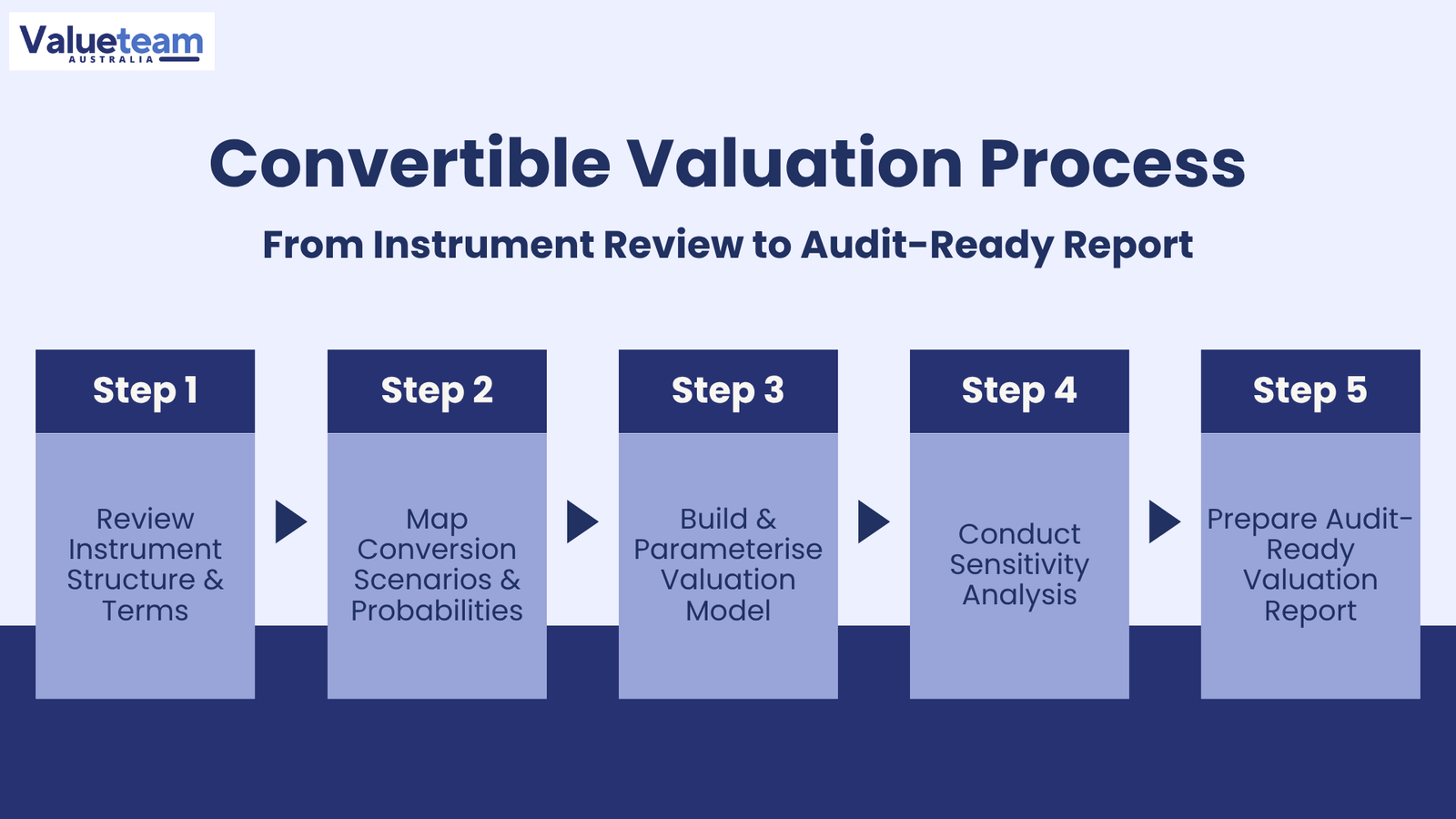
The convertible instrument valuation engagement process is a five-step process that takes the understanding of the instrument through to the provision of an audit report. Each step in the process depends on inputs from previous steps, and the most important investment is in preparing a complete and accurate package of documents before the engagement starts.
Step 1 — Review Instrument Structure and Terms
The first step is to review the legal and financial terms of the instruments to be valued. This involves reading the convertible note agreements and SAFE agreements, the term sheets, and the shareholder agreements – not only the headline economics but all provisions that may impact the payoff of the instrument in any scenario.
- Critical provisions to map: the definition of a qualifying financing, the size of conversion triggers, the mechanics of the liquidation preference at exit, the optional conversion provisions, and the consequences of maturity without conversion.
- This legal work is no rubber-stamp exercise - when practitioners start building valuation models without fully reading the instrument documents, they frequently find provisions midway through the engagement that require a change in the model structure.
- Output: a term summary that captures all economically relevant aspects of each instrument and the scenarios under which they apply.
Step 2 — Map Conversion Scenarios and Probabilities
Once the instrument terms are understood, the next step is to build the scenario framework for the probability-scored scenario analysis. This involves defining all possible outcomes and their probability, given the company’s characteristics.
- Scenarios to consider: successful equity funding at different valuations; early exit/acquisition at different valuations and times; maturity repayment if no event occurs; and liquidation if the business fails.
- The cap table and the most recent funding round valuation provide the quantitative foundation; exit assumptions, the business plan, and comparable companies provide the forward-looking inputs.
- Probabilities must be exclusive and add up to 100%, and be clearly documented so the auditor can understand how each assumption was reached.
Step 3 — Build and Parameterise the Valuation Model
The next step is to build and parameterise the valuation model using the inputs for each scenario, based on the scenario framework and probabilities from Step 2. The conversion terms and triggers identified in Step 1 must be explicitly modelled – not estimated.
- For conversion scenarios: the expected equity value at conversion; the interaction between the equity valuation cap and the conversion discount to determine the equity value to be issued to the holder; the expected conversion date; and the discount rate to present-value the conversion proceeds.
- For the maturity repayment scenario, the principal amount (including interest at the appropriate rate), the maturity date, and the discount rate (adjusted for the issuing company's credit risk).
- For the liquidation scenario: the expected recovery value, the instrument's ranking in the hierarchy of claims, and the recovery rate.
Step 4 — Conduct Sensitivity Analysis
Sensitivity analysis is an essential part of a reliable valuation of convertible instruments because the inputs are uncertain and the most influential factors on the fair value conclusion.
- The sensitivity tables should test the impact of changing each key assumption: what is the fair value if the conversion probability is 10 percentage points higher or lower? What if the value cap is binding at a different level of equity value? What is the impact of the expected conversion date being six months different?
- This analysis has two benefits: it shows that the base-case conclusion is not sensitive and indicates what the auditor should focus on in reviewing evidence.
- For instruments on companies with high outcome uncertainty, the sensitivity analysis may show that a wide range of fair values are supportable, and the audit report should reflect this rather than a precise point estimate.
Step 5 — Prepare Audit-Ready Valuation Report
The last step is the preparation of the valuation report – the main evidence document for the auditor to review and the basis for the classification in the balance sheet and disclosure of the derivative liability assessment in the financial statements.
- A good report describes: the instrument's terms; the scenario structure and probabilities; the valuation model and assumptions; the sensitivity analysis; and the fair value results.
- For the instruments that are classified as FVTPL under AASB 9, the report must also cover the AASB 13 fair value hierarchy classification - whether the fair value is a Level 2 or Level 3 measurement - and the related disclosures.
- The report is a professional judgement that must stand up to scrutiny by an informed auditor, and the quality of the report reflects the quality of the process.
09Our Valuation Process
Why a Structured Process Matters
A consistent engagement process serves as the operational framework for valuing convertible instruments. The following process is the typical best practice for a professional engagement, from initial review of the instruments to the delivery of the final report, and offers a guide for finance teams, startup CFOs, and auditors who are interested in understanding the process and quality of a valuation engagement.
- The issue of SAFE and convertible notes outstanding for several years, without prior period valuations, is a compounding issue at the first audit, requiring historical fair values.
- An auditor examining financial statements for two or three years of SAFE note issuances where no fair value was measured and documented will require retrospective valuations for each period, which can be time-consuming and more uncertain than a contemporaneous valuation.
- Keeping the valuations of all outstanding convertible instruments up to date and documented at each period is the most efficient way to comply with this requirement.
Table 2: Convertible Instrument Valuation Engagement Process Flow
Step | Activity | Key Inputs | Output |
|---|---|---|---|
Step 1 — Instrument Review | Review all legal terms of each instrument; document economically significant features; classify under AASB 9. | Convertible note / SAFE agreements; term sheets; shareholder agreement. | Instrument term summary: AASB 9 classification analysis. |
Step 2 — Scenario Framework | Identify all plausible outcomes; assign scenario probabilities grounded in company-specific evidence and comparable data. | Cap table; latest funding round valuation; business plan; comparable company data. | Documented scenario framework with probability rationale. |
Step 3 — Equity Valuation Basis | Establish the current equity value per share for use in conversion scenario modelling; apply OPM or PWERM if the cap table is complex. | Financial statements; funding rounds; cap table; comparables. | Equity value per share; cap table allocation if required. |
Step 4 — Model Build and Parameterisation | Build probability-weighted scenario model; implement conversion mechanics; apply discount rates and timing assumptions. | All scenario inputs, conversion terms, interest and maturity terms, and discount rate derivation. | Parameterised valuation model; scenario payoff calculations. |
Step 5 — Sensitivity Analysis | Test key assumptions (conversion probability, equity valuation, cap binding, timing); document fair value range. | Model output: assumption ranges from the scenario framework. | Sensitivity tables; documented fair value range. |
Step 6 — Final Report | Prepare an audit-ready report documenting all terms, methodology, assumptions, analysis, and conclusions, including AASB 13 hierarchy classification. | All prior outputs, management factual review, and auditor pre-engagement. | Final signed convertible instrument valuation report. |
10Indicative Timeline and Frequently Asked Questions
Planning Around Realistic Timelines
For startup CFOs, finance teams and advisers responsible for financial reporting or fundraising, it is helpful to know the expected duration of an engagement to value a convertible instrument. The engagement can range in complexity depending on the number of instruments, the terms of the instruments, and whether an underlying equity valuation is required.
Table 3: Indicative Convertible Instrument Valuation Timelines
Assignment Type | Typical Timeline | Primary Determinant | Notes |
|---|---|---|---|
Simple SAFE note (single instrument, uncapped) | 3–5 business days | Completeness of SAFE agreement and cap table. | Straightforward, where equity valuation is current and documented. |
Standard convertible notes (1–3 instruments) | 1 week | Equity valuation currency; scenario probability calibration. | Requires an underlying equity valuation if not current. |
Portfolio of mixed instruments (multiple SAFEs + notes) | 1–2 weeks | Number of instruments; consistency of terms; cap table complexity. | A consistent scenario framework across all instruments is required. |
Complex instruments with multiple triggers | 2–3 weeks | Simulation model complexity; scenario framework design; auditor coordination. | Binomial or Monte Carlo approach; more extensive sensitivity analysis. |
Near-exit / pre-acquisition instrument valuation | 1–2 weeks | Exit scenario modelling; waterfall analysis; deal term review. | Closely coordinated with legal and M&A advisers; allocation of exit proceeds required. |
Are convertible notes considered debt or equity?
Convertible notes are hybrid instruments under AASB 9, with their classification as debt, equity or a combination depending on the contractual terms of the instrument.
- The Solely Payments of Principal and Interest (SPPI) contractual cash flow characteristics test must be applied to determine whether the instrument meets the criteria for measurement at amortised cost.
- The conversion feature of most convertible notes results in them failing this test and being classified as financial liabilities measured at FVTPL, unless the instrument's terms meet the limited requirements for classification as equity under AASB 132.
- The classification is not a business decision - it is a technical one based on the accounting standards. It has implications for the balance sheet, income statement, and disclosures.
Do SAFE notes also require valuation?
Yes, and this is a key area of under-preparation for startups. SAFE notes are financial instruments covered by AASB 9, and, like convertible notes, must be classified and measured.
- Most SAFE notes should be classified as a financial liability measured at FVTPL (fair value through profit and loss) - which means a fair value measurement is required at each reporting date.
- The lack of an interest rate or maturity date does not preclude this.
- Companies that have issued several rounds of SAFE notes without obtaining valuations at the time of issue are building up an accounting liability that will need to be addressed when preparing audited financial statements (often at the time of a major funding round).
What is the most important factor in valuation?
The conversion probability and the expected equity valuation at conversion are the two most important factors in valuing most convertible instruments – and they are directly related to the valuation cap and conversion discount in determining the expected payoff in the conversion scenario.
- For instruments on companies with high growth prospects where the cap is likely to be binding, the expected equity valuation at conversion relative to the cap is the critical driver - a small change in the expected Series A n prospects, the conversion probability and the probability of repayment/liquidation are the key drivers - and the strength of the evidence to support the split between the two scenarvaluation can result in a large change in the probability of the cap being binding and thus the fair value.
- For instruments on companies with less certainty, the focus of any rigorous audit is.
11 Challenges and Lessons Learned
Challenge 1 — The Equity Valuation Dependency
The dependency on equity valuation is the most common challenge. The scenario analysis of a convertible note or SAFE note, with probabilities, is based on an equity valuation of the company – the current equity value per share and the anticipated equity value at the time of conversion.
- For unlisted startups, the current equity value is determined by a separate business or equity valuation, and the quality of that valuation is reflected in the convertible instrument valuation.
- If a company does not have a current, documented equity valuation (perhaps because it has not recently raised funds), it faces a double-whammy: not only is the equity valuation out of date, but the convertible note valuation is as well.
- The takeaway: the CFO of a startup can make no better investment in infrastructure than to retain the current equity valuation as part of the regular year-end financial close process, not only when an equity transaction is contemplated.
Challenge 2 — Calibrating Scenario Probabilities for Early-Stage Companies
The second challenge is determining scenario probabilities for early-stage companies, for which there is little empirical data on outcomes and management’s assumptions about the future are highly speculative.
- A company at an early stage of development that has not yet closed an institutional funding round, is operating in a highly uncertain sector, and whose business plan is based on projections with little historical evidence, poses a challenge.
- The solution cannot be found in the company's business plan alone - it needs to be benchmarked against empirical evidence on startup outcomes in the industry and at the development stage, adjusted for the company's specific situation, and subjected to a sensitivity analysis that reflects the range of plausible assumptions.
- The valuations of practitioners who openly acknowledge this uncertainty - by reporting a range of fair values based on different assumptions about the probability of the various outcomes - are more plausible than those who create an illusion of certainty.
Challenge 3 — The Accounting Complexity
The interaction among AASB 9, AASB 13, and AASB 132 creates a regulatory framework for convertible instruments that is truly complex, and the accounting treatment can differ significantly from the instrument’s commercial substance.
- A SAFE note that founders may view as a straightforward equity commitment may need to be accounted for as a financial liability measured at FVTPL, with fair value changes recognised through the income statement, resulting in a fair value adjustment to profit or loss each period.
- Convertible preference shares may need to be split into equity and liability elements. These are not obvious and need expert advice.
- The best practice companies are those that seek accounting and valuation advice early, before instruments are issued, not after they have been issued and accounted for (or not accounted for) for three years, so that the design of instruments at issuance takes into account the accounting implications.
12 Conclusion and Actionable Insights
Why Convertible Instrument Valuation Matters
Convertible instruments are among the most important, complex, and misunderstood financial instruments used by startups. Their hybrid nature means there are valuation requirements unique to debt and equity, and the quality of the valuation affects the quality of the financial statements, audit opinions, and investment decisions based on those statements.
- These are hybrid securities that usually convert to equity at a future financing, exit, or maturity date - not debt with a conversion option.
- They need to be valued for financial reporting, investor discussions, and to determine the economic effect on equity.
- Failing to account for them as something other than debt is an analytical mistake that has financial implications - for balance sheets, income statements, audit reports, and investor reporting.
For Startup Founders and CFOs
The key takeaway is that accounting for and valuing convertible instruments is a financial governance issue – not an audit issue.
- Keep up-to-date records of all instruments - the convertible note agreements, SAFE agreements, term sheets and current cap table.
- Keep a current valuation of the equity, which can serve as the basis for the instrument's valuation at each reporting date.
- Consult with accounting advisers before instrument issuance to determine the AASB 9 classification and measurement implications of the contemplated instruments.
- Understand that the build-up of unvalued SAFE notes and convertible notes in the pre-audit periods creates an accounting obligation - the earlier the valuation is resolved with contemporaneous documentation, the better (and cheaper) the outcome than retrospective valuation under the gun.
Five Actionable Steps for Practitioners
For junior and mid-career practitioners developing skills in valuing convertible instruments, here are some priorities for skill development.
- Become familiar with the accounting standards, AASB 9 and AASB 132, that govern the classification, measurement and presentation of convertible instruments: the valuation is inextricably linked to the accounting.
- Master the probability weighted scenario analysis approach: designing scenario frameworks, estimating probabilities using empirical data, modelling the payoff profiles of conversion discounts, valuation caps and liquidation preferences, and reporting results in a manner that passes audit scrutiny.
- Build familiarity with the option pricing theory that underpins the hybrid model approach: understanding the model's theory helps you determine when it is appropriate and to question counterintuitive results.
- Make the effort to understand the startup capital market - how SAFE notes work, the terms of convertible notes, the economics of valuation caps and discounts, and the impact of these instruments on the cap table - because valuation in a vacuum is technically sound but commercially uninformative.
- Look for opportunities to work on engagements that require the full suite of skills - instrument review, scenario modelling, equity valuation, sensitivity analysis and audit-ready reporting - because managing the full analytical cycle and communicating the results is what sets advisers apart from analysts who know part of the puzzle.
Our convertible instrument valuation advisory services span the gamut of hybrid securities, from uncapped SAFE notes for early-stage startups to multi-trigger convertible instruments for pre-IPO companies, with the technical sophistication and audit-ready reporting required by financial reporting, investor reporting and regulatory compliance. The cost of a convertible instrument is not what it costs today but what it will cost in the future. Knowing that cost, and knowing it well and early, is a key insight for founders and investors. |