

Table of Content
1. Introduction: Intangible Assets
When business owners prepare to sell, most instinctively focus on the numbers they can see: revenue, EBITDA, physical assets, and net profit. Yet experienced dealmakers know that what truly separates a good exit from a great one often comes down to what the balance sheet cannot easily capture. Intangible Asset Value — the collective worth of brand recognition, customer loyalty, proprietary processes, and market positioning — is frequently the most powerful lever available to sellers who wish to maximise their outcome.
This matters particularly for service businesses, technology firms, and consumer brands, where physical infrastructure is minimal but market position is everything. A software company with recurring contracts and a strong reputation can command a valuation multiple several times higher than a comparable competitor with similar revenue but weaker retention and no defensible market differentiation. Understanding how Intangible Asset Value is recognised, communicated, and validated in a transaction is therefore an essential skill for any advisor, analyst, or aspiring M&A professional.
This guide walks through the types of intangible assets that influence valuation, how buyers assess them, the steps sellers should take to surface and document that value, and the practical challenges that arise along the way. Whether you are advising a client through their first exit or building your own knowledge base in corporate finance, the principles here will sharpen your thinking and improve your outcomes at the negotiating table.
2. Why Intangible Assets Matter More Than Ever
The shift towards knowledge-based and services-driven economies has fundamentally changed what acquirers are paying for. In sectors such as technology, healthcare, professional services, and consumer brands, Competitive Advantage is rarely housed in a factory or a fleet. It lives in the minds of customers, in proprietary systems, in accumulated reputation, and in the relationships that generate recurring income. Buyers — particularly those backed by private equity — have become increasingly sophisticated in identifying and pricing these factors.
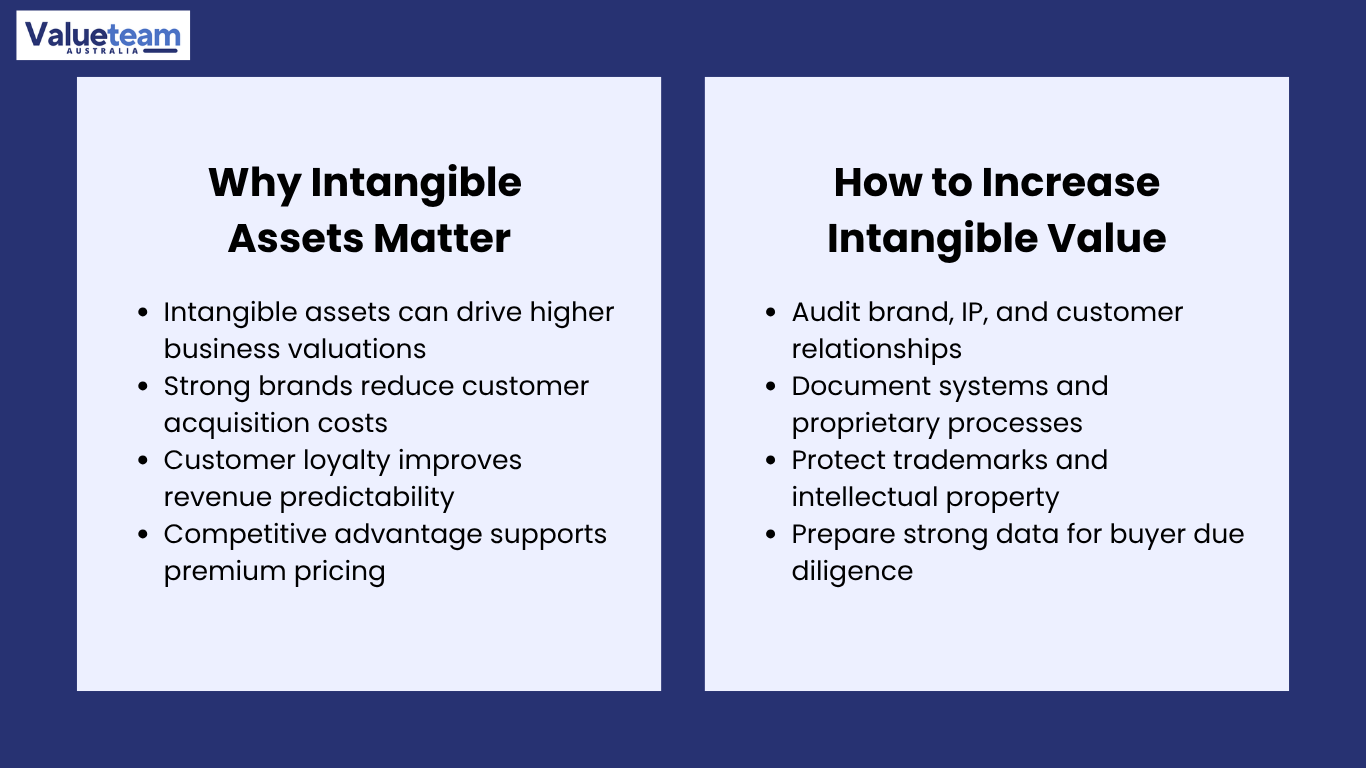
Research consistently shows that intangible assets represent a growing proportion of enterprise value in modern transactions. In many service and technology-led businesses, intangibles can account for more than 60 to 80 percent of the total purchase price. Despite this, many sellers — and junior advisors working their first transactions — underestimate how much work is required to surface, substantiate, and present these assets in a way that withstands buyer scrutiny during due diligence.
The practical implication is clear: sellers who invest time in identifying and documenting their intangible strengths before going to market are better positioned to defend their asking price, resist value adjustments during due diligence, and attract a wider pool of motivated buyers. For advisors, the ability to articulate Business Valuation Drivers that go beyond the income statement is what distinguishes genuinely valuable advisory work from a basic spreadsheet exercise.
3. The Most Common Types of Intangible Assets in Business Sales
Not all intangibles are created equal, and buyers will weight them differently depending on the industry, the transaction structure, and their own strategic priorities. Below is a summary of the most commonly encountered intangible asset categories and what makes each one commercially significant.
Intangible Asset | What Buyers Value | Why It Affects Price |
Brand Equity | Reputation, recall, and perceived market position | Reduces customer acquisition cost; supports premium pricing |
Intellectual Property | Patents, trademarks, proprietary software, trade secrets | Creates legal barriers to competition; defensible moat |
Customer Loyalty | Retention rates, NPS scores, repeat purchase data | Signals Revenue Predictability and lower churn risk |
Goodwill Valuation | Accumulated trust, workforce capability, relationships | Often the largest single component in service business deals |
Competitive Advantage | Unique positioning, switching costs, network effects | Justifies premium multiples; central to a Premium Exit Strategy |
Brand Equity is particularly powerful in consumer-facing businesses where name recognition reduces the cost and effort of acquiring new customers. A well-managed brand — evidenced through consistent pricing power, strong online reputation, and measurable market awareness — signals to a buyer that the revenue base is not purely the product of the current owner’s relationships or personal selling ability.
Intellectual Property represents legal protection for competitive advantages that might otherwise erode over time. Whether it is a registered trademark, a patented process, or proprietary software that forms the backbone of delivery, IP is one of the few intangible categories that can be quantified with reasonable precision and assigned a standalone value. Ensuring all IP is formally registered, clearly owned by the entity being sold, and fully transferable is a critical preparation step for any vendor.
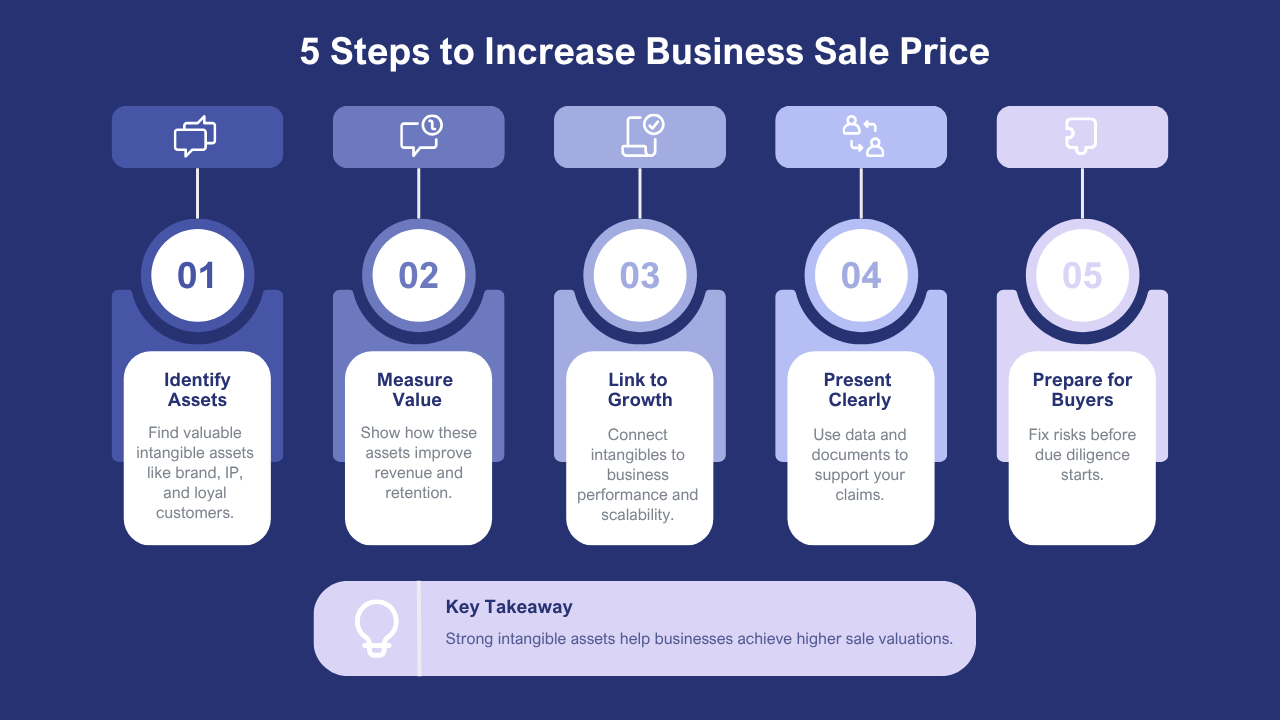
4. Five Key Steps to Identifying and Presenting Intangible Value
Valuing intangibles is as much a process of preparation and communication as it is a technical exercise. The five steps below reflect how experienced practitioners approach this work in an advisory setting, from first engagement through to final negotiation.
Step | What It Involves | Common Challenge |
1. Conduct an Intangible Asset Audit | Systematically document all non-physical value drivers: brand, IP, contracts, know-how, systems | Owners often cannot articulate what they own until prompted; knowledge is tacit, not recorded |
2. Quantify Where Possible | Attach financial proxies to intangibles — e.g., cost-to-recreate for IP, revenue attribution for Brand Equity, churn rates for Customer Loyalty | Attribution is contested; buyers will challenge assumptions without supporting data |
3. Align Intangibles with Business Valuation Drivers | Connect intangible strengths to measurable outcomes: contract renewal rates, gross margin consistency, Revenue Predictability | Requires disciplined financial record-keeping over multiple years |
4. Prepare a Vendor Information Memorandum | Present intangibles in a structured, credible narrative backed by data — not assertions | Overstating value without substantiation destroys credibility with sophisticated buyers |
5. Stress-Test Against Buyer Questions | Anticipate due diligence challenges: key-person dependency, IP ownership disputes, contract assignability | Sellers who have not addressed these issues before going to market face significant price pressure later |
The most valuable preparatory step is often the audit itself. Many business owners have never been asked to systematically list what makes their business difficult to replicate. Walking through this exercise — ideally 18 to 24 months before a planned sale — frequently surfaces issues that can be resolved while there is still time, as well as genuine strengths that have simply never been packaged for a buyer audience.
5. Real-World Examples and What They Teach Us
Consider a professional services firm operating in the HR consulting space across multiple cities. On paper, the business generated solid margins and steady revenue. But when it first went to market, initial buyer feedback reflected concern about key-person dependency: the founding partner was personally responsible for approximately 70 percent of client relationships. The firm withdrew from the process, spent twelve months actively transitioning client management to two senior employees, and implemented a structured CRM system to document all client histories and renewal schedules. When it returned to market, Goodwill Valuation was materially higher because buyers could now see that client relationships were institutional, not personal. The final sale price was approximately 35 percent above the initial indicative offer.
A contrasting example involves a consumer food brand with genuine Brand Equity — strong retail placement, high customer retention, and a recognisable product range — but poorly maintained trademark registrations. During buyer due diligence, it emerged that several of the brand’s core product names had lapsed protections in key export markets. The Intellectual Property gap required remediation at cost, and the purchase price was adjusted downward to reflect the uncertainty. The lesson: intangible value must be documented, legally protected, and transferable to be fully recognised in a transaction.
A third case involves a B2B software business with a genuinely Scalable Business Model — low marginal delivery costs, automated onboarding, and multi-year subscription contracts. Despite relatively modest absolute revenue, the business attracted a valuation multiple well above sector averages because buyers could model the path to significantly higher margins without proportional increases in cost. The combination of Revenue Predictability (through multi-year contracts), Customer Loyalty (evidenced by a net revenue retention rate above 110 percent), and a defensible Competitive Advantage in a niche vertical produced exactly the conditions that justify a Premium Exit Strategy. The sale was completed at a multiple that reflected future potential, not just current performance.
6. Process, Challenges, and What the Market Teaches You
For those new to M&A or advisory roles, it is tempting to treat intangible valuation as a secondary consideration — something handled in the narrative sections of an information memorandum rather than in the core financial model. This is a mistake. The most experienced dealmakers understand that intangibles often determine whether a deal happens at all, at what price, and under what conditions.
The four-phase process below reflects how a well-structured intangible value assessment fits into the broader transaction preparation workflow. Understanding each phase — and the particular challenges that arise within it — is essential for any junior professional who wants to contribute meaningfully to a transaction team.
Phase 1 | Phase 2 | Phase 3 | Phase 4 |
Identify & Document | Quantify & Validate | Benchmark & Position | Present & Defend |
Audit all intangible assets; interview management; review contracts, IP registrations, customer data | Apply financial proxies; test assumptions; link intangibles to historical performance data | Compare against sector norms; identify what differentiates this business from market peers | Translate into buyer-facing narrative; prepare responses to due diligence questions; support negotiation |
In Phase 1, the most common challenge is that business owners have not maintained the documentation necessary to support their own assertions. Customer contracts may be informal, IP may not be formally registered in the entity’s name, and employee know-how may exist #ff0000purely in individuals’ heads rather than in documented systems or processes. Surfacing these gaps early — when there is still time to address them — is one of the highest-value contributions an advisor can make.
Phase 2 introduces the challenge of contested assumptions. Buyers and their advisors will apply their own lens to any financial proxy used to value an intangible. An assumed revenue attribution for a brand, for example, is inherently judgmental. The best advisors come to these conversations with multiple methodologies — cost-to-recreate, income approach, relief-from-royalty — and a clear rationale for why the chosen approach is most appropriate for the specific asset. Knowing the academic foundations of these methods, and being able to defend them under pressure, is what separates a credible advisor from one who simply adopts the number most favourable to the seller.
Phase 3 — benchmarking — is where Goodwill Valuation and Brand Equity assumptions are tested against market reality. Comparable transaction data for private businesses is often limited, but sector reports, industry associations, and publicly announced deals all provide useful reference points. Junior practitioners should develop the habit of tracking M&A announcements in their focus sectors, noting the multiples implied, and understanding the narrative reasoning provided by acquirers when they explain their rationale for price.
Phase 4 is where technical skill meets communication ability. The valuation range must be translated into a story that buyers find credible and motivating — one that acknowledges risks while making a compelling case for why the intangible assets being described are real, durable, and transferable. Overstating is as dangerous as understating: buyers who feel they have been misled early in a process will apply aggressive adjustments throughout due diligence. The goal is not to maximise the opening number, but to defend a justified number through to close.
7. Scalable Business Models and the Path to a Premium Exit
One of the most significant drivers of valuation premium in modern transactions is the presence of a genuinely Scalable Business Model. Buyers — particularly financial acquirers and growth-oriented strategic investors — are not simply purchasing current earnings. They are purchasing the right to grow those earnings, ideally without a proportional increase in costs. A business that can add revenue through existing infrastructure, processes, and customer relationships is worth considerably more than one that requires commensurate headcount, capital expenditure, or management attention to grow.
Revenue Predictability is the most commonly cited feature of a scalable model. Recurring revenue structures — whether through subscriptions, maintenance contracts, retainers, or long-term service agreements — reduce the buyer’s perception of risk and smooth the cash flow projections that underpin discounted cash flow analysis. When Customer Loyalty is high and churn is demonstrably low, buyers can model future revenues with greater confidence, which directly supports a higher present value.
A Premium Exit Strategy is therefore not simply a matter of timing the market or finding the right buyer. It is the result of deliberate preparation: building a business that demonstrates scalability, protects its Competitive Advantage through documented systems and legal protections, and generates the kind of Revenue Predictability that allows buyers to model upside with confidence. Owners who understand this — and who begin building their businesses with an eventual sale in mind — consistently achieve better outcomes than those who treat the sale as a spontaneous event.
8. Conclusion: Actionable Insights for Your Next Step
The valuation of intangible assets is not a niche specialisation reserved for large transactions or listed company M&A. It is a fundamental competency for anyone working in business advisory, corporate finance, or transaction services. Understanding how Brand Equity, Intellectual Property, Customer Loyalty, Goodwill Valuation, and Competitive Advantage translate into price — and knowing how to document, present, and defend them — is what separates advisory that adds genuine value from advisory that merely processes paper.
For business owners planning a future sale, the single most important action is to begin preparation early. Conducting an intangible asset audit, addressing documentation gaps, ensuring IP is formally protected, and reducing key-person concentration are all steps that take time but have a direct and measurable impact on valuation outcomes. The businesses that achieve a Premium Exit Strategy are almost always those where the owners treated the sale as a two-year project, not a two-month sprint.
For junior professionals entering this space, the practical advice is to engage with real transactions wherever possible. Study publicly announced acquisitions, understand how acquirers describe the rationale for their pricing, and build fluency in the language of Business Valuation Drivers and Intangible Asset Value. The technical skills — DCF modelling, comparable analysis, sensitivity testing — can be learned from textbooks. The judgment required to identify, quantify, and communicate Intangible Asset Value in a way that buyers find credible is built through exposure, pattern recognition, and a genuine curiosity about what makes businesses worth more than the sum of their visible parts.
Ultimately, the quality of the information on which a valuation is based determines the quality of the outcome. Get the fundamentals right — clean financials, documented intangibles, credible assumptions — and the process becomes significantly more manageable for everyone involved.
Frequently Asked Questions
Q1. What are intangible assets?
Intangible assets include non-physical assets such as brands, patents, trademarks, software, customer relationships, and proprietary technology.
Q2. Why do intangible assets increase business value?
They generate future economic benefits, strengthen competitive advantages, and often represent significant value beyond physical assets.
Q3. Which intangible assets are most valuable to buyers?
Strong brands, loyal customer relationships, intellectual property, proprietary software, and long-term contracts are commonly viewed as valuable assets.
Q4. Why should sellers identify intangible assets before selling?
Documenting intangible assets helps demonstrate the company’s true value and may justify a higher selling price.
Q5. How does professional valuation support intangible asset recognition?
Professional valuers identify and measure intangible assets using recognised methodologies, helping maximise business value during a sale.