

How Valuation Changes After an Acquisition
How Valuation changes post-acquisition is one of the first questions that junior analysts, finance graduates and people entering the job market face, once the deal is done. In a nutshell, a business no longer becomes a business and begins to be priced as part of a larger entity, and almost every element of the valuation process is affected. These Business Value Changes may be seen as synergies, new capital structure, new growth expectations, and purchase price allocation under accounting principles like IFRS 3. The Post-Acquisition Value is not necessarily the sum of the two pre-deal valuations, instead it depends on the ratio between the benefits and the integration cost and potential risk. Professionals can use Tracing the acquisition impact valuation to grasp the end result of a deal and effectively communicate that information to stakeholders, clients or interview panels.
What Shifts Immediately? How Valuation Changes After an Acquisition
Purchase price allocation occurs when a deal legally closes and the balance sheet of the target is redrawn. The assets and liabilities are restated at fair value, identifiable intangibles like customer relationship, brand names, distribution agreements, and technology are recognized separately and any excess over the fair value of the net identifiable assets is treated as goodwill. business value changes are often the most obvious of the accounting differences between two companies – when a modest book equity can suddenly present a materially higher asset base when intangibles are separated out and goodwill is included. This is the most expedient way to experience the power of the numbers of acquisition financial impact, not just as a concept in a book. It’s also the time when finance teams will find out how much of the purchase price they’ve paid for assets which were not on the target’s balance sheet at the time of acquisition, which is another business value change that should be addressed early in any post deal review. In some respects, the most educational project for junior analysts on a purchase price allocation is that exercise as it helps them to learn how to go through the process of line by line reconciling the seller’s work with the work they are now being required to do.
In addition to the accounting entries, control is changing value. A buyer paying a control premium is paying the seller for the right to make the strategy, change the management, refinance the debt or realize some synergies that a passive minority shareholder would not be able to realize. It’s one of the more complicated aspects of the subject for novices: this premium is designed to allow two buyers to competitively value the same company based on the amount of strategic control they plan to exert once they’ve purchased the business. That premium is reflected in the Post-Acquisition Value that the market is giving to the combined company (pre-combination integration). The valuation, in the form of share price, credit rating, and cost of capital of the acquirer should also be monitored: market re-pricing of the combined risk profile can occur prior to the first integration milestone. Each of the rating agencies, lenders and equity analysts will have its own opinion on the acquisition impact valuation, and in the initial few months after closing these opinions are not necessarily aligned. For example, a credit rating agency might base its assessment almost solely on leverage and cash flow coverage, while an equity analyst’s assessment may be more concerned with whether the synergy case has legs and the two angles can create a temporary divergence in the market’s reads on the deal. Understanding How Valuation Changes After an Acquisition is a fundamental aspect of valuation, which involves accounting for changes in valuation due to the structure of the transaction and the market’s forward-looking expectations.
Table 1: Business Value Changes Before and After Acquisition – How Valuation Changes After an Acquisition
| Valuation Driver | Pre-Acquisition | Post-Acquisition |
|---|---|---|
| Reporting basis | Standalone entity | Consolidated combined entity |
| Intangible assets | Often unrecognized internally | Separately identified and fair-valued |
| Goodwill | Not applicable | Recognized for premium above net assets |
| Discount rate (WACC) | Reflects standalone risk | Reflects combined capital structure and risk |
| Growth assumptions | Independent forecast | Adjusted for synergies and integration plan |
How Do Valuation Methods Respond? How Valuation Changes After an Acquisition
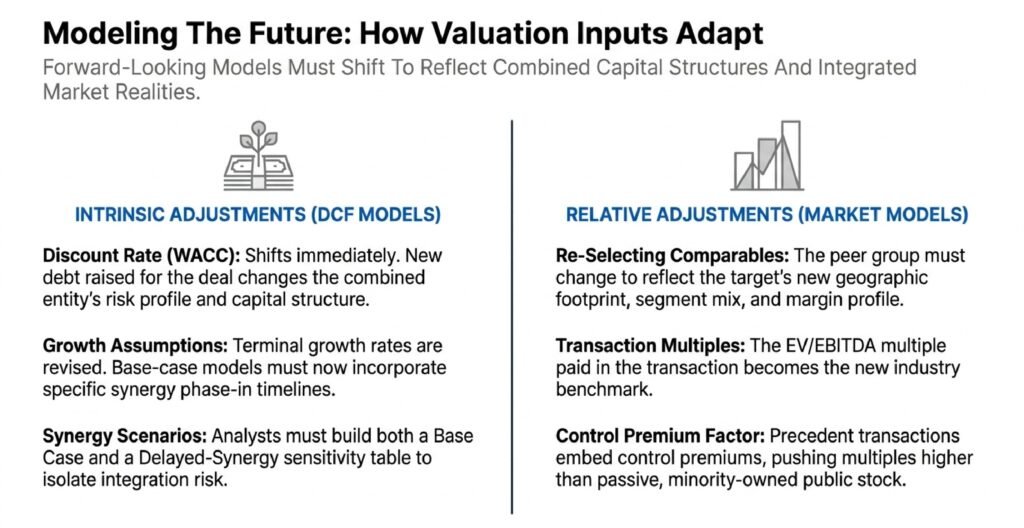
Discounted cash flow models are typically the first to get the move of the day. The discount rate used to calculate the cash flows of the target is frequently adjusted after the deal is struck as the combined capital structure, credit profile and business mix of the combined entity is often different from that of the target. When a new debt issue is used to finance the acquisition, the weighted average cost of capital is likely to shift and the terminal growth assumptions are often adjusted to incorporate the synergies that management will achieve. This is where acquisition impact valuation gets very granular: two analysts looking at the same target can get two different post-deal valuations if they have varying opinions on the speed of cost synergies and/or durability of revenue synergies. Typical one- and two-variable sensitivity tables (discount rate and synergy phase-in) are often the most valuable report a junior analyst can prepare for a deal team to review for the first quarter following closing for acquisition financial impact. It also will be worthwhile to construct no less than two scenarios: a baseline and a delayed-synergy scenario, so that management isn’t caught off guard if realization takes longer than the initial announcement indicates.
Market-based solutions also change for various reasons. The comparable company set that was previously used for comparison may need to be updated once the target is incorporated into a larger company that has a different segment mix, geographic scope or margin composition. The transaction itself may already incorporate multiples like EV/EBITDA or EV/Revenue that are used in the transaction, and thus constitute a new data point for future transactions in the sector, which would impact how merger value creation is measured across an industry. Precedent transaction analysis, especially, tends to be built in to include control premiums which will push multiples higher than they would be if the same company was a minority owned public share.Especially, the analysis of precedent transactions tends to include control premiums that drive multiples up from what they would be if the same company was a minority owned public share, and junior analysts are often asked to explain whether that is the case when they present PV to a client or a panel of interviewers. As more deals close in a sector over time, these transaction multiples evolve into a baseline that helps guide the next generation of business value changes negotiations and justifications. A question that is often asked in interviews for a valuation position is whether a job applicant can explain why a transaction multiple is not the same as a trading multiple based on public market comparables.
What Do Real Cases Show? How Valuation Changes After an Acquisition
Suppose a mid-sized CPG firm is bought by a bigger global CPG distributor looking to diversify the category. The target was valued on a standalone basis, in which it was given a modest growth path and limited distribution and was valued on a discounted cash flow basis. The deal enabled the target’s products to be supplied to three times as many stores within 18 months thanks to the acquirer’s logistics network and retail relations, while synergies from putting the target’s products on the same platform as the acquirer’s products led to a reduction in input costs of approximately 8 percent. The post acquisition value attributed to the target at the acquirer’s next annual test of impairment was significantly higher than the purchase price, in line with textbook examples of merger value creation: the combined company was indeed more valuable than the two companies independently. Analysts who reported on the deal pointed out that distribution was the lion’s share of this merger value creation (not cost savings), and that revenue synergies should be reviewed alongside cost synergies. The finance team also deserves credit for executing the announced case to fruition rather than a slide that was never looked at again by the integration team with a disciplined 90-day plan, and named owners for each synergy line.
The opposite extreme includes a medium-sized industrial equipment maker whose stock price had risen significantly that purchased a specialty component company at a top dollar cost, with expectations of better cross-selling opportunities that were never realized. The integration was longer than anticipated, important engineering personnel of the target left the company within the first year, and the revenue synergies were repeatedly postponed. Two years after the closing, the acquirer booked a goodwill impairment, which it essentially confirm it was an acquisition financial impact that was negative, not value-accretive. Subsequent internal reviews identified unrealistic business value changes built into the initial deal model, and not enough time allowed to accommodate employee turnover or to merge two divergent engineering cultures. The finance side also ran a post-mortem after the deal became problematic and one of them had not stress-tested the case without the biggest single cross selling deal which was ultimately the one that was lost. The takeaway from both scenarios is the same: How Valuation Changes After an Acquisition is more about whether or not the integration plan behind the purchase price is put into practice.
What Are the Key Steps to Follow? How Valuation Changes After an Acquisition
Structured Assessment of acquisition financial impact will help you to explain the result of a deal to a manager, a client or interview panel. When a transaction closes and the target has to be re-valued as part of a larger transaction, most valuation teams go through the following five steps, in some order. The steps should be followed in order and it is usually possible to skip one step in the Post-Acquisition Value estimate and lose touch with reality.
- Re-base Financials. Reconstruct the target’s opening balance sheet in accordance with purchase price allocation, comprising tangible assets, identifiable intangibles and goodwill, to ensure that all future valuation steps are based upon the fair value of the assets or liabilities being valued, rather than their historical book value; this will be the reference point for all future valuations, by which they will be judged.
- Update the discount rate. Recalculate the weighted average cost of capital based on the risk of each investor class after the deal is done, because the debt or equity that is to be issued to fund the acquisition will impact the risk of each investor class, and will directly influence the acquisition impact valuation, more than any other single piece of information in the model.
- Review growth and synergy assumptions. Separate out the revenue synergy from the cost synergy and use realistic phase-in timelines and stress-test the case without synergies to determine how much value will be achieved by the businesses they acquire or how much is driven by the synergies that are achieved.
- Click to re-select the comparable set. Ensure that the precedent transactions and peer group are still relevant to the target’s new segment mix, geography and scale within the combined business, as key to good acquisition impact valuation and often forgotten once a deal team has progressed to the next transaction.
- Be alert for impairment triggers. Management should monitor the goodwill and intangible balances against actual performance each reporting period, because if they do not perform as well as the merger value creation case during a significant portion of the period, they are likely to trigger an impairment charge – which means management will have time to act in response.
All of these steps are interrelated. An updated discount rate without a re-evaluation of synergy assumptions, or a similar set that are unchanged despite a significant change in business mix, can yield a valuation that seems correct but is really incorrect. A defensible overall Business Value Change is accomplished when the professionals who are working through all five steps work together. Implementing this checklist on all acquisitions, not just large or complicated ones, is one of the quickest ways for a junior analyst to build up a feel for acquisition financial impact across industries, and this is the kind of thinking that veteran reviewers are looking for when determining who is ready to lead a deal, not just support it.
Table 2: Acquisition Financial Impact – Common Post-Deal Adjustments – How Valuation Changes After an Acquisition
| Adjustment | Typical Effect on Valuation |
|---|---|
| New debt raised to fund the deal | Increases financial risk; raises WACC |
| Recognition of intangible assets | Increases identifiable asset base; reduces goodwill |
| Realized cost synergies | Improves margins; supports higher valuation |
| Integration costs and restructuring | Reduces near-term cash flow and value |
| Goodwill impairment (if synergies underperform) | Reduces reported value and equity |
What Are the Benefits and Challenges? How Valuation Changes After an Acquisition
If it is done correctly, an acquisition can be one of the quickest way management can achieve merger value creation. Shared facilities, a common purchasing power, cross-selling amongst customer bases and access to lower capital costs can boost the earnings of the merged company far beyond what each business could do alone. This is often met with a re-rating of the market value: the market places a higher multiple on the combined earnings stream because it believes that the synergy promise will continue to be fulfilled, and thus the Post-Acquisition Value profile is higher. For the junior professional, these benefits are significant as they are the reason boards are willing to pay premiums in the first place, and why business value changes are not necessarily bad news – even if short term dilution or new debt gets added to the balance sheet. The one most important factor in achieving the merger value creation that is expected is typically a well-sequenced integration plan that identifies clear ownership of each synergy line, and which can make the difference between two projects that might have the same strategic logic having vastly different outcomes three years down the road.
The problems are, on the other hand, very real. Almost always, costs for integration are underestimated, cultural differences delay decision making, and important staff of the acquired firm can walk out the door before the synergies are realized. The most significant valuation concern is that the original acquisition financial impact case by management may have been overly optimistic and only becomes evident as a goodwill impairment instead of a one-time write-off. There’s additional pressure from disclosure: The auditors want to see a defensible impairment test every year, and there has to be a reason to explain the gap between the expected synergy and performance if it happens, to the audit committee. This is where careful acquisition impact valuation work pays off as well – a well-documented, up-to-date model gives management a heads up long before an impairment is unavoidable, and it provides a defensible paper trail to explain to senior management why the acquisition synergy case didn’t work out as hoped. It’s unlikely that How Valuation Changes After an Acquisition is ever a straight path upward – it’s a multi-year process that requires monitoring, not a number that is fixed at closing day – and the professionals who can monitor it well are the ones deal teams keep coming back to.
Conclusion: How Valuation Changes After an Acquisition
The bottom line for junior and mid-level professionals, who are developing their valuation or transaction advisory career, is that a purchase price is never the solution, it is just the first question. The accounting mechanics of Purchase Price Allocation, the discount rate used and growth expectations for the combined company, and, most crucially, whether or not the synergy story of the deal comes to pass are all significant in how a valuation changes after acquisition. Anyone conducting a review of a transaction should first re-baseline the financial statements, then challenge the discount rate, growth, and comparable set, against the new business reality, and annually monitor goodwill against actual performance, not the Post-Acquisition Value. Use the above five-step checklist as a guide and apply it to nearly any deal you are considering and then review the underlying business value changes at least once a year, not just at closing. Valuation, M&A advisory and corporate development professionals who can tell a manager or client what the merger value creation upside is and what the acquisition financial impact risk is, with evidence—not assumptions—are going to stand out in no time at all, and they’re going to develop the type of judgment in the area of acquisition impact valuation that nothing else can give them. Once you have reviewed the next deal you see in the newspaper (even if you don’t have a formal part to play), you’ll walk through the five steps on an actual, public transaction and one of the best ways to develop this into a skill you can use in any interview or client meeting. Write it down every time you make an assumption because a year later, comparing the assumption to what actually happened is the quickest method for developing actual judgment about how deals create or destroy value.