

What Are the Biggest Business Valuation Risks Companies Should Avoid?
A valuation is only as valuable as the assumptions on which it was based, and many of the most expensive deal screw-ups come from a number that seemed like a good number on paper, but was not stress-tested properly. Knowing the Biggest Business Valuation Risks is the key to anyone involved in mergers, acquisitions, fundraising, tax exposure or years of future financial statements, since a flawed valuation is not only an effect on one spreadsheet, but negotiated price, tax exposure and years of future financial statements. These are some of the greatest risks that can trip up professionals early in their career, and one of the quickest ways is to learn to spot them before they can even appear. This article will explore the potential sources of valuation risk, how purchase price allocation services and intangible asset valuation mitigate some of that risk, the unique aspects of IP valuation risk and brand value assessment, and some of the lessons learned from failing deals by company valuation experts.
What Are the Biggest Business Valuation Risks Companies Face During Due Diligence?
The idea of “due diligence” is to uncover issues before they become costly, but it’s also where the Biggest Business Valuation Risks tend to reside, typically when someone is relying on assumptions that no one has effectively questioned. The typical mistake is using management forecasts as the primary driver of business, without verification of revenue growth, churn and margin expectations through a comparative analysis of similar companies and historical trends. Analysts can be pressed for time and take the seller’s projections at face value just because they don’t have time to build up a model themselves. The second is relying on one approach to valuation over the other – a discounted cash flow valuation, a comparable company valuation and a precedent transaction should all reveal limitations on the business that the other two would fail to highlight at all. A third, less clear source of risk is not updating the model as new data comes in during diligence, and using a model created in week one to justify a price in week six after market conditions or customer data has changed. The 100% cause of all three: When a deal goes on a tight timetable, even the most savvy and knowledgeable analysts are tempted to gloss over a cross-check or take an easy assumption.
These risks are exacerbated when teams from outside the deal are not involved early enough. Business valuators are able to recognise the type of aggressive assumptions that an internal team might miss or rationalise out of a sale when time is of the essence and it is their independence that makes their stamp of approval valuable to a board and/or a lender. The company’s acquisition of a retail chain, for instance, had been based on the expectation of same-store sales growth at its current rate, despite being aware of a short-term marketing campaign that had boosted sales in the year before, which only an independent reviewer uncovered weeks before the deal was signed and the price was recalculated. Later review teams found that the additional expenses of bringing in business valuation experts a few weeks before the discovery was made would have been negligible in comparison to the price change that was imposed. The moral of this story is that the Bad Math is often not the reason the biggest business valuation isrks occur, the reason is that none of the deal team ever asked, “What if? Junior analysts who routinely question the reason behind the growth rate, instead of just fitting it into a model, will often spot these problems much sooner than a senior reviewer will ever notice in the file.
Why Do Purchase Price Allocation Services Help Reduce the Biggest Business Valuation Risks?
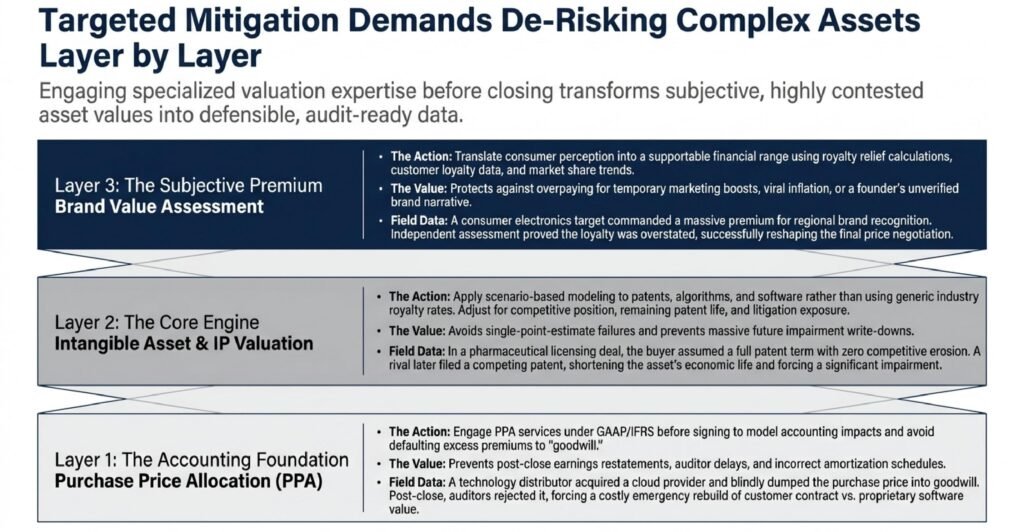
The risk transfers from negotiating to accounting after a deal closes, and this is where the importance of purchase price allocation services comes in to ensure that numbers don’t get off track. GAAP and IFRS require the allocation of the purchase price to the tangible assets, identifiable intangible assets, and the goodwill, and an incorrect allocation can cause the earnings to be misstated for years over incorrect amortization schedules. As mentioned, companies that take the step lightly, rather than deliberately and rigorously as it should be, are likely to be forced to restate their financials or be asked awkward questions by the auditor long after the ink is dry on the deal. Having purchase price allocation services available during the negotiations, preferably before the transaction is closed, enables the finance team to model the accounting effect of various deal structures before they are in place, and allows the management team time to communicate changes in earnings to investors before a shock hits in a quarterly filing. Many finance teams complement purchase price allocation services with a more comprehensive examination by business valuation professionals so the tangible, intangible, and goodwill numbers are all aligned with the earlier assumptions in the deal. In recent years, regulators across multiple jurisdictions have been getting tougher on allocation work, so an allocation that may have cleared the hurdle 10 years ago is likely to be followed up with questions when the supporting documentation is meager.
Imagine a technology distributor that purchased a smaller cloud services company without utilizing the assistance of outside purchase price allocation professionals until after the transaction was finalized. The internal team spent almost the full purchase price on goodwill, which was a reasonable short cut at the time, but meant that auditors would not know how much value was in the customer contracts compared to proprietary software. During its annual audit, the external auditors identified the allocation, requiring the company to hire external company valuation experts to recalculate the allocation under pressure, thus postponing the audit and raising the questions of the company’s board regarding the internal control. The finance director later confessed that hiring the purchase price allocation experts before the signing, and not in response to an auditor grievance, would have been much less expensive than hiring on the fly and the time spent wrangling with the audit committee would have been saved. One of the most obvious examples of the biggest business valuation risks transferring from negotiation table to the audit committee is when the allocation work is rushed or neglected. It is also a reflection of a larger truth: the expense of a bad allocation seldom becomes apparent right away, which is why it is so easy for a deal team under time pressure to misjudge the allocation.
Table 1: Common Sources of the Biggest Business Valuation Risks – What Are the Biggest Business Valuation Risks Companies Should Avoid?
| Risk Area | Typical Cause | Consequence |
|---|---|---|
| Overreliance on management forecasts | No independent stress-testing of projections | Overpaying for unsustainable growth |
| Single valuation method | No cross-check between approaches | Blind spots in the final price |
| Rushed purchase price allocation | Treated as a formality after closing | Restated earnings, audit delays |
| Unquantified intangible assets | No dedicated intangible asset valuation | Goodwill overstatement |
| Unverified brand claims | No independent brand value assessment | Overpaying for perceived brand strength |
How Do Intangible Asset Valuation and IP Valuation Risks Contribute to the Biggest Business Valuation Risks?
Intangible asset valuation is where the meat is in the bones of most contemporary transactions, as patents, trademarks, software and customer relationships are not typically recorded at anything remotely close to a valuation on a balance sheet. In technology and pharmaceutical deals, the value of any single patent portfolio or proprietary algorithm typically can be a major portion of the deal’s value, but can also be the most difficult asset to confidently value. One of the most frequent errors is using a generic royalty rate that is found in an industry database, without considering the competitive position, remaining patent life or litigation risk associated with the asset being used as a royalty. These numbers are entered directly into an amortization schedule and impairment testing, which can cause years of inaccurate earnings reporting until a future audit. A pharmaceutical licensing contract is a good example: after a new competitor launches a competing patent, which reduced the asset’s “realistic economic life” because of its direct threat, the buyer will write down the IP asset significantly to record an impairment loss, an outcome that a more diligent IP valuation risk assessment would have predicted during diligence. Business valuation specialists that specialize in intellectual property generally consider a range of scenarios for patent life and competitive reaction just to prevent such a one-point estimate failure. While this scenario-based thinking is one of the most obvious differences between a junior analyst’s initial intangible valuation and the one that the experienced reviewer eventually rubber-stamps, it is remarkably similar.
These five points, in various iterations, have been encountered in actual transactions where there was significant IP involved, and in each case been a source of IP valuation risk for the deal teams. The first is overestimating the remaining useful life of a patent or technology asset, which underestimates cash flows that the asset has the potential to generate in the future. Second, to disregard the possibility of litigation or existing patents that might limit the economic life of an asset long before the legal end of its life. Thirdly, where better data was not easily available, using royalty benchmarks from an unrelated industry and thereby potentially inflating or deflating the value of the royalty based on the economics of the other industry. Fourth, not realizing that there are two major values to consider: the value of the underlying technology, and the value of the team that created it; the latter is crucial in an asset sale where the key team might not continue to work after closing. Fifth, not valuing any intangible assets at all and just letting the entire premium go into goodwill, a line item that is under more and more spotlight from auditors and more and more being questioned by regulators.
What Role Do Company Valuation Experts Play in Managing Brand Value Assessment Risks?
A brand value assessment is one of the more subjective and controversial components of the brand valuation process when the value of a target company is largely based on its brand’s reputation. Company valuation experts use a structured, defensible process: They usually incorporate the calculation of royalty relief, customer loyalty information, and market share trends into the work, and they’ll use the work to arrive at a number that a founder would likely be more comfortable with. For example, a consumer electronics company bought by a larger conglomerate would get a premium almost entirely because of brand recognition in a particular regional market; only an independent brand value assessment could determine whether the premium is due to true customer loyalty or a short-term marketing campaign that would be lost upon the assets of the conglomerate once the acquisition is complete. That valuation team hired to assess the company’s worth ultimately suggested a lower level premium than that which management had proposed, altering the final negotiation. In fact, one of the biggest business valuation risks in any consumer-facing deal – not to mention in the countless number of industries where a single viral moment or celebrity endorsement can temporarily elevate a brand’s apparent value far above that of its actual customer economics – is to skip this step or simply throw your hat into the ring and accept management’s own brand story without any third-party verification.
Valuating a brand is opaque by comparison to valuating inventory or receivables, and can be, naturally, a more subjective process than that, so a couple equally qualified company valuation experts can come up with different conclusions based on the same data. This isn’t a ‘bug’ in the system – it’s just what an asset is, it resides mainly in the customer’s mind, and not the invoice. Professional business valuators can help with this uncertainty by providing a defensible range of values, spelling out their assumptions and performing a stress test on the brand premium by considering downside scenarios like a competitor product or consumer preference changes. A brand value assessment carried out this way helps avoid false confidence that later serves as a basis for disagreement or write-downs and provides a documented process from which the deal team can refer to if the number is called into question later. This documentation is also helpful after the closing, as it will likely need to be reviewed during a subsequent sale, refinancing or impairment test and argued again.
What Lessons Reduce the Biggest Business Valuation Risks in Practice?
In many transactions, a few lessons are reoccurring frequently enough to be regarded as routine instruction instead of optional advice. First, a valuation should not be a one-off process performed at the start of a transaction, and then forgotten; during the time between the letter of intent and final signing, market values, interest rates and the performance of the target can change significantly and a dated valuation is a risk on its own. Second, independent verification is more important than self-confidence: a deal team that has self-confidence in its numbers is not the same as a deal team that has stressed-tested the numbers. A regional manufacturer also once went on an “all-in” valuation on the same, without knowing that in the first year of closing, its biggest customer was going to walk out the door. Third, when teams record their assumptions in the deal, they aren’t faced with the time and credibility drain of trying to reconstruct the logic of the deal months later when questions arise. Fourth, the best deal teams see each transaction as a learning experience and conduct a brief internal review following the transaction to document what they did well, what they did wrong, and how they can improve the process for the next transaction.
The best takeaway is that biggest business valuation risks need to be managed as a habit across the analyst team, not by an individual analyst. Without precise valuations, legal teams have to draft representations and warranties with incorrect numbers, tax teams will have to structure the deal ineffectively and the operations people will have to determine targets that are only aspirational, but not realistic. Experts who see the link between intangible asset valuation, purchase price allocation services, and brand value assessment have better career prospects than those who view valuation as a technical, stand-alone activity. It is no less important to be able to explain the valuation risk to the non-financial stakeholders than it is to be able to build the model in the first place: if a board doesn’t understand a risk, it cannot take any action before it is a problem. This is a communication skill that needs to be developed from the outset rather than a skill acquired later in a person’s career.
Conclusion: Key Takeaways on the Biggest Business Valuation Risks
Valuation risk does not always present itself clearly; it can be tucked away in the optimism of forecasts, a hurried allocation of purchase price, unverified brand claims and intangible assets that never have undergone an independent review. The next step for professionals pursuing a career in this arena is to learn how valuation professionals with experience in the field test assumptions, understand how purchase price allocation services are performed as they relate to a live transaction, and become comfortable with asking difficult questions of management than simply taking their word for it on intangible asset valuation and brand value assessment. Three practical steps that develop this judgment, more rapidly than reading theory alone, are reviewing actual disclosures from public company filings, practicing IP valuation risks analysis on brands that you are familiar with, and asking to shadow company valuation experts on a live engagement. All of these steps do not take years to begin – they take discipline to not take a number for granted, but to question why a number is the way it is. This is the way to understand and manage the biggest business valuation risks, not in such a way that it leads to unpleasant surprises after the deal closed. Try a small audit: select one of the newest public transactions, read through the footnotes of the purchase price allocation, and consider how the assumptions made about the value of the intangibles would likely withstand the sort of analysis explained in this article.