

Table of Content
1. Introduction to Business Sale vs Share Sale
A decision that is often taken long before due diligence commences, long before price is agreed, and sometimes long before the parties fully understand its ramifications, is one of the most important in any private business sale: the Asset vs. Share Sale decision. This one decision affects the seller’s after-tax sale revenue, the buyer’s tax deductions, the liabilities transferred with the business, and, often, the nominal sale price itself. For business owners and advisers who fail to grasp the principles of Deal Structure Valuation, the consequences are often a negotiation on a false premise – or an unexpected outcome.
In Australia, Transaction Structuring choices are made within a specific tax, legal and regulatory environment that is unique from other markets. The ability to access the small business CGT concessions, the GST implications of going concern sales, the PAYG withholding obligations of the Buyer and the stamp duty consequences of different transfer structures, all interact with the underlying Asset vs Share Sale decision to create a solution that is highly dependent on the facts and circumstances of the transaction in question. This is essential knowledge for those in the transaction advisory business.
This article is for junior to mid-level practitioners in M&A advisory, accounting, legal and corporate finance roles who are interested in building their knowledge of how structure impacts value, the Buyer vs Seller Preferences in deal structuring negotiations, and how the ultimate Deal Pricing Strategy is determined by the tax, risk and commercial considerations that are in play. It is also valuable for business owners considering a sale to understand the importance of structure and the questions to ask when seeking advice.
2. How Buyers Think About Value and Decision Criteria
What each structure involves
An asset sale involves the sale of the business’s assets to the buyer (equipment, contracts, goodwill, intellectual property, stock, etc.) and typically the liabilities specifically agreed to in the sale agreement. The vendor (company) retains any liabilities not sold, and survives the sale as a corporate shell. In a share sale, the buyer acquires the shares of the company that owns and runs the business in question, thereby acquiring all of the company’s assets and liabilities, including all known and unknown, past and future liabilities.
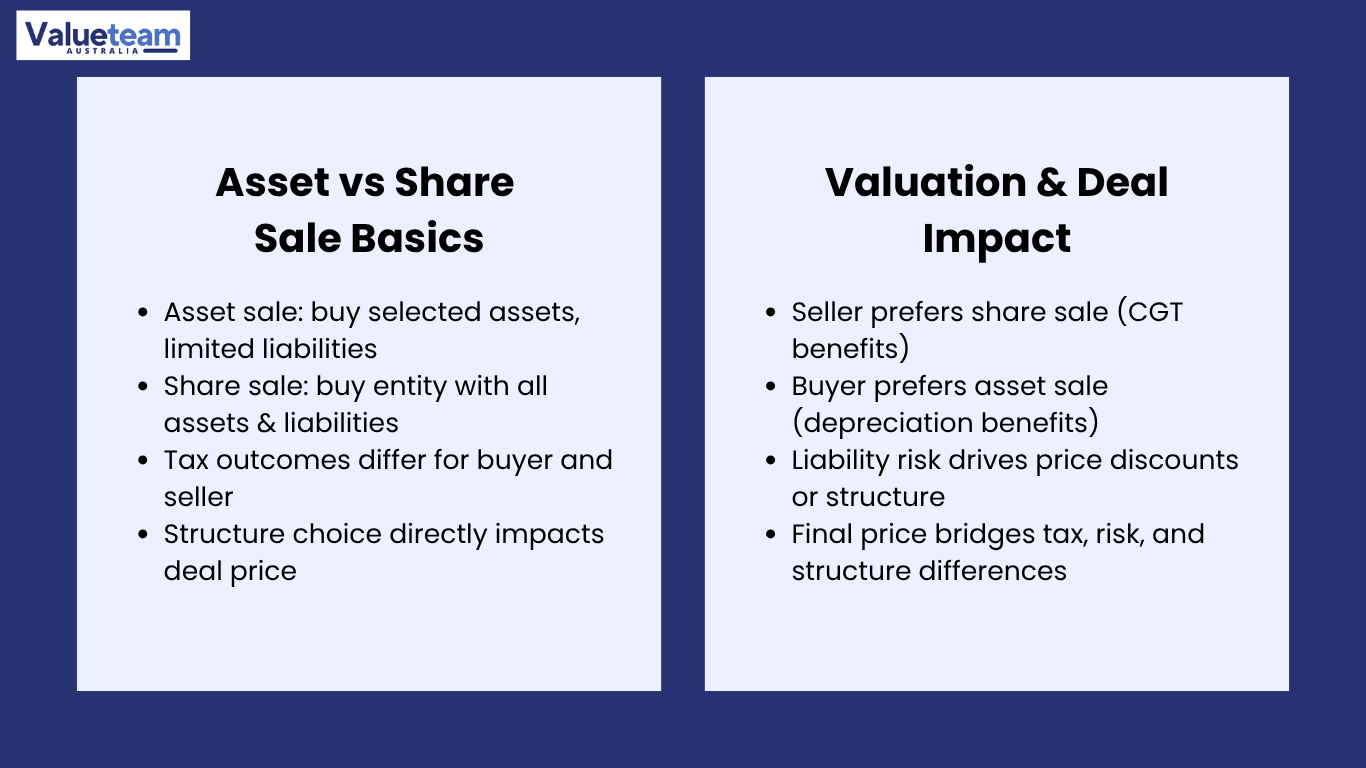
- Asset or Share Sale: the most basic choice of deal structure, which impacts tax, liability allocation and the face value of the deal price.
- An asset sale provides the buyer with a fresh start for the parts of the business sold; a share sale involves the sale of the whole business entity, with its history.
- The two structures have different tax implications in Australia – at the entity level and at the individual shareholder level – that significantly impact the net price received by the seller and the cost of the sale to the buyer.
Why can the same business have different prices under each structure
The same enterprise, producing the same revenues, can have a different Purchase Price Difference depending on whether the sale is structured as an asset sale or a share sale. An asset purchaser gets to depreciate the assets for tax purposes from the purchase price, resulting in tax deductions that reduce the effective purchase price. A buyer who acquires shares inherits the assets’ existing tax basis, which can be much lower than their current value, without the step-up. This is hundreds of thousands of dollars (in net present value) for a mid-market sale, and it has a significant impact on the starting points for negotiations over the deal structure.
3. Tax Implications and How They Shape Valuation
The seller’s perspective: Capital Gains Tax Considerations
Most shareholder-owned businesses and trusts prefer a share sale because it gives rise to a single CGT event at shareholder level, which is potentially eligible for the 50 percent CGT discount (for assets held more than 12 months) and – where the small business CGT concessions apply – potentially eligible for further reductions such as the 15-year exemption, the small business 50 percent active asset reduction, or the retirement exemption. By contrast, an asset sale results in CGT at the corporate tax rate (typically 25-30%) with no access to the individual’s 50% discount and the after-tax proceeds must be distributed to shareholders, often giving rise to a further tax event.
- Share sale: one CGT event at shareholder level; potential availability of individual 50% discount and/or small business concessions.
- Asset sale in company: CGT at the company tax rate (usually 25-30%) with no 50% discount; any remaining proceeds distributed to shareholders may be subject to further tax.
- Capital Gains Tax Considerations can equate to a 15-25% variation in the net proceeds to the seller – make no mistake, negotiating the deal structure is price negotiation.
The buyer’s perspective: depreciation and risk
The buyer will usually prefer an asset sale because it allows the cost of the business to be split across particular asset classes, which can then be depreciated over their useful lives for tax purposes. This depreciation benefit (present value of future tax deductions arising from depreciating the purchase cost of assets) can account for 20-35 per cent of the purchase price (measured as the NPV of future tax benefits), depending on the asset mix and the buyer’s tax rate. This is not possible in a share sale, as the assets’ tax cost base remains unchanged.
In addition to tax, a share sale passes on to the buyer all historical liabilities of the target company, both known and contingent liabilities at the time of the sale. This risk is a key determinant of Buyer vs Seller Preferences: where buyers are unable to negotiate sufficient warranties and indemnities in a share sale, the buyer will either seek a price discount to reflect the additional risk or will structure a sale as an asset sale to avoid liability risk altogether. The buyer’s willingness to assume historical liability risk is a key determinant of Deal Structure Valuation.
Dimension | Asset Sale (Buyer Acquires Assets) | Share Sale (Buyer Acquires Shares) |
Tax for the elder | CGT at company rate; potential double taxation on distribution; less favourable Capital Gains Tax Considerations | Single CGT event at shareholder level; access to individual 50% discount and small business CGT concessions |
Tax for the buyer | Step-up to market value; depreciation deductions on acquisition cost; more favourable Valuation Impact Factors | No asset step-up; historical tax cost base maintained; no additional depreciation shield |
Liability transfer | Buyer assumes only explicitly agreed liabilities; historical liabilities stay with the selling entity | Buyer assumes all liabilities of the acquired company, including undisclosed and contingent obligations |
GST treatment | May qualify as a GST-free supply of a going concern if structured correctly; stamp duty on individual assets | No GST on share transfers; stamp duty on shares (generally lower than on asset transfers in most states) |
Purchase Price Differences | Buyer may pay less (no liability premium); seller needs more to net the same after-tax outcome. | The buyer may pay more to compensate the seller for the CGT drag; the Deal Pricing Strategy must bridge the net proceeds gap. |
4. Five Steps to Structuring a Deal That Works for Both Parties
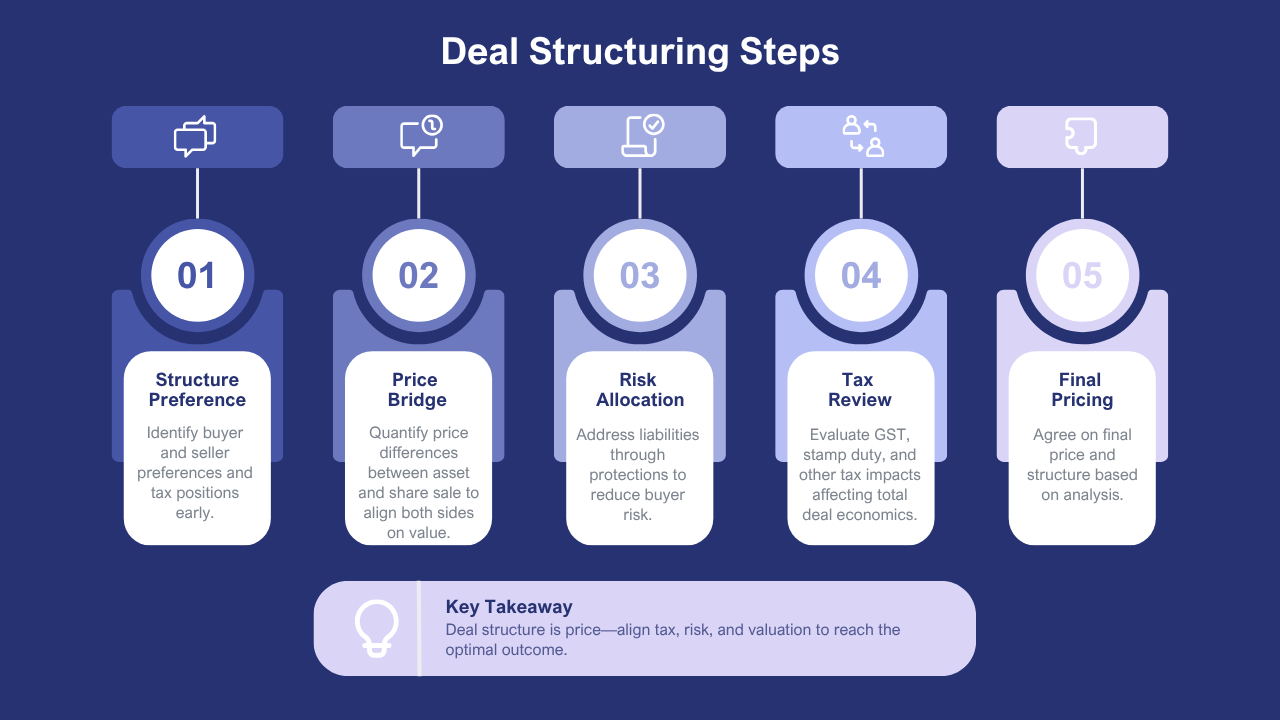
The Transaction Structuring negotiation is not a zero-sum game; the most efficient deals strike a price and structure that minimise the combined tax cost and liability risk for the seller and buyer, rather than optimising one side of the deal at the expense of the other. The following five steps are how successful advisors negotiate this deal element.
Step | What It Involves | Why It Matters | Key Advisory Point |
1. Establish each party’s structural preference and tax position | Identify whether the seller has access to small business CGT concessions; calculate the seller’s net after-tax proceeds under each structure; identify the buyer’s depreciation benefit under an asset deal | Determines the starting point for structure negotiation; often reveals that a share sale is worth significantly more to the seller and less to the buyer in net terms | Advisors should model both structures for both parties before any structural preference is expressed in negotiation — the numbers reveal the actual quantum of each party’s structural interest |
2. Quantify the Purchase Price Differences | Calculate the gross price required under a share sale to deliver the same seller net proceeds as an asset sale; calculate the NPV of the buyer’s depreciation shield under each structure; determine the ‘price bridge’ required | Translates structural preferences into dollar terms; allows the parties to negotiate around a shared understanding of the value gap rather than arguing positions | The price bridge is often smaller than either party assumes before the analysis is done — modelling it explicitly opens space for compromise |
3. Address liability allocation in a share sale | Negotiate the warranty and indemnity package; consider W&I insurance; agree on the scope and duration of indemnities for pre-completion liabilities; conduct a detailed Legal Structure Deals review | Reduces the buyer’s liability exposure in a share sale, making the structure more acceptable; without adequate warranty protection, the buyer’s structural preference for an asset deal may be insurmountable | W&I insurance has become more accessible and cost-competitive in the Australian mid-market; it can bridge the liability risk gap that previously made share sales unattractive to buyers |
4. Review GST, stamp duty, and other tax implications in Australia | Assess whether a going concern exemption applies to the asset sale; calculate stamp duty implications under each structure in the relevant state or territory; review PAYG and payroll tax obligations | Structural choice affects not just CGT but a range of other taxes that collectively affect the economics of the deal | State-specific stamp duty rules vary significantly; what is optimal in one state may produce a different outcome in another — specialist tax advice is essential for any multi-state operation |
5. Negotiate the final Deal Pricing Strategy | Agree on a headline price and structure that reflects the modelled outcomes; document the purchase price allocation for an asset sale; finalise warranty scope and caps for a share sale. | Produces a completed transaction at a price both parties can defend as commercially appropriate,e given the structure’s tax and risk consequences | The final Deal Pricing Strategy should be the output of collaborative modelling, not the outcome of whichever party argues harder for their preferred structure without supporting analysis.is |
The most common breakthrough in negotiations over the Transaction Structure is in Step 2 – modelling the impact of the Purchase Price Differences. When both sides have independently formed strong views on their preferred structure, the discussion will focus on positions. Even when the parties have developed their own independent views of which structure is best, quantifying the dollar value of the benefit to each party and explaining the analysis to the other party leads to better negotiation than debating the theoretical merits of an asset sale versus a share sale. It is the net position, after taxes, that matters, not the gross price.
5. Process, Real Cases, and Lessons for Practitioners
The Transaction Structuring workflow
In reality, the deal structure is determined through a four-stage process that runs in parallel with the commercial negotiation and due diligence phases. Knowing where structure is determined (and where it is most likely to fall) is good preparation for any advisor.
Phase 1 | Phase 2 | Phase 3 | Phase 4 |
Structural Modelling | Initial Heads of Terms | Due Diligence & Structure Finalisation | Price Finalisation & Documentation |
Model seller net proceeds and buyer acquisition cost under both Asset vs Share Sale structures; identify each party’s structural preference; quantify the Purchase Price Differences and price bridge | Agree on an indicative structure in heads of terms; note that structural preference is non-binding at this stage; begin due diligence while the structure remains under discussion; identify Deal Structure Valuation sensitivities | Buyer’s liability assessment informs share sale vs. asset sale preference; W&I insurance terms assessed; Tax Implications Australia advice received; Legal Structure Deals review completed; final structure agreed | Final Deal Pricing Strategy reflects agreed structure; purchase price allocation documented for asset sale; warranty scope and caps finalised for share sale; Capital Gains Tax Considerations confirmed with seller’s tax advisor; transaction documents executed |
Case 1: When the structure creates the deal
A founder-owned tech company was for sale by a vendor with a trust structure and entitlement to the small business CGT concessions. Under a share sale with the concessions, the vendor paid no tax on a $4.2 million deal. The vendor would have paid CGT at the trust’s marginal rate on an asset sale, plus distribution tax, reducing the net proceeds by some $620,000. The buyer preferred an asset sale to benefit from a depreciation step-up, which they calculated to have an NPV of about $310,000. It was instead negotiated as a share sale at a headline price of $4.2 million, with a slight discount to the buyer of $150,000 to offset the loss of depreciation benefits. Both the buyer and the vendor were better off than they would have been with an asset sale at the same headline price. The transaction was facilitated by modelling the two structures and negotiating the bridge rather than the structure.
Case 2: When undisclosed liabilities force a structural change
A mid-market manufacturing company was being sold as a share sale. In due diligence, the buyer’s lawyers discovered several historical environmental compliance issues that were not fully remedied and represented an unknown but contingent liability. The buyer’s first response was that it would not proceed with a share sale because it did not want to take on the liability. Following an assessment of the vendor’s Capital Gains Tax Considerations, which would have significantly impacted the parties, they agreed to a share sale with a specific environmental indemnity, a $400,000 escrow for 24 months for remediation liability, and W&I insurance to address the residual warranty risk. Closing price on the original headline. The lesson: tailoring the deal with specific safeguards to address concerns is often a better outcome for both parties than a change in structure.
6. Conclusion
The question of whether an Asset vs Share Sale is not merely a legal choice; it is a decision that affects both parties’ after-tax results, potential liabilities, and deal economics. Deal Structure Valuation is not an adjunct to price negotiation; it is price negotiation with greater sophistication. Those advisors and practitioners who know how structure impacts value and can model and communicate those impacts to both sides of the transaction consistently deliver superior structure, price, and deal outcomes to those who consider structure an afterthought.
Three action items for practitioners: always model both structures for both parties before making a structural recommendation; explicitly quantify the Purchase Price Differences to establish a factual negotiating position; and recognise that the Deal Pricing Strategy is the output of structure, tax and commercial analysis integrated, not the price of a transaction to be negotiated in the abstract. Structure is price – the sooner the parties recognise that, the faster the deal.
Frequently Asked Questions
Q1. What is the difference between a business sale and a share sale?
A business sale transfers selected business assets and liabilities, while a share sale transfers ownership of the company through the sale of its shares.
Q2. Why does the transaction structure matter?
The chosen structure affects taxation, legal obligations, liabilities, accounting treatment, and negotiation strategies for both buyers and sellers.
Q3. Which option is more suitable for buyers?
The preferred structure depends on transaction objectives, risk considerations, tax implications, and the assets or liabilities involved.
Q4. Why is valuation important for both transaction types?
Valuation provides an objective basis for determining fair pricing and supporting negotiations regardless of the transaction structure.
Q5. Who should seek professional advice before deciding?
Business owners, investors, accountants, tax advisors, legal professionals, and corporate finance specialists should evaluate the most appropriate transaction structure.