

Table of Content
1. Introduction to Buying a Business in Australia
A business acquisition in Australia is one of the most costly and complex transactions a person or organisation will undertake. While buying an asset with a fixed value is a relatively straightforward exercise, a business purchase is the acquisition of a living web of contracts, relationships, people, and operations, all of which are risky and few of which will be fully transparent until thorough due diligence. Acquirers who do not have a systematic Risk Assessment M&A process for this transaction will tend to overpay for the target business, take on unanticipated risks, and find that the business doesn’t perform as expected.
There are unique features of the Australian private business market that impact Valuation and Risk Assessment. There is less private transaction history to benchmark against in Australia than in the US and UK, making Valuation and Risk Factors more difficult to verify. A high proportion of Australian SMEs are owner-managed and have financial structures that obscure the business’s economics from the buyer. Additionally, regulatory issues – such as employment law, lease assignability, licensing and foreign investment – add complexities to the transaction that are not present in the sale of a listed business.
This article is intended for prospective buyers, junior M&A professionals, and advisers to buyers who are interested in how buyers with established valuation and risk-allocation processes tend to think about value and risk in the Australian market. It explains the Buyer Decision Criteria essential to the deal moving forward, the major risk categories that factor into price and deal structure, and the steps buyers can take to avoid the most common post-acquisition regrets.
2. How Buyers Think About Value and Decision Criteria
The Buyer Decision Criteria framework
When searching for acquisitions, savvy buyers in Business Acquisition Australia use a pre-emptive screening process: Does this company fit my buyer criteria? This involves setting the criteria in advance for industry focus, minimum EBITDA, revenue profile, geographical presence, required management retention, and risk profile, and then sticking to them before allocating time and money to a deeper dive.
- Strategic buyers ask: Will this acquisition address a capability gap, expand a customer base or market position that may otherwise take years to develop?
- Financial buyers (PE-funded, family offices) ask: will this business service acquisition finance its own debt, generate free cash flow, and enable an exit at a future, higher multiple?
- All buyers conduct an Investment Risk Evaluation to assess whether the risks are acceptable and at what price they are compensated.
Earnings quality over headline revenue
The one lesson that most experienced buyers bring to every transaction is that revenue is vanity, earnings are sanity, and cash is reality. In the Financial Risk Analysis of a business acquisition, it isn’t the top-line revenue that matters – it is the quality of the earnings that the revenue produces. A business that generates $3 million in revenue, has long-term contracts, and earns 30 per cent EBITDA margins is more valuable than one that generates $5 million in revenue, receives project-based income, and has 12 per cent margins – and buyers will pay accordingly.
Cash Flow Risk Review is fundamental to the earnings quality review. Buyers will look not only at the profit the business reports, but also at the cash it generates – its cash collection cycle, its working capital cycle, and whether or not it needs to reinvest capital to keep producing that profit. A business with strong EBITDA but long collection cycles, high stock turnover, or high capex obligations will not be as valuable to a buyer as one with the same EBITDA and low cash flow risk.
3. Risk Categories That Shape Price and Deal Structure
Financial and operational risk
The buyer will apply a risk discount to its first-pass valuation based on the Financial Risk Analysis and Operational Risk Assessment. Financial risks relate to the sustainability of earnings being purchased; operational risks relate to the continuity of the business post-transaction.
- Financial Risk Analysis: customer concentration (any customer accounting for more than 20% of revenue), margin variability across reporting periods, related-party relationships, hidden liabilities, and working capital sufficiency.
- Operational Risk Analysis: key-person risk (owner or one or two senior staff), lack of process documentation, technology risk, supply chain concentration, regulatory/licence risk.
- Cash Flow Risk Review: debtor ageing, seasonal working capital cycles, payment terms (customers vs suppliers), and capital investment needed to sustain performance.
Legal, regulatory, and structural risks
The Due Diligence Checklist for a Business Acquisition in Australia transaction is longer than the company’s financial statements. Legal and structural risks are one of the most common causes of “post-transaction surprises” – and the most costly to resolve after the deal has closed.
- Assignability and change-of-control provisions in property leases are important for the hospitality, retail, and service industries, where location is critical to business operations.
- Permits and licences that are personal to the vendor or require regulatory approval for transfer, such as those in healthcare, financial services, and construction businesses.
- Payroll liabilities (including entitlements, WorkCover, and any ongoing Fair Work cases that are not reflected in the financial reports).
- Intellectual property: ensuring trademarks, software and processes of the business being acquired are owned by the business and not the vendor personally or via an affiliate.
4. Five Key Steps in a Buyer’s Due Diligence and Risk Process
The Due Diligence Checklist for a professional Business Acquisition Australia transaction is a process, not a list. The five items below correspond to how experienced buy-side advisors address the review and where value-protecting decisions are made.
Step | What It Involves | Risk Being Addressed | Common Buyer Shortcut to Avoid |
1. Define Acquisition Strategy and criteria | Before engaging with any specific target, document the acquisition criteria: sector, size, earnings profile, management requirements, and acceptable Valuation and Risk Factors | Ensures the opportunity genuinely meets strategic or financial requirements before resources are committed | Pursuing a target because it is available rather than because it meets defined criteria; criteria written after the target has been identified to justify a predetermined decision |
2. Conduct independent Financial Risk Analysis | Reconstruct three years of accounts from source documents; normalise EBITDA independently; test the seller’s add-backs; conduct Cash Flow Risk Review for working capital adequacy and capex requirements | Earnings quality; sustainability of normalised EBITDA; working capital adequacy; hidden liabilities | Accepting the seller’s normalised EBITDA without independent reconstruction; not reviewing management accounts in addition to annual statements |
3. Complete Operational Risk Assessment | Assess management depth, key-person dependency, process documentation, technology infrastructure, supply chain resilience, and the business’s ability to operate without the vendor post-transaction | Continuity of operations; performance against acquisition projections; integration complexity | Assuming the business will operate identically post-acquisition, not conducting employee interviews or customer reference calls as part of the operational assessment |
4. Execute legal and compliance Due Diligence Checklist | Review all material contracts (customer, supplier, employment, lease); confirm IP ownership and transferability; identify regulatory licence requirements; assess any pending litigation or contingent liabilities | Legal continuity; transferability of key value drivers; undisclosed liabilities; regulatory compliance risk | Deferring legal due diligence until after heads of terms are signed; not engaging specialist legal advisors for sector-specific compliance requirements (healthcare, financial services, construction) |
5. Apply Investment Risk Evaluation to price and structure | Quantify each identified risk in financial terms; decide which risks are best addressed through price adjustment, warranties and indemnities, or earnout structures; finalise the acquisition price range | Translation of due diligence findings into deal economics; protection against post-acquisition surprises; alignment of price with risk-adjusted earnings | Identifying risks during due diligence but failing to translate them into specific deal protections; accepting representations without demanding corresponding warranties |
Step 5 – turning the Investment Risk Evaluation into a deal structure – is where the research and due diligence become commercial. Each risk should be met with an adjustment to the price, a warranty or indemnity, an escrow, or an earnout that links consideration to post-closing performance. Buyers who identify risks but fail to address them in the deal structure have done due diligence without completing the job. Structuring the deal is the last step of Risk Assessment M&A – not the last step.
5. Process, Real Cases, and Lessons for Buyers
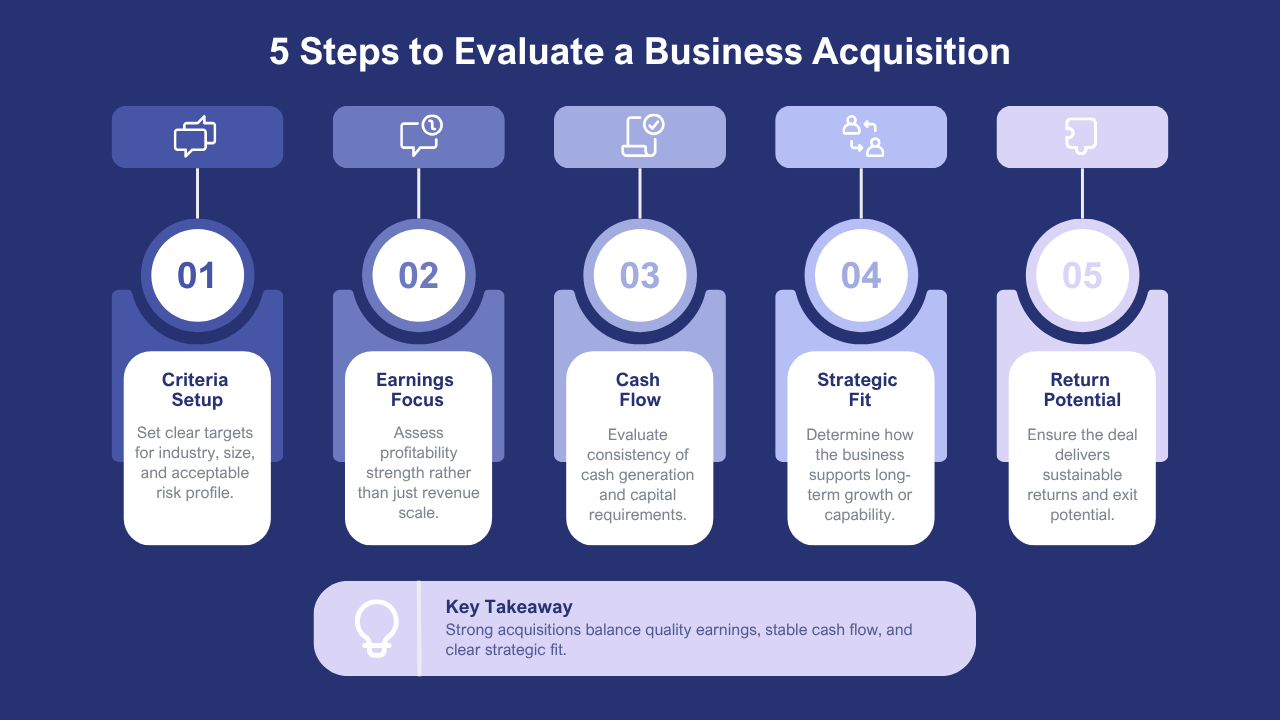
The acquisition assessment workflow
The Acquisition Strategy assessment process from acquisition interest is systematic. Knowing where the key decisions are made – and the typical reason for failure – is a useful point of reference for a first-time buyer or advisor.
Phase 1 | Phase 2 | Phase 3 | Phase 4 |
Strategic Screening | Financial Due Diligence | Operational & Legal DD | Risk Pricing & Close |
Apply Acquisition Strategy criteria; review information memorandum; conduct preliminary Financial Risk Analysis; submit non-binding indicative offer contingent on due diligence; negotiate heads of terms | Independent reconstruction of normalised EBITDA; Cash Flow Risk Review; working capital assessment; tax compliance review; review of management accounts vs. statutory financials | Operational Risk Assessment of management, processes, and systems; complete Due Diligence Checklist for contracts, IP, leases, licences; legal review of all material agreements and contingent liabilities | Quantify all identified Valuation and Risk Factors; negotiate price adjustments, warranties, and earnout structure; finalise Investment Risk Evaluation; complete transaction documents and settle |
Case 1: When financial risk is underweighted
A buyer purchased a logistics company following a due diligence review of the past three years of annual accounts, but did not include a Cash Flow Risk Review of the working capital cycle. After the acquisition, the buyer found that the business needed $600,000 in working capital injections for the first six months to sustain operations while reconciling the difference between the payment terms for suppliers (30 days) and for customers (90 days), a structural cash flow issue that had been funded by the vendor from personal funds rather than from cash generated by the business. The Financial Risk Analysis process had looked at profit but not at cash. The business had been valued at a price-to-earnings ratio, without consideration of the additional capital needed to meet its working capital requirements. The lesson: quality of earnings analysis must include a Cash Flow Risk Review.
Case 2: Licence risk discovered late
A healthcare services business was acquired in a deal that included a cost-cutting shortcut in legal due diligence. After the transaction, the buyer realised that the key licence for the business was held in the vendor’s name (not the entity) and had to be reapplied for, a process that took eight months and effectively shut down two of the business’s five lines of operation. The Operational Risk Assessment did not specifically address the transferability of licenses, and the Due Diligence Checklist used by the buyer’s advisors did not include a regulatory licence mapping exercise. The costs of the remedial action, including lost income during the suspension period, were more than a tenfold increase over what was saved through legal due diligence.
Common buyer risk errors — summary reference
Risk Category | What Buyers Miss | Consequence | Prevention |
Financial Risk Analysis | Related-party transactions; undocumented owner add-backs; deferred maintenance costs not capitalised in accounts | Normalised EBITDA overstated; post-acquisition earnings below acquisition model | Independent EBITDA reconstruction from source documents; sell-side quality-of-earnings review, if available |
Cash Flow Risk Review | Working capital cycle; seasonal cash requirements; debtor ageing; customer payment terms vs. supplier terms | Unexpected post-acquisition cash calls; working capital shortfalls impacting operations | Model monthly cash flows alongside EBITDA; request aged debtor and creditor schedules; review the last 12 months of bank statements |
Operational Risk Assessment | Key-person dependency; undocumented processes; IT infrastructure age; staff entitlement liabilities | Performance deteriorates post-acquisition; key staff leave; integration costs exceed budget | Conduct management interviews; request organisational chart and role descriptions; assess leave liability balances |
Legal / Due Diligence Checklist | Licence transferability; lease change-of-control clauses; IP ownership gaps; employment claims | Material disruption to operations post-completion; unplanned remediation costs; price renegotiation after completion | Engage sector-specialist legal advisors; complete a licence and permit register as a standard due diligence deliverable. |
6. Conclusion
Successful Business Acquisition Australia is not based on luck, but on process. Predefined Buyer Decision Criteria, independent Financial Risk Analysis, comprehensive Operational Risk Review and a full legal Due Diligence Checklist are not “value added” measures that can be afforded or ignored but are the minimum requirements for a buyer who wants to preserve capital and achieve the return that was justified by the purchase price.
For buyers: pay for due diligence commensurate with the capital at risk; treat the Cash Flow Risk Review like an EBITDA analysis; and ensure each identified risk is offset by a specific protection. For advisors: your most valuable service is not making the deal – it is helping the buyer know what they are buying.
Frequently Asked Questions
Q1. What should buyers consider before purchasing a business?
Buyers should evaluate financial performance, legal obligations, operations, market position, growth potential, and business risks before completing a purchase.
Q2. Why is business valuation important when buying a business?
A professional valuation helps buyers determine whether the asking price reflects the business’s fair market value and future earning potential.
Q3. What role does due diligence play?
Due diligence verifies financial information, identifies risks, reviews legal matters, and helps buyers make informed acquisition decisions.
Q4. Who should obtain professional advice during a business purchase?
Buyers should work with valuation professionals, accountants, legal advisors, and financial consultants throughout the acquisition process.
Q5. How does careful planning improve acquisition outcomes?
Thorough planning reduces transaction risks, supports better negotiations, and increases the likelihood of a successful business acquisition.