

Table of Content
1. Introduction: Business for a Strategic Sale
A strategic sale is radically different from a regular business sale. Where a financial buyer, a private equity firm or an independent investor prices a business based primarily on what the business can do, the customers it will attract, the capabilities it will provide, the market position it will accelerate, and the competitive threat it will eliminate. This difference has severe implications for the way businesses ought to be prepared. Strategic Exit Planning does not merely consist of cleaning up the financials and making the business look its best – it is about knowing which particular buyers will find the business most strategically valuable and preparing the business to tell that story credibly.
Business Sale Preparation in the strategic arena also demands a longer preparation horizon than most owners care to acknowledge. The organisational changes that precondition a high-quality strategic performance, increasing the depth of management, formalising customer relationships, reducing dependency of the owner, aligning the product or service roadmap with new buyer priorities, all require time, which is simply not available when the preparation process is initiated under the pressure of a transaction. The businesses that have always thought about the strategic exit they want, and the preparation they need to achieve it, two or more years before they go to market, are the ones where the owner started thinking about the result they want, and what preparation they need to make it happen, two or more years before they go to market.
This guide is intended for business owners who intend to make a strategic exit sometime in the future, and for advisors assisting them in preparing the plan. It addresses the most important aspects of M&A Readiness, the five most significant preparation steps that most owners can undertake in an 18 to 24-month time frame, the specific issues that arise during strategic preparation and the practical lessons that should guide the differences between well-prepared businesses and those that fail to reach their potential at the time of sale.
2. What M&A Readiness Actually Means for a Strategic Sale
Strategic buyers see the business different.ly
Unlike financial buyers, strategic acquirers view a target through an analytical prism. They are not mainly asking whether the business is producing an adequate return on capital at the price of acquisition – they are asking whether the owning of this business is making their own organisation more competitive, more complete, or better placed to compete in the market in which they are competing. M&A Readiness to a strategic sale therefore entails not only knowing what the business is worth on a standalone basis, but what it is worth to certain strategic buyers – and what preparation makes such strategic value more visible and more defensible.
- Strategic buyers will pay a premium based on capabilities, customer relationships, or market positions that they cannot create in a reasonable timeframe – premium value comes not just from earnings, but from scarcity.
- The information memorandum prepared in relation to the strategic process must be framed in terms of a strategic value proposition, rather than simply financial performance: why this business, for this buyer, at this moment in the market.
- Transaction Planning for a strategic exit requires mapping the most likely acquirer categories and understanding each acquirer’s strategic priorities before preparing any marketing materials.
The distinction between M&A Readiness and cosmetic preparation
M&A Readiness is a condition of bona fide operational and financial health — not a collection of documents that have been assembled to provide an impression. Strategic purchasers that move to detailed due diligence will impose a high level of scrutiny on each statement in the information memorandum, and any discrepancy between the story being told and the evidence provided will be detected and priced against the seller. The preparation that comprises authentic M&A Readiness is structural: it alters the way the business functions, not merely the way it is described.
3. Financial and Operational Foundations of Sale Readiness
Financial Clean-Up: making the earnings credible
The most time-sensitive basis for any sale preparation programme is Financial Clean-Up. It covers the reconciliation of three years of financial statements to tax returns, the documentation and evidence for owner add-backs, the removal of personal expenses from the business P&L, and the provision of monthly detail that the buyer must have to understand trading patterns and quality of earnings. Buyers facing financials that must be rebuilt on a large scale before they can be analysed apply a credibility discount to all the rest that the seller presents.
- Three years of reconciled financial statements, each normalisation add-back recorded and evidenced before commencement of buyer engagement.
- The current-year management accounts include monthly profit and loss and an easy transition to the prior-year comparative.
- ATO compliance up to date: signed tax returns have been lodged, BAS is up to date, and there are no outstanding disputes or undisclosed positions.
Operational Optimisation: building the case for continuity
Pre-strategic sale Operational Optimisation is designed to achieve two objectives simultaneously. It boosts the operational risk discount that buyers place on businesses that are dependent on the founder, or that lack documented processes – and it shows strategic buyers that the business is integration-ready. A business whose operations have been systematised, whose key processes are documented, and whose management team can operate independently is not only easier to acquire but also easier to integrate, two qualities which strategic buyers place a premium on when comparing alternative targets.
The specific areas of focus of Operational Optimisation will depend on the nature of the business. Still, three elements are always applicable: the relocation of key relationships between the owner and key clients and suppliers to the team, the documentation of the core operations of the business in a format accessible to the integration team of a new owner, and the implementation of management reporting that will give a buyer confidence in the post-completion performance monitoring capabilities of the business.
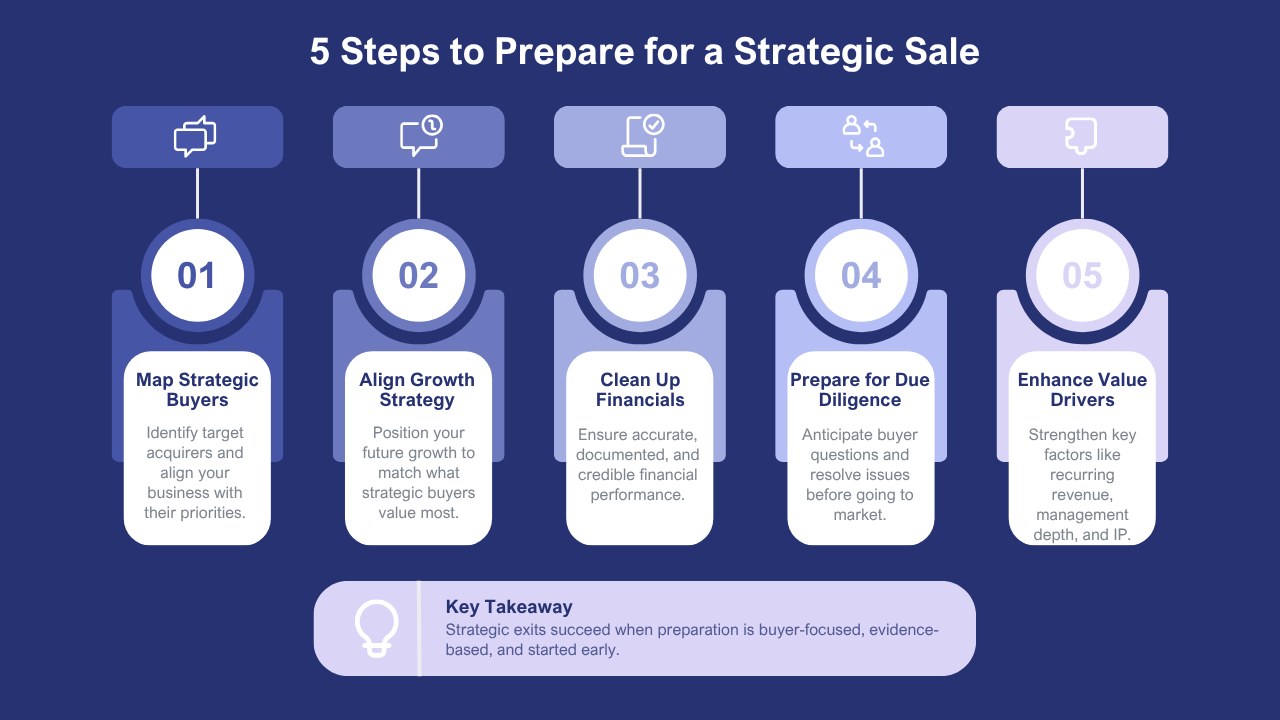
4. Five Steps to Preparing for a Strategic Sale
The best-paying preparation procedures for a strategic exit are those that also address the valuation the business will fetch and the ease with which the acquirer can complete and integrate the transaction. These five steps outline the priorities that experienced advisors use in an 18 to 24-month Strategic Exit Planning programme.
Step | What It Involves | Strategic Impact | Timing |
1. Transaction Planning: map the buyer universe | Identify the three to five most likely strategic acquirer categories; understand each acquirer’s strategic priorities, recent M&A activity, and capability gaps; assess which specific attributes of the business are most strategically valuable to each category | Determines how the business should be positioned and which preparation investments will resonate most with the most likely buyers; avoids generic preparation that addresses no buyer specifically | Immediately: this analysis should precede all other preparation decisions |
2. Growth Strategy Alignment: connect the business’s trajectory to buyer priorities | Ensure the business’s forward strategy is aligned with the growth opportunities that strategic buyers in the target acquirer categories are pursuing; document and substantiate the growth narrative with evidence | Justifies a premium multiple by demonstrating that the business’s trajectory compounds within the acquirer’s strategic context; allows the buyer to model upside with confidence | 6–18 months: requires strategic decisions that take time to demonstrate |
3. Financial Clean-Up and quality-of-earnings preparation | Complete the EBITDA normalisation schedule with documented evidence for each add-back; commission a sell-side quality-of-earnings analysis; ensure three years of clean, reconciled financial records are available | Removes the single most common source of price erosion in due diligence; gives the buyer’s advisors a pre-prepared framework for the financial analysis that establishes the seller’s normalisation as the starting point | 3–12 months: immediate actions possible; some structural changes require time |
4. Due Diligence Preparation: Anticipate and answer the buyer’s questions | Conduct a vendor due diligence exercise covering financial, legal, operational, and commercial dimensions; build and populate a virtual data room; identify and proactively address all issues that a motivated buyer will discover | Accelerates the transaction timeline; reduces buyer’s perceived risk; prevents price chips that are disproportionate to the actual magnitude of the issues discovered | 6–12 months before going to market: data room built and tested before any buyer sees it |
5. Value Enhancement Strategy: invest in the drivers that move the multiple | Identify the specific value drivers that will move the business from the middle to the top of the acquirer’s valuation range: recurring revenue conversion, management independence, IP formalisation, or customer diversification | Each value driver addressed adds a measurable multiple premium; the preparation investment is almost always returned many times over in the final transaction price | 12–24 months: structural changes take the longest; begin immediately for maximum impact |
Step 1 – buyer mapping – Transaction Planning – is the step that most fundamentally influences the preparation programme. All other preparation is generic, without knowledge of what buyers are most likely to purchase or what they want to purchase. A business whose three most likely strategic acquirer categories are identified, the recent acquisition activity of those acquirers is mapped, and the business is prepared with specific attributes that each acquirer will prioritise, will always achieve better results than a business prepared to generic standards. This analysis will not take months but days, and whatever results it yields should inform every other decision the preparation programme makes.
5. Process, Real Cases, and Lessons for Advisors
The strategic preparation workflow
In preparation for a strategic exit, Business Sale Preparation is a formal multi-phase programme, not a checklist to be completed in the final weeks before marketing. The following four-phase workflow is how experienced M&A advisors arrange the preparation timeline for owners with 18 to 24 months before their target sale.
Phase 1(Months 1–3) | Phase 2(Months 3–12) | Phase 3(Months 12–18) | Phase 4(Months 18–24) |
Strategy & Baseline | Value Enhancement | Buyer Readiness | Strategic Sale Process |
Transaction Planning and buyer mapping; current-state baseline assessment; commission independent valuation; identify the top three value gaps; begin Financial Clean-Up and Earnings Normalisation documentation | Implement Value Enhancement Strategy priorities: recurring revenue conversion, management transition, customer diversification; Growth Strategy Alignment with buyer priorities; Operational Optimisation and process documentation | Buyer Readiness Preparation: sell-side quality-of-earnings completed; virtual data room built and populated; Due Diligence Preparation across all workstreams; updated valuation reflecting preparation improvements | Information memorandum prepared and aligned to strategic buyer narrative; M&A Readiness confirmed; controlled auction or targeted outreach commenced; Transaction Planning completed; deal negotiation and close |
Case 1: Buyer mapping changes the preparation priorities
A technology services company started its Strategic Exit Planning with a generic preparation programme centred on financial clean-up and management documentation – the standard approach. A formal buyer mapping exercise that an advisor implemented identified that the three most credible categories of acquirers, which included large professional services firms, platform technology companies, and privately-backed consolidators, each prioritised various attributes. The PE-based consolidators were more concerned with management independence and scalable processes. The technology companies that owned the proprietary process and the clientele in a given vertical were the main targets of the platform technology companies. The more important factors for professional services firms were the quality of headcount and the non-compete provisions for key employees. The analysis of the Transaction Planning shifted the resources of preparation out of a general operational improvement programme and into three specific initiatives, namely, methodology documentation, vertical client contract formalisation, and senior employee retention agreements, all of which directly addressed a priority of the buyer category that was most likely to pay a premium. The result was a sale to a platform technology acquirer at approximately 1.8x the price a generic buyer would have paid to acquire the same business.
Case 2: Due Diligence Preparation as a deal accelerator
An advisory firm was hired by a healthcare services business to conduct a comprehensive Due Diligence Preparation exercise 14 months before it was to be strategically sold. The vendor due diligence found seven matters: two customer contracts, which contained assignment clauses that required the consent of any counterparty, one lease, which contained a change-of-control clause and which required the consent of any counterparty, an IP licensing arrangement that had lapsed, a key employee with no such formal employment contract, and two positions with the ATO, which had not been formally settled. All of the issues were solved within the next 10 months. Once the business went to market and a strategic buyer began their due diligence, the team could respond to every request within 48 hours, with the requests pre-populated in a data room. The due diligence period of the buyer was fulfilled in six weeks instead of the usual 10 to 14 weeks – a period that the buyer specifically quoted as a reason for his willingness to meet the price expectations of the seller. Buyer Readiness Preparation not only minimises price risk but also completion risk.
6. Conclusion
Strategic selling of a business is a programme, not a project. Strategic Exit Planning done with a two-year horizon always yields better results than preparation rushed into the six months lead up to going to market – because the changes that most matter to strategic buyers take time: Growth Strategy Alignment, management independence, Operational Optimisation and Value Enhancement Strategy each require sustained investment that cannot be squeezed into weeks. Those businesses whose owners started preparing much earlier than they had to are the ones able to achieve the best strategic exits.
To owners: start with the Transaction Planning exercise – map your probable strategic buyers, figure out their priorities, and have that analysis guide every preparation investment that you make. To advisors: the engagement that creates the most value is not the one you initiate when the client is ready to sell; it is the one you begin 18 to 24 months ago, when there is still time to do the work that actually changes things. M&A Readiness is a developed, not proclaimed, concept.
Frequently Asked Questions
Q1. What is a strategic sale or acquisition?
A strategic sale or acquisition involves buying or selling a business to achieve long-term growth, expand market share, or create operational synergies.
Q2. Why is preparation important before a transaction?
Proper preparation improves business readiness, reduces transaction risks, and increases the likelihood of achieving a favourable deal.
Q3. What areas should businesses prepare?
Businesses should review financial performance, operational processes, legal compliance, customer relationships, and key intangible assets before a transaction.
Q4. Who should assist during transaction preparation?
Business owners should work with valuation experts, accountants, legal advisers, and corporate finance professionals.
Q5. How does preparation improve transaction value?
Well-prepared businesses demonstrate lower risk, stronger growth potential, and greater operational stability, making them more attractive to buyers.