

Table of Content
1. Introduction: Intangible Assets
Most business owners are asked what their business is worth, and they refer to the profit and loss statement. A savvy consumer who has purchased different products would answer the same question differently, by referring to something less visible: the business’s reputation, the customer relationship that no longer needs to be resold, the proprietary processes that rivals can hardly replicate, and the team’s and systems’ knowledge. They are Intangible Asset Value components, the Non-Physical Asset Value that tops and exceeds the earnings that a business generates and in most modern business transactions, they constitute the largest portion of the price paid.
The Knowledge of Intangible Asset Value is one of the most commercially important areas of knowledge for business owners preparing to sell their businesses. The difference between a business that sells a commodity at a multiple, and one that fetches a Business Sale Premium, is nearly always explained by intangibles: stronger brand recognition, higher Customer Loyalty Value, more defensible intellectual property, or a Goodwill Contribution which is much more reflective of the actual market positioning than merely the residual after tangible assets are priced. These are not mushy ideas; they can be measured, documented and have a direct impact on the ultimate price of the transaction.
This article explains how Intangible Asset Value can determine the price of a business sale in the Australian market, what categories of intangibles carry the most weight with buyers, how to identify and document them before taking them to market and what the practical steps are to turn intangible strengths into Valuation Uplift Drivers that will hold up under the scrutiny of business due diligence. The frameworks here are how the most advanced buyers and sellers consider the value that lives off the balance sheet.
2. Why Intangibles Drive Sale Price — Not Just Earnings
The gap between book value and transaction price
The price paid in virtually any business transaction (other than a government transaction) is nearly always greater than the net tangible assets of the business. That excess, the pricing of the Non-Physical Asset Value that the business has, is determined by the market. To buyers, paying a price that is above the tangible asset value does not make the decision irrational; it is simply the recognition that the earnings that the business is going to generate, and will continue to generate, are a source that is not going to appear on the balance sheet.
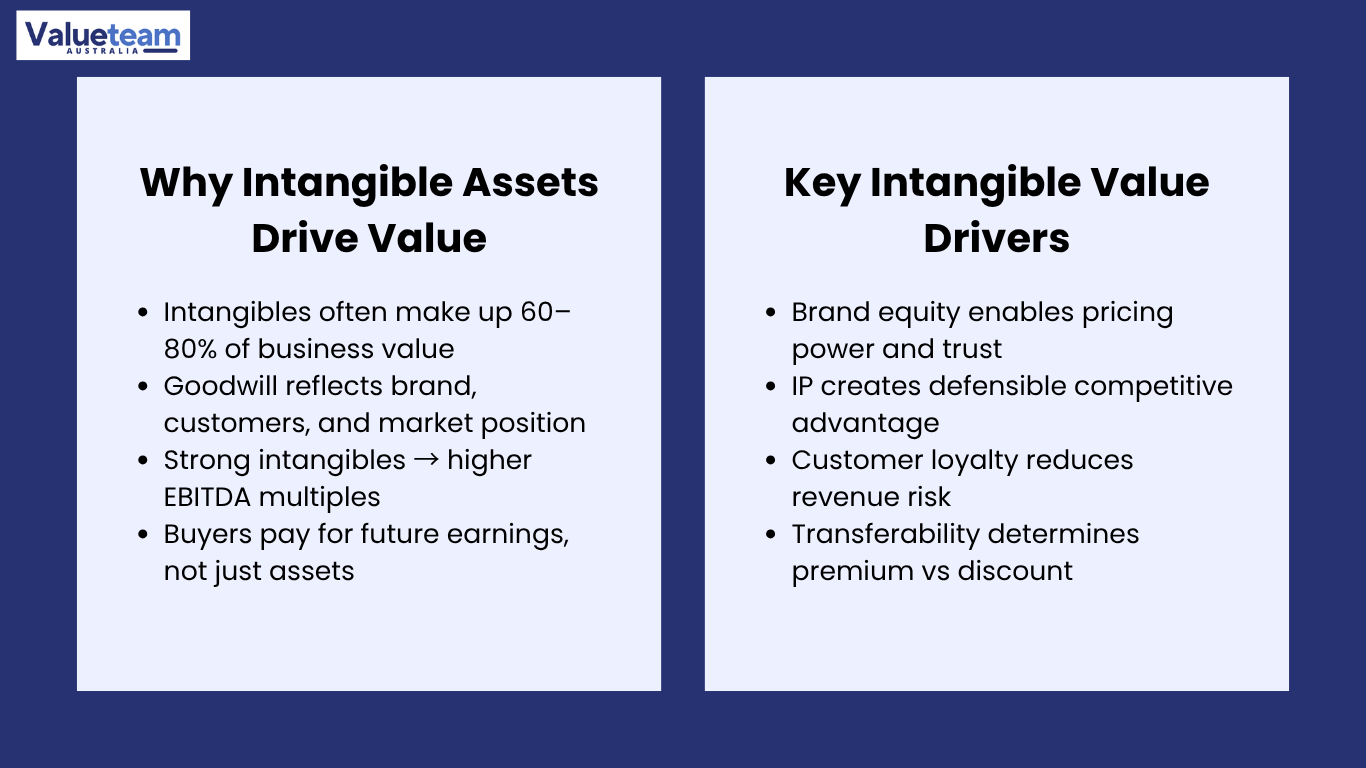
- The collective value of customer relationships, brand positioning, assembled workforce capability, and market position that a buyer is acquiring in conjunction with the physical and financial assets is termed the Goodwill Contribution in a transaction.
- Correlations between high Intangible Asset Value and high EBITDA multiples are commonplace even when reported earnings are equal.
- Intangibles often constitute 60 to 80 per cent of the overall value of the transaction – identification and documentation of intangibles is a primary, not a secondary, exercise in valuation.
How buyers assess Intangible Asset Value
Advanced purchasers and their agents will systematically, rather than intuitively, treat Intangible Asset Value. They particularly determine whether the intangibles are institutional and transferable: whether the brand reputation is institutional or personal to the owner, whether the customer relationships are institutional or informal, and whether the intellectual property is legally protected or simply a practice that a competitor could replicate. Intangibles that are real and transferable attract premium prices; those that are personal to the founder or undocumented are highly discounted or out of the deal altogether.
3. The Key Intangible Categories That Drive Business Sale Premium
Brand Equity Impact: the pricing power of reputation
The impact of Brand Equity in a transaction context is the quantifiable difference that a recognised, trusted brand makes to a business’s ability to attract customers, charge premium prices, and maintain relationships without ongoing reinvestment in acquisition. A good brand, to buyers, makes the cost and uncertainty of sustaining revenue (which is directly translated into a lower risk premium and a higher multiple) less expensive and less uncertain.
- Institutional brand equity, which is held by the business entity rather than the individual founder, is transferable and thus fully valued in a transaction.
- Measurable indications of brand strength: Net Promoter Score, unprompted awareness research, pricing premium over unbranded alternatives, or customer acquisition costs trends over time.
Intellectual Property Value and Competitive Advantage Assets
Intellectual Property Value includes registered patents, trademarks, copyrights, proprietary software, and trade secrets that generate a defendable competitive position. The most important question that the buyers ask is whether the IP poses a real barrier to the competition – and whether the barrier is legally secured, owned clearly by the institution, and can be transferred to a new owner. Competitive Advantage Assets that are not legally registered or documented as such, but instead personally registered, documented, and institutionalised, are weaker in providing valuation support than those that are formally documented and institutionalised.
- The most directly valued types of Intellectual Property Value are registered trademarks, entity-owned patents, and formally documented proprietary methodologies.
- Competitive Advantage Assets that lower the capex a buyer will incur after acquisition include proprietary software platforms and automated processes that reduce the cost of delivering the product or service.
Customer Loyalty Value: the commercial weight of retention
One of the most consistently misunderstood factors contributing to the Business Sale Premium is Customer Loyalty Value. Owners are usually concerned with customer satisfaction; buyers with customer retention – that is, with the data that will prove the likelihood of the customer base continuing to buy after the ownership transition. High Customer Loyalty Value, as reflected in retention rates, contract renewal history, and NPS data, mitigates the most fundamental risk the buyer will face following the acquisition: that the business they have purchased will not be able to generate the revenues to which they have underwritten.
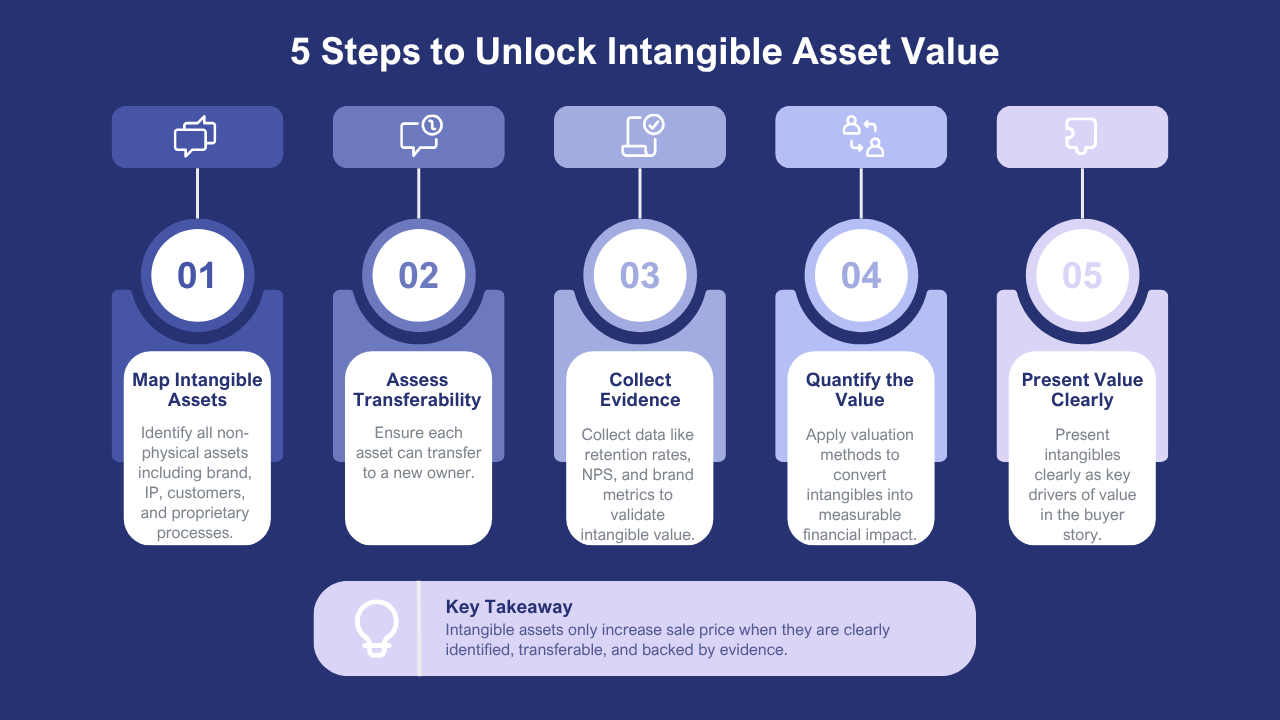
4. Five Steps to Identify, Document, and Present Intangible Value
What is most often heard in the failure of Intangible Asset Value to translate into Business Sale Premium is not that the intangibles are not there, but that they are not identified, documented, and presented in a manner that can withstand buyer scrutiny. The following five steps echo how experienced advisors make the intangible value identification process look in a pre-sale setting.
Step | What It Involves | Valuation Uplift Drivers Created | Common Failure Mode |
1. Map all intangible assets | Systematically identify every category of Non-Physical Asset Value in the business: brand, IP, customer relationships, proprietary processes, assembled workforce, market licences, and data assets | Ensures no material intangible is left out of the buyer narrative; creates the inventory on which documentation and valuation are based | Sellers focus on the obvious intangibles (brand, registered IP) and miss the less visible ones (proprietary operational methodology, unique supplier relationships, data assets) |
2. Assess transferability | For each identified intangible, assess whether it is genuinely transferable to a new owner: is the brand tied to the founder’s identity? Are customer relationships contractual or informal? Is the IP legally registered in the entity’s name? | Only transferable intangibles support Business Sale Premium; non-transferable intangibles must be addressed before marketing or disclosed with a mitigation plan | Sellers present intangibles as valuable without assessing whether they transfer; buyers discover the non-transferability during due diligence and use it as a price chip |
3. Gather evidence | Assemble the data that supports each intangible claim: retention rates and NPS for Customer Loyalty Value; royalty benchmarks for Intellectual Property Value; brand recognition research for Brand Equity Impact | Evidence converts assertions into defensible positions; buyers who can verify intangible claims are more confident in paying a premium for them | Intangible value is asserted in the information memorandum without supporting data; buyers cannot verify the claims and apply a conservative discount rather than a premium |
4. Quantify where possible | Apply recognised valuation approaches to material intangibles: relief-from-royalty for brand and IP; multi-period excess earnings for customer relationships; cost-to-recreate for proprietary systems | Creates a specific, documented Valuation Uplift Drivers analysis that anchors the negotiation around the intangible premium rather than leaving it as a qualitative assertion | Sellers rely on a general narrative about intangible strength without any quantification; buyers fill the vacuum with their own (conservative) estimates |
5. Present as part of the sale narrative | Integrate the intangible value analysis into the information memorandum; connect each intangible to a specific commercial outcome (lower customer acquisition cost, pricing premium, reduced capex); frame Exit Price Maximisation around the sum of tangible and intangible value. | Shapes the buyer’s analytical framework from the outset; buyers who receive a well-prepared intangible analysis are more likely to offer at the top of the valuation range. | Intangible value is buried in the appendices or mentioned as an afterthought rather than positioned as a central driver of the business’s commercial strength. |
Step 2 – evaluating transferability – is the most frequently omitted step in pre-sale intangible analysis, and the omission is always costly. Buyers apply a test to all intangibles they encounter: Will this asset yield the same economic benefit in our hands as it did in the seller’s? If the answer is no (because the brand is associated with the founder’s personal profile) or if the relationship between the buyer and the seller is not formalised, the buyer will price it accordingly. By detecting and eliminating transferability gaps before the sale process, much more value is preserved than by negotiating the deal after the offer has been made.
5. Process, Real Cases, and Lessons for Owners and Advisors
The intangible value documentation workflow
To construct the Intangible Asset Value case for a sale, there must be a structured, parallel process to the financial preparation work. The following four-stage workflow reflects the process of intangible value recognition implemented by experienced advisors within the general scope of the pre-sale preparation programme.
Phase 1 | Phase 2 | Phase 3 | Phase 4 |
Intangible Asset Audit | Evidence Gathering | Quantification & Valuation | Narrative Integration |
Map all intangible asset categories; assess transferability of each; identify documentation gaps; prioritise based on likely impact on Business Sale Premium | Compile retention and NPS data for Customer Loyalty Value; secure IP registrations in entity name; gather brand recognition evidence; document proprietary processes formally | Apply recognised valuation methods to material intangibles; prepare the Valuation Uplift Drivers schedule; commission an independent intangible valuation where the quantum justifies it | Integrate intangible analysis into the information memorandum; connect each Goodwill Contribution and Competitive Advantage Asset to a specific commercial outcome; position Exit Price Maximisation case for buyers |
Case 1: Brand equity that almost went unpriced
A consumer healthcare company is to be sold, with an initial information memorandum that addressed only financial performance. The business had a brand it had developed over 18 years, a consistent price premium of about 22 per cent over non-branded alternatives in the category, and repeat purchase rates much higher than the sector average. None of it was measured or reported; it was presented as background information. The opening bid price was a typical multiple of earnings, and there was no brand premium. Upon resubmission of the analysis along with the current financial documents, the buyer came back with a new offer about 900,000 higher than the previous one. The intangible value was present in the initial offer; it had just been invisible because it had not been quantified.
Case 2: Intellectual Property Value that required protection.
An onboarding technology services business had established a proprietary onboarding methodology in six years of iterative client work. The methodology was truly differentiated – competitors could not replicate it without similar investment, but it had never been formally documented or patented. The Intellectual Property Value was in the heads of three senior consultants and in a set of presentation decks. After the strategic buyer showed interest and their legal team reviewed the IP position, they assessed the IP as having low standalone value and concluded that the methodology could not be protectable in its current form. The seller’s team took four months to formally document the methodology, copyright-protect the documentation, and create a client-facing certification programme that demonstrated the methodology’s unique structure. The updated IP position, presented to the buyer with revised documentation, was accepted as a material intangible asset, and the Non-Physical Asset Value assigned to it in the final purchase price was approximately 650,000. The documentation work project is estimated to cost around 45,000.
6. Conclusion
The Intangible Asset Value is not a fluffy concept reserved for big consumer brands or technology firms. It can be found in practically all businesses that have developed a real market presence, customer loyalty, proprietary capabilities, or a reputation that influences buyer behaviour. The difference between a business that implements a commodity exit and one that implements Exit Price Maximisation is nearly always explained by how well those intangibles were identified, documented, transferred and presented. Each of these is quantifiable, each is documentable, and each is capable of being presented as a Valuation Uplift Drivers case, which a buyer can review and use for due diligence.
To owners: begin the intangible asset audit immediately – before a buyer is present in the room. To advisors: the most useful pre-sale service you can offer is to help clients see the Non-Physical Asset Value they have created but never quantified, and to build the evidence base that will enable buyers to pay them with confidence. The discrepancy between a business’s value and the achievement of a sale is virtually always an evidence gap, rather than a value gap.
Frequently Asked Questions
Q1. What are intangible assets?
Intangible assets are non-physical assets such as brands, patents, software, customer relationships, trademarks, and proprietary technology that contribute to business value.
Q2. Why do intangible assets increase business value?
They generate future economic benefits, strengthen competitive advantages, and often represent significant value beyond tangible assets.
Q3. Which intangible assets are most valuable?
Strong brands, loyal customer relationships, intellectual property, proprietary software, and long-term contracts are commonly valuable intangible assets.
Q4. Why should sellers identify intangible assets?
Clearly identifying intangible assets helps buyers understand the company’s true value and supports higher transaction pricing.
Q5. How does professional valuation help?
Professional valuers identify, measure, and document intangible assets using recognised methodologies to support business sales.