

Why Do Companies Need Different Types of Valuation?
At some point, all companies ask themselves the following question: What’s this business worth? The answer varies based upon the purpose of the question. Value comes in many different lenses and one number will not fit all the times. Knowing the different types of valuations is critical to any finance, accounting, or corporate advisory professional and is a very common question at job interviews. The knowledge of when to apply an income based approach or a market-based approach or an asset based approach is a skill that is not just theoretical but has to be learned as a professional, whether you’re a junior or mid-level professional or you’re interviewing for a job that requires the application of income or market or asset based approach. It discusses the various types of valuation that are used by companies and how they can be implemented through a valuation advisory service, and what it means for a business valuation expert to ensure that the results are defensible, compliant, and useful for decision-making – with real examples, a short step-by-step process, and a few lessons that only come up when a valuation is actually used to inform a decision.
What Are the Different Types of Valuation Companies Use?
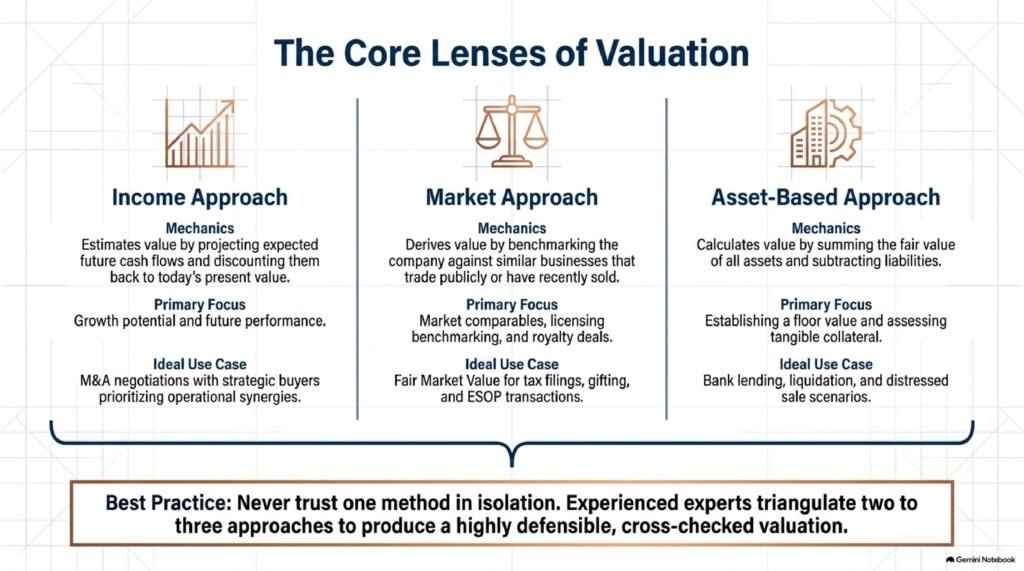
Companies don’t apply one valuation to all things, as value varies based on context. In general, there are three families of valuation: the income approach, which is the value calculated from the present values of the asset’s future cash flows; the market approach which is the value of a company based on comparable businesses that have recently sold or are publicly traded; and the asset-based approach, which is the sum of the assets’ fair value minus the fair value of the liabilities. In addition, there are a variety of more specialized types, such as valuations for financial reporting, tax planning, litigation, and employee stock ownership plans. They each have their own specific use, and one professional who is familiar with one approach will find it difficult when it comes time to take on a new assignment, since the data, assumptions and even the level of documentation required can vary significantly from one engagement to the next. Where a valuation is used for internal strategic planning, for example, it may be based on management’s own projections and forecasts that may have been less rigorously vetted or adjusted, but where a valuation is prepared for a court hearing, this should involve careful examination and in some cases, a revision of the same projections and forecasts. In this area, PPA valuation methods come into play; after the acquisition, purchase price allocation adds to the standard methods, with accounting principles applied in the same way as anywhere else, but with tools that are specific to PPA. In regulated industries, several of these specialized valuations eventually culminate into a larger corporate compliance solution that involves ongoing compliance, not just during a transaction so the role of valuation is often more of a recurring discipline rather than a one-time output.
The method seldom is chosen just for the sake of it; it depends on the reason for the engagement, the level of value that is being sought, and the audience that will read the report. A valuation done for a bank will focus on the value of the collateral as well as the liquidation value of the company, a strategic buyer will focus on synergies and growth potential, and a tax authority will focus on the fair market value of the company in the strict, well-precedented standard. Companies that provide valuation advisory services usually take clients through this step early in the process – before any models are completed – as it wastes time and leads to a number that no one can trust. This is often the first true lesson that early career professionals learn: technical modeling skills are not the most important thing to understand; what’s most important is understanding “why” the valuation is being requested in the first place, knowledge that is usually first gained from working closely with business valuation experts on a client engagement rather than reading about it in a manual. A lot of people learn this through structured valuation courses, not from doing it on a live engagement, and firms which invest in this sort of training seem to have analysts which move the center of the engagement types with very little hand holding, as they realize how the intent of an engagement changes the questions they ought to ask at the get go.
Why Do Different Types of Valuation Matter in PPA and Compliance?
There are many examples of the intermingling of different valuations types, but one of the easiest is purchase price allocation. In the United States, the accounting standard is ASC 805 and internationally it is IFRS 3; in both cases, when one company acquires another, they split the purchase price into identifiable tangible assets, intangible assets like customer relationships, trademarks, and technology, and then goodwill, which is defined as the difference between the purchase price and the sum of the net assets. This distinction is important because the amortization of tangible and intangible assets differ and because goodwill is not amortized but is instead tested annually for impairment, the initial allocation will have a lasting impact on the earnings of the acquirer for years to come. PPA valuation methods are based on multiple disciplines: the income approach is based on the value of customer relationships and technology, as well as projected cash flows; the cost approach is based on the value of items such as fixed assets and internally developed software; and the market approach is based on intangible royalty rates compared to similar licensing deals. The most contentious aspect of the process is the useful life of the intangible asset; the longer the useful life, the more likely the asset was overvalued in the first place and the more likely it will be debatable with auditors in the near future in regards to the use of a shorter life. Some analysts may begin with a separate course in valuation that concentrates specifically on PPA mechanics and only then move onto a live valuation, hence the popularity of PPA valuation training courses for junior staff. A mistargeted allocation is not only a bookkeeping error, but it will alter future amortization, tax positions, and the impairment testing for years to come, which is precisely what valuation advisory services are designed to avoid.
This is where corporate compliance solutions come in handy in the context of valuation work. Market participants such as regulators, auditors and tax authorities will scrutinize valuations for their reasons and expect the assumptions to be documented, sourced and reasonable for the market conditions at the time. A company that takes the word “valuation” for granted is likely to face rework, audit issues and tax penalties years later when the numbers are reviewed, and rework is likely to be more costly at that point than to get the valuation right the first time. Business valuation experts knowledgeable about compliance-driven work construct models from the ground up with an audit trail, instead of having to figure out how to add one in after the fact when a regulator asks a pointed question about a discount rate or a growth assumption. Documenting all assumptions is a good practice to get into early in the job – auditors who are not familiar with the deal will have to defend their reasoning at the final day of the audit in 18 months – ideas and concepts that are documented are the ones that create a successful audit, not the ones that are stored in the memory of the analyst.
What Are the Five Key Steps in a Different Types of Valuation Engagement?
In most cases, the sequence of events for any of the types of valuation described above is similar, and having this sequence predetermined can often make the junior analyst appear prepared instead of reactive when making their first few client calls:
- Establish the purpose and level of value — each engagement begins by establishing the reason for the valuation and the specific legal/tax/corporate compliance solutions requirement, which will impact each subsequent step of the engagement.
- Compile and standardize financial information — analysts collect historical statements, projections, and market information, and adjust for one-time activities so that the figures show the performance of the company’s business, a task that can be honed through valuation hands-on courses, not just lectures.
- Choose the right strategy or strategies — is it income-based, market-based or asset-based, or a combination of all three? The team selects the best approach based on the purpose of the model, the industry, and the data quality; typically more than one is used to cross-check the results and identify any discrepancies from other assumptions.
- Construct the model and use the selected method — PPA valuation methods, discounted cash flow models or guideline company comparisons are actually built and tested for this transaction, typically in coordination with the services of valuation advisory firms that were specifically hired for the transaction.
- Document, review and issue the report — findings are documented, reviewed by second qualified professional and typically by a senior business valuation specialist at the firm before the final number is delivered to the client for review.
How Do Business Valuation Experts Apply Different Types of Valuation in Real Cases?
Let’s take a mid-size manufacturing firm called Meridian Industrial Group that is bought by a private equity firm and expanded in a new area. The finance team hired outside valuation advisory services after the deal closed for the purpose of preparing a Purchase Price Allocation in order to meet accounting and tax regulations. A team of business valuers was brought in to divide up the purchase price into working capital, equipment and machinery, a trained staff, contracts with customers, and goodwill. The contracts were valued on a modified income approach (based on retained revenue from existing customers and discounted to present value) and the machinery using a cost approach (adjusted for remaining useful life and depreciation). The delay of several weeks in the exercise was due to the fact that the target company’s records were of a mixed nature, combining personal and business expenses, a common problem in owner-managed companies, and this meant that the team had to carefully normalize the company’s profits before they could be confident in using any valuation method. A second issue arose when the team needed to estimate the costs of the workforce, which they had not been able to track separately for several years, and so they had to rebuild the data on recruiting and training costs. The junior members of the team later said the experience has taught them more in one month than any of the valuation training courses they’d attended before, but added that the courses have provided them with the language and structure with which to follow the speed of the live deal. In retrospect, the team found another sort of process change that should be implemented in future deals: discussing access to the data room and a checklist of normalizations with the seller’s accountants prior to the fieldwork would have saved nearly two weeks.
The second case study is a family run textile firm named Harlow & Voss Textiles, where two family members could not agree on the value of their shares because one wanted to sell out of the business. There was no sale to an outsider party and so the valuation could be based on hypothetical market conditions and a fair value standard set by company law in the jurisdiction rather than negotiated in the context of the transaction. The engagement included an income approach based on five years of normalized cash flow, while there was a market approach based on comparable private transactions within the same industry that were less influential due to the company’s stable client base. The two approaches were then weighted to determine the weighted average, which took into account that the income approach was more relevant to the company’s client base. Disagreements between the parties regarding the use of an appropriate market rent study for certain related party rent payments to a family trust for the company, which most textbooks don’t mention, but is a frequent area of contention in closely held companies, slowed the process and resulted in an independent study of the appropriate market rent to finally agree to the adjusted earnings amount. The lesson of this case and many others: There is no interchangeability of types of valuation; the number arrived at with one standard of value in a shareholder dispute might be technically correct in one standard, but legally wrong in another. And when it comes to shareholder disputes, business valuation experts are trained to spot these sorts of gaps.
Table: Different Types of Valuation and Their Common Uses
| Valuation Type | Primary Approach Used | Typical Use Case |
|---|---|---|
| Purchase Price Allocation | Income, Cost, Market | M&A accounting under ASC 805 / IFRS 3 |
| Fair Market Value | Income, Market | Tax filings, gifting, ESOP transactions |
| Fair Value (Litigation) | Income, Market | Shareholder disputes, divorce settlements |
| Liquidation Value | Asset-based | Bank lending, distressed sale scenarios |
| Strategic / Synergy Value | Income, Market | M&A negotiations with strategic buyers |
What Are the Benefits and Challenges of Different Types of Valuation?
With proper application, the various valuation methods that are within the company’s reach provide a credible benchmark for decision making for management, investors and regulators alike. A robust valuation can help give a company a negotiating edge when it wants to sell, it can be used to line up lenders when financing, and it can minimize the possibility of tax authorities seeking a valuation dispute, as well as ongoing corporate compliance solutions. Additionally, businesses that take the time to get the valuation advice right are more likely to be moving quickly during a transaction, since the process of due diligence has begun even before a deal is on the table – and buyers are less likely to negotiate prices when the underlying assumptions are already well documented. When a valuation is prepared or accepted by a third party, it offers the same level of confidence for investors and boards that outside advisory support is meant to do. For professionals, multiple valuations instill a diversified skill-set that can be applied across audit, corporate finance and advisory roles—hence the push from many firms to have staff undertake formal valuation training courses instead of just one for the project they are working on.
The challenges aren’t hypothetical, though. Often the most difficult challenge is data quality, particularly in private and family owned businesses where financial information includes personal and business transactions, and it is not uncommon for an analyst to spend more time cleaning up the historical data than actually modelling it. In niche businesses, market comparables may be limited and the choice of comparable becomes subject to judgment call which, if it’s made later, is subject to subsequent justification — sometimes by further expanding the universe of market comparables and making clearly-stated adjustments, rather than forcing a poor match. Also, standards keep evolving; accounting bodies regularly update their guidance that impacts the valuation of intangible assets, and experienced teams need continuous training in valuations to ensure that they are up to date on these changes instead of taking a valuation class early in their career. The best take away from repeated battles has been that any one method should not be relied on alone and that cross-checking between two or three methods is what makes the difference between a rough estimate and one that will stand up before an auditor, court or that type of corporate compliance solution that regulators are looking for.
Conclusion: Turning Different Types of Valuation Into a Career Advantage
There are various types of valuation because companies have different questions at different points of their life cycle, such as when they are seeking capital, when they have a dispute amongst shareholders, or when they are closing an acquisition. Knowing when to use an income approach, market approach, or an asset approach, and when PPA valuation methods fit into post-merger accounting, is a practical skill that will set capable CPAs apart from the ones who simply run templates without thinking of what the number is being used for. The actionable steps to take for anyone looking to pursue a career in this field are simple: Take advantage of valuation training courses to gain technical knowledge across a wide range of valuation methods, not too much, and not too soon; When possible, learn from experienced business valuation professionals through practice on live engagements, as judgment is more difficult to impart than technique; and document the work product as part and parcel of the deliverable – don’t skimp on documentation in the name of efficiency, as it is rarely an efficient process! Companies reap rewards from having their own team work with independent valuation advisers and a strong corporate compliance offering, so that each number they generate is defensible long after the report is signed – against an auditor, a regulator, a court, and even a prospective buyer.
1 thought on “Why Do Companies Need Different Types of Valuation?”