

How Does Business Valuation Support M&A Decisions?
No mergers or acquisitions are a failure, except in cases where the price, business combination or timing is wrong. Business Valuation Support M&A Decisions is a vital component of almost every stage of a deal. Valuation provides both a defensible and data-rich solution to the question of how much a business is worth, as well as how much risk lies within that figure, from the first meeting of the business’s managers until the final closing statement. A foundational understanding of valuation is essential for all investment bankers, M&A professionals, corporate development executives, and private equity professionals who are preparing to enter into the M&A, investment banking, corporate development, or private equity worlds, as it is the basis for negotiation, financing, and accounting in the post-deal phase. The article traces the evolution of valuation to support diligence, purchase price allocation of M&A deals after signing, the valuation approach to a household name change, the critical role of valuation of intangible assets and brand equity in M&A deals and lessons practitioners have learned from real transactions and near misses.
How Does Business Valuation Support M&A Decisions During Due Diligence?
The first point where a deal’s assumptions intersect with reality is the point of “due diligence” and that’s where Business Valuation Support M&A Decisions can become apparent. Buyers also order valuations before a term sheet is signed to determine if the seller’s asking price is based on sustainable revenue, working capital requirements and industry multiples or on a one-time revenue event or aggressive forecast based on a single strong quarter. Discounted cashflow models are constructed, precedent transactions are compared, public transactions are benchmarked, and the three approaches are then brought into a defensible range, not a single point estimate that appears to be a good prediction but is easily toppled. This range is the starting point for all future negotiation discussions that come later, and is typically the first deliverable a junior analyst is asked to stress test – changing the growth rates and discount rates, and the margin assumptions, until the model withstands questions and starts to look better and better, and, when the deal is closed, directly into M&A purchase price allocation. In the deal team, which generally consists of seniors, you’ll hear each line of the model challenged, and a model that can’t stand that challenge on its own has little chance of standing up to a skeptical counterparty, a lender’s credit committee, or a team of valuation advisors recruited to sanity check the numbers later in the process.
In addition to providing a price range, valuation during diligence can also identify risks that would not be apparent from a review of financial statements, like valuing intangibles like patents, software, or long-term customer contracts that are rarely found on a balance sheet at their full value. A very different valuation lens may be required when valuing a manufacturing firm with falling margins and a loyal, contractually guaranteed customer base versus a software company whose value resides essentially in its recurring subscription income and proprietary code. At this stage, working closely with the business valuation professionals ensures that deal teams avoid one-off adjustments in the accounts, or aggressive revenue recognition, and provides them with a common and defensible point of reference before the legal wheels start turning. One of the most frequent causes of deals going sour after they are done is improperly skipping this step—or rushing it to the deadline they set on themselves—but don’t do that, because it could result in a deal that needs repricing or even gets dropped entirely when the numbers are more carefully examined by the board or by the lender. Junior analysts who are able to recognize these red flags before or as a model is being developed are far more likely to gain the trust of senior bankers than colleagues who only work with a template.
Why Does M&A Purchase Price Allocation Matter for Business Valuation Support M&A Decisions?
Valuation work is not over after a transaction closes; indeed, the allocation of the purchase price in the deal will dictate how the purchase price will be allocated among the acquired assets and liabilities on the financials. Both US GAAP and IFRS require buyers to recognize tangible assets, identifiable intangible assets, and goodwill, with fair values to each category to be determined using valuation methods rather than an approximation. This exercise immediately impacts future depreciation and amortization expense, deferred tax accounting, and the analysis and interpretation of the acquirer’s financial statements for years to come. Business valuation experts are now commonplace at most mid-market and large-cap acquirers because the allocation is examined by auditors and regulators—and can significantly affect reported earnings from acquisition—so companies hire valuers of some sort, rather than depending on their internal finance teams, which may not have specialized experience or independence that the auditors and regulators are looking for. In many companies, the finance and deal teams will actually start working at the scope of this allocation weeks before the signing; this is so that, when the clock hits the regulatory filing deadlines, there are no surprises. The early-career mistake is getting the timing wrong: analysts who wait until they’ve closed to begin collecting the data for their allocation find that critical employees have already departed from the target firm, with the institutional knowledge that they took with them.
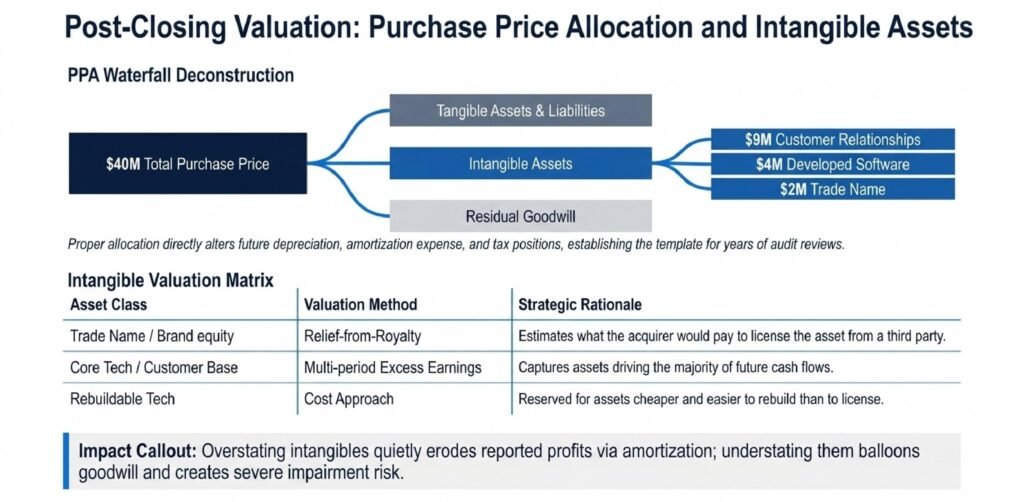
For a logistics technology company, think about a medium-sized industrial distributor coming in for a forty million dollar purchase. A hurried internal estimate could have booked the majority of the price as goodwill and moved on, but a well done M&A purchase price allocation utilised market data to determine that customer relationships had a useful life of nine million dollars; developed software had a useful life of four million and a trade name had a useful life of two million, all of which are legally amortizable. This affected the reported earnings of the acquirer for the following five years, the tax situation, and the finance team’s view of which acquired assets were providing return and which were simply sitting at cost. Examples like this demonstrate the need for Business Valuation Support M&A Decisions to encompass beyond the closing dinner and right into years of monetary reporting, audit committee reviews and, in the end, the subsequent due diligence procedure. The information contained in that first engagement report may often be referred to by analysts in future engagements with the acquirer as its internal template and methodology will be used in those future deals.
Table 1: M&A Purchase Price Allocation Categories – How Does Business Valuation Support M&A Decisions?
| Asset Category | Example | Typical Treatment |
|---|---|---|
| Tangible assets | Equipment, inventory, property | Recorded at fair value at acquisition date |
| Customer relationships | Contracts, recurring accounts | Amortized over estimated useful life |
| Developed technology | Software, patents, trade secrets | Amortized or tested for impairment |
| Trade name or brand | Product or company name | Finite or indefinite life, tested annually |
| Goodwill | Residual value after allocation | Tested annually for impairment |
How Do Valuation of Intangible Assets and IP Valuation for M&A Shape Business Valuation Support M&A Decisions?
In knowledge intensive industries, the value of intangible assets has emerged as one of the largest components in a deal’s value – sometimes, by far the largest component – and that value is becoming more important than the value of plant, equipment and inventory. Whether it’s a patent from a pharmaceutical company or the codebase of a software company, or a customer base of a consumer goods brand, all of these things are seldom recorded on the books at their true economic value – which is why buyers should seek the help of a specialist to weigh them carefully before agreeing to a purchase. There are three methods that are accepted in most cases for IP valuation in M&A: Relief from Royalty, Multi-period Excess Earnings (Measuring what would the acquirer have paid to license the asset from a third party) and Cost (Valuing assets that are easier and cheaper to rebuild than to license from another party). Deciding which approach is most suitable for the asset and also being prepared to explain it to the sceptical auditors is something that most analysts take a number of deal cycles to really get right—and it directly feeds into the eventual purchase price allocation in an M&A transaction. For example, a biotechnology acquisition may depend nearly exclusively upon the valuation of just one patent portfolio, as the product itself may not be ready to earn any revenues in a few years. Software and tech deals are comparable, in that a code base that had been developed by a small team over a number of years can be worth a lot more than the development costs when its contribution to recurring revenue is accurately modeled out.
An incorrect intangible valuation will have repercussions long after the deal closes and sometimes it will be much more difficult and costly to fix. When the value of the acquired patents or software is overstated, the amortization expense can quietly eat into reported profits for years, leading to uncomfortable questions from investors, analysts and lenders on the quarter. But if a buyer fails to record them in this way, goodwill grows on the balance sheet, and it is possible that the company will be exposed to an unseen risk of impairment if the acquired business ultimately underperforms. Hence, Business Valuation Support M&A Decisions is so frequently based on the intangible piece from the beginning and not in the aftermath of an auditor or regulator asking a question. This is a brief overview of the five steps that are routinely performed by deal teams in tackling IP valuation in M&A, and generally require close cooperation and coordination between the deal team, outside counsel and the valuation specialists themselves.
Table 2: Five Key Steps in Valuing Intangible Assets for M&A – How Does Business Valuation Support M&A Decisions?
| Step | Key Action |
|---|---|
| 1. Identify separable assets | Distinguish assets that can be sold or licensed independently, such as patents, trademarks, and customer lists, from those bundled into goodwill. |
| 2. Select the valuation method | Match relief-from-royalty, excess earnings, or cost approach to the asset type and the data actually available. |
| 3. Gather market and royalty data | Benchmark license rates, comparable transactions, and industry royalty surveys to support key assumptions. |
| 4. Model cash flows and useful life | Project the asset’s contribution to revenue or cost savings and estimate how long that benefit will realistically last. |
| 5. Document and defend the analysis | Prepare a report that satisfies auditors, tax authorities, and future buyers who may review the deal years later. |
What Do Business Valuation Experts and Valuation Advisory Services Contribute to Brand Asset Valuation?
Brand equity is hard to measure, even with a well-known consumer brand, as it is intangible, emotional, and hard to price with confidence. This is the point in the pathway where business valuation professionals get paid: They perform market research, they analyze royalty data and they review the historical financial performance, all to arrive at a defensible dollar amount that represents brand strength—closely tied to the broader valuation of intangible assets described above in the diligence process. A company that provides a quality beverage product may be able to sell for a tremendous premium just because it is on the shelf, available in stores and enjoys a loyal customer base; only a thorough brand asset valuation can determine whether or not this premium is warranted. Many times, independent valuation advisory services are engaged specifically for this segment of the analysis, as it is often difficult for internal teams to have the market data, comparable royalty rates, or the objectivity to challenge a founder’s emotional opinion of his/her brand’s value, and a founder who created the brand over decades is rarely the most objective person to determine what that brand’s worth to another party is today. That said, if anyone isn’t emotionally attached to the brand, they can undervalue decades of customer trust because it isn’t a revenue or expense line item on any financial statement.
Outside credibility: A value from an independent source, with documentation, is much more defensible to a Board, a lender, or an auditor than an internal estimate under pressure. The problem is that brand valuation is much more subjective than the valuation of a factory or a receivables ledger, and thus two equally qualified business valuation experts can come up with meaningfully different numbers from the same facts. Deal teams do this by triangulating using several approaches, stress-testing important assumptions, and opening up the range rather than saying on the negotiating table, “This is a value that nobody needs to doubt. When handled this way, Business Valuation Support M&A Decisions is a way to evidence-based negotiation, not a place where both parties feel they received false precision and will end up having a dispute at a later time, and it’s the brand asset valuation conversation, not any line item on a spreadsheet, that will determine whether both parties feel the final price was fair.
What Lessons Emerge From Business Valuation Support M&A Decisions in Practice?
A few patterns reoccur frequently enough to be more than coincidental in hundreds of deals. First, overly optimistic valuation assumptions for synergies have always fallen short of expectations: a regional retailer that bought a competitor on the basis of a 15 percent valuation on cost synergies within one year had a learning curve, as the synergies only amounted to half that in reality, because the valuation models have been phrased as fantasies and idealized plans instead of realistic assumptions and execution risk. Second, the deals that simply look at valuation as a singular valuation process end up having disputes at closing due to the fact that market conditions, interest rates, or the trading performance of the desired company may change significantly between the letter of intent and final signing. By inviting in valuation advisory services early in the process, and refreshing valuations with updated information as it emerges instead of just initial information, both parties are negotiating from the same level playing field, which is the reality, rather than from a false one. Another trend that should be noted is that deals that integrate the most seamlessly into the post-acquisition environment are nearly always the ones that kept the valuation team engaged as well as signing the deal and then moving on to the next one. Those teams that allocate resources for this continuous interaction from the outset, and not consider it scope creep, tend to identify issues with integration before they get really expensive – not a year later at an earnings call.
But the single most important thing to keep in mind is that Business Valuation Support M&A Decisions is not a task that is to be left to finance alone; it is a cross functional discipline. Legal teams require the valuation to provide them with accurate representations and warranties; tax teams will need it for structuring the deal efficiently; and operation teams will need it to establish realistic and achievable targets for the post-merger entity instead of aspirational ones. A junior professional that has a good grasp of the link between valuation of intangible assets, the purchase price allocation of an M&A and the negotiation strategy is likely to pick up the pace in his/her career, compared to a junior professional who views the valuation of intangible assets as a stand-alone model that is not connected to the other aspects of the M&A. In practice, the technical model is only half the battle, and the other half is learning how to explain it to non-financial stakeholders, particularly to skeptical board members – and often, that’s also the tougher part of the business valuation, and the one most often forgotten: a well-built model that nobody in the room understands will not last long if it gets in the way of a tough negotiation, which is why the best business valuation experts spend as much time explaining their work as they do building it.
Conclusion: How Does Business Valuation Support M&A Decisions?
Business value is not an event that occurs at the time of signing, it’s a thread that extends through the diligence process, through negotiations, through the purchase price allocation, through financial reporting for years afterward. The bottom line for practitioners in the M&A trenches is to master at least one valuation method thoroughly, to be familiar with how business values are determined when doing a real transaction, and to become accustomed to working with business valuation practitioners instead of accepting their reports as sacred text. Three practical steps that can get you better at this skill than just reading theory: review a couple of real M&A purchase price allocation disclosures from public company filings, practice relief-from-royalty calculations similar to what is done in real-life IP valuation M&A engagements for brands you are familiar with, and ask to sit in on a valuation advisory services engagement. Business Valuation Support M&A Decisions is a skill that, when applied well, makes a negotiation a fact-based conversation, and makes a good candidate, a candidate one deal team wants in the room when the numbers get tough and the stakes are high.
1 thought on “How Does Business Valuation Support M&A Decisions?”