

Table of Content
1. Sale Value of a Business: Why Valuation Is Not Simply about Revenue
The typical business owner will spend years developing a business and months preparing to exit. This is the most frequent cause of poor exits. The most successful businesses in a sale are not always the most profitable or fastest-growing; they are the businesses whose owners recognised which Value Drivers Business buyers pay top-dollar multiples for, and who took the time to maximise those drivers before placing their business on the market. Exit Value Maximisation is not a deal skill.
In the minds of buyers, everything they value in the business they are buying relates to two questions: how good are the earnings I am buying, and how much of my money will I need to invest after the transaction to support them? A business that positively answers these questions – in the sense of showing a stable, transferable, growing stream of earnings that does not require the continued involvement of the seller – will attract a higher multiple than another business with the same dollar earnings stream but that cannot answer these questions positively. Keeping the buyers’ priorities in mind is the key to successful exit planning.
This article lists the most potent Value Drivers for Businesses that Australian owners can implement in preparing for an exit, explains why each matters to buyers, and outlines the steps to implement the changes that generate the most value in a reasonable timeframe. Whether you are a professional or the owner of a business, the agenda reflects what makes a good exit great.
2. How Valuation Shapes Negotiating Position from Day One
Earnings quality over earnings quantity
Perhaps the most consistent factor in M&A is that buyers pay for earnings quality at least as much as they do for earnings quantity. A business making $800,000 in normalised earnings before interest, taxes, depreciation and amortisation (EBITDA) from a broad range of contracted customers will typically command a higher multiple than one making $1.2 million from a narrow range of transactional customers. Profitability Improvement matters – but stability, predictability, and transferability of profitability are more important.
- Recurring Revenue Model: revenue that is contracted, subscription-based, or retainer-fee-based and that renews predictably is much more important to every type of buyer than project- or transaction-based revenue.
- Year-on-year growth is more important than the absolute size of any given year; three years of linear growth are more impressive than a big year followed by a flat year.
- Year-to-year margin stability is a sign of operational excellence; year-to-year margin volatility is a sign of weakness, regardless of the average margin.
The multiple compression risks that owners underestimate
All risks that a buyer sees in due diligence are either discounted in the multiple paid or managed by the deal structure – typically both. Risk Mitigation Strategies in the 12-18 months leading up to a sale are therefore precisely the same as multiple improvements that reduce owner dependency by half a turn (of EBITDA), document customer contracts by another quarter turn, and document management depth by another half turn, yielding a better sale outcome than simply waiting. Buyers are risk-pricers; sellers who can reduce risk before the buyer can price it create value.
3. The Five Highest-Return Value Drivers Before Exit
Not all improvements are equally valued in terms of return on pre-exit time and effort. The five Value Drivers Business initiatives below are the highest-return items for most business owners in a 12 to 24-month timeframe before exit, in order of their most common impact on buyer multiple (not on headline EBITDA).
Value Driver | What It Involves | Multiple Impact | Typical Implementation Timeframe |
1. Recurring Revenue Model conversion | Convert transactional or project-based revenue to retainers, subscriptions, or long-term contracts; document renewal rates and average contract tenure | 0.5–1.5x multiple premium for businesses with >60% recurring revenue vs. comparable fully transactional businesses | 12–24 months to build a meaningful contract base; can begin immediately for service businesses with willing customers |
2. Customer Diversification | Reduce revenue concentration: no single customer should exceed 15–20% of total revenue; add new customer segments; diversify sales channels. | 0.5–1.0x compression avoided for each major concentration risk resolved; buyers systematically discount for concentration | 6–18 months to diversify meaningfully; requires deliberate new customer acquisition investment |
3. Strong Management Team independence | Reduce owner dependency: transition key client relationships to employees; document all operational processes; build a management layer capable of running the business without the founder.r | 0.5–1.5x premium for businesses that demonstrably operate without the owner; key-person risk is the single most common multiple-suppressor | 12–24 months minimum for genuine transition; cultural and relationship change cannot be rushed |
4. Profitability Improvement and Margin Quality | Remove personal expenses from the business P&L; benchmark cost structure against sector peers; eliminate inefficiencies; improve gross margin; demonstrate consistent EBITDA margins across three years | Every dollar of defensible EBITDA added multiplies into the sale price at the transaction multiple; margin consistency reduces the buyer’s risk discount | Immediate to 12 months for financial clean-up; structural margin improvement may take 18–24 months |
5. Operational Efficiency and scalable systems | Document core operational processes; implement systems (CRM, ERP, project management) that reduce reliance on individual knowledge; demonstrate that the business can scale without proportional headcount increase | Scalable Business Model characteristics add 0.25–0.75x to multiple buyers; pay for leverage, not just earnings | 12–24 months for meaningful systemisation; begins immediately but requires sustained investment |
Driver 3 – Strong Management Team independence – is the most impactful driver of multiple factors for owner-managed businesses. Still, it is the most commonly overlooked because it requires the owner to actually move away from day-to-day operations, rather than merely documenting that others could do the job. Buyers are not interested in a theoretical management team; they pay for evidence that the business can operate in the owner’s absence. This evidence is developed over 12-24 months and cannot be cooked up in the month or so before a sale process.
4. Revenue, Growth, and the Scalability Premium
Why Revenue Growth Strategy matters to buyers
Buyers don’t just pay for today’s revenues – they pay for the revenues they expect in three to five years. A business with an articulated Revenue Growth Strategy, proof of pipeline, a product roadmap, or a market opportunity provides a foundation for buyers to have confidence in future earnings and therefore justify a higher multiple. A business that has grown at 15% per annum over the last few years but has no documented strategy for continued growth is valued more conservatively than one with identical past performance and a plausible plan.
- Write down your growth strategy: what customers, what channels, what products and services, what markets are the focus for the next three years.
- Back up the strategy with supporting facts: a pipeline of active prospects, letter-of-intent contracts, product development issues resolved, or partnering documents.
- A Scalable Business Model that can grow revenue without a linear increase in cost is the most valuable growth narrative for a business owner preparing for an exit.
Operational Efficiency as a growth enabler
Operational Efficiency initiatives before an exit have a two-pronged impact: they boost current-year EBITDA and signal to potential buyers that the company can grow without a corresponding increase in cost of goods sold. The company that has invested in systems, automation, and process standardisation has removed the growth barrier posed by manual processes, with people at the centre. Buyers investing in the post-exit period can measure this scalability premium – it decreases the management and investment capital that must be committed to drive the growth case they are backing.
Business Characteristic | Buyer Perception | Multiple Implication | Owner Action Required |
Recurring Revenue Model >60% of total revenue | Low revenue risk; predictable cash flow; strong customer retention; low acquisition cost per $ revenue | Premium multiple; often 1–2x above transactional peer | Convert service agreements to recurring retainers; implement subscription or maintenance contract structure |
Declining revenue in the final year before the sale | Earnings quality concern; buyer models conservative base case; earnout likely proposed | Multiple applied to lower EBITDA; structural discount applied | Delay sale if possible; invest in revenue recovery; address the cause, not just the symptom |
Customer Diversification: top customer <15% of revenue | Low concentration risk; revenue is institutionalised, not relationship-dependent; transferable | No concentration discount; clean multiple applied to the full EBITDA base | Active new customer development 12–18 months before sale; consider new channels or geographies |
Strong Management Team in place, the owner stepped back and demonstrated | Operational continuity post-acquisition; integration risk reduced; buyer confidence in earnings persistence | Premium multiple; broader buyer universe (PE buyers require this) | Begin management transition 18–24 months before sale; document the transition evidence |
5. Process, Real Cases, and the Exit Preparation Roadmap
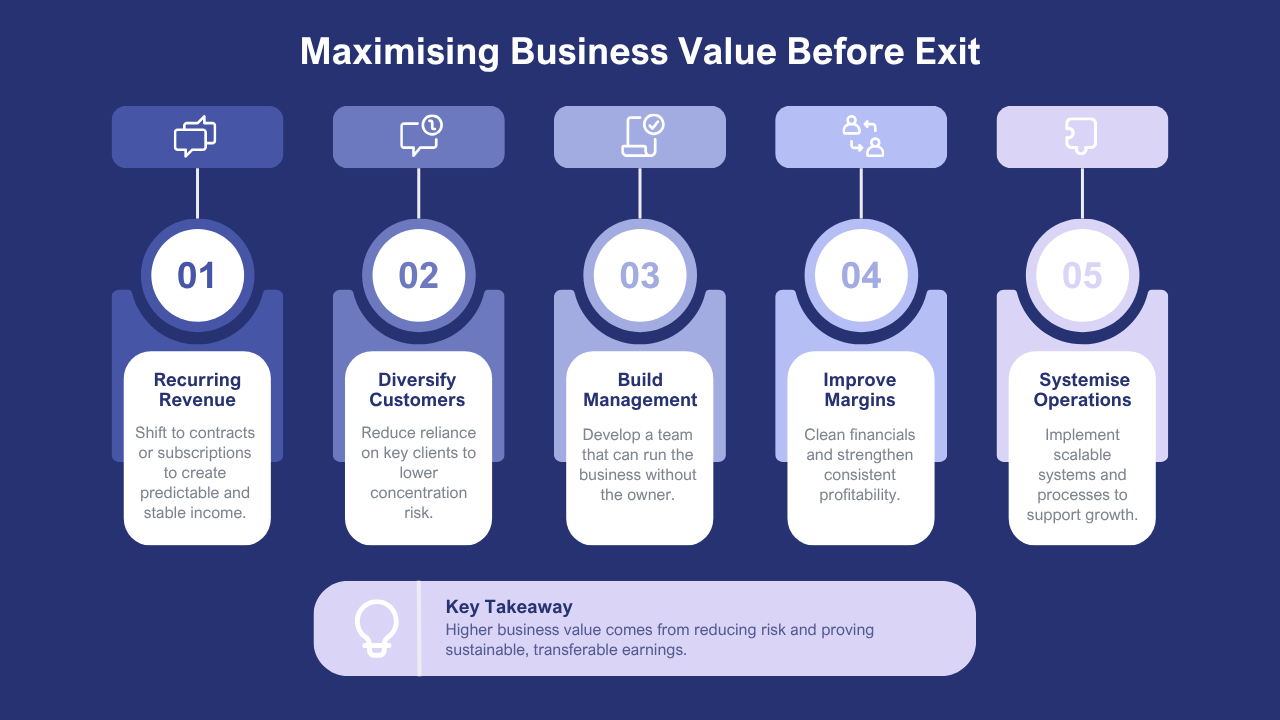
The exit preparation workflow
Exit Value Maximisation is a process and not a series of unplanned improvements in response to potential buyer due diligence. The four-step process below is how experts structure the pre-exit improvement process for business owners looking to sell their business in 18 to 24 months.
Phase 1(Months 1–3) | Phase 2(Months 3–9) | Phase 3(Months 9–18) | Phase 4(Months 18–24) |
Baseline & Gap Analysis | Revenue & Customer Work | Operational & Team | Financial Clean-Up & Sale |
Commission pre-sale valuation; identify Value Drivers, Business strengths and gaps; model the multiple impact of each key risk; prioritise the 2–3 improvement initiatives with the highest Exit Value Maximisation return | Implement the Recurring Revenue Model conversion for key accounts; begin the Customer Diversification programme; document and substantiate the Revenue Growth Strategy with pipeline evidence; reduce owner sales dependency | Transition client relationships to the management team; implement Operational Efficiency improvements and systems; document processes; demonstrate Strong Management Team capability without owner involvement | Conduct EBITDA normalisation and Profitability Improvement documentation; prepare sell-side quality-of-earnings; commission updated valuation; engage M&A advisor; go to market with a fully prepared business |
Case 1: The recurring revenue transformation
The software development business generated $2.1 million in revenue, mostly from project-based work. The owner engaged an advisor 22 months before his planned exit and discovered that the revenue model was the primary multiple depressing factor: technology services buyers paid 4x to 5x for a project-based business, but 7x to 9x for a business with Recurring Revenue Model (RRM) characteristics. Over the next 18 months, the owner converted the 12 largest clients to annual retainers for maintenance and support, increasing recurring revenue from 8 per cent to 61 per cent of revenue. EBITDA dropped marginally in the year of conversion because the upfront component of revenue is lower for retainers. Still, the business was sold with a revenue mix that warranted a 7.5x multiple rather than the pre-conversion 4.5x multiple. The business was sold for 65 per cent more than the initial indicative sale price – not due to increased earnings, but multiple expansion.
Case 2: Building management independence under time pressure
The professional services firm had $1.4 million in EBITDA and started the exit process 14 months before the intended sale. The advisor to the owner found that 78 per cent of clients were serviced directly by the founder. A 12-month transition plan was put in place: two senior associates were promoted to client relationship roles, the founder was tactically isolated from client communications, and CRM data was used to show the change to potential buyers. At the time of sale, the founder’s contribution to client revenues was just 22 per cent. The Strong Management Team narrative was supported by 12 months’ client retention under the new relationship model, and buyer due diligence confirmed the transition. The business eventually sold for a multiple of 0.8x above the initial buyer’s offer, with vendor management independence cited by the buyer’s advisor as the primary driver of the premium.
6. Conclusion
Exit Value Maximisation does not occur in the last few months before sale; it occurs 18 to 24 months in advance of the market process. The Value Drivers Business that attract high multiples are not accounting tricks; they are real attributes of the business that lower buyer risk, and bolster confidence in post-sale earnings. Conversion to a Recurring Revenue Model, Customer Diversification, Independence of a Strong Management Team, Profitability Improvement and Operational Efficiency systemisation are all value enhancers – and together, they can turn an ordinary exit into a great exit.
For owners: engage to obtain a valuation now and use it to prioritise your preparation; the impact on the multiple of each improvement is measurable, and the premium almost always covers the cost. For advisors: the optimum time to prepare a client for exit is three years before sale – the next best time is now.
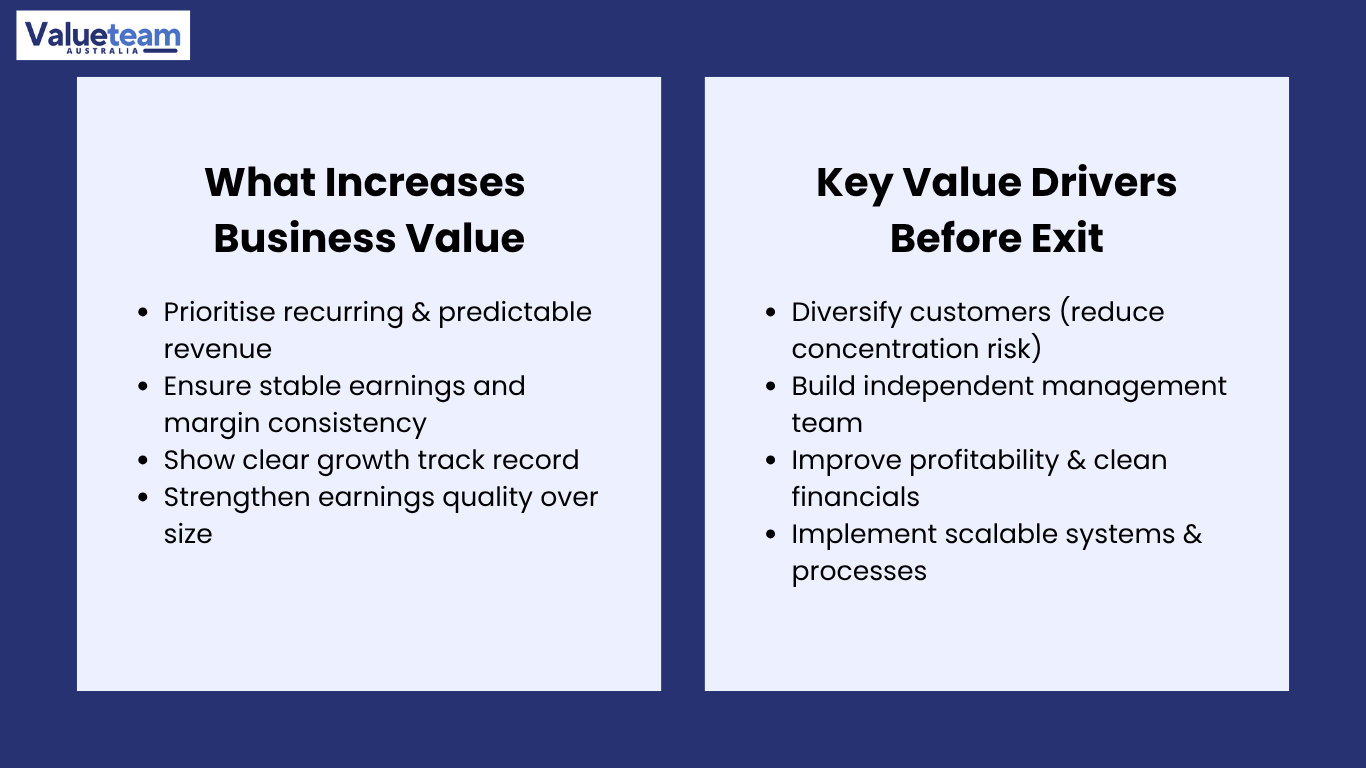
Frequently Asked Questions
Q1. What determines the sale value of a business?
The sale value depends on financial performance, profitability, cash flow, assets, customer relationships, growth potential, industry outlook, and market conditions.
Q2. Why should sellers obtain an independent valuation?
An independent valuation establishes a credible market value that supports pricing decisions and strengthens negotiations with potential buyers.
Q3. Can business improvements increase sale value?
Yes. Improving profitability, operational efficiency, financial reporting, and customer retention can increase business value before a sale.
Q4. Who benefits from understanding business value?
Business owners, shareholders, investors, buyers, and financial advisors benefit from knowing the company’s estimated market value.
Q5. How does professional valuation improve the sale process?
Professional valuation reduces pricing uncertainty, builds buyer confidence, and supports successful transaction outcomes.