

Table of Content
1. Introduction: Top Valuation Mistakes Sellers Make During an M&A Process
The sale of a business is the most important financial decision owners will make. But an M&A transaction is a process in which, more often than not, the seller is far less informed than the buyer – professional buyers and their advisors do many transactions, sellers do one. The errors stemming from this imbalance are common, costly, and predictable. They are not only important for business owners who are considering selling their company; they are critical for anyone who advises them – including analysts and M&A professionals.
Sellers’ most common valuation errors are not always the most harmful. Overvaluation Risks and Unrealistic Expectations are often the most-mentioned, but are symptoms, not causes. The root causes – Poor Financial Preparation, Ignoring Market Comparables, Inaccurate Forecasting, and mismanaged sale process – are the defects that create the environment in which the symptoms are expressed. Actively managing the underlying causes before market entry is the key to a transaction that closes at a reasonable price rather than at a discount or not at all.
This article identifies the most significant valuation errors sellers make in the Australian M&A market, explains how these mistakes lead to problems, and offers practical advice that experienced advisers use to avoid them. Whether you are advising your first-time client on their exit or developing your technical expertise, the observations outlined here are a reflection of what works and what doesn’t in M&A transactions.
2. Pricing and Expectation Mistakes: Where Deals Begin to Fail
Overvaluation Risks and the Anchoring Trap. Overvaluation Risks originate when a seller sets an asking price based on an expectation that does not reflect today’s market’s valuation. The common causes of the anchoring error are: setting the value of a business at the same multiple as a transaction in the US or UK (without adjusting for market size and exit liquidity); relying on an indicative valuation from a broker who has prepared the valuation to secure the listing mandate; or believing that the recent strong trading period is the business’s normalised earnings.
- 6x EBITDA in a US comparable is not necessarily equivalent to 6x in the Australian private market, where exit liquidity and pool sizes are smaller.
- Unrealistic Expectations set at the start of the process create anchors that are very hard to shift – even if the evidence is that the business is worth less.
- The best defence against Overvaluation Risks is for the vendor to obtain an independent valuation from a qualified source, using up-to-date comparable transactions, before setting expectations.
Mispricing Business: the cost of going too high and too low
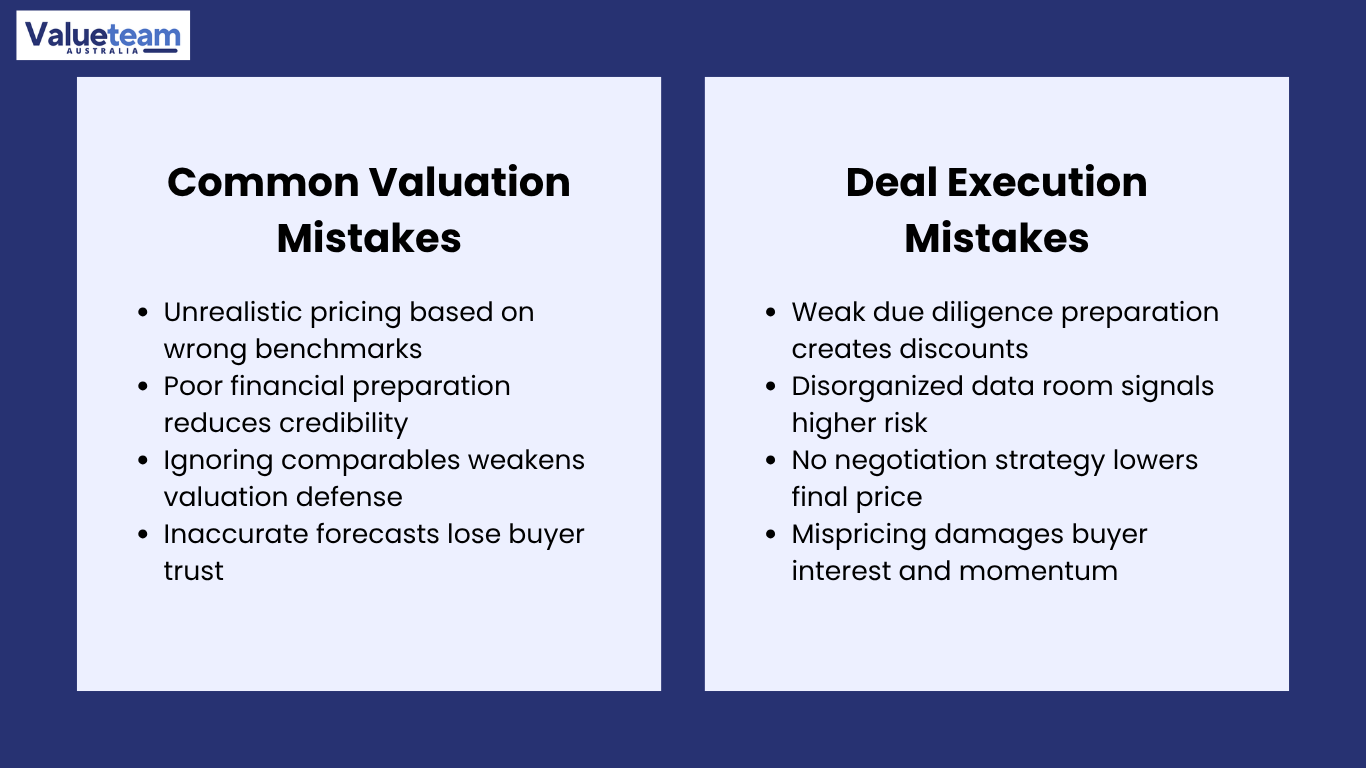
Mispricing business comes at a cost. Selling too high turns away potential buyers, relegates the business to the “too expensive” pile in buyers’ pipelines, and damages the brand when the seller inevitably has to come down – often viewed as a sign of desperation. Underpricing, though less frequent with savvy sellers, results in lost value. The best strategy is to set a price within a credible valuation range that is competitive in the market but withstands due diligence.
3. Financial and Data Preparation: The Foundation That Holds or Fails
Poor Financial Preparation and its due diligence consequences
Poor Financial Preparation is the most common mistake in Australian private business sales. This includes everything from inconsistent financial statements year to year, undocumented owner add-backs, and unreconciled management accounts to tax returns that do not reconcile with the financial statements shown to buyers. When a buyer’s due diligence team can reproduce the seller’s EBITDA from scratch – as every professional buyer does – variance between the seller’s reported earnings and what the financial records support is the number one reason for price adjustment.
- Minimum professional sale process standards include three years of financial statements reconciled to tax returns, with owner addbacks documented and supported.
- Data Room Issues – jumbled, truncated or inconsistent sets of documents – not only indicate to buyers that management is not of the highest quality, but also create holes in the audit trail that professional advisors will interpret as issues rather than routine sloppiness.
- A pre-prepared, sell-side quality of earnings analysis ensures that the most frequent form of value destruction in due diligence does not occur: that the buyer’s independent reconstruction of earnings results in a lower normalised EBITDA than the seller’s actual earnings.
Data Room Issues and Information Management Failures
Data Room Issues are more than just about document completeness. The availability and presentation of information in a virtual data room are indicators of management quality. When buyers find themselves struggling in a poorly organised data room, where documents are in the wrong folders, versions conflict, or where they request documents that are not available, they do not just find the process inconvenient. They revise their estimate of the operational risk and their level of scrutiny of other matters. The opposite is also true: an organised, full, properly indexed data room tells the buyer that the underlying business is well run, and that the seller is taking the whole process seriously.
4. Five Valuation Mistakes That Cost Sellers Money — and How to Avoid Them
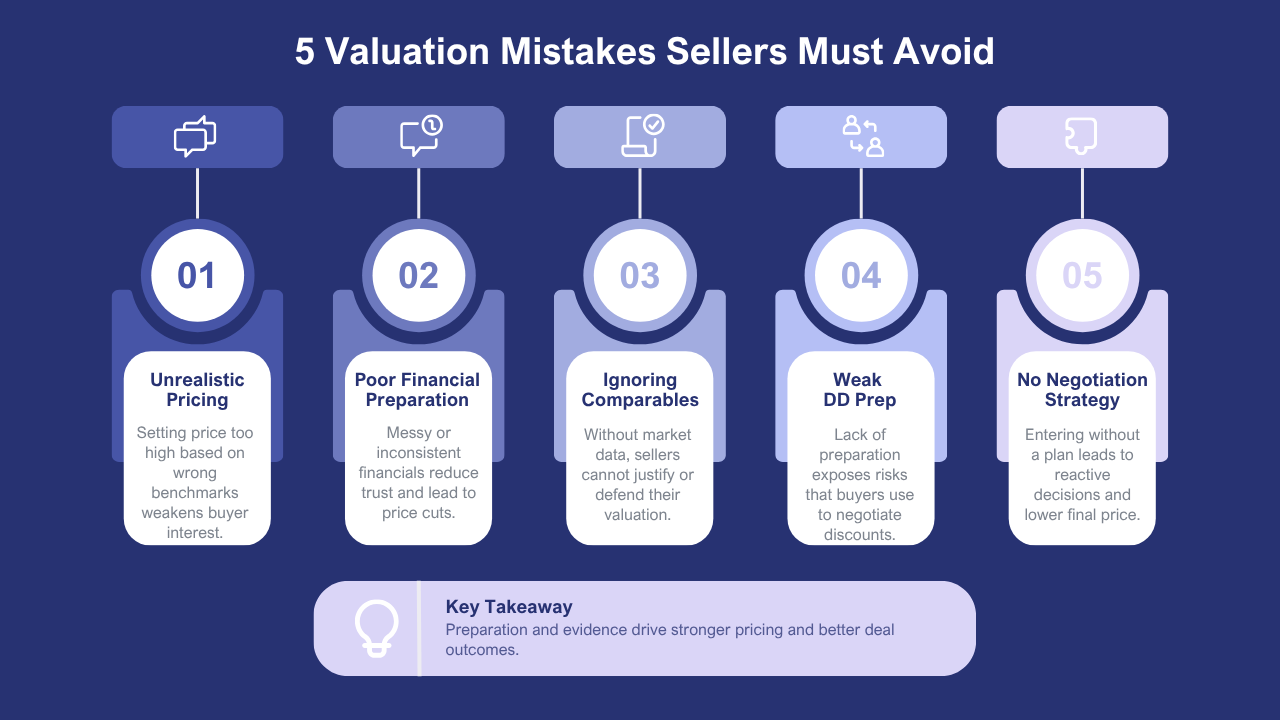
The following five mistakes are the most costly mistakes sellers make during the valuation and negotiation phases of an M&A process. There are specific ways in which each of these mistakes can cause harm, and each can be avoided with preparation and guidance.
Mistake | Mechanism of Damage | Financial Consequence | Prevention |
Overvaluation Risks: anchoring to non-comparable multiples | Seller’s price expectation is built on US benchmarks, aspirational broker guidance, or a peak trading year — none of which reflects current Australian market pricing for this specific business | Credible buyers disengage; process runs long; seller reprices under pressure from a position of perceived weakness | Commission an independent valuation with documented Australian market comparable data before setting any price expectation; distinguish between enterprise value and equity value |
Inaccurate Forecasting: projections not anchored to historical performance | Seller’s information memorandum presents a DCF or growth story that requires 30–40% growth from a business that has grown at 8% historically; buyers discount heavily or ignore the projections entirely | Buyer applies a conservative multiple to current earnings, ignoring the upside case entirely; an earnout is imposed for the growth component | Growth projections must be substantiated by specific, evidenced initiatives — pipeline data, signed letters of intent, product launches, or market entry evidence; unsupported projections are worse than no projections |
Ignoring Market Comparables: no benchmark for multiple selection | Seller does not understand what comparable businesses in their sector are trading at; cannot respond intelligently when the buyer’s advisor presents a lower comparable | Buyer’s multiple position goes uncontested; seller has no analytical basis to defend their price | Before going to market, compile recent comparable transactions from sector reports, broker databases, and IBISWorld data; understand the specific value drivers that justify positioning above or below the sector average |
Lack of Due Diligence preparation on the sell side | Seller treats due diligence as the buyer’s problem rather than preparing the responses, documents, and explanations the buyer will request | Buyer identifies inconsistencies that the seller did not anticipate; price chips accumulate through the due diligence period; deal fatigue sets in | Conduct a sell-side due diligence review before going to market: identify the issues the buyer will find and address or explain them proactively |
Weak Negotiation Strategy: no price discipline or deal structure planning | Seller enters negotiation without a documented price floor, a clear view of the value adjusters that are acceptable, or a plan for responding to buyer due diligence findings | Seller makes concessions reactively under pressure; final price drifts materially below the range that was achievable with better preparation | Define the price floor and acceptable structure before the process begins; prepare specific responses to the most likely buyer challenges; engage an experienced M&A advisor to manage the negotiation process |
Mistake 4 – Lack of Due Diligence preparation on the sell side – is the mistake sellers who have hired advisors and think they are ready, most often make. Due diligence preparation is not document preparation. It involves the seller and their advisors anticipating all the questions that a motivated and sceptical buyer might ask – about the normalisation adjustments, about the revenue trends, about the key relationships, whether they are transferable – and having answers ready to those questions based on evidence. Sellers who discover their weaknesses for the first time during due diligence will be at a serious disadvantage in the negotiation process.
5. Process, Real Cases, and Lessons for Advisors
The seller preparation workflow
All the bad things can be avoided with the right preparation workflow. The sequence shown below is how seasoned sell-side advisors prepare for the market during the pre-working period to avoid unpleasant surprises.
Phase 1 | Phase 2 | Phase 3 | Phase 4 |
Valuation & Benchmarking | Financial & Data Preparation | Process Design & Narrative | Negotiation & Deal Management |
Independent valuation with documented methodology; Ignoring Market Comparables avoided by compiling sector comparable data; price range established before any buyer engagement; Overvaluation Risks identified and addressed | Poor Financial Preparation addressed: three years of reconciled accounts; EBITDA normalisation documented; sell-side quality-of-earnings analysis prepared; Data Room Issues eliminated through structured VDR build | Information memorandum prepared with evidence-based growth narrative; Inaccurate Forecasting avoided by anchoring projections to historical data and specific initiatives; target buyer list developed; sale process structure agreed | Weak Negotiation Strategy prevented by pre-defining price floor and deal structure parameters; Lack of Due Diligence responses prepared; Deal Failure Risks managed through proactive disclosure; price discipline maintained through close |
Case 1: The cost of bypassing preparation
A healthcare services business owner chose to sell to a known strategic buyer without using an M&A advisor. The owner had an informal estimate from the accountant, which ranged from $3.8 to $4.2 million. The prospective buyer’s due diligence team undertook a significant financial review and noted three problems: there were unexplained differences in the revenue timing for the past two years, which resulted in a reduction in normalised EBITDA (the earnings before interest, tax, depreciation and amortisation used to price the business) by 18 percent from the owner’s estimate; the main regulatory licence was held by the founder personally; and three of the five largest clients did not have formal contracts. The Poor Financial Preparation, Data Room Issues, and Lack of Due Diligence on the seller’s side resulted in a final price of $2.9 million, some 30 per cent lower than the informal valuation. The issues were used to justify price reduction, each of which the owner could not dispute.
Case 2: Forecasting credibility, determining the earnout
A technology company was sold with an information memorandum that forecasted 45 per cent growth over three years based on the manager’s projections for a new product line that had yet to generate any revenue. The buyer’s advisors deemed this an inaccurate forecast and demanded an earnout for the full 45 per cent growth premium. The vendor’s advisors did not question the projections before publication. The earnout was based on challenging targets that the business failed to meet, and the transaction required a 70 per cent down payment to the seller. An alternative approach to growth forecasting – a base case built on historical performance and the new product as upside with pipeline evidence – would have delivered either a more certain consideration or an earnout more likely to be achieved. Inaccurate Forecasting didn’t create upside for the seller; it created deferred and unrealised consideration.
Quick reference: Mistake, signal, and response
Mistake | Warning Signal During Process | Advisor Response |
Overvaluation Risks | Buyer engagement is lower than expected; no binding offers received after 60+ days | Conduct comparable benchmarking review; present market evidence to seller; manage expectation reset proactively rather than waiting for the market to force it |
Poor Financial Preparation | Buyer’s due diligence produces an EBITDA figure materially lower than the seller’s claim | Prepare sell-side quality-of-earnings analysis immediately; document each add-back with supporting evidence; do not proceed to a second buyer without addressing the discrepancy |
Data Room Issues | Buyer requests the same documents multiple times; due diligence period extends beyond the agreed timeline | Conduct a data room audit; assign a dedicated data room coordinator; respond to all requests within 48 hours with a clear index update |
Weak Negotiation Strategy | Seller accepts each buyer’s price reduction without a documented response, and the final price drifts below the original floor. | Prepare a written negotiation brief before the process begins; each due diligence finding that triggers a price adjustment request should have a pre-prepared response; never concede without a counteroffer. |
6. Conclusion
The errors that sellers make when valuing a business for sale in an M&A process – Overvaluation Risks, Poor Financial Preparation, Inaccurate Forecasting, Ignoring Market Comparables, Lack of Due Diligence, Weak Negotiation Strategy, and Data Room Issues – are consistent, systematic and avoidable. They are not the result of seller naivety but rather the unfamiliarity of the M&A process, where there is an informational advantage for professional buyers. The great leveller is preparation: hiring experienced advisors, commissioning an independent valuation (with a focus on market comparables) and undertaking a sell-side due diligence review before the business is put on the market.
For advisors, the best service they can provide their sellers is the difficult conversation that takes place before the process starts: the conversation that overcomes Unrealistic Expectations, uncovers the Deal Failure Risks lurking in the numbers, and establishes a price they can hold onto rather than give away. The best outcomes for sellers come to those who listened to their advisors early and have enough time to act.
Frequently Asked Questions
Q1. What are common valuation mistakes during mergers and acquisitions?
Common mistakes include unrealistic assumptions, inadequate due diligence, inaccurate financial forecasts, overlooking risks, and selecting inappropriate valuation methods.
Q2. How can valuation errors affect a transaction?
Errors may result in overpaying, undervaluing a business, failed negotiations, audit issues, or post-acquisition financial challenges.
Q3. Why is due diligence important in valuation?
Due diligence verifies financial information, identifies potential risks, and improves the reliability of valuation conclusions.
Q4. Who should be involved in the valuation process?
Experienced valuation professionals, accountants, legal advisors, management teams, and financial consultants should participate throughout the transaction.
Q5. How can businesses avoid valuation mistakes?
Businesses should engage qualified advisers, use reliable financial data, apply recognised valuation methods, and thoroughly review key assumptions.