

Table of Content
1. Introduction: Brand Value
In most M&A deals, all eyes are on the price. But for those who have been in the deal room, it is not the price that commands attention; it is the rationale behind the price. And, more than anything else, the answer is brand. Brand Value in M&A is one of the most important, and often poorly understood, factors in deal-making. Companies with defensible brands consistently command higher multiples, have shorter deal-closing timeframes, and experience lower levels of due diligence contention than those whose fundamental value is directly tied to the balance sheet.
It’s not just about the brand, or even advertising. Brand Value in M&A includes the trustworthiness a business has earned from its customers, the ability to charge a premium for that reputation, the customer retention that comes from that trust and the positioning that makes it hard to copy. For acquiring parties – whether they be private equity, corporations, or growth investors – these features translate into reduced risk and predictable earnings. For vendors, these qualities enable them to receive a Purchase Price Premium beyond what earnings multiples might reflect.
For early- and mid-career professionals in advisory, investment banking, corporate finance, and business development, the ability to evaluate, negotiate, and monetise a brand in a deal is a true point of differentiation. This article explains the role of Brand Equity Valuation, how it plays out in transactions, the process that practitioners should take to identify and defend brand as a source of value in transactions, and the lessons learned when the process goes wrong.
2. Why Brand Is a Deal Variable, Not Just a Marketing Metric
The inclination for those with primarily a financial modelling background is to see brand as a “soft” variable, discussed in the “soft” sections of an information memorandum, not part of the numbers. This approach fails to account for the influence of brand perception in the acquisition financial model. Buyer Perception Value – the way a prospective acquirer values the quality, longevity and portability of a brand – affects the risk discount factor applied to cash flows, the purchase price multiple applied to normalised earnings, and the allocation of purchase price to Goodwill in Transactions.
When a business owner sells a company with brand value, he or she is selling customer preference that does not need to be re-earned. This preference translates into economic outcomes: reduced customer acquisition costs, increased average transaction size, and improved retention. All of this feeds through to the bottom line, even though an intangible factor, such as brand, triggers it. A buyer who appreciates this will pay for it – and a seller who can show a buyer the data will be able to hold out for a higher price than a seller with a less-than-impressive brand.
The ramifications for the Deal Negotiation Strategy are profound. Brand is not a constant that is entered into the spreadsheet on day one. It’s a dynamic input to the negotiation process, reflecting perceptions of its longevity, portability, and strategic fit. Learning how to maximise Buyer Perception Value in a deal by managing the levers that influence perceptions (through preparation, communication, and evidence) is one of the most important skills an M&A practitioner can learn.
3. How Brand Equity Is Valued in a Transaction
There is no one method of Brand Equity Valuation. In practice, experienced advisors use a range of methods, depending on the brand’s characteristics, the industry in which it operates, and the data available. They all have their merits and limitations, and the most reputable will often apply several methods to derive a range rather than a point estimate.
Valuation Method | How It Works | Best Suited For | Key Limitation |
Relief-from-Royalty | Estimates brand value as the present value of royalties the business would otherwise pay to license the brand from a third party | Consumer brands, licensed IP, and franchises | Royalty rate selection is subjective and contested |
Income Approach | Isolates revenue and margin attributable to brand strength versus generic competitors; discounts to present value | Businesses with a measurable pricing premium or brand-driven retention | Requires clean data on brand-attributed vs. non-brand revenue |
Cost Approach | Estimates the cost to recreate the brand from scratch — advertising spend, time, campaign investment | Early-stage brands or as a floor value check | Understates the value where the brand has compounded over time |
Market / Comparable Transactions | Benchmarks against Brand Equity Valuation multiples from comparable deals in the same sector | Well-defined industry segments with active M&A markets | Private transaction data is limited; public proxies may distort results |
The relief-from-royalty method is the most widely recognised method used in formal Brand Equity Valuation exercises, primarily because it links the brand’s value to a financial proxy that is familiar and understandable to buyers and sellers alike. But it is highly sensitive to the assumed royalty rate, which the buyer will scrutinise. Sellers (and their independent advisors) who have paid for independent Brand Valuations supported by market research and royalty rates derived from comparable transactions are in a stronger position than those who rely on their own assumptions.
An important note for practitioners: Brand Equity Valuation is not Goodwill in Transactions. Goodwill is the residual paid in excess of the fair value of the net identifiable assets – it is a dependent variable, not an independent variable. Brand equity is a discrete and identifiable intangible asset, and should be valued independently and allocated a share of the total purchase price. This distinction is important for both technical reasons and for negotiating around the specific types of intangible assets.
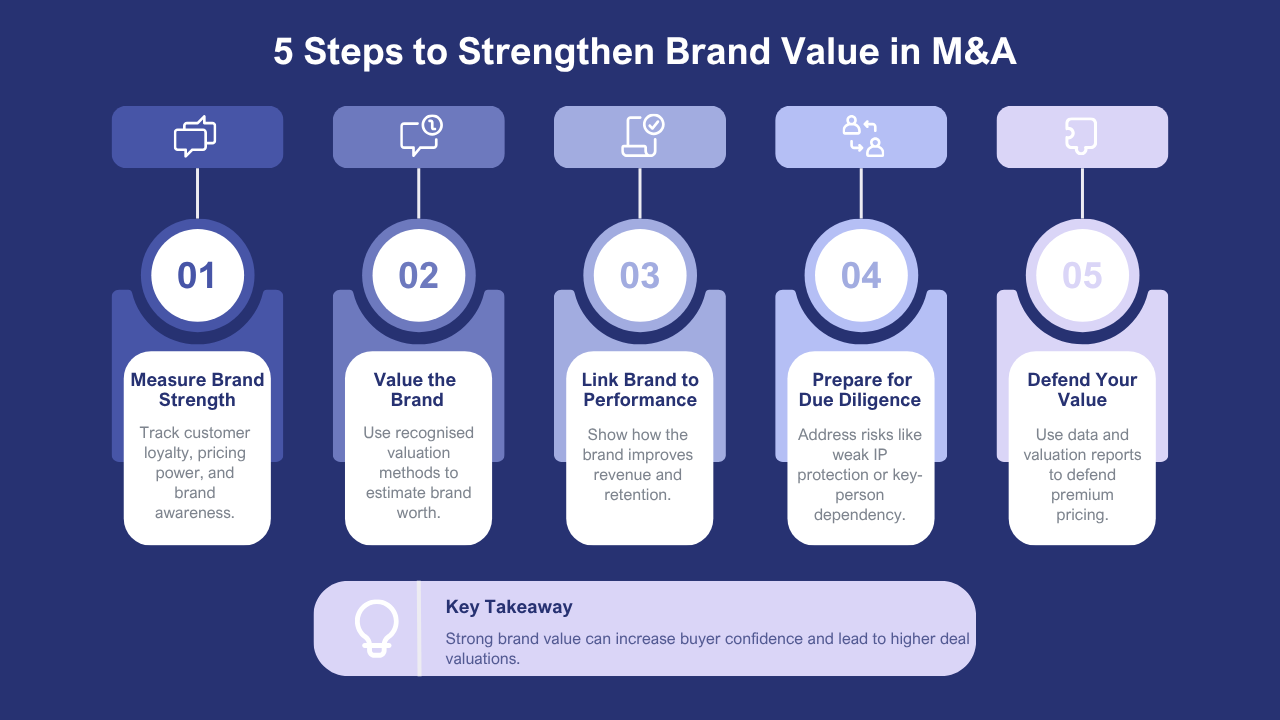
4. Five Key Steps for Assessing Brand Value Before and During a Deal
Whether you are a practitioner advising the seller on the market or the buyer on due diligence, the five steps below outline how seasoned practitioners assess and negotiate brand value throughout a transaction. There are risks at each step, and knowing them in advance helps practitioners.
Step | What It Involves | Common Challenge |
1. Establish Brand Strength Metrics | Quantify brand performance using measurable indicators: Net Promoter Score, brand awareness surveys, share-of-voice, pricing premium data, and customer lifetime value by acquisition channel | Data is often absent or inconsistently tracked; sellers must commission research to fill gaps |
2. Conduct a Brand Equity Valuation | Apply one or more recognised valuation methodologies (relief-from-royalty, income approach) to produce a defensible value range with documented assumptions | Methodology selection and rate assumptions are routinely contested; independent validation strengthens credibility |
3. Map Brand to Business Valuation Drivers | Connect brand strength to financial outcomes — show how brand drives retention, pricing power, and margin — linking intangibles and earnings explicitly | Buyers’ discount assertions; the connection must be evidenced with historical data, not narratives alone |
4. Prepare for Intangible Asset Negotiation | Anticipate buyer challenges: key-person dependency on brand founder, geographic limitations of brand reach, risk of brand damage post-transaction, contract assignability | First-time sellers are often caught off guard by the technical rigour of buy-side due diligence teams |
5. Anchor Deal Negotiation Strategy to Evidence | Use Brand Strength Metrics, independent valuations, and comparable transaction data to establish and hold a justified price position throughout negotiation. | Sellers who cannot substantiate brand value claims face progressive price erosion during due diligence as buyers reframe unverified assertions as risk. |
The key failing at Step 1 is a lack of data. Companies with good brands have not done the maths. They know customer satisfaction, but they don’t measure it; they know they charge a price premium, but they don’t know what it is; they know people are aware of their brand, but they don’t measure it. Sellers who are aware of this opportunity – and ideally 12-18 months out from market – can do the necessary research to establish a credible evidence base ahead of buyer negotiations.
Step 4 is key for aspirational advisors. Intangible Asset Negotiation is not a merely technical process. It’s about managing psychology: buyers and their advisors have a professional interest in uncovering risk, and brand claims are often in their sights. Knowing which risks to Brand are real and material – and which risks are typical buyer positioning – enables advisors to respond effectively without giving away too much.
5. Real Cases and What They Reveal About Brand in Deals
A prime example of Brand Value in M&A transactions is in the consumer industry. For instance, a mid-market personal care firm had developed a strong brand identity in a particular market through clear branding and community engagement. When it put itself up for sale, it attracted two suitors: a financial buyer interested in the business based on its EBITDA multiple, and a strategic buyer that recognised the brand as a means to gain direct access to a customer segment it could not reach through its current brand portfolio. The financial buyer’s offer was based on the company’s earnings. The strategic buyer’s offer, which was accepted, included a “Purchase Price Premium” for the Strategic Acquisition Value of the brand’s target audience. The difference was around 40 per cent, almost all of it due to the buyers’ perceptions of the brand.
The second example is a professional services firm that has developed substantial Brand Value through 20 years of published research, awards, and a proprietary methodology. As part of due diligence, the buyer learned that the brand was almost synonymous with a senior partner who would retire soon after the sale. The Buyer Perception Value fell to zero when the buy-side team re-evaluated each client, service and revenue line through the filter of key-person risk. The firm’s price was renegotiated down, and a long earnout was put in place. The takeaway here is that Brand Strength Metrics need to account for institutional brand value, rather than personal brand value, to be retained through a sale.
The third example is from the technology sector: A Software as a Service (SaaS) company had achieved Competitive Positioning through a combination of product quality and strong brand equity in its category. When the firm was sold, the buyer initially offered a “run-of-the-mill” purchase price allocation, with the majority of the above-book value allocated to Goodwill in Transactions. The seller’s accountants were able to successfully lobby for a higher allocation of the purchase price to a separately identified intangible asset – the brand – backed by an independent Brand Equity Valuation report. This has significant tax and reporting ramifications for both the buyer and the seller, and the seller’s demonstration of a plausible, independent brand valuation report influenced the outcome of that deal.
6. Process, Challenges, and What the Market Teaches You
For novices to M&A, it is easy to be drawn to the numbers that can be captured in a model – EBITDA, growth, and working capital. The less obvious lesson, learned in the course of working on deals, is that the toughest deals are often those in which the figures are clear but the intangibles are up for debate. Brand Value in M&A is one such area, and the people who are best equipped to deal with it are those who have learnt both the technical language in which to discuss it and the commercial acumen to know when to stand firm and when to give ground.
The following four-phase process is a typical brand value assessment and negotiation process within a sales workflow. Knowing what goes on at each stage – and what tends to go wrong – is good preparation for those working in, or hoping to work in, transaction advisory.
Phase 1 | Phase 2 | Phase 3 | Phase 4 |
Brand Audit & Evidence Gathering | Brand Equity Valuation | Negotiation Positioning | Due Diligence & Close |
Commission brand research; compile Brand Strength Metrics; document IP ownership; map brand to revenue and margin outcomes | Apply relief-from-royalty or income approach; document assumptions; seek independent validation; prepare buyer-facing summary | Integrate brand value into Deal Negotiation Strategy; prepare responses to likely buyer challenges; anchor Purchase Price Premium to evidence | Support buy-side brand due diligence; defend assumptions; negotiate purchase price allocation between Goodwill in Transactions and identified brand asset |
Phase 1 can be problematic in practice for questions of priority and timing. Often, sellers enter Phase 1 with an active transaction and little time to commission research. This is a structural disadvantage. Buyers will assess the brands (often with firms that have developed their own brand assessment methodology), and sellers who cannot match that level of detail are at a constant information disadvantage. The best way for sellers to prepare is to establish a brand evidence base before going to market, rather than responding to a buyer request.
Phase 2 raises the issue of independence. A Brand Equity Valuation prepared in-house will be viewed with much greater suspicion by an experienced buyer than one prepared by a known third party. This is especially true for private equity buyers, who usually have experienced due diligence practitioners. The cost of the independent brand valuation is more than repaid in the negotiation, almost every time, the underlying brand strength and assumptions are sound.
Phase 3 is the test of the Deal Negotiation Strategy. The Buyer will challenge the assumptions underpinning each Brand Strength Metric, and so too will the royalty rates or discount rates. Sellers and advisors need to be ready not just to justify the methodology but to work with the buyers to address concerns they have – including risks that are real and pushing back on positioning techniques that seek to reduce the value of the brand without a real basis. This is a blend of technical and negotiation skills that young professionals often learn on the job, perhaps alongside their mentors.
Phase 4 – Purchase price allocation – is often an important yet often-ignored phase of Intangible Asset Negotiation. The allocation of the purchase price between tangible assets, specifically identified intangibles (such as brand), and residual Goodwill in Transactions has significant tax, amortisation and financial reporting implications for the buyer and seller. Sellers pushing for a higher allocation to brand (as specifically identified intangible asset) may potentially reduce their tax burden. In comparison, buyers may have other reasons to prefer a higher allocation to goodwill. Knowing the commercial interests at play at this point – and the financial underpinnings of those interests – is a key technical skill for those who work in transactions that involve substantial intangibles.
7. Competitive Positioning and the Strategic Logic of Brand Premiums
Those who pay the most for brand are rarely paying for brand per se. They are paying for the access the brand provides: to a particular market segment, to a new market, the opportunity to cross-sell an existing product line under a prominent brand or to remove a competitive threat that would take years to develop organically. This is the Strategic Acquisition Value of a brand – the additional value that a particular buyer would pay for a brand because of its particular fit in their strategic portfolio, over and above what a “generic” buyer would pay.
Viewing Competitive Positioning in this way has implications for advisors. It’s not enough to find the buyer who will pay the highest price; it’s about finding the buyer who can get the most strategic advantage from the brand – and then to run a process that makes sense of that advantage. This typically means a limited-process sale rather than an auction, and the preparation of a document that explains the brand’s value from a buyer’s perspective, not just its prior financial history.
For young professionals, this is a critical shift in mindset: Brand Value in M&A is not an absolute value that every acquirer will perceive and value equally. It is a relative value that will differ across different buyers based on their strategic context, competitive advantages and growth plans. For one buyer, a brand could be valued at a minor premium, while for another it could be a game-changing opportunity. M&A advisors who see their client’s brand through the lens of each possible acquirer – instead of through the lens of a single, generic value model – are the ones who deliver the most value.
8. Conclusion: Actionable Insights for Your Next Deal
Brand Value in M&A is not a niche factor, confined to consumer deals involving billion-dollar companies. It is a core variable that comes to the fore in virtually every transaction involving a business with a presence in the marketplace, with customers, or any other kind of reputation that affects the purchase decision. For vendors, knowing how to measure, report, and justify Brand Value is one of the clearest ways to capture a Purchase Price Premium that reflects the business’s true asset quality rather than its current financial metrics.
For analysts and advisors, the best starting point is to become conversant in the technical language of Brand Equity Valuation and the business logic of Strategic Acquisition Value. This involves learning how buyers express brand rationale in public announcements about past transactions, becoming familiar with the techniques used in Intangible Asset Negotiation, and understanding how Brand Strength Metrics translate into the financial performance metrics that matter to buyers. The technical skills can be taught; the judgement – which brand claims will be substantiated and which will not – comes with experience of the real deal-making process.
For business owners looking to exit in the future, the best advice is to start gathering the data now. Pay for brand research, monitor Competitive Positioning data, ensure all Intellectual Property relating to brands is registered and owned by the right entity, and minimise any key-person risks that tie brand perception to a specific individual. A crafted brand narrative, backed by valid data and, where possible, verified by independent claims, is not just a bargaining point – it is a message to potential buyers that the business is well-managed and that the Purchase Price Premium being asked is realistic. That message, communicated effectively and convincingly throughout a transaction, is what makes a Premium Exit Strategy.
Frequently Asked Questions
Q1. Why is brand value important during M&A negotiations?
A strong brand enhances customer loyalty, market recognition, and future earnings potential, making the business more attractive to buyers.
Q2. How is brand value assessed?
Brand valuation considers financial performance, market position, customer perception, competitive strength, and expected future income.
Q3. Can brand value affect acquisition pricing?
Yes. Businesses with recognised brands often command higher purchase prices because buyers expect stronger long-term returns.
Q4. Who benefits from understanding brand value?
Business owners, investors, acquirers, valuation professionals, and corporate finance advisers benefit from reliable brand valuations.
Q5. How does independent brand valuation support negotiations?
It provides objective evidence of brand value, helping both buyers and sellers negotiate fair transaction prices.