

Table of Content
1. Introduction: Buying a Business in Australia
Acquiring a business is a major financial decision for an individual or organisation. The process of getting from “first glance” to “closing the deal” in Australia is seldom a straight line. For buyers – whether they are first-time entrepreneurs, serial entrepreneurs, or institutional investors – to achieve a transaction that enhances value rather than erodes it, it is important to understand how value is really determined. Business Valuation Australia is not a one-size-fits-all process: it is influenced by market conditions, transaction size, the type of buyer and the information available at various points in the process.
The Australian market is different in a combination of ways that those who have not been here before may not appreciate. The market for private transactions is more limited than in markets such as the United States and the United Kingdom, so Market Comparables are more difficult to find and apply judiciously. Foreign investment, employment, and industry-specific licensing are regulatory factors that affect prices. The concentration of transactions in healthcare, technology services, and professional services means that several factors can change rapidly when supply and demand are out of balance.
This article is for anyone interested in how a smart buyer in Australia might buy a business: what they look at, how they test the business model, and what happens when the numbers don’t add up. Whether you are advising a buyer, undertaking your first deal, or developing conceptual understanding in preparation for an advisory function, the insights and lessons offered here reflect how sophisticated buyers progress from initial screening to final price.
2. What Buyers Are Actually Looking For
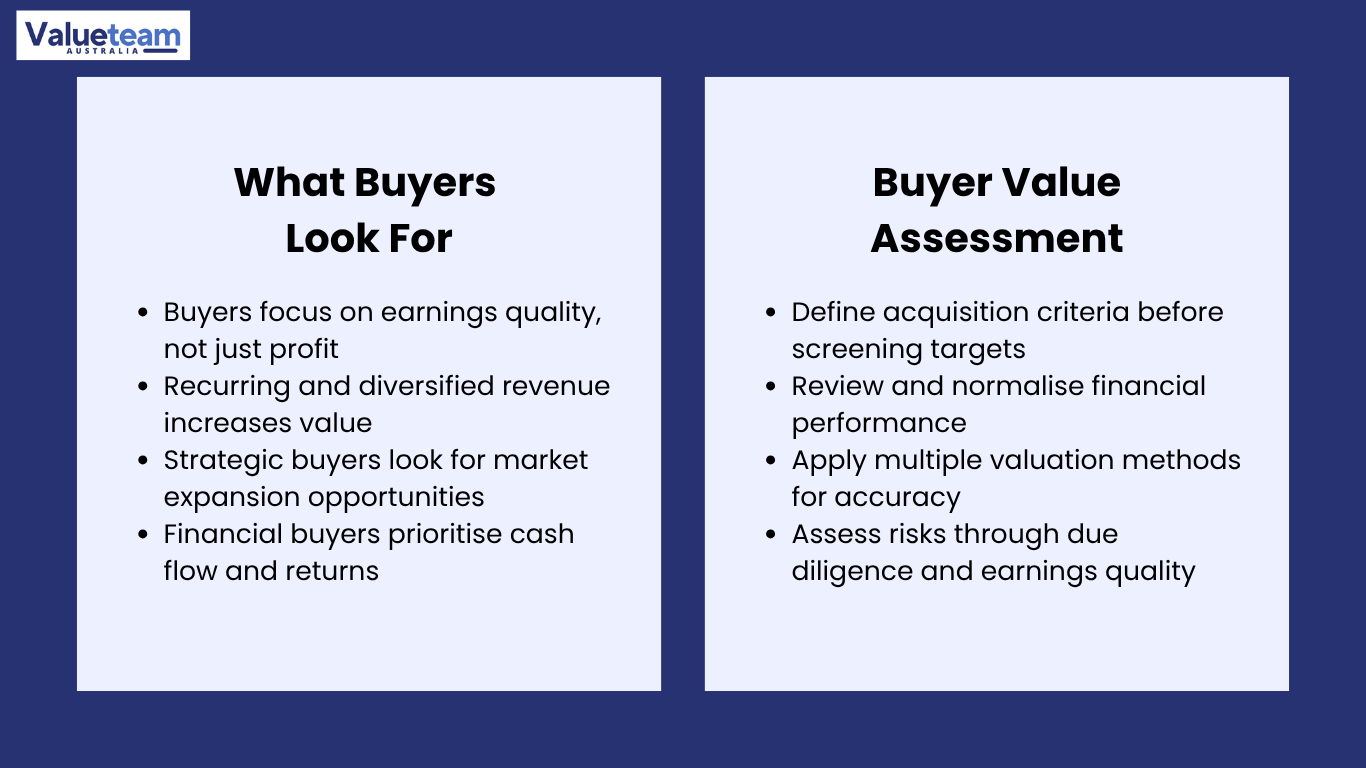
Many believe buyers are merely looking for profitable businesses. It is a prerequisite, not the key criterion. What makes a business sell at a multiple rather than a premium multiple is the quality of its earnings, a key component of any Earnings Quality Assessment. They want to know not only how much a business is making, but how much it can make, how well it will defend its revenue streams and how much it can make for a new owner.
One of the first places savvy buyers look is at a business’s revenue concentration. If more than 20-25 per cent of revenue comes from a single customer, there is inherent risk in that structure that affects a buyer’s ability to forecast future revenue and earnings confidently. Retention rates, the split between recurring and one-off revenue, and whether accounts are formal or informal are all factors in the buyer’s confidence calculation. A business with better-quality earnings – diverse, recurring, and contractual – will command higher EBITDA Multiples Australia than a comparable business with identical earnings but a vulnerable revenue structure.
In addition to earnings quality, buyers view the business through the prism of their Acquisition Criteria. Strategic buyers consider whether the business complements their strategic capabilities, extends their customer base, or improves their market position in ways that would take years of investment to build. Financially motivated buyers – such as private equity and family offices – use a more mechanistic approach: will the business service the debt used to acquire it, generate enough free cash flow, and be ready to be sold at a higher multiple some years later? Knowing whether you are dealing with a strategic or financial buyer informs every aspect of value creation and presentation.
3. The Valuation Methods Buyers Apply
Buyers do not use just one method. It’s common in Business Valuation Australia to use multiple Buyer Valuation Methods, cross-checking each against the others to establish a reasonable range of values, rather than a single valuation point.
Buyer Valuation Methods | How It Works | Best Suited For | Key Limitation |
EBITDA Multiples Australia | Applies an industry-benchmarked multiple to normalised EBITDA; the headline methodology in most deals | Profitable SMEs across most sectors; straightforward to calculate and compare | Multiple selection requires current market data; it may be misleading if EBITDA is improperly normalised |
Cash Flow Analysis (DCF) | Projects future free cash flows and discounts to present value using a risk-adjusted rate | High-growth or capital-intensive businesses; useful for stress-testing multiple-based results | Sensitive to terminal growth and discount rate assumptions; frequently disputed |
Asset-Based Valuation | Values the business at the fair market value of its net tangible and intangible assets | Asset-heavy businesses: manufacturing, property, logistics; liquidation scenarios | Understates going-concern value for service, technology, and brand-led businesses |
Market Comparables | Benchmark the target against recent comparable transactions in the same sector. | Validates EBITDA multiple assumptions where sector M&A activity is sufficient | Private data is limited in Australia; public proxies may distort private market pricing. |
Typically, Australian mid-market buyers base their analysis on EBITDA Multiples Australia and apply Cash Flow Analysis to validate assumptions. Market Comparables are sourced from industry reports, broker-realised deals, and publicly reported deals. Still, the buyer will be wary of over-reliance on benchmarks that could represent different deal structures and/or market conditions. An important learning point for junior analysts: it is not just the target’s financial performance that drives the multiple a buyer pays – it is also the buyer’s cost of capital, Acquisition Criteria, and the market for alternative assets. The same method can yield different valuations for different buyers, depending on their Acquisition Criteria.
The Cash Flow Analysis is particularly important in the Australian environment, where many mid-market businesses have seasonal revenue streams, capital expenditures capitalised in a clumpy fashion, or working capital needs that don’t “average out” over a typical 12-month period. Those advisors who project cash flows without a corresponding adjustment for this risk model DCF results that overestimate or underestimate the business’s free cash flows. Buyers who account for this seasonal and structural variability in their models – and who can explain the rationale for their chosen discount rate – have a huge advantage in price negotiations. The weighted average cost of capital for a private company is more judgmental than for a public one, and the ability to articulate the basis for the chosen rate is a clear signal to a senior advisor of the technical proficiency of a young practitioner in the middle of a real transaction.
4. Five Key Steps in a Buyer's Value Assessment
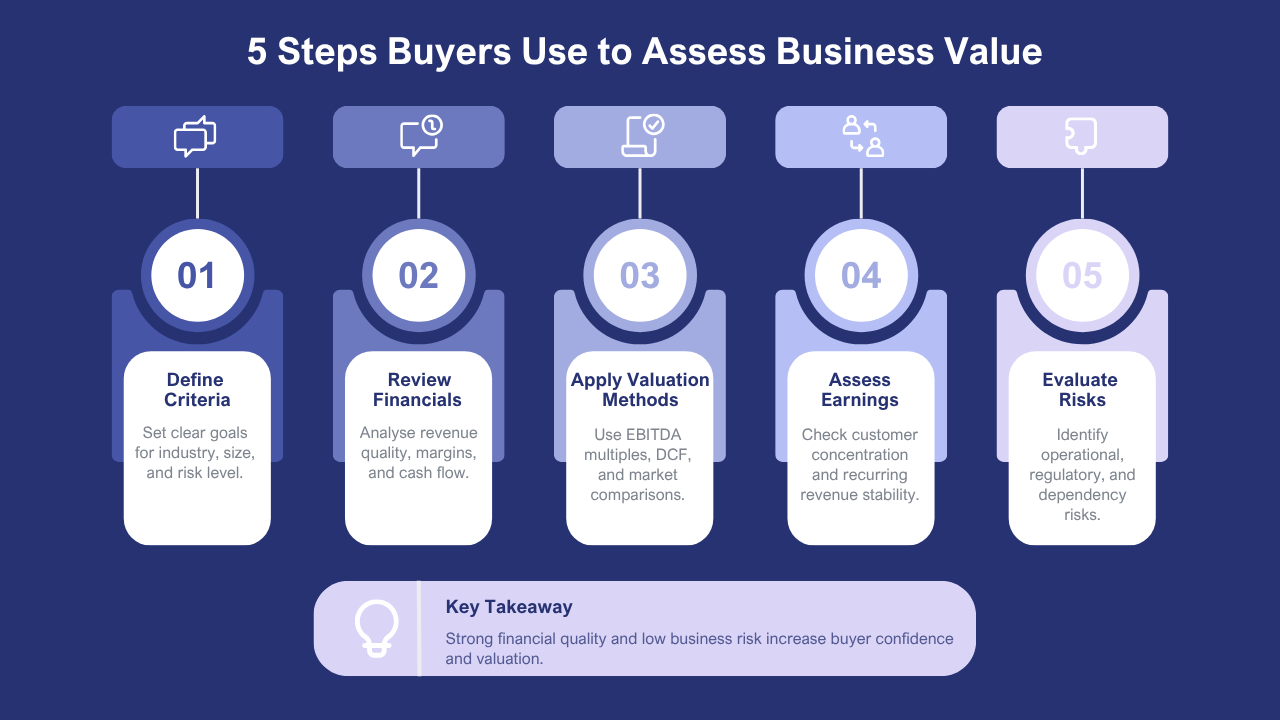
The five steps below represent the Australian approach to structured buyers’ value assessment. These steps build on each other,r and risks are created by skipping any of them, usually during due diligence or after closing – and often at considerable expense.
Step | What It Involves | Common Pitfall |
1. Define Acquisition Criteria | Establish clear parameters: sector focus, minimum EBITDA, revenue profile, geographic footprint, management retention requirements, and acceptable Risk Assessment Factors | Buyers without defined criteria waste time on unsuitable targets and struggle to compare opportunities objectively |
2. Financial Performance Review | Analyse three years of financials; normalise EBITDA for owner add-backs and one-offs; assess revenue quality, margin trends, and working capital using Cash Flow Analysis | Accepting management-prepared normalisation without independent reconstruction is the most common source of post-acquisition surprises |
3. Apply Buyer Valuation Methods | Develop a price range using EBITDA multiples benchmarked against Market Comparables; stress-test with DCF; cross-check against asset-based floor value | Over-reliance on a single method, or generic multiples without sector-specific calibration, produces valuations that misrepresent actual market conditions |
4. Conduct Earnings Quality Assessment | Test the sustainability and repeatability of earnings: customer concentration, contract tenure, revenue mix, margin stability, and management dependency | Buyers focused on headline EBITDA without assessing earnings quality are exposed to deterioration once key relationships are tested post-transaction |
5. Quantify Risk Assessment Factors | Identify and price specific risks —key-person dependency, regulatory exposure, integration complexity, and competitive threats—then translate each into a price adjustment or contractual protection. | Failing to convert identified risks into deal terms leaves the buyer without recourse if those risks materialise after settlement. |
The Financial Performance Review (Step 2) is the most critical step in the valuation process and is often overlooked by first-time buyers. EBITDA normalisation involves commercial judgment as to which adjustments are truly one-off and which are recurring. For instance, owner remuneration adjustments need to be weighed against the real cost of replacing the owner’s role in the operations, which is typically greater than sellers are willing to admit. Step 5 is also crucial and is often the most debated. Sellers want to minimise risk discounts; buyers want to maximise. Advisors who can distinguish between genuine structural risks and “game playing” on the part of the buyer and seller, assess the financial consequences of each risk, and translate the results into deal-specific terms (such as price adjustments, warranties, or earn-out arrangements) help clients secure better deals.
5. The Due Diligence Process: Where Valuations Are Tested
Setting an indicative price is just the start. The Due Diligence Process is where the underpinnings of a price are tested, confirmed and often overwritten. For buyers, the two main objectives of due diligence are to confirm the seller’s claims and to identify the Risk Assessment Factors that will either add to or detract from the price. The price of a transaction often moves between an indicative offer and a final contract, and most of the time, it moves for due diligence reasons.
The financial due diligence process focuses on the quality of the earnings being purchased. Buyers and their advisors audit the profit and loss account from underlying documents, consider add-back adjustments, and analyse the working capital position. The Earnings Quality Assessment conducted at this point is often more extensive than the seller’s, and it is not uncommon for the buyer to uncover related-party transactions, non-recurring income, or capitalised expenses that alter the normalised EBITDA on which the price was based. In parallel, commercial, operational, and legal due diligence is underway – the assignability of contracts, employment obligations, lease agreements, regulatory licences, and potential liabilities are all being explored for their impact on value and future performance.
In Australia, many SMEs use cloud accounting packages and vary in the rigour of their data entry, which means their books need to be rebuilt to support an Earnings Quality Assessment. Advisors then weigh up the management accounts against the tax returns and reconcile any differences. The risk and uncertainty are minimised when sellers engage an accountant to provide a “sell-side” quality-of-earnings assessment before the transaction enters the market, leading to greater confidence and a higher valuation for the business. The Risk Assessment Factors (RAFs) identified during due diligence need to be properly assessed as well: a concentration of revenue with one client accounting for 30 per cent of sales is a structural issue that affects the valuation multiple, whereas a warranty can support a small lease extension. Experienced practitioners build a risk hierarchy that enables them to prioritise their negotiating efforts and to avoid making everything an issue of life and death. This approach exhausts buyers and sellers and kills deals that would otherwise go through.
6. Real Cases and What They Teach Practitioners
A common theme in Business Valuation Australia is that the headline EBITDA and the investable EBITDA are not the same. A logistics company offered normalised EBITDA of around $2.8 million over three years of trading. The Headline Offer was based on a multiple of the industry average. During the Due Diligence Process, advisors found that two major customer contracts, accounting for 38 per cent of gross turnover, were due for renewal 6 months after settlement and that there was no guarantee of the renewal terms. The Earnings Quality Assessment reduced the investable EBITDA to around $2.1 million to account for concentration risk. The final offer reflected a discounted multiple applied to the revised base, resulting in a discount of more than 25 per cent off the initial offer.
The second example concerns a health care services company that attracted significant interest from prospective buyers due to industry growth opportunities. Due diligence identified that a substantial portion of “recurring” revenue was attributable to a single government program under policy review. The Risk Assessment Factors related to regulatory dependency were not revealed in the information memorandum. Ultimately, the deal went through, but only with an earn-out, making 30 per cent of the price dependent on revenue performance after the deal. The take-out: in any market where government funding and/or licensing is significant, the Financial Performance Review must be the first to consider regulatory and policy risk – not the due diligence phase.
Our third case study is about preparation. A professional services firm undertook a Financial Performance Review with its advisors 18 months before the sale. The review identified hard-to-justify add-backs and a pricing structure that caused margin volatility. These were rectified before sale. When the business was put on the market, the Earnings Quality Assessment undertaken by potential buyers verified the figures presented, reducing the time taken for due diligence and avoiding price renegotiation (often necessary when hidden issues are unearthed during due diligence). The sale price was at the top of the expected range – in part because there was no doubt about the quality of the information.
7. Process, Challenges, and What the Market Teaches You
Most of the learning in the M&A field comes from the Due Diligence Process. Developing a sense of the four phases of the value assessment process from the perspective of the buyer – and the challenges inherent in each – is one way to build knowledge in the area.
Phase 1 | Phase 2 | Phase 3 | Phase 4 |
Screening & Initial Assessment | Indicative Valuation | Due Diligence | Price Finalisation & Close |
Apply Acquisition Criteria to targets; review information memorandum; run preliminary Financial Performance Review and Market Comparables check | Normalise EBITDA; apply EBITDA Multiples Australia benchmarks; run Cash Flow Analysis; submit non-binding indicative offer | Conduct Earnings Quality Assessment; quantify Risk Assessment Factors; verify all financial, legal, and operational representations | Reconcile findings with opening price; negotiate adjustments, warranties, and earnout terms; finalise purchase price allocation |
Phase 1 focuses on screening to improve process efficiency. Buyers who lack Acquisition Criteria for their targets tend to proceed with due diligence on targets that did not meet those criteria. Setting minimum and preferred criteria before starting a process is not red tape; it is a precondition for effective capital allocation. Phase 3 is the most difficult due to information asymmetry. The vendor knows the business better than any buyer can in a few weeks of due diligence, and there is an obvious tendency for them to present their firm in the most positive light. The Due Diligence Process helps counter that – but it demands that buyers and their advisors ask for source documents, not summaries, and be willing to track down the truth wherever it may lead. One of the most important skills for young practitioners is to doubt summaries and ask for source data.
Phase 4 – price determination – assesses the effectiveness of the technical work in Phases 1-3. Not all risks flagged in due diligence should translate into price discounts. Some risks should be allocated through warranties, escrow deposits and earnout schemes that incentivise post-sale behaviour while reducing the risk of transferring uncertainty to the seller. Learning to discern which tool should be used to address which risk – and to explain that effectively to the buyer and seller – is the art of the M&A advisor. The Australian mid-market, in particular, is fertile ground for advisors who can marry the technical with the pragmatic.
8. Conclusion: Actionable Insights for Your Next Acquisition
Knowing how and why buyers really value Australian businesses is the cornerstone of successful acquisitions. The technical models are important: EBITDA Multiples Australia, Cash Flow Analysis, Earnings Quality Analysis, and Market Comparables all work better when applied diligently and in combination. But technique is not everything. Ultimately, it is the buyers who are the most successful in practice who apply commercial acumen to the use of technique: they focus on identifying companies that meet their Acquisition Criteria, assess and confirm that they are underwriting earnings quality through a Financial Performance Review, and price and manage the Risk Assessment Factors that inevitably emerge in every serious Due Diligence Process.
For the young, mid-career professionals, the best investment is to develop a sense of pattern recognition – the ability to identify high-quality earnings from their presentation. This skill is acquired by reading transaction announcements, participating in deals alongside senior colleagues who have developed these skills, and reviewing how acquirers justify their prices in public documents. For advisors to buyers, the checklist is straightforward: establish Acquisition Criteria before starting any process, insist on an independent Financial Performance Review before any firm offer, and take the Due Diligence Process seriously as the most valuable risk assessment. In Business Valuation Australia, discipline and preparation underpin successful transactions.
Frequently Asked Questions
Q1. What should buyers evaluate before purchasing a business?
Buyers should assess financial performance, legal obligations, customer relationships, operational processes, business risks, and growth opportunities before completing a transaction.
Q2. Why is business valuation important when buying a company?
An independent valuation helps buyers determine whether the asking price reflects the business’s fair market value and future earning potential.
Q3. What role does due diligence play in an acquisition?
Due diligence verifies financial information, identifies operational and legal risks, and supports informed investment decisions.
Q4. Who should assist buyers during an acquisition?
Valuation professionals, accountants, legal advisers, and corporate finance specialists can help evaluate risks and structure the transaction effectively.
Q5. How does professional advice improve acquisition outcomes?
Professional guidance reduces transaction risks, supports better negotiations, and increases the likelihood of a successful acquisition.