

Table of Content
1. Introduction: ESG Reporting Mistakes
As ESG reporting becomes mandatory in Australia, the impact of ESG Reporting Errors has shifted from a reputational nuisance to potential litigation and financial losses. The Australian Securities and Investments Commission (ASIC) has stepped up enforcement against greenwashing and deceptive sustainability claims; institutional investors are placing increasing emphasis on the quality of reporting; and assurance practitioners are undertaking more extensive reviews than companies have faced under voluntary reporting regimes. The days of aspirational sustainability reporting are being replaced with the need for more data-backed, evidence-based and consistent reporting.
For Australian companies, the errors that compromise ESG reporting credibility are not wilful. Rather, they are the result of structural deficiencies – weak governance, data management, methodology and content that is not well connected to evidence. Knowing what these Sustainability Reporting Pitfalls are, why they happen and how they can be overcome is one of the most useful areas of knowledge for anyone in or entering the ESG advisory, finance, legal or sustainability function.
This article outlines the most common ESG Reporting Errors in the Australian market, including the risks each poses and how to avoid or correct them. Whether you are reviewing your company’s first-ever sustainability report or helping a client with a compliance overhaul, the issues described here are common to those with experience in this field.
As ESG reporting becomes mandatory in Australia, the impact of ESG Reporting Errors has shifted from a reputational nuisance to potential litigation and financial losses. The Australian Securities and Investments Commission (ASIC) has stepped up enforcement against greenwashing and deceptive sustainability claims; institutional investors are placing increasing emphasis on the quality of reporting; and assurance practitioners are undertaking more extensive reviews than companies have faced under voluntary reporting regimes. The days of aspirational sustainability reporting are being replaced with the need for more data-backed, evidence-based and consistent reporting.
For Australian companies, the errors that compromise ESG reporting credibility are not wilful. Rather, they are the result of structural deficiencies – weak governance, data management, methodology and content that is not well connected to evidence. Knowing what these Sustainability Reporting Pitfalls are, why they happen and how they can be overcome is one of the most useful areas of knowledge for anyone in or entering the ESG advisory, finance, legal or sustainability function.
This article outlines the most common ESG Reporting Errors in the Australian market, including the risks each poses and how to avoid or correct them. Whether you are reviewing your company’s first-ever sustainability report or helping a client with a compliance overhaul, the issues described here are common to those with experience in this field.
2. Data and Measurement: Where Errors Begin
The problem of Inaccurate ESG Data
Inaccurate ESG Data is the most basic type of reporting error because everything else – targets, story, claims, assurance – is built on the numbers. The most frequent causes of inaccuracy in data reported in Australian sustainability reports are the lack of consistency in methods across business units, the failure to update emission factors in line with the latest National Greenhouse Accounts (NGA) revisions, and posting errors that go undetected because there is no internal process for quality review.
- Emission factors downloaded from external databases without checking that they are up-to-date and fit for Australian operations – this can lead to a 10-25% misstatement of emissions.
- Energy and water data are sourced from invoices, which lead to estimation errors that can be amplified when dealing with multiple sites.
- Restatement of previous year’s results without disclosure – a significant issue of consistency in GRI and AASB S2.
- Scope 3 estimates from spend-based models are reported as measured data, without disclosure of the estimation method or range.
Disclosure Gaps in metric coverage
Disclosure Gaps occur when organisations fail to disclose metrics that are material to stakeholders’ perceptions of their operating performance, either because the data is not positive or because the data-collection process has not been set up. In either case, the result is a report that is not “smart investor-friendly”. Selective disclosure is one of the key triggers for Greenwashing Risks findings by ASIC, because the impression given by showing the positive subset of metrics and omitting the negative subset is misleading, even if the individual statements are true.
3. Governance and Process Failures
Poor Governance Practices in the reporting process
Poor Governance Practices in ESG reporting are often evident when the ESG report is prepared by the sustainability team or an external advisor, with limited review by the board or executive, and the board signs off on the report at the very end, with little consideration of its substance. This practice is not compliant with AASB S2 – the standard requires the board to oversee climate risks and opportunities, rather than rubber-stamp a document.
- No review of draft disclosures by the board before the report’s publication; the board reviews the report,but not the assumptions or data.
- The ESG reporting team is based in the communications or marketing department, not finance or risk – this leads to a lack of credibility when assurance providers or informed investors begin to read the report.
- No data lineage is available to support the reported metrics; when the assurance provider requests supporting documents, they are not available.
Reporting Inconsistencies across periods
Reporting inconsistencies across reporting periods are among the most problematic mistakes in ESG reporting because they point to either poor data governance practices or gaming of the metrics by experienced users. Examples include: changing the reporting boundary between reporting periods without disclosure; using a different vintage of emissions factors in consecutive periods without disclosure; and changing the definition of a metric (e.g., the calculation method for total recordable injury frequency rate) without disclosure or restatement of figures.
The practical standard for consistency is the same as financial reporting. If you change the method or reporting boundary, disclose the change and the reason, and restate prior-year data to enable a meaningful comparison. Companies that fail to uphold this standard are not only violating reporting standards – they are creating ESG Audit Issues that their Assurance Provider will need to disclose.
4. Five Critical ESG Reporting Mistakes — and How to Avoid Them
The five mistakes outlined below are the most significant Sustainability Reporting Pitfalls observed – those that attract the attention of the ESG Audit Issues, bring the ire of regulators, and cost the organisation trust. All can be overcome with appropriate process and governance, but only if the organisation is aware of the particular failure mode.
Mistake | Why It Happens | Consequence | How to Avoid It |
Greenwashing Risks: overstating sustainability commitments | Marketing language is applied to unverified claims; targets are announced before baselines are established; aspirational goals are presented as current achievements | ASIC enforcement action; loss of investor and customer trust; potential civil liability under the Corporations Act for misleading disclosures | Verified data must support every claim; distinguish clearly between current performance and future commitments; do not announce targets without a documented pathway to achievement |
Inaccurate ESG Data: using outdated or inapplicable emission factors | Data teams source emission factors once and do not update them annually; NGA factors change each year, but organisations use the original version | Materially misstated emissions figures; failed assurance; inaccurate prior-year comparatives | Update emission factors annually from the current NGA publication; document the factor used for each metric in the methodology note; have the data team sign off on factor currency before each report cycle |
Disclosure Gaps: omitting material negative performance | Teams select metrics that show improvement and omit those that do not; Compliance Mistakes ESG include reporting safety performance only in years without incidents | Selective disclosure creates a misleading overall impression and is treated by ASIC as equivalent to a false positive claim; assurance providers will identify the gap | Disclose all metrics identified as material in the materiality assessment, regardless of performance; explain underperformance with context and remediation plans rather than omitting the data |
ESG Risk Mismanagement: disconnecting risk from disclosure | ESG Risk Mismanagement occurs when the sustainability report identifies climate or social risks, but the board has not integrated those risks into the organisation’s formal risk register or strategic planning | Contradiction between the risk disclosure and the business’s actual risk management practices creates a credibility problem and potential liability if the risk materialises without having been managed | Require the risk function to review ESG disclosures; ensure all material ESG risks identified in the report appear in the risk register; link sustainability strategy to the risk management framework |
Reporting Inconsistencies: changing methodology without disclosure | Year-on-year boundary or methodology changes are made to improve apparent performance or simplify data collection, without informing readers | Comparability is destroyed; assurance providers issue findings; sophisticated investors identify the change and question management’s integrity | Establish a documented methodology for each metric in year one and maintain it; the ESG governance owner must approve any changes, disclosed in the report, and accompanied by restated prior-year figures |
The fifth mistake – Reporting Inconsistencies – is the most important because it is the one most easily overlooked as an accounting rather than a governance failure. Consistency mistakes are actually governance mistakes: they happen when the organisation doesn’t have a formal owner for the methodology document, when the team producing the current report can’t see the methodology used last year, or when the analyst responsible for the current report changes the methodology without review. Developing a methodology register – a document that specifies what each metric is, how it is calculated, and where the data comes from for each reported metric – and ensuring that it is owned by governance is the best way to prevent it.
5. How Mistakes Compound: Process, Cases, and Lessons
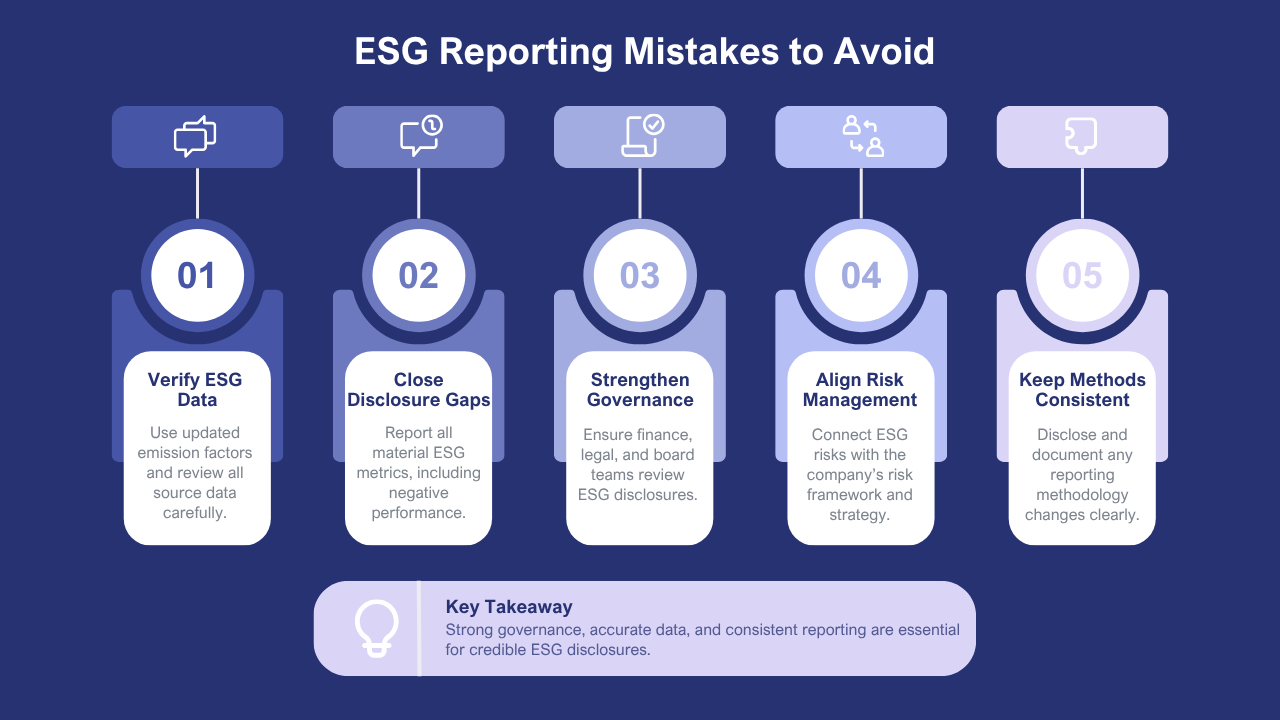
The error propagation cycle
Most ESG Reporting Errors are not isolated – they follow an error propagation cycle whereby a fundamental failure in data or governance leads to a ripple effect of errors. The following process map shows how data quality errors at data collection propagate to Greenwashing Risks at publication.
Stage 1 | Stage 2 | Stage 3 | Stage 4 |
Data Collection Failure | Governance Gap | Publication & Disclosure Gaps | Consequence & Remediation |
Inaccurate ESG Data collected: wrong emission factor applied, incomplete site coverage, or manual entry error in the source system. No quality review catches the error at this stage. | Report drafted by the communications team without a finance or sustainability review of the underlying data. The board approves the report without reviewing the methodology. Poor Governance Practices allow the error to persist. | Report published with inaccurate figures and selective metric coverage. Material negative performance is omitted. Reporting Inconsistencies with the prior year is not disclosed. ESG Audit Issues emerge during assurance. | Assurance finding issued; investor or regulator challenge received; restatement required. ESG Risk Mismanagement findings emerge if disclosed risks do not appear in the risk register. Remediation costs significantly exceed prevention costs. |
Case 1: The cost of aspirational targets
A consumer goods company made a “net zero by 2040” announcement in its sustainability report without first measuring its baseline emissions or establishing a credible pathway to decarbonise. The announcement was crafted by the company’s communications department and signed off by the board. When questioned by an institutional investor about the underlying data and the strategy to meet the target, the information was unavailable. ASIC then initiated an investigation into whether the announcement was a misleading disclosure. The Greenwashing Risks of regulatory inquiry, legal and reputational costs far exceeded what the baseline measurement and strategy development would have cost.
Case 2: Inconsistency discovered during assurance
A financial services company, preparing its second sustainability report, switched its approach to accounting for electricity emissions (Scope 2) from location-based to market-based between reporting periods, without making the change clear. The change led to a 62 per cent decrease in reported Scope 2 emissions, which was included in the report’s narrative as an indicator of “significant progress” toward emissions reduction. The ESG Audit Issues review by the assurance provider detected the methodology change and called for a restatement. The organisation was required to issue an erratum, restate the previous years’ numbers, and disclose the methodology change to those who had received the original report. The loss of credibility was much greater than the cost of disclosing the changed methodology in the report.
Prevention checklist for practitioners
Control Area | Prevention Measure | Timing |
Inaccurate ESG Data | Update all emission factors from the current NGA publication; conduct a cross-functional data quality review before reporting; compare to the prior year, and investigate variances >10% | Before data is finalised — at least 6 weeks before report publication |
Disclosure Gaps | Map reported metrics against the materiality matrix; identify any material topics not covered; document reasons for any exclusions | During report scoping — before drafting begins |
Greenwashing Risks | Legal review of all forward-looking claims and targets; distinguish between verified current performance and future commitments; remove unsupported superlatives | Before board sign-off — legal sign-off is a gate, not a courtesy review |
Reporting Inconsistencies | Maintain a methodology register; compare current-year methodology to prior-year register; require senior sign-off for any changes; disclose and restate if changes are approved | At the start of each reporting cycle, methodology review precedes data collection |
ESG Audit Issues | Provide assurance provider with full methodology documentation, data trail, and prior-year comparatives at engagement commencement; address queries promptly; treat findings as governance intelligence. | Throughout the assurance engagement, not only at the close review |
6. Conclusion
The Top 10 ESG Reporting Errors in Australia are avoidable – but only if sustainability reporting is treated with the same process, governance and data integrity that financial reporting receives. Greenwashing Risks, Inaccurate ESG Data, Disclosure Gaps, Reporting Inconsistencies, and ESG Risk Mismanagement are not technical reporting errors; they are governance errors resulting from under-resourcing, under-governing and under-reviewing the reporting process.
For reporting practitioners, the key to mitigating Sustainability Reporting Pitfalls is a three-point approach: compile a methodology register and treat it as a governance document; ensure sign-off by finance and legal on all metrics and claims; and build the assurance relationship as a quality control rather than a compliance process. The organisations free of Compliance Mistakes ESG are not those with the most advanced reporting systems, but those with the most rigorous processes.
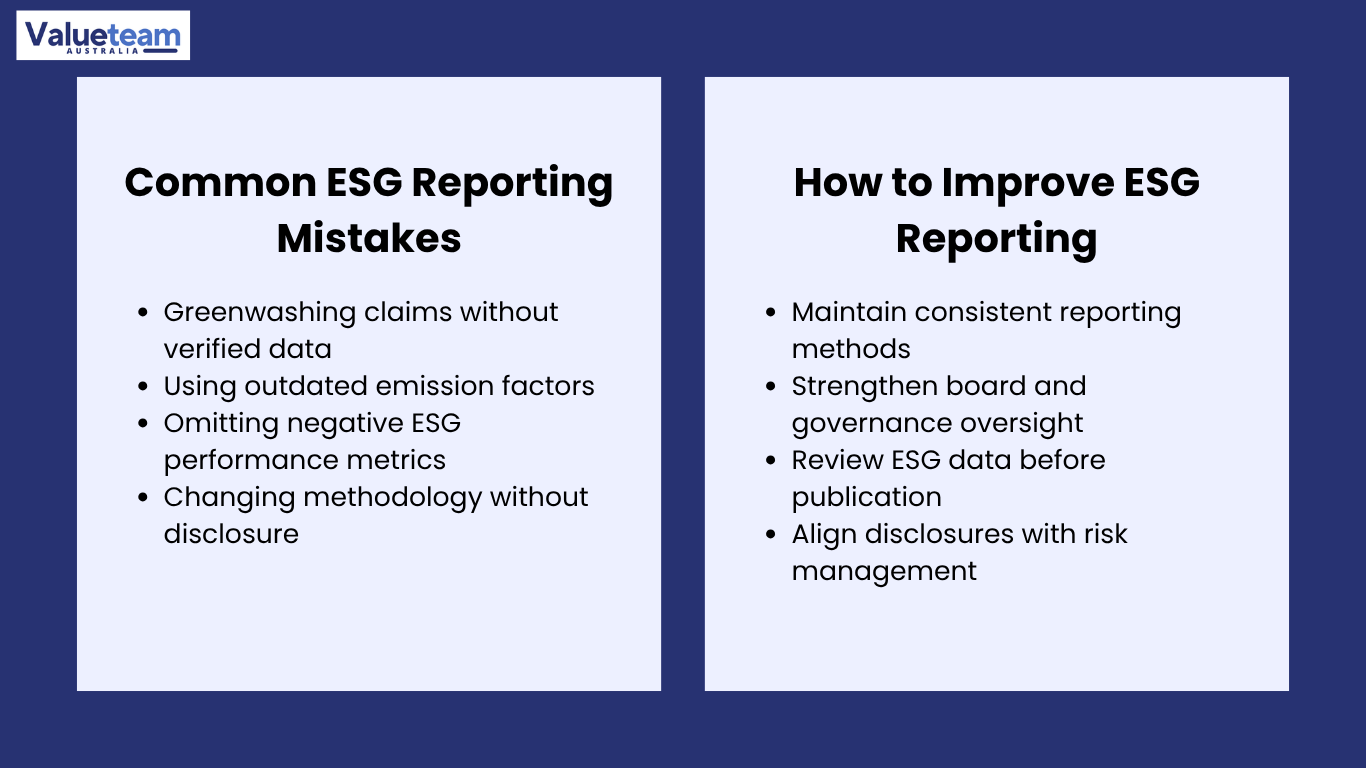
Frequently Asked Questions
Q1. What is ESG reporting?
ESG reporting involves disclosing an organisation’s Environmental, Social, and Governance performance, risks, policies, and sustainability initiatives.
Q2. What are common ESG reporting mistakes?
Common mistakes include incomplete data, inconsistent reporting, weak governance, insufficient documentation, and failure to meet reporting standards.
Q3. Why is accurate ESG reporting important?
Accurate reporting improves transparency, strengthens stakeholder confidence, supports regulatory compliance, and enhances corporate reputation.
Q4. Which organisations should prioritise ESG reporting?
Listed companies, large organisations, and businesses with sustainability or climate reporting obligations should prioritise robust ESG reporting practices.
Q5. How can businesses improve ESG reporting quality?
Businesses should establish clear reporting frameworks, collect reliable data, strengthen governance processes, and regularly review sustainability disclosures.