

Any finance, accounting, or advisory professional or professional aspirant in Australia should know what factors influence the value of a business. Business value is not a number plucked off a spreadsheet, but rather it is based on earnings, assets, market conditions, industry risk, and the confidence of a buyer in future performance. Business valuation Australia is essential for junior and mid-level professionals to develop the skills and knowledge required for a career in corporate finance, accounting, and advisory services. By examining the primary reasons for value, how it’s determined, and the lessons that can be taken from actual interactions, you can be confident to discuss valuation in job interviews, client conversations, or daily work. It also explores the differences between valuing SMEs and larger corporates, and what to consider when using Australian valuation services for a transaction, dispute, or succession planning.
What Factors Affect Business Value in Australia When It Comes to Financial Performance?
The initial focus of any valuation process is typically financial performance, and it is certainly one of the most significant contributors in business valuation Australia engagements. All the indicators of revenue growth, profit margins, cash flow consistency, and debt levels, indicate how sustainable a business is likely to be. A company with predictable, recurring sales, like a subscription-based software business, will generally command a higher valuation than a company with the same annual sales but one-time sales. Earnings before interest, tax, depreciation and amortisation (EBITDA) is also examined carefully as it removes accounting items to reveal the intrinsic earning power of the business.
But quantity is not the only thing that matters: quality of earnings is just as important. A valuer will standardize financial statements to eliminate one-off expenses, owner-related expenses, or windfalls that cause financial statements to be misleading. This is a skill that junior analysts should acquire early in their careers, as misreading financial statements can cause the valuation to be far too high or low. One of the most useful and transferable skills acquired from valuation work is being able to read financial statements critically, not superficially, which directly helps to obtain accurate SME valuation Australia results for small and family businesses. Other factors are also part of the assessment, such as working capital trends and requirements for capital expenditure, as the company that needs to continually reinvest to maintain its revenue stream will likely be valued more conservatively than a company that generates cash in a highly cost-effective manner. Business valuation analysts generally prepare a three- to five-year forecast and vary the growth, margin, and reinvestment rates to see how sensitive the valuation is to such changes. This sensitivity testing is what makes a defensible valuation, and a good practice to get in to early in any finance career.
What Factors Affect Business Value in Australia Through Market and Industry Conditions?
No market is worthless without its business. Buyers’ willingness to pay will be affected by industry growth trends, competitive intensity, regulatory factors, and interest rates and inflation in the broader economy, among other factors. For instance, for companies in industries that are being directly impacted by disruption like traditional retail vs. online retail, valuation multiples are likely to be squeezed, whereas companies in more resilient industries such as essential infrastructure or healthcare services are likely to have higher multiples. That is why business valuation Australia professionals always compare the target company with the data that is relevant to the target sector and not with generic data.
The local conditions are also a factor, one which can be overlooked by newcomers. A similar business, with the same products and services, in a growing population area in a capital city might have a different enterprise value to that of a similar business in a regional area where there is a declining population. Changes in the interest rate will impact discount rates in valuation models, and therefore impact the present value of cash flows. In the eyes of the junior, this further emphasises the need to keep abreast of some economic indicators, noting the commentary of the Reserve Bank, industry reports and sector forecasts is not ‘background reading’ — it is a key input to valuation assumptions and recommendations to clients. Two other issues that are becoming more pertinent in business valuation Australia are currency exposure and the concentration of the supply chain. A manufacturer whose manufacturing line is dependent on one supplier overseas, for instance, may be considered to have more risks for a valuer to account for in calculating his discount rate or to apply a specific adjustment to his cash flow projections. An understanding of these contextual risks, which is not seen in every company but can be, is what makes a valuation credible to lenders, investors and courts alike.
What Factors Affect Business Value in Australia Depending on the Business Valuation Methods Used?
Choosing the valuation method that you will use can have a direct and sometimes dramatic impact on the valuation figure, so it is essential to understand Business valuation methods as a part of your knowledge base when working in this area. The three most frequently used approaches are the income approach (discounted cash flow or capitalisation of earnings), the market approach (comparable transactions or multiples of listed companies) and the asset approach (net asset value, typically for asset heavy or distressed businesses). Each method is appropriate for various businesses, and often an expert valuer will use more than one method to validate each other and ensure that a defensible range of valuation is created.
The table below summarises how these approaches are typically applied in practice.
| Business Valuation Methods | Best Suited For | Key Limitation |
|---|---|---|
| Income approach (DCF/capitalisation) | Businesses with predictable cash flow | Highly sensitive to growth and discount rate assumptions |
| Market approach (comparable transactions) | Businesses in sectors with active M&A activity | Reliable comparable data can be scarce for niche industries |
| Asset approach (net asset value) | Asset-heavy businesses, holding companies, distressed sales | Often understates value of intangible assets and goodwill |
The selection of the appropriate approach — or of a combination of approaches — is a skill that experienced valuers possess, but novices don’t, and is one of the most frequent subjects for job interview questions related to valuations in Australian valuation services companies. One best practice to get into early on is to run two approaches in parallel and reconcile any material difference between them; if there’s a big discrepancy, then it’s likely that something has changed in your assumptions (e.g., growth rate is too high, comparable transaction is no longer applicable, etc.) and needs to be revisited prior to presenting the figure to a client.
What Factors Affect Business Value in Australia for Small and Medium-Sized Enterprises?
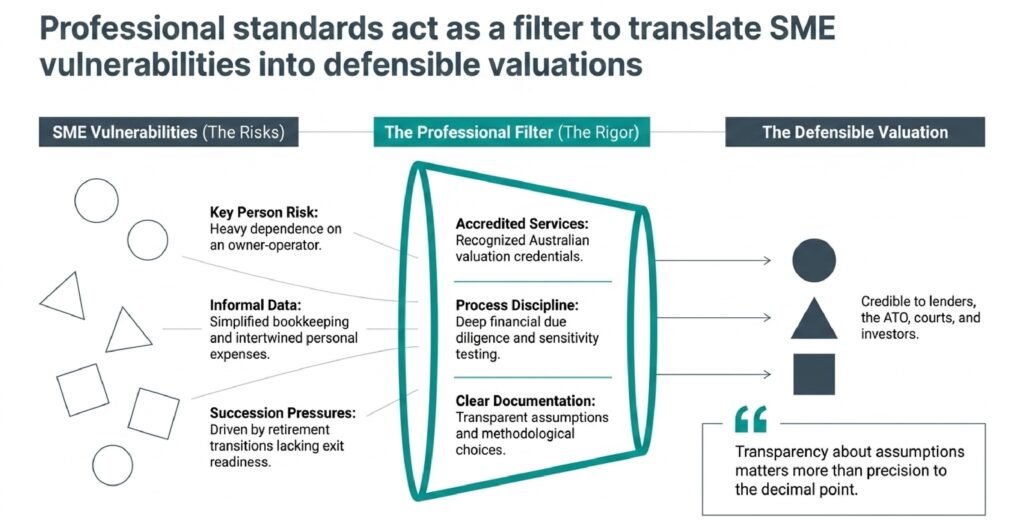
The challenges in valuing a small and medium-sized enterprise (SME) are different to those faced by larger firms, so SME valuation Australia is a specialised area of the valuation industry. The single owner/operator may be critical in the operations of many SMEs, and when that owner/operator leaves, so too can go the customer base, supplier arrangements and institutional knowledge. This “key person risk” can lead to a lower valuation unless the business has strong systems, documented processes and a team in place to carry out the business without the founder’s support.
Another frequent difficulty for SME valuation work is record-keeping quality. Many smaller businesses operate with simplified bookkeeping, do not have formal contracts with customers and/or suppliers, or take on multiple business and personal expenses. Often, analysts must dedicate a great deal of time to normalizing the financials before they can even consider starting a valuation and then inconsistencies often arise, impacting the final valuation. The lessons learned in SME engagements are valuable to the junior professional because they involve judgment, communicating with business owners who might not be familiar with financial terminology and the ability to explain the valuation results in laymen’s terms — something that formal valuation training doesn’t always equip him or her with. There has also been a significant increase in the demand for SME valuation Australia services, as many business owners around the country are retiring over the next ten years and looking for succession planning. The valuation is not the only result of many of these battles, but it is a part of a larger discussion around exit readiness, which may involve a third-party sale, transitioning ownership to family members or a management buyout. Specialist SME valuation Australia services that are carried out frequently will not just create the valuation report but will additionally provide practical suggestions for making the enterprise even more appealing and less risky by the time of the deal.
What Factors Affect Business Value in Australia When Selecting Professional Valuation Services?
The reliability, autonomy and qualifications of the practitioner(s) performing the valuation directly influence the credibility and defensibility of the valuation number. Using the services of recognised Australian valuation practitioners, typically members of professional institutions that have recognised valuation qualifications, minimises the risk of disputes with the other party to a transaction and the risk of litigation or tax issues. Typically, courts, financial institutions and the Australian Taxation Office will expect valuations to be carried out in accordance with recognised standards and to be based on clear and well-documented assumptions, and not informal estimates.
The process also has an impact on the outcomes. The valuation process usually includes an initial scoping discussion, a financial and operational due diligence process, one or more valuation methods, sensitivity testing of key assumptions and a final report that includes clearly expressed limitations. One of the most common error traps is to skip steps such as not testing how sensitive the valuation is to growth or discount rate assumptions, which can result in figures that do not stand up to scrutiny. For those professionals wanting a career in this area, process discipline should be taken as seriously as technical modelling skill. One of the most frequent lessons that are learned in every Australian valuation services project is that rather than precision to the decimal point, transparency about assumptions is more important. No matter how the valuation result is, a client and other stakeholders are much more likely to accept the result if the explanation is put in writing and open for review. When practitioners provide one mysterious number without explaining the methods and assumptions used, this has a tendency to raise more questions and be more problematic in dispute cases.
Five Key Drivers That Shape Business Valuation Australia Outcomes
The following five trends consistently impact engagements and outcomes regarding valuation, and are summarized for quick reference:
- The quality and consistency of earnings are crucial for any Business valuation Australia scenario as this will dictate the amount of confidence a buyer has in cash flow in the future and therefore the multiple used.
- The industry and market position matters in determining the level of risk premium and growth expectations in a business, meaning whether it is seen as being resilient or vulnerable to disruption.
- The valuation method chosen can impact the result by a wide margin and choosing the valuation method is one of the most critical steps in the process.
- In SME valuation Australia, owner dependency and management depth is particularly relevant, while key person risk can be a key factor significantly depressing value.
- The figure’s resistance to negotiation or legal challenges depends on the credibility of the advisory team, such as adherence to recognised business valuation methods and standards.
Real-World Examples of Business Value in Practice
Let’s say you have a medium-sized manufacturing company in the region of Victoria that is considering selling the company in the near future. Revenue had been increasing steadily over the last three years, and on the surface, it was all a mix of good business, but on closer inspection, it was found that almost 40% of the revenue was from one customer contract, which was set to expire in 12 months time. The owner’s initial expectation was lowered by approximately 15% due to the customer concentration risk applied to the discount rate used for the capitalisation of earnings approach adopted by the valuer. This case highlights the need for Business valuation methods to be adjusted to take account of the underlying risk factors in addition to headline revenues.
In the other case, a small professional services business in Brisbane wanted an opinion as to value for a partner buy-in. The business didn’t have many fixed assets and was based on a strong relationship with two senior partners, so the asset approach wasn’t a good fit for the business, and the team instead used a blended income and market approach, based on similar transactions from similar advisory firms. The final report also advised that the business should formalise its client contracts and cross train staff to minimise the need for reliance on individual clients — a common comment in SME valuation engagements in Australia where succession planning is an emerging issue that drives demand. Both examples illustrate that value results are not simply numbers thrown out of a calculator, but rather a diagnostic process that can reveal operational risks that the business owner was not aware of.
Benefits and Challenges of Understanding Business Value in Australia
Valuation skills are clearly beneficial to professionals throughout the course of their careers. It establishes a level of trust and standing throughout the finance, accounting, mergers and acquisitions, and advisory field, and it provides a framework for younger employees to express analytical thinking in a job interview or performance evaluation. Clients and employers always appreciate someone who can not only tell them the value of a business, but also the why — how to tell the story of the numbers, market, and methodology. The logic and process that has been used here can be applied very effectively in other valuation contexts such as lending, investment analysis and business strategy.
The challenges are as real as they could be. Valuation also involves understanding the incompleteness and messiness of the data, dealing with client expectations when the numbers don’t add up to what the client thought he would hear, and keeping up with changing economic conditions that influence discount rates and market multiples. For junior professionals, the most difficult part of the job, after learning the technical aspects of modelling, is the communication aspect – making the complex assumptions understandable and trustworthy to the business owners, boards, or litigation parties. Australian valuation firms typically do this by providing a structured mentoring program, peer review of reports, and exposure to a variety of industries early in the career. There is also an emerging valuation value across the Australian valuation profession that soft factors – leadership depth, retention of staff, digital competency, and even environmental and governance – are increasingly impacting buyer appetite and therefore value. These qualitative indicators are not included in a technically correct valuation of the assets and can easily be overlooked in competitive sale transactions when sellers and buyers are considering both historical financials and other factors. Establishing the ability to identify these qualitative risk factors, in addition to the quantitative modelling they have been taught in the standard business valuation methods, is what will create an all-round and credible skill set for those new to the profession.
Conclusion: Actionable Insights
The value of the business in Australia is determined by the financial performance, the market and industry context, the valuation method used, the management and governance of the business behind it, and the judgement and credibility of those doing the job. For individuals looking to develop their career in this field, the obvious future steps are as follows: improve financial statement analysis, get used to all three fundamental methods of business valuation, find work in SME valuation situations where judgement plays the key role, and gain recognised business valuation qualifications that fit with established Australian valuation services standards. A strong understanding of these fundamentals will continue to be among the most important skills to have in an Australian finance and advisory career, whether they’re working as part of a valuation team or directly advising clients. Often, simple, practical steps such as reading a set of financial statements critically, comparing two valuation methods for the same business, and watching a senior colleague work through an SME engagement is enough to get people from theory to practice.