

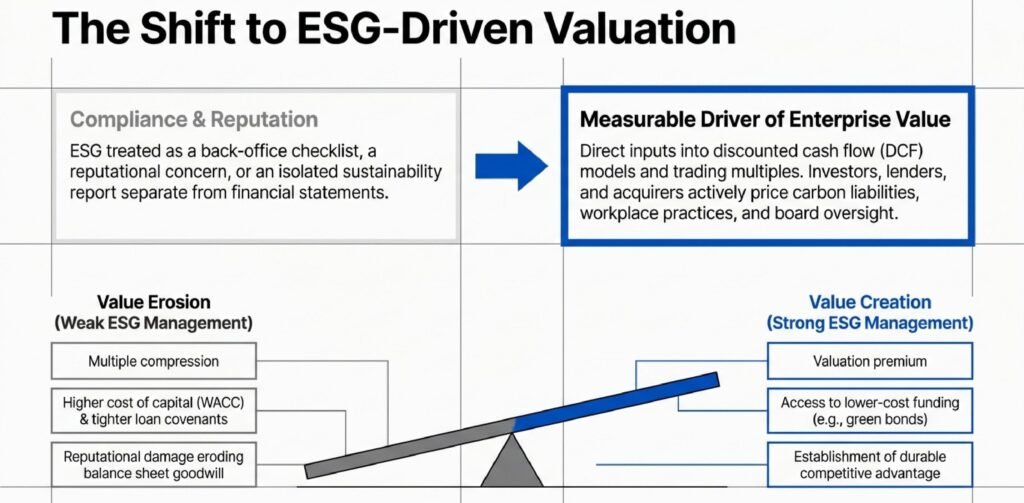
From compliance checklist to measurable driver of enterprise value: ESGs have become a fundamental change. Because of this, discussions about the effects of ESG Risks on Company Valuation now accompany and factor in classic valuation drivers like EBITDA and free cash flow to discounted cash flow models and trading multiples. This connection is no longer a choice for them, the junior analysts and sustainability officers and the people starting a career in finance or risk. Ineffective ESG risk management can lead to a series of compressions, increased capital costs and eroding goodwill that is hidden on the balance sheet. Companies that integrate sustainability into their business plans, however, tend to have a valuation premium, especially as companies valuation Australia develops in response to tougher climate disclosure requirements. This article provides an overview of how these risks can be expressed in numbers, and offers some practical steps and an emerging field of sustainable business valuation to help.
How Do ESG Risks Influence Company Valuation?
How Do ESG Risks Influence Company Valuation Today?
Valuation is simply a prediction of future cash flows discounted to the present, taking into account risk. ESG Risks generally impact company value through three pathways: (1) the size and timing of the cash flows; (2) the discount rate applied to the cash flows; (3) the exit or terminal multiple that an investor is willing to pay. If, for example, a company has unpaid environmental liabilities, it could expect lower revenues than it would otherwise have as it is limited in what it can do, the capital cost of meeting emissions limits, or margin-draining litigation. This has come to be interpreted as “quasi-debt,” meaning that analysts have increasingly been subtracting the amounts they think they will have to remediate from enterprise value as they would subtract net debt. It is a welcome change from 10 years ago when ESG issues were considered a reputational risk instead of a financial risk, and is especially evident in the practice of company valuation Australia, where regulators now require climate exposure to be shown in reported numbers. Climate transition risks, labour disputes and governance failures are now part of the base case in rating agency models, audit committee discussions and due diligence models performed by private equity.Climate transition risks, labour disputes and governance failures are now considered as part of the base case, not a footnote, in rating agency models, audit committees and private equity due diligence models. What this boils down to is that two companies with the same revenue and margin profile can have vastly different valuations based on whether they have material unmanaged ESG exposure or not. Formerly, all the research notes sent by sell-side research desks were mainly about earnings momentum, but today each note includes a note to mark the risk on earnings due to ESG issues.
ESG risk management has the most direct and obvious impact on the discount rate channel. A company with a high EGR is likely to require a higher required return from lenders and equity investors, this is because the increased EGR equates to increased uncertainty over future cash flows. That is reflected in a higher cost of capital or in more stringent loan covenants or in a larger equity risk premium embedded in the cost of equity calculation. Insurers can further reinforce this by either increasing premiums, or by refusing to provide cover, on property that is at risk of physical climate impacts, like flooding or bushfire, that directly impact the replacement cost assumptions they are using when valuing assets. This is the essence of sustainable business valuation – attempting to value resilience, not just past performance. On the terminal value side, buyers are typically using a lower exit multiple for businesses with poor governance frameworks, believing that that is an increase in the risk of future events that will destroy value, such as a safety accident, fraud or regulatory punishment. Combined, these processes make it very rare for ESG exposure to be limited to a handful of line items: it is spread throughout the valuation model, from near-term forecasts to the assumptions made decades into the future. A junior analyst will need to learn where each risk is coming into the model, and it’s a skill that is easily transferable from equity research to credit analysis to corporate development.
Which Real-World Examples Show How ESG Risks Influence Company Valuation?
Real cases help to elucidate the mechanics better than theory does. Volkswagen’s 2015 emissions scandal was an environmental and governance debacle that lost the company approximately 15% of its market capitalisation value in mere days, and had the company to pay penalties, recalls and litigation amounts of tens of billions of euros during the past few years. The episode illustrated how one governance disclosure can ultimately lower near term cash flow, increase the cost of capital, and result in de-rating the stock, as the market reprices the likelihood that other such hidden governance problems are lurking for other parts of the business, a practice being called “sustainable business valuation” in the advisory world. The pattern was different with Vale, the Brazilian mining giant, following the Brumadinho tailings dam collapse in 2019. It was responsible for the deaths of hundreds of people, the criminal prosecution of executives and the suspension of production at several facilities which combined wiped out a large share of the company’s enterprise value and made its cost of capital much higher for years to come. In both instances, environmental and social shortcomings have spread beyond the level of any single business unit, into financing risks, licence-to-operate risks, and management credibility. In both cases, the companies also had to deal with years of higher legal and monitoring expenses that still lower free cash flow long after the headliners had died down.
Governance weaknesses create the same types of trends domestically. One of Australia’s oldest financial services companies, AMP Limited, suffered a significant fall in the value of its shares following the 2018 Royal Commission that uncovered fee-for-no-service behaviour and an inadequate oversight role by the company’s Board of Directors, an event that continues to be referred to in company valuation Australia training materials as an example of the rapid repricing of trust once lost. The good news is that businesses that take transition risk management well can be rewarded instead of penalized. It’s precisely because renewable energy developers and owners of grid infrastructure look more stable in terms of cash flows in a policy environment than their fossil-fuel reliant counterparts have been able to secure more affordable green financing and higher exit multiples. That’s why, in today’s market, professionals talk about good ESG risk management as a value-protection and value-creation discipline rather than a “safe” compliance function. The following short table provides a summary of the types of risks that have emerged in real valuation results in similar situations rather than one-off occurrences and across markets.
Table 1: How ESG Risks Influence Company Valuation Across Sectors –
| Risk Type | Example Sector | Typical Valuation Impact |
|---|---|---|
| Environmental liability | Mining & resources | Lower terminal multiple, higher remediation provisions |
| Governance failure | Financial services | Share price de-rating, higher cost of equity |
| Labour & supply chain | Retail & manufacturing | Reputational discount, revenue volatility |
| Climate transition risk | Energy & utilities | Higher discount rate, stranded asset write-downs |
| Data & privacy governance | Technology | Regulatory fine exposure, contingent liabilities |
What Benefits and Challenges Appear When ESG Risks Influence Company Valuation?
The impact of an ESG risk management approach is increasingly being felt in the cost of capital. Businesses with a robust environmental and governance history are more likely to be able to access green bonds, sustainability linked loans and equity investment at more favourable terms, as lenders see them as having lower risk over the life of the financing. Employee retention and employee productivity are also higher at companies with believable social practices, directly affecting revenue and margin assumptions that go directly into a discounted cash flow model. Perhaps most significantly for those at the beginning of their careers, there’s more demand than supply for individuals who can truly tie sustainability information to financial impacts, and it’s an ability that continues to grow. Investors using sustainable business valuation approaches are also willing to pay a premium for businesses that can show them a sustainable competitive advantage, rather than a glossy sustainability report – manufacturing companies with “true” lower energy costs from ESG initiatives, for example. This premium is likely to increase over time because the lower funding costs will release capital for additional investments in the very practices that gave the premium in the first place.
The problems are as real. Across organisations, consistency of data quality is lacking, and even within a company over time, the level of consistency is not sufficient to allow analysts to compare ESG performance on a like for like basis. Rating agencies often differ in their ratings due to the variability in how they assign weights to ESG factors, making it difficult to gain trust in any individual score. Regulators in Australia, the UK and the EU are specifically targeting greenwashing – where a company claims a green or sustainability profile without any actions to back it up – and the reputational and legal damage can be a new valuation liability. The added cost of assurance and verification also detracts from the value of sustainable disclosure in the short-term, as it can also become a burden for small businesses with limited resources, who may not have the sustainability expertise to do this themselves. It is important that analysts interpret the data presented in ESG disclosures, but not necessarily take it on faith, as the discrepancy between a sustainability report and actual operational data is typically where real risk lies, where possible, checking the narrative claims against operational data.
What Five Steps Help ESG Risk Management When ESG Risks Influence Company Valuation?
The difference between good and great analysts is the ability to repeat the process of being mindful of ESG. The next five steps outline the way that forward-thinking finance and advisory teams design their ESG risk management process prior to incorporating it into a valuation model. These actions don’t necessarily call for exotic tools, and in fact, they are largely about discipline, consistent data and challenging management’s own story about their risk exposure. Oftentimes, it is not the analysis itself that is the most difficult part; it is agreeing, from the outset, which issues are actually material and worth taking the time to analyze. Those who can comfortably navigate this process in an interview or at work are the professionals who demonstrate a solid understanding of what ESG is and how it can actually make a difference in a spreadsheet.
- Identify which environmental, social and governance issues are actually of financial consequence for the sector concerned, and not just using a checklist of issues.
- Data integration: Incorporate ESG metrics directly into the revenue, cost and capital expenditure assumptions within the financial model, rather than as an extra appendix.
- Scenario and stress testing: Value the enterprise under scenarios and regulatory risks to assess enterprise value sensitivity to transition or physical risks.
- Independent verification: Look for third-party assurance of the main disclosure, because verified information is much more compelling to investors than self-reported information.
- Continuous monitoring: Keep track of regulatory developments, litigation and controversy databases on an ongoing basis as the risk exposure in the area of ESG can shift more rapidly than the annual reporting cycles.
If this five-step methodology is followed diligently, then ESG can transform from a story into a number – just what investors want. It also provides a defensible audit trail, so that if a valuation is called into question – as is common in an audit, by a regulator or by a counterparty in the course of a transaction, the basis of the valuation can be shown to have been based on specific evidence and not general impressions. Over time, the Australian companies’ valuation benchmarks are being changed by many firms of advisers that have embraced variations of this process to match APRA’s climate risk guidance and the recent, and now required, climate-related financial disclosure reporting process for large companies. This sequence is a practical approach to show the real impact of sustainable business valuation for a junior professional, not just the acronym ESG. It is also a sequence that can be easily transferred to other markets, as the principles of materiality, data, stress testing, verification, and monitoring apply in all markets, irrespective of local disclosure requirements
Table 2: Sustainable Business Valuation Metrics Used in ESG Risk Management – How Do ESG Risks Influence Company Valuation?
| Metric | What It Measures | Why It Matters to Valuation |
|---|---|---|
| Carbon intensity per revenue dollar | Emissions relative to output | Signals transition and carbon-pricing exposure |
| Board independence ratio | Share of independent directors | Correlates with governance quality and fraud risk |
| Employee turnover rate | Workforce stability | Predicts productivity and culture-related cost risk |
| Supply chain audit coverage | Share of suppliers audited | Flags labour and reputational risk exposure |
| Green revenue share | Revenue from sustainable products/services | Supports premium multiple assumptions |
How Do ESG Risks Influence Company Valuation in the Australian Market?
Australia is a useful case study, as there has been a rapid shift in regulation over the past few years. Firms engaging in company valuation Australia are no longer able to simply add climate exposure as an optional commentary, as the Australian Prudential Regulation Authority (APRA) has issued its climate risk guidance and has also introduced a mandatory climate risk financial disclosure regime for large listed entities that will commence in 2025. Superannuation funds, having more investable capital than any other sector in the country, have become especially influential in this change, as many now have a clear stance on how they wish to screen and steward the companies in which they invest. Property and infrastructure valuers have adapted discount rates for properties at bushfire, flood or coastal erosion risk, which is in line with the insurer’s repricing, and in some instances, the insurability has been reduced. Banks and insurers have also become more stringent on their underwriting criteria for carbon-intensive borrowers, such underwriting impacting the assumptions of the valuers for the cost of debt and asset useful life. Mining and energy companies on the ASX are among the areas most under the spotlight, not only because of their industry’s legacy of environmental damage, but because their products are closely linked to global decarbonisation policies and the ability to soundly manage environmental, social, and governance (ESG) risks is a real competitive edge and not just a marketing ploy. In fact, lenders are increasingly asking for transition plans in tandem with financial statements when evaluating these companies for refinancing existing facilities.
It is a unique and saleable skill-set for consumers in the Australian market. An analyst with a deeper understanding of company valuation Australia frameworks, as well as the expectations of APRA and how they are passed to decisions on bank loans, and of the impact of superannuation stewardship on the company register will have a distinct advantage over another analyst who only knows about ESG as a component of a general framework. The practice also now spreads to the private markets, where private equity and infrastructure firms have begun to embed sustainable business valuation adjustments into their bidding processes before deals ever enter due diligence, rather than through the endgame of due diligence. As employers actively seek candidates for jobs in this intersection of skills, job seekers with a strong understanding of these local requirements, and how they relate to real valuation results, are more likely to be at an advantage. The trend is clearly headed in a direction where ESG factors will be a key and permanent consideration for all serious valuations, and not a passing fad. Anyone who begins to develop that fluency now, and not when it becomes a compulsory requirement, will simply have the advantage over those who have not done so.
Conclusion: How Do ESG Risks Influence Company Valuation?
In all of the examples presented in this article, the equation is the same: unmanaged environmental, social, and governance exposure impacts cash flow forecast, the discount rate, or the exit multiple – and well-managed exposure can have the opposite effect. The difference between good analysts and average analysts is their ability to see the link between ESG risks and the specific, traceable channels that ESG risks affect company valuation, as opposed to as a ‘reputational issue.The ability to see the link between ESG risks and the specific, traceable channels that ESG risks affect company valuation, rather than ‘reputational issue’, is the mindset that separates good analysts from average analysts. If you’re just starting, there are three steps to take. First, understand how to follow one identified ESG problem, like a governance lapse or a missed emissions goal, all of the way to its influence on a discounted cash flow model—the very skill that interviewers and managers are seeking. Second, be able to read sustainability disclosures critically and not take statements as gospel – that is what good ESG risk management should be all about. Third, develop a familiarity with local regulatory circumstances, notably if pursuing company valuation Australia jobs as disclosure obligations and stewardship requirements are evolving rapidly and those that remain in the loop will be rewarded. Sustainability and finance have become one and the same, and the pros who will prevail over the next ten years are the ones who can seamlessly navigate from a sustainability report to a valuation model – and do more than just that, they will make it a standard practice of financial analysis in today’s age.