

What Is the Role of Valuation in Financial Reporting?
Understanding What Is the Role of Valuation in Financial Reporting?
Each set of financial statements is based on a set of numbers that someone had to estimate and that’s where valuation comes in to accounting. Valuation is the process used to determine the value of an asset, liability or business for the purpose of preparing accurate and standards based financial statements, ranging from goodwill impairment testing, share-based payments, revalued property to many more. The role of valuation in financial reporting is a key concept for many junior and mid-level professionals in audit, corporate finance, or valuation advisory as they get ready to understand and decipher the balance sheet and work out the effects on reported earnings. A large proportion of this work is regulated by the fair value financial reporting requirements under global standards with local standards like valuation standards Australia entities complementing and adding to the detail on how they are implemented in practice. This article describes what happens, how it happens, some examples, and typical issues faced by practitioners.
What Is the Role of Valuation in Financial Reporting for Preparers and Auditors?
Financial statements are prepared to give a true and fair position of the company which in some cases of the balance sheet items requires an estimate of the present value of the items at the current market value instead of the original historical cost. Financial reporting valuation supplies that estimate for various assets, including goodwill and other intangibles acquired in a business combination, investment property carried at fair value, share-based payment expenses, biological assets, and financial instruments not traded on an active exchange. If none of these disciplines were present, the reported price would change further and further away from the economic reality each year, as inflation, market fluctuations and technological change would diminish its relevance in the long term. This type of valuation is not a one-time event associated with a transaction, but rather a continuous process throughout the accounting cycle, reapplying at each reporting date for items being valued at fair value or for items being tested for impairment. Preparers must thus incorporate valuation into the regular financial close process and not wait for an acquisition year to see this as a specialist task for valuation experts, because no transactions should be deemed to have occurred for indefinite-life assets that must be tested at least annually whether or not a transaction occurred.
When asking why is valuation important in financial reporting, it’s also important to acknowledge who relies on the resulting numbers and why they are so important for being accurate. Investors and lenders rely on asset values reported to measure solvency and returns; boards rely on impairment outcomes to evaluate whether assets acquired have been performing as expected; and regulators rely on assumptions disclosed to ensure that management does not intend to manage earnings by making overly optimistic assumptions. This places a real conflict between valuation and consistency, comparability and defensibility of financial reporting over time. That means that external auditors are always present, scrutinizing not only the arithmetic of a valuation model but the reasonableness of each of the assumptions on which it is based, including discount rates, growth projections, and so on, so that junior professionals in this area spend as much of their time learning how to document and defend judgment calls as they do learning the valuation model theory itself. Auditing questions are questions that are being asked about a model, and when they are asked early in the building process, they are not a personal attack on the integrity of the model, but instead they help those who can develop a comfort level with them distinguish themselves from those who find an on-going dialogue with the questions too irritating.
What Are the Core Valuation Standards Australia Entities Must Follow?
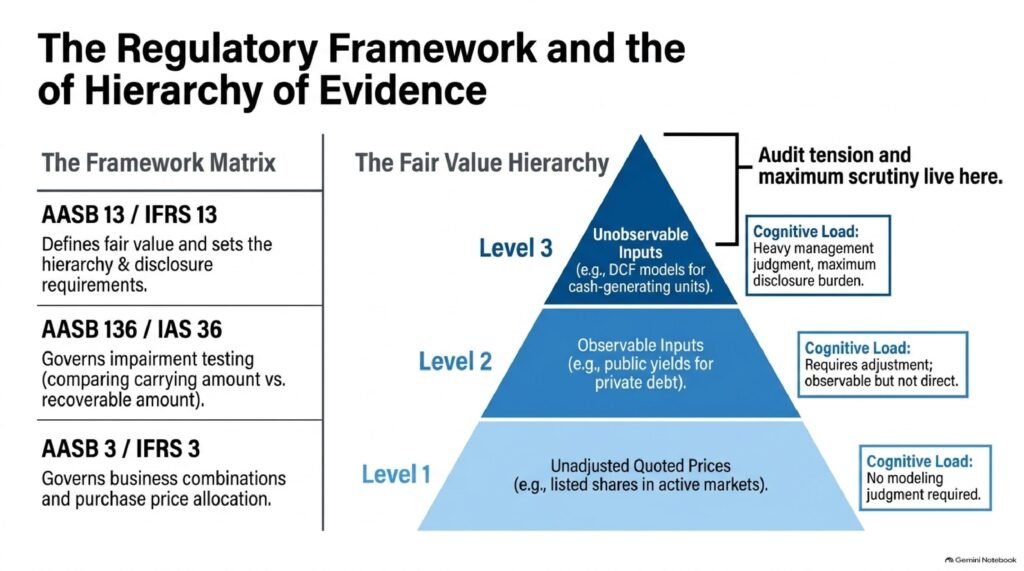
Australian Accounting Standards Board entities report subject to a framework largely based on IFRS, with each IFRS for example having an Australian equivalent. The key standards that Australia preparers rely on for consistency are all focused on fair value and the disclosure requirements contained within AASB 13, the local version of IFRS 13. Impairment testing is covered by AASB 136, which requires an entity to compare the carrying amount of an asset or cash-generating unit with its recoverable amount at least once a year for goodwill and indefinite-life intangibles and whenever an event or a change in circumstances occurs that suggests that an asset or cash-generating unit may be impaired. Business combinations and the purchase price allocation resulting from them are covered by AASB 3, which corresponds to IFRS 3, thus connecting the financial reporting discipline introduced in the previous parts of this series directly back to the financial reporting framework. These three standards are the pillars on which most valuation standards Australia practitioners rely on day to day, and a sound knowledge of all three standards is considered to be a minimum standard for someone entering a position as a valuation or technical accountant.
In addition to the accounting standards themselves, practitioners under accounting standards Australia entities are also subject to guidance from bodies like the Australian Securities and Investments Commission (ASIC), which has had a number of reviews on how listed entities apply fair value and impairment requirements, and is not afraid to call for explanations of disclosures it deems inadequate or inconsistent with the evidence. Many valuers also adhere to the International Valuation Standards issued by the International Valuation Standards Council as they offer in-depth methodology guidance which the accounting standards do not specify in much great detail. In terms of the practical applications for a junior accountant, the accounting standard will tell you what to measure and what you need to disclose, while the professional valuation standard and firm methodology will tell you how to construct a defensible number, and both are important when a file is reviewed. Where there are multiple jurisdictions, this comes compounded by differences in the interpretation of disclosure expectations in different countries, where the underlying standard is the same in terms of wording; a jurisdiction by jurisdiction reference guide is frequently used in conjunction with the main accounting policy manual for multinational finance groups.
Table 1: Key Valuation Standards Australia Entities Commonly Apply – What Is the Role of Valuation in Financial Reporting?
| Standard | Focus Area | Typical Application |
|---|---|---|
| AASB 13 / IFRS 13 | Fair value definition and disclosure | Sets the fair value hierarchy and disclosure requirements |
| AASB 136 / IAS 36 | Impairment of assets | Annual goodwill and indefinite-life intangible testing |
| AASB 3 / IFRS 3 | Business combinations | Purchase price allocation and goodwill recognition |
| AASB 116 / IAS 16 | Property, plant, and equipment | Optional revaluation model for carrying value |
| International Valuation Standards | Valuation methodology | Supplements accounting standards with technical guidance |
How Does Fair Value Financial Reporting Work in Practice?
The three-level hierarchy is the basis for fair value financial reporting and indicates the quality of evidence used to value a financial asset. The inputs for Level 1 are quoted prices in active markets for identical assets and nothing at all is modelled. Level 2 inputs are observable prices, but not directly quoted prices, for example the valuation of the debt of a private company based on the yields of similar publicly traded bonds, and there may be some adjustment for differences between the debt being valued and the market evidence available. The disclosure requirements are most stringent at Level 3 because the reader of the financial statements has no external reference to be able to sanity check the results and the notes require more to explain how the Level 3 figure has been calculated and how sensitive it is to changes in key assumptions. A significant portion of the controversial valuation work in financial reporting occurs in Level 3, which is precisely why a majority of the time of a valuation professional is spent building and defending assumptions, rather than obtaining quoted prices. Regulators are keen to see how items move from one level to another from one reporting period to the next, as an unexplained jump from level 2 to level 3 can indicate that it is likely that the market evidence of the items has actually vanished, or, less innocently, that management has selected a method of valuation that it is easier to manipulate.
In essence, the fair value financial reporting requirements involve creating the model, typically a discounted cash flow analysis or a market multiple comparison or a hybrid of the two, and then subjecting the results to stress testing using various reasonableness tests, such as implied multiples, market capitalisation bridges and prior period trends. The recoverable amount of a cash generating unit is compared with its carrying value, and if the carrying value is higher than the recoverable amount, an impairment charge is booked on the spot, as it becomes a matter of profit or loss, and is why boards and finance teams pay close attention to such calculations in times of market volatility and when a business acquired under an original business case fails to deliver those expected returns. Sensitivity analysis is a normal part of the deliverable, the auditor and the audit committee want to know how much head space does the auditor have before a small adjustment of the discount rate or a change in the growth assumptions causes an impairment, and disclosing this head space transparently is part of a compliant package of fair value financial reporting. This sensitivity disclosure is now part of the standard reporting template of many finance teams, instead of being generated as an afterthought when regulators ask for it, as they have indicated that boilerplate language, without real quantification, is not what the fair value financial reporting disclosure requirements are asking for.
What Five Steps Strengthen Financial Reporting Valuation?
- Determine which standard is appropriate first. Make sure that the item being valued is subject to the same accounting standard because there are three standards AASB 13, AASB 136, and AASB 3, each with different measurement bases and disclosure requirements.
- Ground assumptions on observable data. Wherever possible use market observable inputs; do not use the Level 3 inputs, which are assumptions, for products that are truly illiquid; models that are entirely based on assumptions are the ones where regulators are most attentive.
- Document judgment as it is made. Write the rationale for each assumption as it is made; it is much more difficult to persuade an auditor to believe in the reason for an assumption months after it was made than to believe in it the day it was made.
- Stress-test the headroom. Conduct a sensitivity analysis for the discount rate, growth rate and other judgmental inputs to ensure that management and auditors have a sense of proximity to an impairment.
- Get on board with Early Auditors. Communicate methodology and assumptions to external auditors as early as possible before year end, as it will avoid disputes/rework as year end nears.
What Do Real-World Financial Reporting Valuation Examples Show?
Think of an ASX-listed manufacturing company that recognised huge goodwill for picking up a smaller competitor three years ago, with the name Harrow Mining Equipment Ltd. In response to the decline in commodity prices and the reduced order book of the division purchased, the finance team ran an impairment test as required by the standards set out by valuation standards Australia (VSA) for listed entities. The recoverable amount was calculated with a discounted cash flow model based on revised forecasts of future five-year cash flows, and the resulting amount was below the division’s carrying value, making it necessary to record a material impairment charge, which the audit committee had to explain to shareholders during the following results briefing. The finance team also had to explain to the audit committee every key assumption in the model, such as the terminal growth rate and the working capital adjustments, because the committee members wanted to be assured that the forecast had not been reduced artificially so that the headline impairment was as low as possible as compared to what the economy deserves. It also led the company to rethink the methodology used for their discount rate, as the auditor questioned the original discount rate as being too low due to changing dynamics in the industry of mining equipment, and as such, a valuation opinion can extend well beyond the accounting line item itself and become part of a wide range of governance discussions.
An alternative illustration of the latter type is a diversified property group that values its investment holdings at fair value (revaluation model). A sample of the properties was valued using the external valuer for both the direct market comparison and income capitalisation methods during each reporting period, and the properties were valued in accordance with the group’s financial reporting valuation process, with the resulting fair values reflected in the group’s net asset value. In an environment of rising interest rates, capitalization rates across the portfolio spread apart, and even properties with stable rental income were undervalued simply due to the higher discount applied to the future cash flows, something the finance team had to make clear to investors who initially believed that the decline was a sign of poor property quality. The group eventually included a short narrative part to its investor pack which explained the difference between market-wide rate changes and asset-specific rate changes, a practice other property groups have since followed to prevent the sort of investor confusion that this caused. This case highlights a larger lesson for all of us in the junior ranks: What is important to communicate about financial valuation is the story behind the number and not just the number itself, because the movement in fair value financial reporting is often a function of macro-economic inputs influencing the financial valuation rather than a function of a specific asset being valued.
What Challenges and Lessons Arise in Financial Reporting Valuation?
In financial reporting, the most persistent issue is forecast uncertainty – about the cash flows that underlie most Level 3 fair value estimates; and about whether or not an impairment charge is recognized, which involves a party’s involvement in the process of forecasting cash flows. But auditors are sensitive to this tension and regularly test how close the projections are to historical accuracy and to the consensus of analysts and to the broader trends in the industry before accepting that the projections are reasonable, and therefore, valuation teams need to be prepared to substantiate forecast assumptions with facts, not just management’s intentions. Another recurring issue is the determination of an appropriate discount rate as there can be significant sensitivity to the choice of this one input, and a rate properly reflecting the risk profile of the asset rather than a borrowing of a company-wide cost of capital requires substantial technical judgment—essential to good financial reporting practice at fair value. Data availability is another challenge for unlisted or thinly traded assets, where there is less market evidence and the valuer will have to rely more on comparable transactions or industry benchmarks that may not be a perfect match of the asset being valued.
The most obvious message learned from those who have successfully practiced is the importance of being transparent about uncertainty rather than giving the appearance of precision. A reasonable alternative assumption would be used to disclose the minimum and maximum results they would choose to apply the assumption, not just a single result, would create credibility with auditors, audit committees, and investors alike and is required under today’s disclosure requirements for fair value financial reporting. Practitioners will also learn the importance of having a standing relationship with the auditor as they start week one, as disagreements found in week one will be much cheaper to resolve than disagreements found in final sign-off. Lastly, simplicity is key in making models understandable to those whom they will have to explain at a meeting with a non-technical audience, such as an audit committee or a board, and this is one of the quickest ways to earn the respect of other professionals in financial reporting valuation activities.
Table 2: Common Challenges in Fair Value Financial Reporting and Practical Mitigations – What Is the Role of Valuation in Financial Reporting?
| Challenge | Practical Mitigation |
|---|---|
| Optimistic management forecasts | Benchmark projections against history and independent market data |
| Discount rate selection | Build asset-specific rates rather than reusing a generic corporate rate |
| Sparse market evidence | Use comparable transactions and disclose the judgment applied |
| Late auditor disagreement | Align on methodology and key assumptions early in the reporting cycle |
| Overly complex models | Keep models simple enough to explain clearly to a non-technical audience |
Conclusion: Building a Career Around Financial Reporting Valuation
Today, valuation is not a side issue in financial reporting but is at the core of accounting for and reporting on goodwill and intangible assets, as well as property and financial instruments. Skills that can be utilized across careers in audit, corporate finance, and advisory include understanding the role of valuation in financial reporting; know and be aware of the valuation standards Australia and international standards bodies are constantly developing; consistent application of the fair value financial reporting principles. The next step for professionals developing their skills in this area is to read a series of published financial statements, along with the valuation disclosures, and trace back the chain of thought to the reported carrying value, explaining all of it in plain language; tracing the chain from the valuation to the business narrative is what ultimately sets a strong practitioner apart from a purely technical one.