

Table of Content
1. Introduction: Understanding Earn-Outs, Working Capital Adjustments and Deal Pricing
Among the most widespread illusions of business owners and new practitioners in M&A is the belief that a deal is closed once an agreement is reached on the headline price. However, in reality, the headline enterprise value is just the beginning. A transaction will go through a set of Deal Pricing Mechanisms that can significantly add or subtract from the amount actually paid. These instruments that influence the final economics of any deal include Working Capital Adjustments, Earn-Out Structures, deferred consideration, and Post-Closing Adjustments.
To junior professionals joining M&A advisory, accounting or legal teams, practical differentiators include fluency in M&A Payment Structures. Such mechanisms are common in most private-market transactions in Australia, although they are usually swept under the carpet during theoretical training in favour of headline valuation techniques. Explaining how a Working Capital Adjustment works, why a buyer proposes an earnout, and what Transaction Completion Accounts involve – and to model the financial implications of each – is truly appreciated by clients and deal teams alike.
The article is a practical guide to the top three most frequently encountered Deal Structuring Techniques in Australian private M&A transactions: earnout structures, working capital adjustments, and the broader family of post-closing price adjustment mechanisms. It will address how both work, why each is used, the particular negotiation dynamics each creates, and the lessons that practitioners carry forward from transactions in which those mechanisms were well-crafted and those in which they became the cause of protracted disputes.
2. Earn-Out Structures: Bridging the Valuation Gap
Why earnouts exist
An Earn-Out Structures arrangement is a Performance-Based Payments system that defers part of the purchase price and makes those deferrals contingent on the acquired business meeting specified performance targets after the transaction has been concluded. Earnouts are in place, as often buyers and sellers have genuinely different views on what the business will earn in the future, and an earnout allows each side to price in whatever they think is most likely to happen in the future,not to force an agreement on the uncertain future at a single point in time.
- The seller thinks the business will grow at 30, but the buyer will only underwrite 15. The earnout structure compensates the base price for 15% growth and an incremental consideration in the event of 30% growth.
- Performance-Based Payments based on EBITDA, revenue, or other specific milestones enable the seller to capture the value of a growth trajectory that they are confident in, and the buyer does not need to pay up front because the projections have not been validated.
- On the one hand, earnouts for the buyer would lower the initial capital expenditure, align the seller’s incentive with the business’s performance after the acquisition, and redirect the risk of not meeting the promise back to the party that made the prediction.
What makes an earnout work — and what makes it a dispute
A poorly designed Earn-Out Structures arrangement is one of the most surefire ways to trigger post-acquisition litigation in private M&A. These problems are caused by three structural issues: a vague definition of metrics, a lack of seller autonomy during the earnout period, and a choice of conflicting accounting methodologies between signing and completion. With the EBITDA metric, both the seller and the buyer may make different adjustments after completion, and the buyer, who now controls the financial reporting, may make operational or accounting decisions that will reduce the reported EBITDA in ways the seller cannot challenge, unless explicitly covered in the earn-out documentation.
Effective earnout documentation not only defines the target metric but also how it will be calculated, what accounting policies will govern the calculation, what choices the management of both parties has the right to make independently during the course of the earnout and what dispute resolution mechanism will apply in case the parties disagree on how it will be calculated. Sellers who acquiesce to earnouts without such a degree of specificity are declining Financial Negotiation Terms that give the buyer vast discretionary control over the result.
3. Working Capital Adjustments: The Most Commonly Contested Deal Mechanism
What the Working Capital Adjustment is and why it matters
A Working Capital Adjustment is a Purchase Price Adjustment mechanism that ensures the buyer receives the business with adequate working capital to operate normally and that the seller does not extract excess cash or allow working capital to deteriorate in the period between the deal being agreed upon and completed. The adjustment mechanism compares the actual working capital supplied on completion with the target level and adjusts the purchase price up or down by the difference.
- Working Capital Adjustment = Actual Completion Working Capital Target Working Capital. Favourable difference: buyer pays more. Negative difference: less money paid by the buyer.
- The target working capital is the normal amount of working capital needed to run the business, usually based on an average level over 12 months to prevent seasonal distortions.
- A Purchase Price Adjustment is a dollar-for-dollar adjustment: a shortfall in completion working capital of $200,000 directly reduces the amount that is paid to the seller.
The negotiation dynamics of target working capital
The target working capital level is one of the most technically challenging parts of any transaction that employs this mechanism. Buyers usually want a higher target (that is, they will receive more cash before completion), and sellers want a lower target (that is, they will receive more cash before completion). The change is directly proportional to price – each dollar of movement in the target corresponds to a dollar of value transfer between the parties.
The most justifiable target-setting methodology is to use the average of the prior 12 months of average monthly working capital consistently, and to apply the same methodology to the Transaction Completion Accounts. The fact that either party may set the target on a basis that does not correlate with historical averages creates an immediate opportunity to manipulate, either by pre-completion cash extraction by the seller or by an inflated target that provides the buyer with a windfall adjustment at completion. It would be crucial to align on the calculation methodology and the target in the sale agreement to avoid the most common type of Post-Closing Adjustments dispute.
4. Five Steps to Designing and Negotiating Deal Pricing Mechanisms
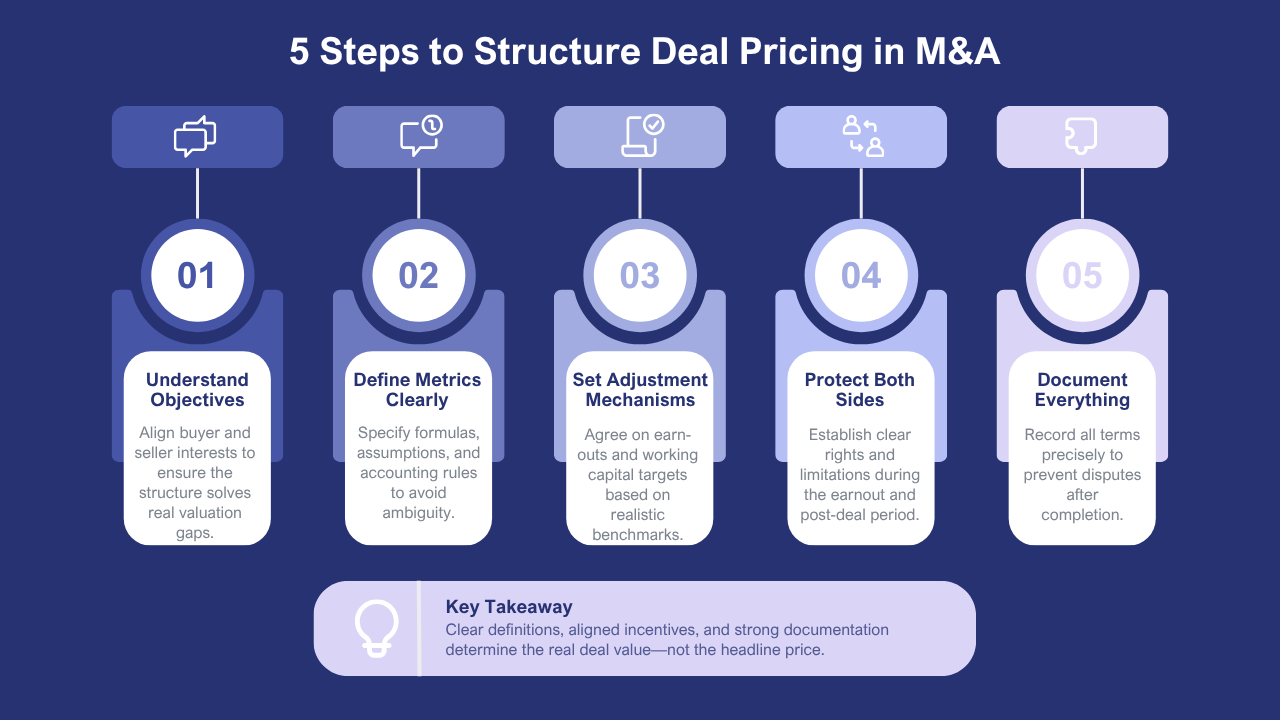
The same basic principles must be used whether one is designing an earnout, negotiating a working capital target, or developing a more comprehensive M&A Payment Structures package. The five steps below are how experienced practitioners approach these mechanisms in live transactions.
Step | What It Involves | Key Negotiation Point | Common Mistake |
1. Understand each party’s structural interest | Identify why the buyer wants an earnout or adjustment and why the seller is accepting it; model the financial outcome for both parties under different scenarios; confirm the mechanism genuinely bridges a valuation gap rather than simply shifting risk | The mechanism must genuinely align the buyer’s and seller’s interests — if the seller has no realistic path to the earnout payment, the mechanism adds complexity without bridging the gap | Using mechanisms to paper over a fundamental valuation disagreement rather than addressing it, proposing an earnout when the seller has no operational autonomy to influence the outcome |
2. Define the metric with surgical precision | For Earn-Out Structures: define the metric (EBITDA, revenue, or milestone), the accounting policies that govern it, the specific add-backs permitted, and the calculation period. For Working Capital Adjustment: define what is included and excluded from working capital, the target level, and the calculation methodology | The metric definition is the most contested element of any earnout; ambiguity in the definition is always resolved in favour of the party with control over the financial statements (usually the buyer) | Agreeing on the metric category (e.g. “EBITDA”) without specifying the adjustments, policies, and calculation mechanics, leaving material judgment calls to be resolved post-completion |
3. Model the Transaction Completion Accounts process | Establish the process for preparing and reviewing completion accounts: who prepares them, what accounting standards apply, the timeline for preparation and review, the process for raising disputes, and the dispute resolution mechanism | The Transaction Completion Accounts process governs who wins ambiguous disputes; a neutral accounting expert as dispute resolver is the most commonly accepted standard in Australian private M&A | Deferring the completion of the accounts process design to the lawyers without financial advisors involved; no independent expert mechanism, forcing all disputes into litigation |
4. Negotiate seller protections during the earnout period | Agree on the seller’s operational rights during the earnout period: which decisions require seller consent, what restrictions apply to the buyer’s ability to change the business, and what accounting policy changes require the seller’s agreement | Seller protections are only enforceable if they are specific and documented; general non-interference language without a defined scope gives the buyer extensive discretionary authority | Accepting earnout terms without specific seller protections; relying on the buyer’s goodwill rather than documented rights to influence the outcome |
5. Document Post-Closing Adjustments clearly in the transaction documents | Ensure all adjustment mechanisms are documented in the sale agreement with sufficient specificity to be interpreted consistently: the adjustment formula, the governing accounting policies, the timeline, the interest rate on disputed amounts, and the dispute resolution pathway | The sale agreement is the only reference point once the deal is complete; any ambiguity in the adjustment provisions will be resolved against whichever party had the lesser bargaining power at completion | Treating the adjustment provisions as boilerplate, not reviewing the financial model implications of the legal drafting before the agreement is executed |
The step that most often determines whether an Earn-Out Structures arrangement is yielding its intended result or is in conflict is Step 2: defining the metric with precision. The definition of EBITDA used in an earnout should address all of the adjustments that could conceivably occur during the earnout period: what happens when the buyer acquires another business and integrates it with the target? Which group overheads can the buyer charge? Is the depreciation policy one that the buyer can change? Is the buyer able to hasten recognition of revenue? All of these questions involve a dollar difference in the earnout payment, and each should be clearly stated in the documentation due to the actual payment difference.
5. Process, Real Cases, and Lessons for Practitioners
The deal pricing mechanisms workflow
Deal Structuring Techniques of an earnout, working capital adjustment and other Deal Pricing Mechanisms are negotiated as part of the overall transaction process and not as a separate exercise. The workflow below, in four stages, shows how the work of experienced advisors is imbued with these mechanisms and the deal timeline.
Phase 1 | Phase 2 | Phase 3 | Phase 4 |
Mechanism Design | Heads of Terms | Legal Documentation | Completion & Post-Deal |
Identify which Deal Pricing Mechanisms are appropriate given the valuation gap and risk profile; model the financial outcomes under different performance scenarios; identify each party’s key interests and design mechanisms that genuinely bridge the gap | Agree on the structure of the Earn-Out Structures and Working Capital Adjustment in heads of terms; document the metric category, the target level, and the key governance principles before legal drafting begins; identify M&A Payment Structures that require specialist tax advice | Financial advisors review legal drafts for consistency with the agreed model; metric definitions tested against scenarios; Transaction Completion Accounts process documented; seller protections during the earnout period specified; Post-Closing Adjustments formula confirmed | Completion accounts prepared to the agreed methodology; Working Capital Adjustment calculated and agreed; Earn-Out Structures performance tracked against documented metrics; disputes escalated to the agreed independent expert mechanism |
Case 1: The undocumented accounting policy
The acquisition was structured under a two-year Earn-Out arrangement based on EBITDA. In the first year of the purchase, the buyer centralised the IT infrastructure and charged a share of the group IT expenses to the earnout entity – a cost that had not been incurred when the deal was priced. The seller pointed to this amount as reducing the earnout EBITDA below what would have been earned without the buyer’s decision. The buyer claimed it was a fair expense of the merged company. The definition of EBITDA in the sale agreement did not specifically address group overhead allocations. The case went to litigation, where both sides incurred costs that far exceeded the value of the dispute. The moral is simple: Earn-Out Structures documentation should not only discuss what is included in EBITDA, but also what the buyer cannot do to influence it. The policies of overhead allocation should be agreed upon and locked during the signing process.
Case 2: The working capital ambush
A manufacturing company was sold using a Working Capital Adjustment mechanism without a specific target. The parties have agreed that the target would be normal working capital, but have not specified how normal would be determined. When completed, the advisors to the Buyer prepared a Transaction Completion Account which reflected working capital of $1.1 million – approximately 380,000 less than what the seller thought that normal working capital should have. The controversy was whether seasonal inventory patterns should be included in the target and whether a large debtor that had existed for 10 months should be treated as a current or overdue receivable. Since the target and the methodology had not been documented, both interpretations were technically defensible. The buyer finally settled on a compromise that was 180,000 dollars less than what they had initially expected – all avoidable with the appropriate Purchase Price Adjustment documentation at the time of the sale agreement.
Practical reference: Mechanism, risk, and protection
Mechanism | Primary Risk | Seller Protection | Buyer Protection |
Earn-Out Structures | Buyer makes post-completion decisions that reduce earnout EBITDA; metric ambiguity resolved in buyer’s favour | Document all adjustments and exclusions; specify operational autonomy rights; agree on the overhead allocation policy at signing | Cap the earnout at a defined maximum; specify non-manipulation obligations on the seller during the earnout period |
Working Capital Adjustment | Target set inconsistently with historical average; seasonal distortion inflates or deflates the target | Use a 12-month average as the target; agree on methodology and inclusions/exclusions in the sale agreement before completion | Conduct an independent review of completion accounts; agree on pre-completion covenants restricting seller cash extraction |
Post-Closing Adjustments broadly | Completion accounts prepared by the buyer applying favourable policies; disputes unresolved for extended periods | Agree on the accounting policies governing the Transaction Completion Accounts at the time of the sale agreement, and include an independent expert mechanism. | Clear timeline for preparation and review; interest provision on disputed amounts; right to review source documentation |
6. Conclusion
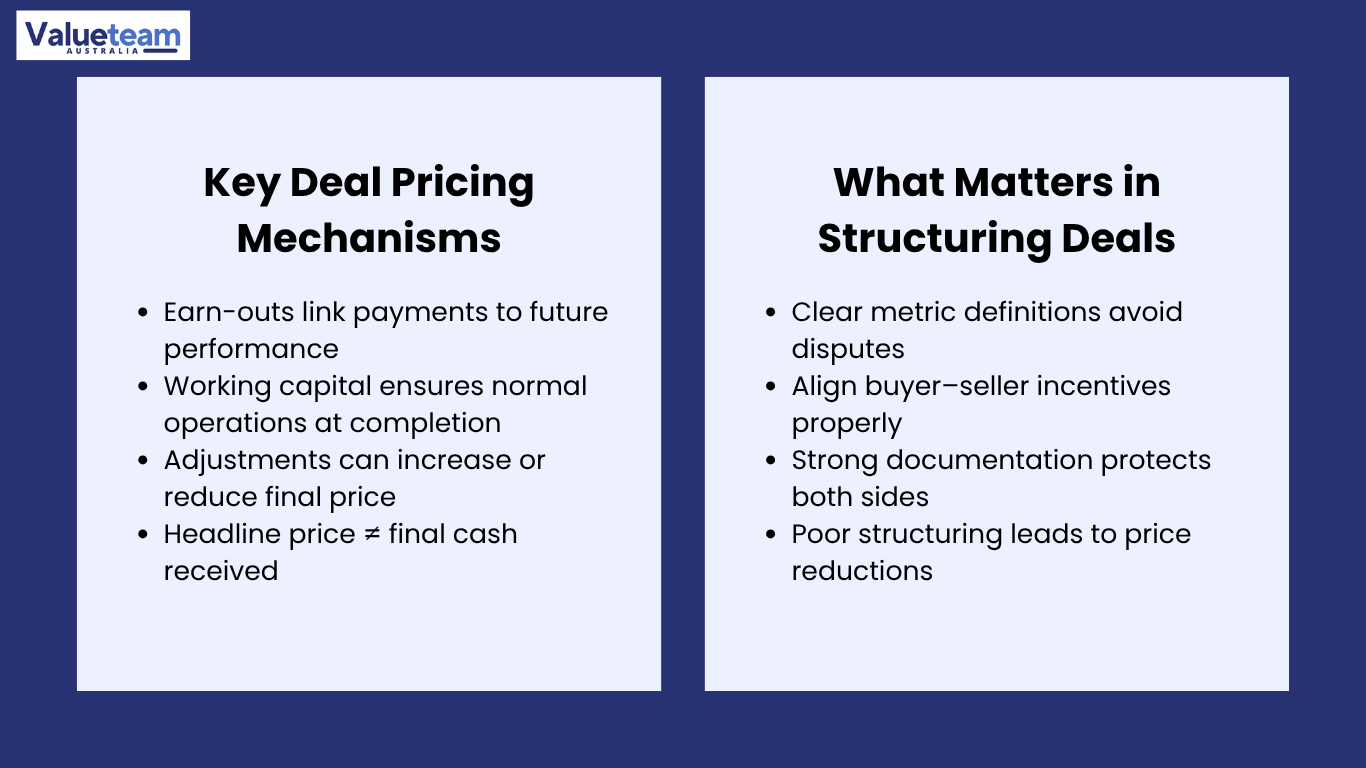
The Earn-Out Structures, Working Capitals Adjustment mechanisms and the broader family of Post-Closing Adjustments are not marginal deal mechanisms – they are the tools by which the final economics of a deal are determined. Whether a deal will yield the required result and not result in an expensive post-completion dispute is almost always a question of the quality of the documentation rather than the parties’ business intent. Ambiguous Financial Negotiation Terms, undefined metrics, and underdocumented adjustment processes are all foreseeable sources of post-closing conflict.
To practitioners: treat each Deal Pricing Mechanisms provision as an occurrence that will be tested under the worst interpretation that can be made out of the other side, and document accordingly. To buyers, the definition of the earnout metric is as significant as the earnout target. To sellers: the earnout that you can enforce is that which your lawyers have written down and exactly before you finalised the deal.
Frequently Asked Questions
Q1. What is an earn-out in a business acquisition?
An earn-out is a payment arrangement where part of the purchase price depends on the business achieving agreed financial or operational targets after the transaction.
Q2. Why are working capital adjustments included in acquisitions?
Working capital adjustments ensure the business is transferred with an agreed level of operating assets and liabilities, promoting fair pricing for both parties.
Q3. How do earn-outs affect deal pricing?
Earn-outs align buyer and seller interests by linking future payments to business performance, reducing valuation uncertainty during negotiations.
Q4. Why is working capital important in transaction pricing?
Adequate working capital supports business continuity after completion and helps ensure the agreed purchase price reflects the company’s true operating position.
Q5. How do professional advisers support transaction structuring?
Valuation experts, accountants, and legal advisers help structure earn-outs, calculate working capital adjustments, and negotiate fair pricing that supports successful transactions.
1 thought on “Understanding Earn-Outs, Working Capital Adjustments and Deal Pricing”