

Table of Content
1. Introduction: Formal Valuation Report
To many business owners, the notion of engaging a Formal Valuation Report is something they do only once – when they want to sell. In fact, the range of situations that necessitate or are greatly improved by the provision of a formal, independent valuation is far more extensive than most owners and their advisers realise. Whether it be for tax structuring events, Shareholder Disputes Valuation cases, compliance with the Australian Accounting Standards, or determining the M&A Valuation Timing for a sale, merger or acquisition, there are numerous instances in the life of a business where a credible, documented valuation is required – and knowing ahead of time where they lie is the best risk mitigation strategy for any owner or advisor alike.
The difference between an informal Estimate of Value and a Formal Valuation Report is more than a matter of form and content. It is a distinction of purpose, accountability, and evidential value. An informal estimate – such as a business broker might provide in the course of a discussion about listing a business, or such as an accountant might provide as a planning guide – has its place in low-stakes situations. But when that estimate is used to meet the ATO’s requirements in support of a position for CGT purposes, in court, or to meet the Audit and Compliance requirements of a financial reporting obligation, its shortcomings become potential weaknesses. The Independent Valuation standard – the work of a qualified, credentialed professional, reported to a defensible methodology, and signed off with professional accountability – is what’s needed in those situations.
This piece is aimed at business owners who may wish to know when a formal report is required and when an informal estimate will suffice, and at rising and mid-level professionals who want to learn about the issues so they can advise their clients with confidence. It addresses the main trigger events that require or strongly advise a Formal Valuation Report in Australia, the five steps to preparing one, the challenges practitioners face, and the lessons learned from real cases where the timing and quality of the valuation made all the difference.
2. Tax and Compliance Triggers: When the ATO Requires Formal Support
Tax Valuation Needs are a common, non-discretionary trigger for a Formal Valuation Report in Australia. Businesses and their advisors are obliged to provide the Australian Taxation Office with reliable valuations of transactions supported by documented methodology – and when valuations are disputed, the quality of the documentation is the key factor in whether the taxpayer’s position is maintained or amended. The most common tax valuation needs are for capital gains tax events on the transfer of business assets, tax consequences of Division 7A on non-arm’s-length transactions between related parties, employee share schemes, and research and development (R&D) incentive claims that rely on the fair value of assets used in the relevant R&D.
Compliance requirements in the tax field in Australia have become more rigorous in recent years, as the ATO has focused on business valuations as a compliance area. The ATO has more stringent requirements for the documentation of valuations, which were once acceptable with minimal evidence, now requiring evidence of methodology, comparison analysis, a nd sign-off by a qualified preparer in any area where the valuation is significant to the taxpayer’s position. The upshot for advisors to SMEs is that the valuation report used for tax purposes should be of a quality that would withstand ATO scrutiny, rather than needing to be supplemented in a rush if challenged. This standard should be considered far cheaper to achieve than cleaning up a mess later.
Interrelated party transactions between different tax jurisdictions are a specialised but growing area of Tax Valuation Needs for Australian multinationals and other entities with a multinational structure. The ATO’s arm’s-length standard means that related party transactions should be priced as if they were arm’s-length transactions – and evidence of compliance with this standard must be formally documented in terms of the economic value transferred. For aspirational practitioners, an understanding of the OECD Transfer Pricing Guidelines and their interaction with Australian tax law is a valuable distinguishing factor, as this is an area where the market for advice continues to exceed supply.
3. Legal and Dispute Contexts: Where Independent Evidence Is Non-Negotiable
Legal Valuation Purposes include many scenarios in which the value of a business or its assets is at stake in legal proceedings, contractual arrangements, or regulatory matters. In each case, the standard of evidence is significantly higher than in a commercial transaction context, and the Independent Valuation standard (i.e. prepared by a qualified expert without a material interest in the outcome) is not merely recommended but required. The most prevalent Legal Valuation Purposes in Australia are valuations carried out for Shareholder Disputes, valuation litigation, family law property settlements (where the business is an interest in the property to be divided), compulsory acquisition, and insolvency asset valuations.
Shareholder Disputes Valuation is especially prevalent in SME businesses where management relations break down, partnerships expire, or minority shareholders seek to exit a business that is reluctant to provide a liquidity event. In such cases, each side of the dispute will ordinarily have valuations prepared, and the differences between these valuations will form the core of the dispute. Unlike the US, Australian arbitrators and courts do not simply take the average of the valuations – they compare the methodology, assumptions and expert opinion of the valuations and favour one that is better constructed and better argued. This means that the quality of the Formal Valuation Report (not the figure itself) is crucial. Experts who appreciate this place defend the methodology first and foremost, above all else
There are special issues for valuers in family law cases involving a business interest. The Family Court requires a business interest to be valued at its fair value at the date of separation, which necessitates the historical reconstruction of the business’s financial position and, where there has been a significant change to the business since that date, the need to adjust for those changes. The Independent Valuation for family law must not only be methodology sound. Still, it must also be prepared by an individual who meets the court’s requirements for an expert witness. These criteria rule out informal or unsigned valuations regardless of the quality of the analysis. For those providing advice to clients in separation, the timely engagement of a business valuer (before the crystallisation of positions) leads to better outcomes for both sides than when business valuation is undertaken midway through the process.
4. M&A and Corporate Finance: Getting the Timing Right
M&A Valuation Timing is one of the most important elements of any transaction process, and is often misplayed by advisors and business owners in both the early and late game. Waiting too long to engage a valuer – in the weeks just before a sale – results in a report that reflects the value of the business as it stands, with no opportunity for preparation to improve those aspects of the business that might have added value. Engaging a valuer too soon – before the financial house is in order, and before the management team’s story is consistent – results in a report whose insights are no longer relevant by the time they are needed. The ideal M&A Valuation Timing for most Australian SMEs is 12 to 18 months in advance of the expected sale or transaction, to provide enough time to address any identified value gaps and ensure the report is not out of date.
Business Sale Preparation is the obvious place where a Formal Valuation Report delivers value. An independently prepared, credible valuation is used in a sale process to: provide a firm basis for price negotiations between the vendor and the buyer; signal to the buyer that the business is ready for sale (and therefore less risky); mitigate the information asymmetry between the vendor and the buyer that allows the buyer to negotiate price adjustments; and to provide a basis for the vendor’s advisors to counter the analysis of the buyer’s due diligence team. Vendors who do not produce a formal valuation before going to market are essentially giving up the analytical high ground to the buyer – and in a transaction, giving up the high ground means giving up price.
Formal Valuation Reports are also common for corporate finance events other than trade sales. Management buyouts, fundraising from external investors, bank financing for an acquisition, and the buyout of a minority shareholder at a price agreed in a shareholders’ agreement buy-sell process are all situations in which the valuation needs to be credible to a financially savvy audience. The Financial Reporting Standards of AASB 3 (Business Combinations) and AASB 136 (Impairment of Assets) require specific standards for determining the fair value of acquired assets and for subsequent impairment testing of goodwill – standards that are required for any entity whose financial statements are audited. For listed and large private corporations, these are ongoing Audit and Compliance requirements.
5. Five Situations That Require a Formal Valuation Report
In Australia, there are five situations across the areas of tax, legal and corporate finance where a Formal Valuation Report is most commonly mandated or highly recommended. Knowing each of these – and the type of report that’s required – is a valuable insight for advising business owners throughout the lifetime of a business.
Trigger Situation | Why a Formal Report Is Required | Key Standard to Meet |
Capital Gains Tax events (asset transfers, restructures, estate planning) | Tax Valuation Needs: ATO requires documented, methodology-supported valuation to establish the cost base or market value used in CGT calculations; informal estimates are routinely challenged | Qualified preparer; documented methodology; arm’s-length market value standard; must withstand ATO review |
Shareholder Disputes Valuation (buyouts, deadlocks, oppression proceedings) | Legal Valuation Purposes: courts require independent expert evidence meeting the Expert Witness Code; competing valuations are assessed on methodological rigour, not just outcome | Independent expert credentials; full methodology disclosure; compliance with Expert Witness Code of Conduct |
Business Sale Preparation (trade sales, MBOs, partial divestments) | M&A Valuation Timing: a formal report establishes the vendor’s price anchor, resists buyer due diligence adjustments, and signals professional preparation to the market | Credible comparables; normalised earnings base; sensitivity analysis; formal sign-off by a qualified valuer |
Financial Reporting Standards compliance (AASB 3, AASB 136 goodwill impairment) | Audit and Compliance: auditors require independently supportable fair value assessments for business combinations and annual goodwill impairment testing | AASB-compliant methodology; auditor-grade documentation; annual refresh for ongoing goodwill testing |
Family law property settlements involving business interests | Legal Valuation Purposes: Family Court requires valuation at the date of separation by a qualified expert meeting court standards; historical reconstruction is often required | Family Court expert witness standard; valuation at specified date; methodology documented to withstand cross-examination |
The table above captures the five most structurally important triggers. Still, practitioners should be aware of a few other contexts in which a Formal Valuation Report is a valuable addition, even if not required. Division 83A valuations for Employee Share Schemes require a defensible determination of what the fair market value would be at the time of grant. Claims for business interruption insurance require pre-loss valuations for quantum. And estate or succession planning – where business owners are transferring their interests to family members or the next generation of business leaders – can benefit from a formal report which documents the value used to structure the succession plan and minimises the potential for future disputes between parties with conflicting views of the value.
6. Process, Challenges, and What the Market Teaches You
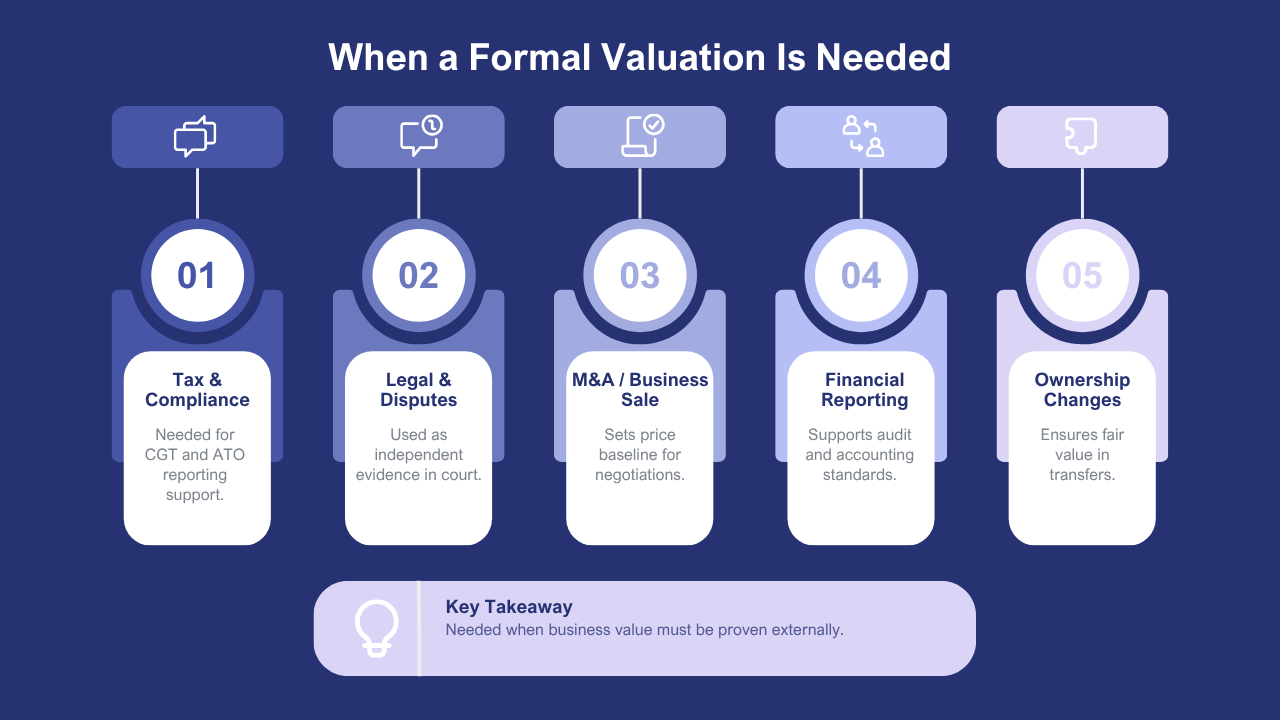
Knowing when to prepare a Formal Valuation Report is only part of the practitioner’s challenge. Knowing how to prepare for one – and more importantly, how to manage some of the points of contention that emerge during the course of an engagement – is equally important. The following four phases reflect the “real world” nature of a formal valuation engagement, from brief to report.
Phase 1 | Phase 2 | Phase 3 | Phase 4 |
Brief & Scope Definition | Financial Reconstruction | Methodology & Evidence | Report, Review & Delivery |
Define purpose, legal standard, and required report type; identify the intended audience (ATO, court, buyer, auditor); agree on engagement terms and timeline; collect three years of financial records | Normalise earnings; identify and document add-backs; reconcile management accounts to tax returns; assess working capital profile and balance sheet for Compliance Requirements Australia contexts | Select methods appropriate to the purpose and audience; gather market comparables; apply the Independent Valuation standard; document all assumptions to the required evidential level | Draft Formal Valuation Report with full methodology disclosure; conduct quality review against applicable standard (tax, court, audit); issue signed report; support client in any challenge or review process |
Problems often arise in Phase 1. The lack of clarity about the report’s purpose and audience in the brief creates a scope problem that can result in a report being produced under the wrong standard. A valuation for internal planning purposes (where the analyst may adopt shorter-form reporting and less rigorous comparisons) is structurally incompatible with reporting to the ATO, the court, or an auditor. Where the purpose of the engagement shifts partway through the process, or the report is used for different purposes without additional information, the report’s standard being inappropriate for the new audience is fraught with risk for the client and the advisor. Five minutes of scoping up front avoids hours of repair.
The third phase – identifying the methodology and gathering evidence – is the most technical phase of any Legal Valuation Purposes engagement. The Independent Valuation standard for court purposes is stricter than the standard for transaction purposes. All assumptions need to be recorded and withstand cross-examination. Comparable transactions must be justified, rather than merely stated. Any discount rate used in an income-based approach must be derived from a WACC calculation that the opposing expert and the judge can test. Many who are unfamiliar with the demands of Legal Valuation Purposes work fail to appreciate these issues and provide reports that are technically robust in their financial modelling but not sufficiently evidentiary to be meaningful to the proceeding in which they have been produced.
Audit and Compliance purposes are a different matter – less adversarial than Legal Purposes, but not without their challenges. Auditors engaged to review goodwill impairment testing under AASB 136 must exercise scepticism over management’s assumptions used to calculate value, and regularly challenge the discount rate, growth rates and overhead allocations to individual cash-generating units. The Formal Valuation Report provided to auditors, therefore, needs to take these challenges into account and address them directly, rather than present uncertainty that will either be filled in by the audit team’s conservative bias or flagged as a qualification. Valuation advisors who have participated in audits with their clients gain valuable insight into the audit team’s focus, which they can use to structure the report to facilitate an efficient review.
7. Real Cases and What They Reveal
A prime example of the consequences of poor M&A Valuation Timing is a professional services organisation that went to market with only a broker’s indicative report. The vendor had been told that a formal report was not needed because the business was simple. The prospective preferred buyer’s due diligence team, working with a Big Four advisory firm, conducted an earnings quality analysis and found that normalisation adjustments reduced the investable EBITDA by 22 per cent compared to the broker’s assessment. Without the vendor having a “Formal Valuation Report” prepared at market entry, they tended to accept the price adjustment. The price of a report at the start of the process (about $14,000) would have given an independent analytical basis for contesting at least some of the adjustments. The final sale price was significantly lower than what it would likely have been based on an earlier independent valuation.
Another example illustrates the benefits of early involvement in a Shareholder Disputes Valuation. The owners of a manufacturing company were unable to resolve a dispute and agreed that one owner would purchase the other’s share at fair value. The parties used independent valuers at around the same time, before a lawsuit was commenced. The two reports, prepared to a similar standard and using the same method, had estimates that differed by 12 per cent, a difference that could readily be resolved. The overall cost of the valuations was around $28,000. If litigation had been necessary, it would have certainly cost 10 times this figure and taken much longer. The moral: in dispute matters, the competency and integrity of the Independent Valuation are key factors in determining whether the matter is settled commercially or litigated, which is costly.
8. Conclusion: Actionable Insights for Owners and Advisors
When a Formal Valuation Report is required in Australia, there is no one standard answer, but there is a standard approach. Any situation in which the value of a business is to be communicated to a financially or legally sophisticated audience – the Australian Taxation Office, a court, an auditor or the due diligence team of a sophisticated buyer – is a situation that demands the Independent Valuation standard. Any context in which the value ascribed to a transaction will later be tested against Compliance Requirements Australia is a context where the quality of reporting, not just the value itself, is what matters to the client’s interests.
The most practical advice for business owners is to recognise which events are likely to trigger a valuation (a business sale, a restructure, a change in business partners, an employee share scheme) and to ensure valuations are undertaken well before the event so that the process can do the most good. A 12-18-month Business Sale Preparation process is not excessive; it is an example of what works. For those with an ongoing Audit and Compliance role, the time to engage with a valuation specialist is before the reporting deadline, to ensure a sound, rather than a rushed, valuation.
For those who are new to or in the early stages of their careers in this space, the best thing you can do is simply to memorise the trigger events described in this article and the Formal Valuation Report standard of reporting applicable to each. The capacity to identify, during a client discussion, before the client does, that a future transaction or event will involve an Independent Valuation to a particular standard is the type of advisory activity that strengthens client relationships. Tax Valuation Needs, Legal Valuation Purposes, M&A Valuation Timing and Financial Reporting Standards compliance are all areas where the cost of providing the right advice promptly is far outweighed by the cost of doing it too late.
Frequently Asked Questions
Q1. When is a formal valuation report required?
Formal valuation reports are commonly required for mergers and acquisitions, financial reporting, taxation, litigation, shareholder disputes, succession planning, and financing.
Q2. Why is an independent valuation report important?
Independent reports provide objective and well-supported conclusions that improve credibility and support important financial and legal decisions.
Q3. Who typically requests formal valuation reports?
Business owners, investors, accountants, auditors, legal professionals, lenders, regulators, and government authorities may require formal valuation reports.
Q4. What does a formal valuation report include?
The report generally includes valuation objectives, financial analysis, methodologies applied, assumptions, supporting evidence, and the final valuation conclusion.
Q5. How does a formal report benefit stakeholders?
It enhances transparency, supports compliance, reduces disputes, and provides reliable information for business decision-making.
1 thought on “When Do Australian Businesses Need a Formal Valuation Report?”