

Table of Content
1. Introduction to M&A Deal Negotiations
In the M&A advisory process, the business valuation is not only a calculation: it’s the first line of defence in a negotiation. Business Valuation in M&A serves as the starting point for all subsequent price negotiations, the decision-making framework for the buyer and seller, and the evidence used to justify price concessions or rejections. A seller who knows their valuation knows what they can ask for and why, and has the conviction to stick to their guns. A buyer with a well-modelled deal knows how much they can afford to pay while maintaining a positive return on the transaction – and can use that as a discipline to avoid overpaying in a competitive auction.
For junior- to mid-level professionals looking to work in the transaction advisory market, one of the biggest mindset shifts is moving from calculating valuation to communicating and negotiating valuation. The Financial Modelling M&A process generates outputs that are important not because they are the “right” answers – there is no “right” answer to valuing a private business – but because they shape the dialogue between the buyer and the seller in a value-enhancing (or value-destroying) way. A well-prepared valuation model, effectively communicated and defended, shifts the Negotiation Leverage in the author’s favour.
This article is for those interested in how valuation and negotiation work together in a real M&A deal – how the starting valuation positions the parties to a deal, how Price Adjustment Mechanisms (PAMs) are used to negotiate to a point valuation cannot take us to, and how successful practitioners seek to preserve their clients’ positions from the first offer to closing. Whether you are representing the vendor, the purchaser, or building your own technical skill set, the models here reflect the reality of deal-making.
2. How Valuation Shapes Negotiating Position from Day One
The valuation as a negotiating anchor
The first price in an M&A negotiation has an outsized impact on the negotiation’s outcome – a recognised psychological and commercial phenomenon. Buyer Seller Negotiation in private M&A negotiations demonstrates that parties who set the price anchor based on a credible business valuation have a behavioural advantage over parties who react to an anchor – a number they did not set. This means the seller should anchor the indicative price in the information memorandum or the response to the initial offer, based on a business valuation, not on the seller’s aspiration or an estimate provided by the broker.
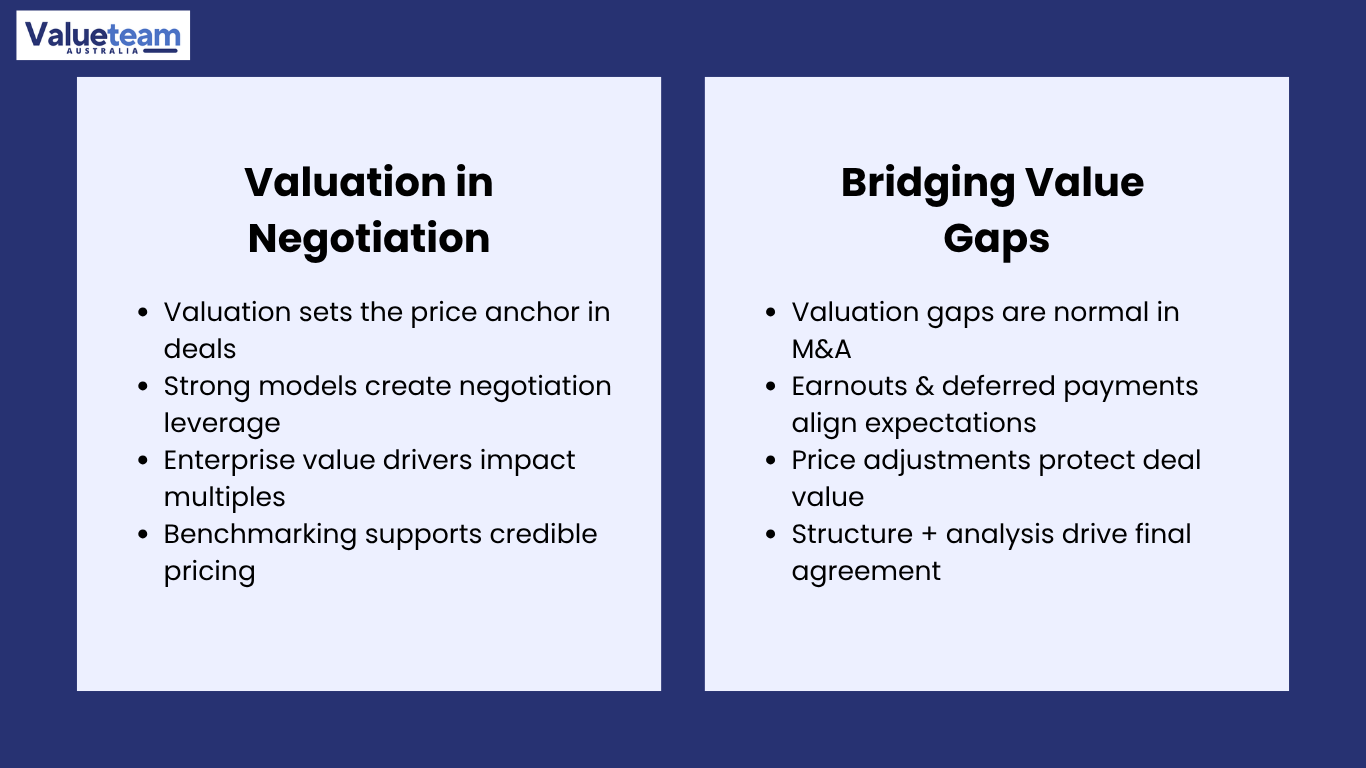
- A seller who provides an independent business valuation with supporting methodology sets the agenda for the negotiation – the buyer must either accept the seller’s argument or develop an alternative analysis.
- A buyer who makes an indicative offer, backed by Financial Modelling M&A output (i.e., the price, the earnings base, and the return), demonstrates commercial discipline that commands respect and speeds the process.
- Negotiation Leverage is less about who wants it more and more about who has better information and who has effectively communicated the implications of that information for price.
Enterprise Value Drivers that shift the multiple
The multiple used in an EBITDA of business valuation is not a constant but depends on how the market prices the Enterprise Value Drivers of the business being valued. Predictable revenue streams, geographic and customer diversity, management talent, intellectual property and scalable processes justify higher multiples. Concentration, owner dependence, margin volatility and lack of processes justify lower multiples. It is the analytical underpinning of Business Valuation in M&A to understand which factors apply to a given business and to communicate their impact on value with data.
For Valuation Practitioners, Valuation Benchmarking against similar deals is the most common way to determine and defend a multiple. Industry reports, and comparable deals disclosed by brokers (and, if applicable, public announcements of acquisitions) provide external comparables that turn the abstract “market multiple” into concrete figures. The side with the best comparable information and the ability to effectively communicate it has a clear information advantage.
3. Bridging Valuation Gaps with Deal Mechanisms
Why business valuation gaps exist and why they are normal
Most M&A transactions start with a difference in business valuation between the buyer and the seller – and this is not a sign of bad behaviour or wrongheadedness. It is based on different expectations for the business’s future returns, different market risk premiums, and different information sets. The seller sees the upside; the buyer sees the risk. In this situation, Deal Pricing Strategy is not about pricing the business to determine the “right” price; it is about determining a structure that narrows the gap between the seller’s and buyer’s views of the business, given their scepticism about the future.
- Earnouts pay part of the price based on post-deal performance, enabling the seller to profit if the business performs better than the buyer expects.
- Deferred consideration is consideration paid over time, lowering the buyer’s immediate cash outflow and risk-sharing between the parties.
- Vendor financing (where the seller lends some of the consideration to the buyer to finance part of the purchase price) reduces the buyer’s initial cash outlay and demonstrates the seller’s belief that the business will have the capacity to service the liability.
Price Adjustment Mechanisms in Practice
Price Adjustment Mechanisms (PAMs) are provisions in a sale agreement that seek to adjust the headline price of the purchase to the actual financial condition of the business at completion – usually through a working capital adjustment (WCA), net debt adjustment (NDA) or a locked-box mechanism. These mechanisms seek to ensure that the buyer acquires the business in the financial position assumed at the time the price was determined, rather than being affected by any unexpected financial fluctuations between the contract date and completion.
Working capital adjustments are the most widely used Price Adjustment Mechanisms in Australian private market deals. These set a target amount of working capital at which the business is assumed to be valued, and then increase or decrease the price at completion depending on whether the actual working capital at completion is higher or lower than the target. The target working capital is one of the most technically challenging aspects of any business deal – a $200,000 difference in the target is a $200,000 difference in the price, so this is a negotiation that can benefit from rigorous preparation.
Mechanism | How It Works | When to Use It | Negotiation Consideration |
Earnout | Part of the consideration is deferred and paid if post-completion performance metrics are met; it bridges the buyer-seller business valuation gap on future earnings | Where the seller believes in future growth, the buyer discounts; management continuity post-completion is important | Define metrics precisely; agree on EBITDA adjustments post-completion; specify the seller’s operational autonomy during the earnout period |
Working Capital Adjustment | Completion price adjusted up or down based on actual vs. target working capital at completion date | Nearly all transactions ensure the buyer receives the business in the assumed financial condition | Target working capital negotiation is dollar-for-dollar; use a 12-month average to avoid seasonal distortion; agree on the accounting policies that govern the calculation |
Locked-Box | Price is fixed at a historical balance sheet date; any value leakage between the locked-box date and completion is prohibited | Transactions where the seller wants price certainty; common in PE-backed vendor processes | Identify all permitted leakage items precisely; monitor for any unpermitted value extraction between signing and completion |
Vendor Finance | The seller provides a loan for part of the acquisition price, reducing the buyer’s upfront cash requirement. | Where the buyer has limited capital or wants to share risk, it signals the seller’s confidence in the business. | Negotiate the interest rate, repayment terms, and security; address the interaction between the vendor loan and the earnout if both are used. |
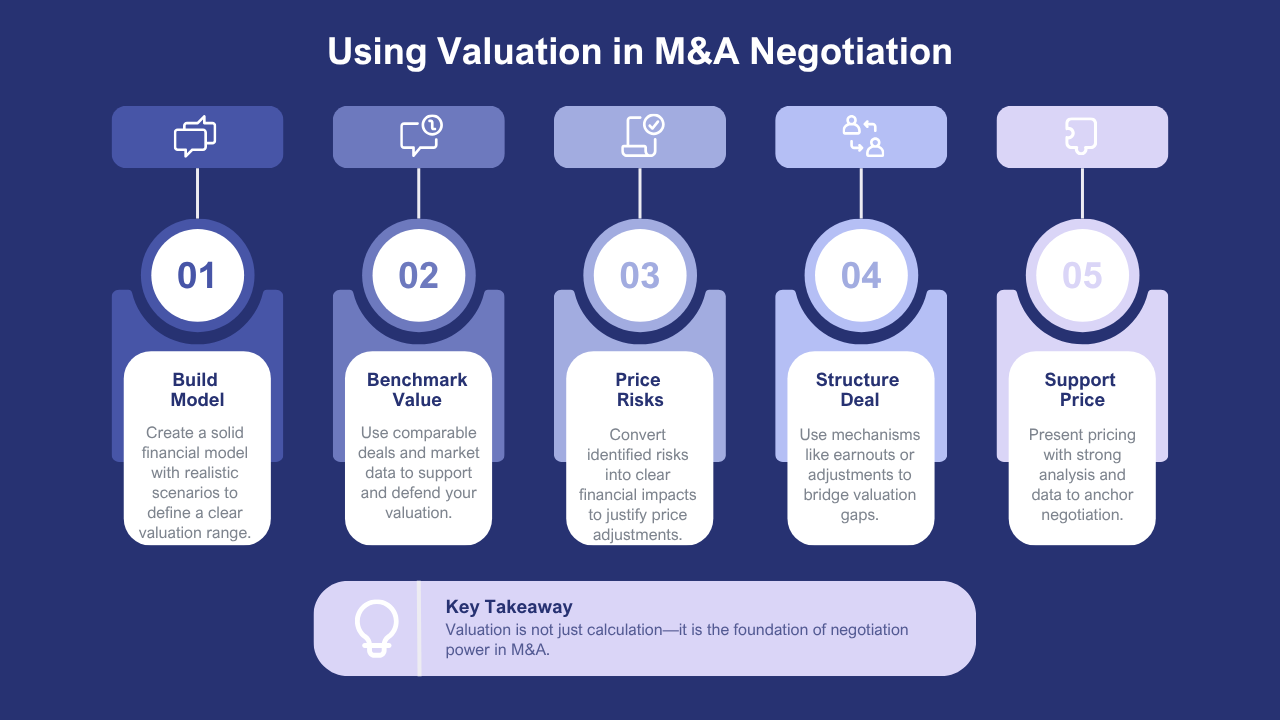
4. Five Steps to Using Valuation as a Negotiating Tool
The most successful Buyer Seller Negotiation in M&A is not “positional” negotiation – it is about leveraging superior preparation to develop and support a business valuation thesis. The following five steps reflect the approach to merging Financial Modelling M&A with negotiation strategy.
Step | What It Involves | Negotiation Outcome | Common Mistake |
1. Build a rigorous Financial Modelling M&A base case | Reconstruct normalised EBITDA from source documents; model the DCF under base, upside, and downside assumptions; run sensitivity analysis on the key value drivers | Establishes the buyer’s disciplined price range; allows the buyer to resist escalation beyond the range that meets return criteria | Building only one scenario, accepting the seller’s normalised EBITDA without independent reconstruction; sensitivity analysis limited to one or two variables |
2. Establish Business Valuation Benchmarking references | Compile comparable transaction multiples from sector reports and disclosed deals; identify the specific Enterprise Value Drivers that position this business above or below the sector average | Provides external validation for the price position; reduces the subjectivity of multiple selections in negotiation | Using generic sector multiples without adjusting for the specific quality characteristics of the target, relying on benchmarks that are too old or from non-comparable markets |
3. Identify and quantify the Negotiation Leverage points | Map each identified risk to its valuation impact; prepare a risk-to-price adjustment schedule; determine which risks are best addressed through price vs. contractual protection | Translates due diligence findings into specific price positions rather than vague concerns; gives the buyer a structured basis for price adjustment requests | Identifying risks during due diligence but not translating them into specific dollar adjustments; accepting qualitative risk acknowledgement without price or contractual consequence |
4. Design the Strategic Deal Structuring position | Determine the optimal combination of upfront consideration, deferred consideration, earnout, and Price Adjustment Mechanisms to bridge any business valuation gap while protecting against downside scenarios | Creates a deal structure that both parties can accept — seller gets confidence in full value realisation; buyer pays based on verified performance | Over-complicating the structure; failing to model the interaction between multiple mechanisms (e.g. earnout and working capital adjustment); producing a structure that neither party’s lawyers can document clearly |
5. Anchor the Deal Pricing Strategy with documentation | Present the final price position with supporting analysis — comparable transactions, normalisation schedule, sensitivity tables, and risk-to-price bridge | Positions the price as the analytically defensible output of a rigorous process rather than an arbitrary opening offer | Announcing a price without supporting analysis — this invites a counter-narrative from the opposing party that is difficult to rebut without equally rigorous documentation |
Step 3, the quantification of risks in terms of a price adjustment, is the step most often overlooked or de-emphasised by inexperienced practitioners. In due diligence, risks are identified as observations: “there is customer concentration” or “the founder is key to customer relationships”. These observations only become Negotiation Leverage when translated into financial terms: “the customer concentration increases the probability of losing revenue over the first 12 months after the acquisition by X per cent, therefore the enterprise value should be reduced by $Y.” The ability to put numbers on observations is the analytical practice of transaction advisory – and it is learned, not innate.
5. Process, Real Cases, and Lessons for Practitioners
The negotiation workflow
In a sound M&A process, Business Valuation in M&A feeds the negotiation process throughout, rather than the traditional approach of producing a single business valuation before the process starts and then ignoring it. The four steps in the workflow below illustrate how advisors bring together negotiation and valuation throughout the process.
Phase 1 | Phase 2 | Phase 3 | Phase 4 |
Valuation & Initial Offer | Due Diligence & Risk Pricing | Structure Negotiation | Final Price & Documentation |
Financial Modelling M&A base case prepared; Valuation Benchmarking references compiled; indicative offer submitted with supporting analysis; negotiating range established against return criteria | Enterprise Value Drivers confirmed or challenged by due diligence findings; risks translated into Negotiation Leverage; risk-to-price adjustment schedule prepared; revised valuation range presented | Price Adjustment Mechanisms (earnout, working capital, locked-box) negotiated; Strategic Deal Structuring finalised; Transaction Value Optimisation achieved through structure rather than headline price alone | Deal Pricing Strategy finalised; binding offer submitted with full analysis; price positions documented with supporting rationale; heads of terms and transaction documents executed |
Case 1: Benchmarking creates the deal
A technology services company was put on the market with a seller’s price expectation of a 7x EBITDA multiple, based on US merger and acquisition (M&A) deals the founder had read about. When the buyer offered a 4.5x to 5.5x multiple for the sale (representing a range of multiples in Australia for the same industry for businesses of the same size and revenue quality), the seller failed to respond. The buyer’s advisor provided an analysis of the Buyer’s Valuation Benchmarking of five disclosed comparable Australian mergers and acquisitions in the same sector over the last 24 months, which justified the 4.5x to 5.5x range. The analysis also highlighted that two of the Enterprise Value Drivers for the business – a high percentage of recurring revenue and a high NPS score – warranted an increase to the higher end of the range. The seller’s advisor couldn’t produce any similar data to justify 7x. The sale was done at 5.5x EBITDA – higher than the initial buyer offer, and lower than the seller’s expectation – because the benchmarking analysis provided an objective market benchmark that the advisors could agree on as a compromise.
Case 2: When an earnout structure saves a deal
A professional services firm was being sold for an indicative price that implied a growth plan that the buyer could not commit to. The seller felt the business could grow by 35 per cent over the two years following the sale, driven by a pipeline of new business. The buyer would only underwrite 15 per cent growth. Rather than requiring the seller and buyer to either accept the optimistic or pessimistic business valuation, the advisors negotiated a price with a base component based on 15 per cent growth and an earnout of up to $1.1 million over two years at 35 per cent growth. The Price Adjustment Mechanisms were linked to specific revenue targets. The deal closed because the Strategic Deal Structuring enabled both parties to price for what they believed was likely to happen, rather than agreeing to an uncertain outcome. Two years later, the seller got the full upside the growth target was beaten.
6. Conclusion
Valuation in M&A is not the technical precursor to negotiation; it is the negotiation articulated. The best outcomes in M&A deals are achieved by practitioners who understand that Financial Modelling M&A is not just a tool of calculation but a tool of communication; that Negotiation Leverage comes from preparation, not charm; and that Transaction Value Optimisation comes not only from the price but the structure, mechanisms, and analysis that define the economics of the deal.
Practitioner take-outs: build a valuation model that you can defend in a room full of the other side’s advisers; quantify all risks that you identify in the deal rather than simply expressing them in qualitative terms; and use Price Adjustment Mechanisms rather than walking away from a potentially viable deal because of differing valuations. In M&A, those who are best prepared take the best deals.
Frequently Asked Questions
Q1. Why are negotiations important in mergers and acquisitions?
Negotiations help buyers and sellers agree on transaction pricing, deal structure, commercial terms, risk allocation, and post-transaction responsibilities.
Q2. How does valuation support M&A negotiations?
An independent valuation provides objective pricing information that supports fair negotiations and informed decision-making.
Q3. What factors are commonly negotiated?
Common negotiation topics include purchase price, payment terms, warranties, indemnities, earn-outs, working capital adjustments, and closing conditions.
Q4. Who participates in M&A negotiations?
Business owners, investors, legal advisors, accountants, valuation professionals, and corporate finance specialists typically participate in negotiations.
Q5. How can businesses improve negotiation outcomes?
Preparation, professional advice, reliable financial analysis, and independent valuation help achieve balanced and successful transaction outcomes.
4 thoughts on “How Business Valuation Drives M&A Deal Negotiations”