

Table of Content
1. Introduction AML / KYC Compliance Checklist for Australian Firms
AML compliance in Australia has entered a phase of heightened regulatory intensity. AUSTRAC – the Australian Transaction Reports and Analysis Centre – has engaged in a series of high-profile enforcement measures over the last few years, imposed record civil penalties on covered entities, and signalled that ineffective anti-money laundering frameworks will be the subject of the full weight of supervisory action regardless of the size of the business. The compliance requirements of fintechs and professional services firms designated as reporting entities under the Anti-Money Laundering and Counter-Terrorism Financing Act 2006 (AML/CTF Act) are both expansive and highly technical, continually evolving as AUSTRAC updates its Regulations and guidance materials.
For junior and mid-level compliance professionals, understanding what a well-operating AML Compliance Program in Australia would look like and which precise gaps expose the organisation to regulatory risks is one of the most practically valuable areas of knowledge in financial services and professional services positions. The requirements of the AML/CTF Act extend beyond the more obvious identity verification and transaction monitoring requirements to a comprehensive list of governance, reporting, staff training, and program maintenance requirements that touch every aspect of the business.
This article will present a structured Anti-Money laundering Checklist of Australian designated reporting entities to address the five core compliance requirements, the common failure modes that regulating authorities identify in enforcement activities, and the practical measures that fintechs and professional firms can implement to establish and maintain a program that complies with the requirements of the AUSTRAC Regulations and that has a genuine capacity to manage the money laundering and terrorism financing risks that the business is exposed to.
2. The Regulatory Framework: What AUSTRAC Requires
Who is a designated reporting entity under the AML/CTF Act?
The AML/CTF Act covers a range of businesses that provide designated services, broadly defined to include the facilitation of financial transactions, lending, currency exchange, remittance services, exchange of digital currency, and some professional advisory services. Reporting entities are usually designated to fintechs that facilitate payments, offer buy-now-pay-later, operate digital wallets, or exchange cryptocurrency. Accountants, lawyers, and real estate agents are part of the category of professional firms undergoing reforms to the AML/CTF Act, which are gradually being implemented.
- Accessibility AUSTRAC Regulations take effect as of the initial designated service transaction; there is no minimum transaction limit at which obligations become effective.
- Failure to enrol with the or to maintain a compliant AML/CTF program may result in civil penalties of up to $22.2 million per contravention against a body corporate.
- The risk-based AML framework requires entities to evaluate their respective money laundering and terrorism financing risks and tune their programs accordingly, with a higher-risk client or product requiring more intensive controls than a lower-risk one.
The two-part program structure
The AML/CTF Act has a program of compliance, which is known as a compliant Compliance Program AML, and which has two components: Part A has the governance, risk assessment, and operational procedures of the program; Part B, in particular, has the Customer Due Diligence (CDD) and KYC Requirements procedures. Both sections have to be recorded, accepted by senior management or the board, and kept up to date as the business and risk environment change. As part of the supervisory process, the auditor may request AML/CTF programs of the particular financial institution, and the quality of their documentation is also a compliance measure.
3. KYC Requirements and Customer Due Diligence
The Identity Verification Process — what standard and when
KYC Requirements under the AML/CTF Act require reporting entities to gather, verify, and document customer identity before providing a designated service. The information required depends on the customer type: for an individual customer, it usually includes full name, date of birth, and residential address, which should be verified against a reliable, independent source. In the case of companies and trusts, the requirements include beneficial ownership identification – determining who ultimately owns or controls the entity, which is the natural individual(s).
- The Identity Verification Process should be conducted through a reliable, independent source, such as an official government document or an electronic verification service that cross-references with official records.
- Customer Due Diligence should be accomplished before the initial designated service transaction and cannot be postponed to a later date without a documented risk justification.
- Higher-risk customers such as politically exposed persons (PEPs), non-face-to-face customers, and customers in high-risk jurisdictions will require enhanced Customer Due Diligence.
Beneficial ownership and the complexity of entity customers
Determining the beneficial owners of corporate and trust customers is one of the most consistently underdeveloped aspects of Customer Due Diligence programs. The AML/CTF Act mandates that entities make reasonable efforts to determine any individual who ultimately owns or controls more than 25 per cent of the customer entity, or who otherwise exercises effective control over it. In practice, this would involve peering through multi-layered ownership structures, which may prove complex and time-consuming. Multiple entities often hold the immediate ownership layer, and this is where they cease, a practice identified by AUSTRAC as a typical compliance gap.
Customer Type | KYC Requirements Summary | Enhanced Customer Due Diligence Trigger | Common Gap |
Individual (domestic) | Full name, date of birth, address; verified against a reliable independent source (passport, driver’s licence, or electronic verification) | PEP status; non-face-to-face; transaction patterns inconsistent with stated purpose | Verification conducted against customer-provided documents only, without independent source confirmation |
Individual (foreign national) | Same as domestic; additional documentation may be required from foreign government sources | High-risk jurisdiction; complex source of funds | Foreign documents accepted without translation or independent verification; no risk flag for high-risk country of origin |
Company | Company name, ACN/ABN, registered address, principal place of business; beneficial owner identification | Complex ownership structures; unregulated jurisdictions; shell company indicators | Beneficial ownership not traced beyond the immediate shareholder level; no documentation of the basis for identifying beneficial owners |
Trust | Trust deed review; trustee identification to individual beneficial owner level; beneficiary class documentation | Discretionary trusts with a broad beneficial class; high-risk trustee jurisdictions | Trustee identified, but beneficiaries not assessed; no review of trust deed for control provisions. |
4. Five Core AML Compliance Obligations — and How to Meet Them
An effective AML Compliance Program in Australia responds to five requirements that, when combined, form the structural requirements of AML Compliance Australia under the AML/CTF Act. These obligations have specific documentation, operational, and governance requirements that must be fulfilled independently; failure to meet any of them creates a systemic regulatory risk.
Obligation | What Is Required | AUSTRAC Regulations Requirement | Most Common Deficiency |
1. ML/TF Risk Assessment | Conduct and document a formal assessment of the money laundering and terrorism financing risks specific to the business: products, services, customers, delivery channels, and geographies | Must precede all other program components; must be reviewed and updated when the business or risk environment changes significantly | Generic risk assessment copied from a template without a genuine analysis of the entity’s specific risk profile; no documented review cycle |
2. Customer Due Diligence and KYC Requirements | Collect and verify customer identity before first service; conduct enhanced due diligence for higher-risk customers; maintain ongoing CDD as the relationship evolves | Risk-Based Approach AML: intensity of CDD proportionate to assessed customer risk; procedures documented in Part B of the AML/CTF program | CDD is not updated when customer risk profiles change; there is no process for identifying and escalating higher-risk customers; enhanced CDD is not applied to PEPs |
3. Transaction Monitoring | Implement systems or processes to detect unusual or suspicious transactions; monitor transaction patterns against expected customer behaviour; document the methodology and thresholds applied | Must be proportionate to ML/TF risk; high-risk products or customers require more intensive monitoring; monitoring must generate actionable alerts | Monitoring systems not calibrated to the entity’s specific product and customer risk profile; alert thresholds not reviewed or updated; no documented process for reviewing and actioning alerts |
4. Suspicious Matter Reporting | Submit a Suspicious Matter Report (SMR) to AUSTRAC as soon as practicable and no later than 24 hours (for terrorism financing) or 3 business days (for other suspicious matters) after forming a suspicion | SMR obligation attaches when there are reasonable grounds for suspicion; it does not require certainty; tipping off the customer is prohibited | Suspicion formed, but SMR not lodged; SMRs filed late; staff not trained to identify and escalate suspicious activity; tipping off risk not understood |
5. Record-Keeping and Compliance Program AML Maintenance | Maintain CDD records for 7 years after the relationship ends; retain transaction records; keep the AML/CTF program current; conduct independent reviews; provide annual compliance reporting to the board | Annual compliance report to the board; independent review of the program at least every three years; records in a readily accessible format | No formal review cycle; program last updated several years ago; records not easily retrievable; no board-level compliance reporting |
The compliance aspect that has had the most impactful regulatory results in the enforcing activity by the Australian Securities and Investments Commission is Obligation 3 – Transaction Monitoring. Most entities have a monitoring system in place. Still, they have tuned it to generic thresholds rather than the specific risk profile of their product and customer base. A digital payments company where clients frequently send and receive amounts near the cash transaction reporting threshold must set up alerts specifically to structure the patterns – multiple transactions just below the threshold – in addition to the regular alerts. Generic monitoring that lacks product-specific risk patterns creates the illusion of compliance without the reality.
5. Process, Real Cases, and Lessons for Compliance Professionals
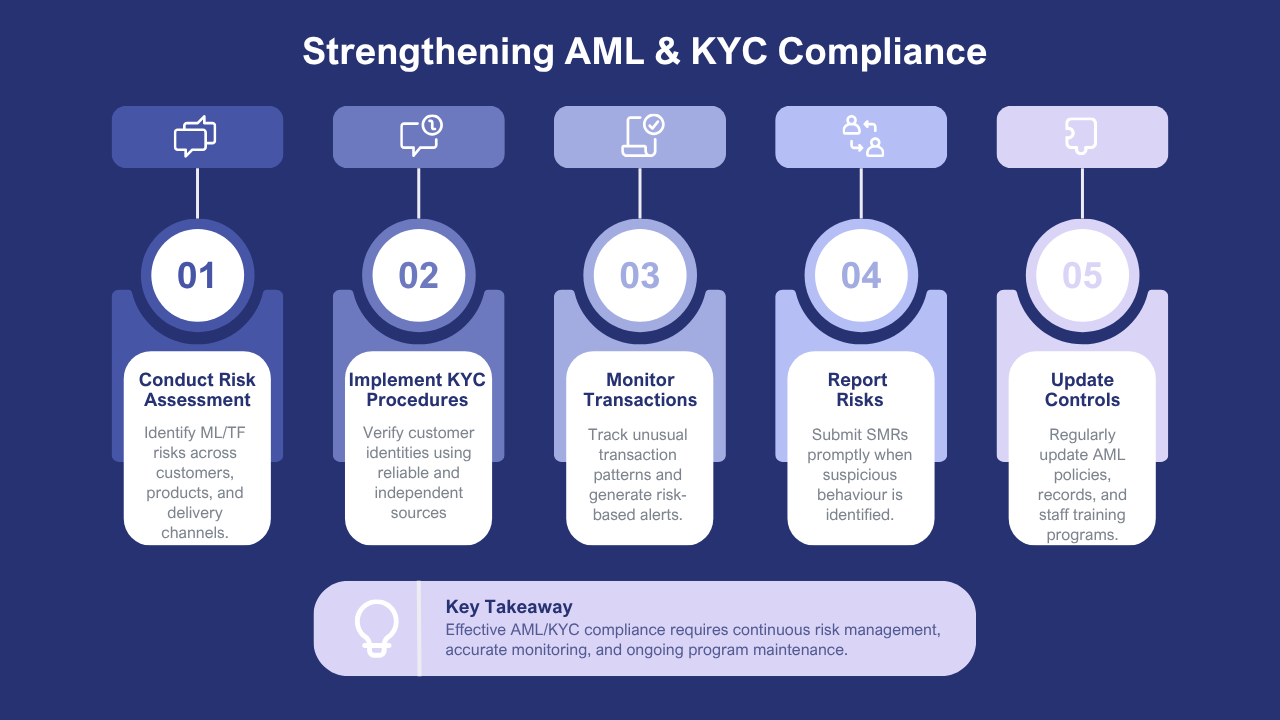
The Anti-Money Laundering Checklist implementation workflow
Construction/remediation of a structured AML Compliance Program in Australia. The workflow below, comprising four phases, reflects how advanced compliance practitioners implement or uplift an AML/CTF program on behalf of a fintech or professional firm entering or maturing in the regulated environment.
Phase 1 | Phase 2 | Phase 3 | Phase 4 |
Risk Assessment & Enrollment | Program Design & Documentation | Implementation & Staff Training | Ongoing Monitoring & Review |
Complete ML/TF risk assessment for the entity’s specific products, services, customers, and channels; enrol with AUSTRAC as a reporting entity; appoint an AML/CTF Compliance Officer; establish the Risk-Based Approach AML framework | Draft Part A (governance, risk, controls) and Part B (KYC Requirements and Customer Due Diligence procedures); design Transaction Monitoring methodology; document Suspicious Matter Reporting escalation process | Implement Identity Verification Process for new and existing customers; deploy Transaction Monitoring system with product-specific thresholds; train all staff on AML Compliance Australia obligations; conduct initial program testing | Maintain ongoing Customer Due Diligence; review and update Transaction Monitoring thresholds; lodge required reports with AUSTRAC Regulations; conduct annual board compliance report; conduct an independent program review every three years |
Case 1: Transaction Monitoring gaps that triggered enforcement
One of the remittance service providers had deployed a transaction monitoring system that alerted on transactions exceeding a dollar limit but had not configured any warnings for structuring behaviour, a series of smaller transactions designed to avoid the reporting threshold. Over 14 months, a small group of customers systematically split transfers that would otherwise have exceeded the reporting threshold into multiple transfers below the threshold. The Transaction Monitoring system did not issue any warnings because every transaction was below the set threshold. The pattern was detected during AUSTAC’s supervisory review, and the entity was found to have a material weakness in its monitoring program. The remediation involved reconfiguring the monitoring system, reviewing transaction data over three years, and filing a significant number of Suspicious Matter Reporting submissions that would have been filed contemporaneously. The lesson: monitoring should be tuned to the risk patterns of the products and customers of the product the entity is part of, rather than to generic industry controls.
Case 2: Customer Due Diligence failure in a professional services context
The financial advisory firm had been offering investment advice services for several years without revising its KYC Requirements procedures to reflect the increased beneficial ownership requirements introduced in updated guidance from the Australian regulator, AUSTRAC. Existing clients were onboarded to the previous standard, and there was no mechanism to update their records as the regulatory standard evolved. In a supervisory review conducted by AUSTRAC, it was found that incomplete beneficial ownership documentation was present in about 35 per cent of corporate client files. The company had to put in place a systematic client file remediation programme, during which all affected clients were contacted and the necessary documentation obtained. It required six months, used substantial resources in compliance, and could have been avoided by ensuring that the Compliance Program AML has a documented review cycle aligned with the updates to the program’s audit guide. The lesson: compliance programs should be living documents that change as the regulatory environment evolves, and should not be inactive documents prepared at the time the compliance program is first launched.
6. Conclusion
Fintechs and professional firms (AML Compliance Australia) are subject to a substantive and ongoing governance requirement, not a one-time documentation process. An effective AML Compliance Program in Australia requires an authentic Risk-Based Approach to AML thinking, rigorous Customer Due Diligence and Identity Verification Process procedures, calibrated Transaction Monitoring, timely Suspicious Matter Reporting, and a program maintenance discipline that keeps the entity abreast of changes in the AUSTRAC Regulations.
- The most frequent enforcement observations are associated with generic rather than risk-specific programs: oversight of thresholds that are not calibrated to the entity’s products, CDD not updated as the regulatory standard is revised, and SMRs not filed because staff lack the training to identify and escalate suspicious activity.
- To junior compliance professionals: the published enforcement outcomes, industry guidance and typologies reports published by AUSTRAC are the most practically oriented ongoing learning resource available – they describe the particular patterns of failure that regulators have identified and what a well-implemented system of controls looks like in practice.
- In the case of fintechs and professional firms, consider the Anti-Money Laundering Checklist as a continuous quality management discipline, not a project with a completion date; the programs that pass regulatory oversight are those sustained by a team that regards compliance as a real operational priority.
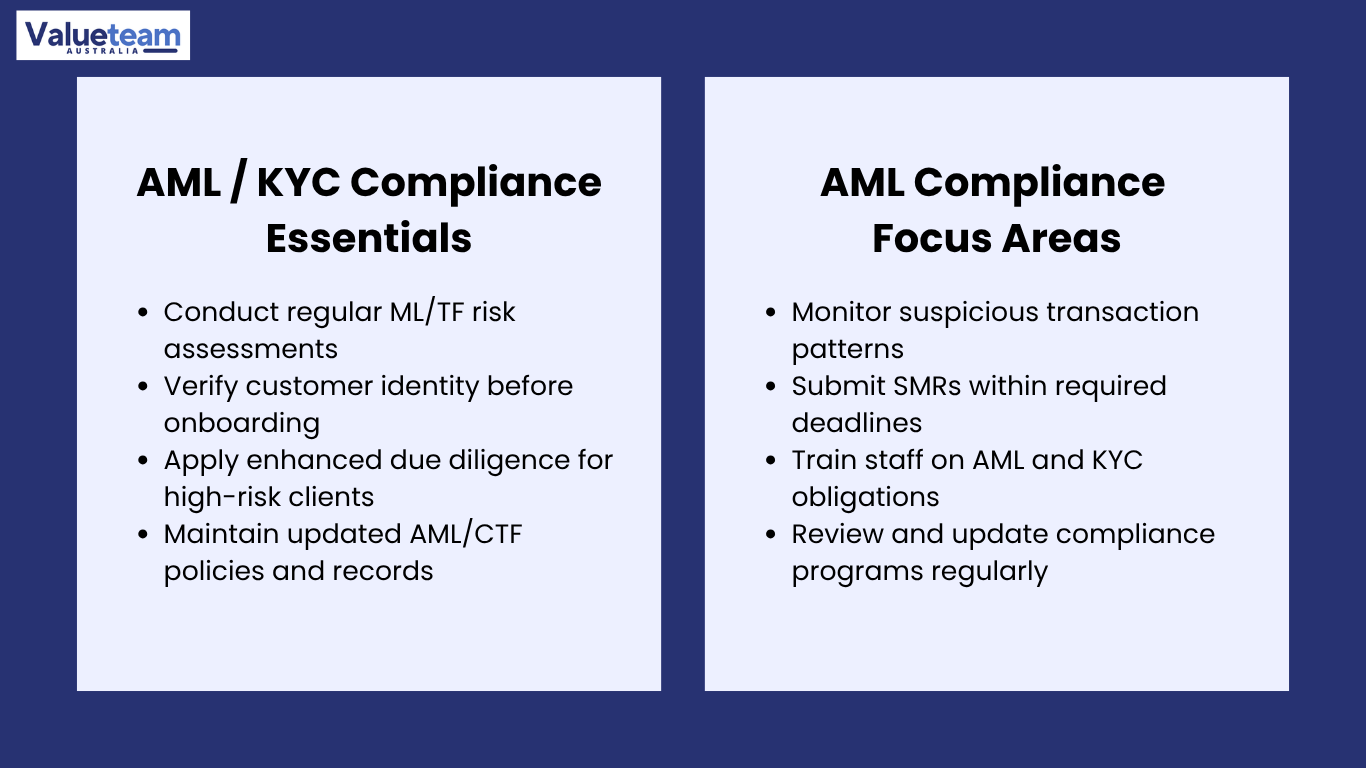
Frequently Asked Questions
Q1. What are AML and KYC requirements?
Anti-Money Laundering (AML) and Know Your Customer (KYC) requirements help businesses prevent money laundering, terrorist financing, and other financial crimes.
Q2. Why is AML/KYC compliance important?
Compliance helps organisations meet regulatory obligations, reduce financial crime risks, and protect their reputation and customers.
Q3. What should an AML/KYC checklist include?
It typically includes customer identification, risk assessments, ongoing monitoring, record keeping, employee training, and suspicious matter reporting procedures.
Q4. Which businesses require AML/KYC compliance?
Financial institutions, reporting entities, and businesses regulated under Australia’s AML/CTF framework are required to implement AML/KYC controls.
Q5. How does a compliance checklist benefit organisations?
A structured checklist helps businesses establish effective compliance processes, minimise regulatory risks, and maintain consistent internal controls.