

Table of Content
1. Introduction: Business Valuation Methods
All business valuations start with a methodology, and the choice of methodology can have a dramatic impact on the value calculated, the credibility of that number with third parties, and its relevance to the transaction or decision for which it was calculated. The three most commonly used methods (Discounted Cash Flow (DCF), EBITDA Multiples, and Asset-Based Valuation) are based on three different theories of value. Knowing not only how each method works but also why it works, when to use it, and when not to, is an essential piece of conceptual knowledge for any business advisor, corporate finance, or transaction services professional.
The nature of the work often makes it easier for junior and mid-level practitioners to simply apply these methods in a “use what you know” fashion: choose a method, input data, and get a result. Experienced advisors understand it differently. Each method addresses a slightly different question about value and value to whom. A Discounted Cash Flow (DCF) answers: what is the value of the future economic benefits of this business discounted to the present? EBITDA Multiples asks: What is the ratio of similar businesses in the market to their earnings? Asset-Based Valuation asks: how much would it cost to put together, or dismantle, the assets of this business? Cross-checking these questions – using the methods to test, rather than simply report the highest value – is what transforms a business valuation into more than advocacy by spreadsheet.
In this article, we explore each method in detail, compare how they are applied across various business situations, present the five key steps of a robust Business Valuation Techniques process, and provide case studies showing how the choice of method and execution can significantly impact results. Whether you are advising a client on a transaction, in your first job as an advisor, or developing the technical skills to participate on a deal team, the approaches described will be a core part of your skill set.
2. Discounted Cash Flow: The Income Approach in Detail
The Discounted Cash Flow (DCF) is the most comprehensive of the three main Business Valuation Techniques. It is part of the family of Income Approach Valuation Methods, and is based on a principle familiar to most students of finance: a dollar in the future is worth less than a dollar today, and the future dollar’s worth is determined by the discount rate, which is a function of the risk of its receipt. When applied to a business, the DCF evaluates the present value of the business’s future cash flows (“free cash flows”), discounted at a rate that reflects the business’s cost of capital and level of risk.
In reality, a DCF model requires the user to make assumptions about revenue growth, profit margins, capital expenditures, working capital, and a terminal value (typically the largest single figure in the calculation). The terminal value can be calculated as a growing perpetuity (with a fixed long-term growth rate applied to last year’s cash flow), or by applying an EBITDA Multiples exit multiple to the terminal-year EBITDA. Given that the terminal value can account for 60% to 80% of the Enterprise Value Calculation in many mid-market and small-to-medium enterprise (SME) valuations, it is critical to understand the assumptions underlying this one line item, as well as the entire projection period.
The most important practical weakness of the Discounted Cash Flow (DCF) technique is sensitivity to assumptions. A 2% change in the discount rate, the terminal growth rate, or the revenue assumption in years four and five of the projection period can result in a change in output of tens of percentage points. This is something to be celebrated rather than apologised for – when used properly in a scenario and sensitivity analysis, it provides some of the most important insights of a valuation. Savvy buyers and sellers recognise this and use DCF not as a crystal ball but as a framework to understand the possible range of value under different scenarios and as a tool for an orderly discussion about which assumptions are most likely to be correct.
3. EBITDA Multiples: The Market Approach in Practice
The EBITDA Multiple approach is the most widely used method in transactions in the Australian private market, especially in the SME and mid-market sectors, where most transactions occur. The method is a Market Approach Valuation and is based on the idea that similar assets should sell for similar prices. By looking at the prices recently traded comparable assets have sold for, relative to their normalised EBITDA, an analyst can use that multiple to value the subject business and arrive at a figure comparable to what the market is paying. The attraction of this method is its simplicity: it links value to the market’s view of value rather than a projected set of future cash flows that may be disconnected from the market.
The key variable in an EBITDA Multiples approach is the multiple – the factor by which normalised EBITDA is multiplied to determine Enterprise Value Calculation. There are significant differences in multiples across sectors, company size, earnings quality, growth rates and market circumstances. Historically, EBITDA multiples for SME transactions in the Australian mid-market have ranged from 3x to 6x across most sectors, while technology-enabled and healthcare businesses have consistently traded at multiples above this range due to their growth opportunities, recurring revenue streams, and strategic importance. Being able to identify the factors that may be compressing or expanding multiples in a given sector, and being able to support the multiple applied with recent, relevant transaction data, is the most critical technical skill in undertaking a credible Market Approach Valuation.
The most commonly cited constraint on the use of a Market Approach Valuation in the Australian private market is the lack of information about comparable transactions. In contrast to listed equity markets, where pricing is public and up-to-date, private M&A transaction data is private and available only via broker databases, industry publications and personal networks. This paucity of data means that valuators are forced to use substitutes – multiples of listed company trading activity, publicly available deals in related industries, or international data adjusted for market conditions – that add to the uncertainty of the analysis. Recognising this uncertainty, transparently disclosing how the multiple is chosen and reporting a range, rather than a single point estimate, is better than reporting a single number without further explanation.
4. Asset-Based Valuation: When the Balance Sheet Drives Value
Asset-Based Valuation approaches business valuation from a different starting point than the DCF and multiples methods. The question is not “what is the value of the business’s future earnings” but rather “what is the value of the business’s identifiable assets – both tangible and intangible – regardless of the business”. This valuation approach is most relevant in scenarios where the value of the business is largely found in its balance sheet and not its future earnings: capital-intensive businesses such as manufacturing, real estate investment and asset finance, wind-down or liquidation scenarios, and holding structures where the key objective is to value the underlying asset portfolio rather than the operating business.
In practice, the Asset-Based Valuation approach is an exercise in restating the value of each identifiable asset from its book value to its fair market value: the value of the asset at which it would be bought and sold in a transaction between a willing buyer and a willing seller. Real estate assets need to be appraised, manufacturing plant and equipment need to be checked for market value versus written down book value, intangible assets like customer databases, brands and computer systems need to be identified and valued, and contingent liabilities (such as warranties) need to be recognised at their expected cash outflow values. The difference between the fair value of assets and the fair value of liabilities yields the restated net asset value – the result of Asset-Based Valuation.
The biggest pitfall of this approach is its reliance on value businesses that derive value from their earnings power rather than from their assets. A consulting company with valuable client relationships, a strong reputation, and a team of employees may have little net tangible assets recorded on its balance sheet. Still, it may command a high multiple of earnings in a sale. An Asset-Based Valuation approach to such a company will yield a lower-bound estimate rather than a value relevant in a transaction, and a primary approach without adjustments for goodwill and going concern will bias the value downward that a willing buyer might pay. Knowing when this method is the primary method to apply and when it is only used as a check on the floor value is part of Valuation Best Practices.
5. Valuation Method Comparison: Choosing the Right Framework
Most seasoned practitioners of Business Valuation Techniques don’t use just one method. The practice is to employ two or three methods, viewing each as a window or lens through which different dimensions of value can be measured, and triangulating to a reasonable range. The table below presents a Valuation Method Comparison across key dimensions that concern practitioners in the Australian SME and mid-market space.
Method | Theoretical Basis | Best Suited For | Primary Limitation | Typical Role in Practice |
Discounted Cash Flow (DCF) | Income Approach Valuation: present value of future free cash flows | High-growth, capital-intensive, or stable cash-generating businesses with forecastable revenues | Highly sensitive to terminal value assumptions; output varies widely with discount rate | Stress-test and sense-check for multiple-based headline; primary method for PE and growth equity |
EBITDA Multiples | Market Approach Valuation: market pricing of comparable businesses | Profitable SMEs and mid-market businesses across most sectors; trade sale context | Comparable data is limited in Australian private markets; multiple selection is subjective | Buyers widely understand headline methodology in most Australian mid-market transactions |
Asset-Based Valuation | Net asset value at fair market value; going concern or liquidation basis | Asset-heavy businesses; holding structures; liquidation scenarios; manufacturing | Understates going-concern value for earnings-driven or intangible-rich businesses | Floor value reference: primary method only for asset-centric or wind-down scenarios |
6. Five Steps to Applying Business Valuation Techniques Rigorously
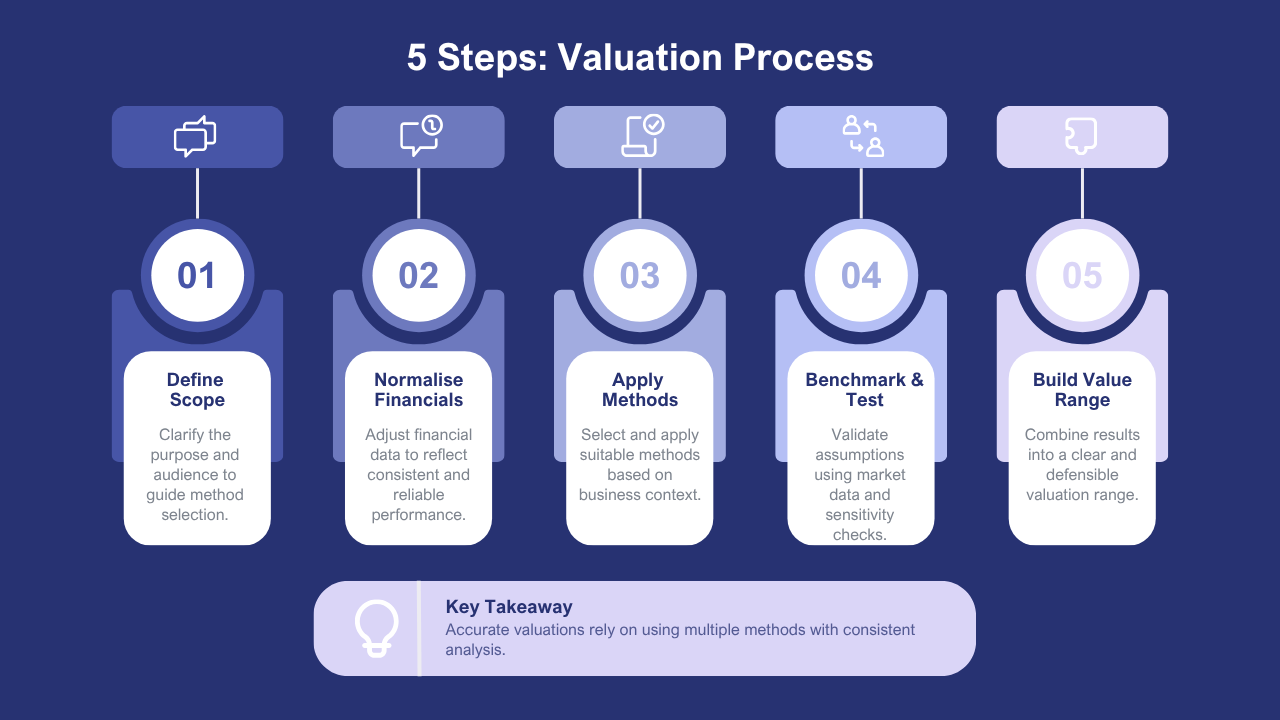
Regardless of which of the above methodologies is chosen as the lead method, there is a consistent process for rigorously applying the Business Valuation Techniques. The following five steps represent Valuation Best Practices as applied by seasoned practitioners in advisory practices, accounting firms and corporate development functions in Australia and around the world.
Step | What It Involves | Common Challenge |
1. Define scope and purpose | Establish the valuation’s intended use, audience, and required report standard before selecting any methodology or beginning financial analysis | Scope ambiguity leads to method selection that serves the wrong audience; a report prepared for internal planning may be unsuitable for a trade sale due diligence context |
2. Normalise the financial record | Reconstruct three years of financials; remove owner add-backs, one-off items, and non-arm’s-length transactions; establish a clean, sustainable EBITDA baseline for all Financial Modelling Methods | Financial records are often inconsistent year-on-year; management accounts may not reconcile to tax returns; owner expenses require careful documentation and commercial justification |
3. Select and apply Valuation Method Comparison | Choose primary and secondary methodologies based on business type, sector, and data availability; apply each rigorously with documented assumptions; note where methods diverge and why | Single-method analysis is vulnerable to challenge; using methods that conflict without explaining the divergence undermines credibility with sophisticated buyers and their advisors |
4. Benchmark and stress-test | Compare EBITDA Multiples against sector transaction data; run DCF sensitivity tables across key assumptions; validate Asset-Based Valuation against independent appraisals where material assets exist | Buyers will challenge every assumption; practitioners who stress-test their own analysis before presenting it are better prepared to defend a price position under pressure |
5. Construct the Enterprise Value Calculation range | Synthesise outputs into a defensible value range with a stated primary methodology and disclosed rationale; present sensitivity analysis to show what drives the floor and ceiling of the range | Point estimates are easier to attack than ranges; a well-constructed range with documented drivers is more credible and more useful for negotiation than a single number presented without context |
Step 2 – normalising the financial income – is most critical to the quality of the valuation outcome. All else can be forgiven, but not an uncertain earnings stream. The rigour of reconstructing the last three years’ financial account records from underlying documents, matching management accounting numbers to tax returns, and documenting all adjustments made in the EBITDA normalisation schedule is the analytical workhorse of the valuation process. For those new to the field, the development of a normalisation template – and its consistent deployment in all cases – is one of the best investments in professional skills at this level of the career path.
7. Process, Challenges, and What the Market Teaches You
To grasp the application of Business Valuation Techniques in an advisory environment, it’s not enough to know the techniques involved. It also requires an understanding of how a valuation is constructed, where the conflicts lie, and where the art of the business valuation professional is applied to overcome the mechanical application of the methods. The workflow below outlines the four steps of a formal valuation engagement.
Phase 1 | Phase 2 | Phase 3 | Phase 4 |
Scoping & Data Collection | Normalisation & Modelling | Benchmarking & Stress-Test | Report & Negotiation Support |
Define methodology approach; collect three years of financials; gather management accounts, asset registers, contracts, and sector data for Market Approach Valuation benchmarking | Reconstruct EBITDA; build DCF projection model and EBITDA Multiples analysis; perform Asset-Based Valuation where applicable; document all assumptions in Financial Modelling Methods template | Compare against sector comparables; run DCF sensitivity tables; validate Enterprise Value Calculation range across all methods; identify key value drivers and risks | Draft formal Valuation Best Practices report; present findings with full methodology disclosure; support client in defending value position through due diligence and negotiation |
Perhaps the most obvious lesson practitioners learn from their engagement experience is that the Valuation Method Comparison exercise is not a maths exercise – it is a communication exercise. The best DCF model in the world will not preserve a seller’s price bargaining position unless it can be explained and confidently defended in a discussion with a cautious buyer’s advisor. This is especially true with the discount rate assumption in a Discounted Cash Flow (DCF) calculation: sellers would like to see lower rates (which yield higher values), while buyers would like to see higher rates (which yield lower values). Knowing the academic way to estimate the weighted average cost of capital for a private firm and being able to explain why the rate used is the right rate, and not just the convenient one, are among the most useful technical skills a junior analyst can acquire.
Another case where the number crunching is less important than the judgment is in the interplay between the Market Approach Valuation and the Income Approach Valuation. In a strong M&A market, transaction multiples may be inflated by competitive bidding, strategic premiums, and low financing rates – none of which reflect the intrinsic value of the acquired businesses. A DCF-based Enterprise Value Calculation that uses these multiples will overestimate the terminal value that a robust income approach might apply. On the other hand, in a sluggish market with lower multiples, a DCF may be higher than an EBITDA Multiples valuation, as it reflects the long-term cash generation potential of a business whose current earnings are temporarily below normalised levels. Understanding these phenomena, and being able to explain why your analysis is a reflection of value and not simply noise, is the type of judgment that distinguishes high-quality valuations from the routine application of mechanical approaches.
8. Real Cases and What They Reveal
Our favourite example of the relationship between EBITDA Multiples and Discounted Cash Flow (DCF) is technology companies that are aggressively reinvesting in growth at the expense of short-term earnings. Imagine a SaaS company with $800,000 in annual recurring revenue that has a policy of putting all of its free cash flow back into sales and development – resulting in low or negative EBITDA but excellent growth (45% year-on-year). The EBITDA Multiples approach to this business yields a low or negative earnings base, offering little guidance. A Discounted Cash Flow (DCF) model that captures the business’s growth and projected path to profitability results in a much higher value – but one that is all reliant on the veracity of the growth assumptions. The sale ended up setting the price on a revenue multiple, a common variation on the Market Approach Valuation that applies to growth businesses not yet profitable, and justified by the DCF exercise as a sanity check. The principle here is that when the primary method produces a meaningless result, a professional discipline is to adapt the method rather than “make up” a value proposition that is not consistent with what the business can deliver.
A second example highlights the role of Asset-Based Valuation as a minimal value. The manufacturer had a normalised EBITDA of $600,000 and was being valued for a trade sale. Using the EBITDA Multiples method, an Enterprise Value Calculation was arrived at of around $2.4 million to $3.0 million at a 4x to 5x range, which is typical for the sector. A simultaneous independent Asset-Based Valuation of the business’s assets (plant, equipment and property) determined a net asset value of $2.1 million. The proximity of the asset-based floor to the earnings-based range served as a valuable clue: an acquirer of this business was paying a relatively low premium to purchase the earnings stream, beyond the value that could be realised in an orderly auction of the assets. This insight provided the buyer with greater comfort with the purchase – and helped the vendor’s advisors ward off a price re-negotiation request that invoked earnings risk as the reason, because the assets’ value capped the potential loss. This is the role that the asset-based method plays in Valuation Best Practices.
9. Conclusion: Applying These Methods in Practice
The three main Business Valuation Techniques discussed in this article – Discounted Cash Flow (DCF), EBITDA Multiples and Asset-Based Valuation – are not mutually exclusive alternatives between which the analyst must choose. They are complementary techniques that, when used in conjunction and with transparency about the assumptions and limitations of each, result in a valuation analysis that is more complete and more convincing than can be achieved with any one technique alone. The purpose of the Valuation Method Comparison is to use each method to test the assumptions of the others. If the DCF and Multiples Valuation techniques arrive at a similar conclusion, that’s reassuring. If they don’t, it’s more useful for a practitioner to understand why, rather than just computing the average of the two.
For those building their technical skill set, the practical implication is making sure that each of the three methods is understood deeply – not just that they can be applied (by filling in a template), but that they are understood as to why they are constructed the way they are, and what they actually measure. The Financial Modelling Methods that enable DCF analysis, the industry research that assists in selecting EBITDA Multiples, and the asset appraisal skills that inform Asset-Based Valuation can all be learned. Reading the press releases for past transactions, studying how acquirers explain their valuation process in public statements, and getting to see as much of the valuation process in action as possible are the quickest routes to recognising the underlying patterns that define the skilled valuation practitioner.
For valuation advisors to clients involved in a transaction or dispute, the key principle of Valuation Best Practices is disclosure. What’s out of the bag is on the table. A valuation that justifies the discount rate used, the range of EBITDA Multiples applied, and what would have to change for the value to be significantly different is a valuation that can be negotiated. One that offers an answer without explaining how it got there is just a number – and in any deal involving smart professionals on the other side, a number without a narrative is just a number.
Frequently Asked Questions
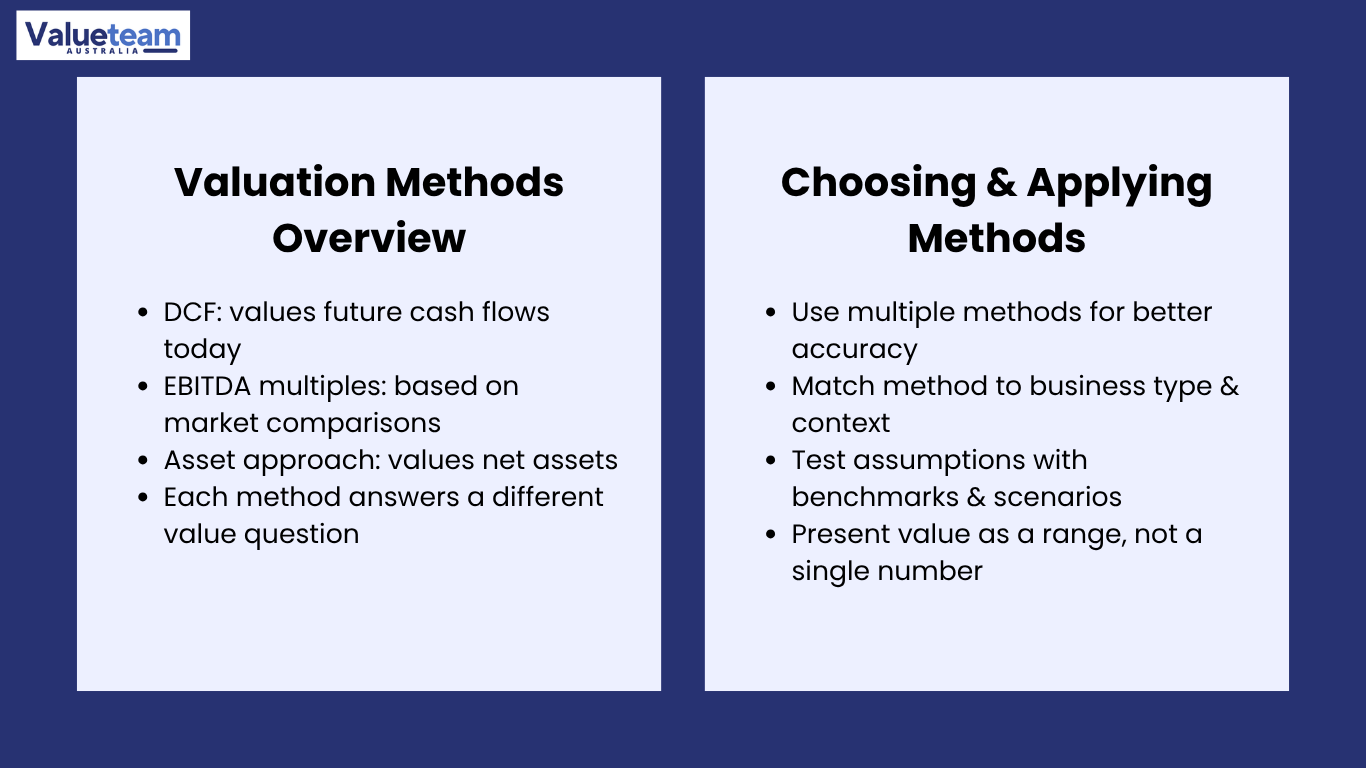
Q1. What are the main business valuation methods?
The three primary valuation methods are the Income Approach, Market Approach, and Asset-Based Approach, each suited to different business circumstances.
Q2. How does the Income Approach work?
The Income Approach estimates business value by calculating the present value of expected future cash flows or earnings.
Q3. What is the Market Approach?
The Market Approach estimates value by comparing the business with similar companies or completed market transactions.
Q4. When is the Asset-Based Approach appropriate?
The Asset-Based Approach is commonly used for asset-intensive businesses or companies where asset values represent a significant portion of overall business value.
Q5. How do valuers select the appropriate method?
Professional valuers consider the valuation purpose, business characteristics, available data, and industry conditions before selecting the most suitable methodology.
2 thoughts on “Business Valuation Methods Explained: DCF vs EBITDA Multiples vs Asset Approach”