

Table of Content
1. Introduction
Environmental, social and governance (ESG) – how companies evaluate and report on their ESG risk management and opportunities – was for much of the last decade an optional, largely self-imposed activity in Australia, primarily in response to pressure from institutional investors and the need to maintain a positive reputation. That has changed materially. The Australian ESG Compliance Regulations 2026 now include compulsory financial disclosures on climate change for large entities, heightened governance standards from regulators, and supply chain sustainability scrutiny cascading down to the SME sector through the supply chains of large corporate customers. For ESG compliance, companies that have not yet established an approach to ESG Compliance in Australia are running out of time.
Corporate Sustainability Regulations 2026 are defined by the Treasury Laws Amendment (Financial Market Infrastructure and Other Measures) Act, which requires large entities to comply with sustainability reporting standards AASB S1 and AASB S2 – the Australian versions of the IFRS Sustainability Disclosure Standards. The standards mandate that entities meeting the relevant thresholds disclose material sustainability-related risks and opportunities, including climate-related physical and transition risks, governance arrangements to manage these risks, and the metrics and targets used to measure performance. The mandatory reporting period began for the largest entities in 2024 and will flow down to mid-market and then small businesses over the next two years.
This article is aimed at business leaders, senior and junior managers, and professionals who want to understand what ESG Compliance Australia means in 2026, how to build internal capability and processes to meet those requirements, and how to take a proactive approach to the challenge. Whether you work in a large entity already subject to mandatory reporting or a mid-market entity that is gearing up for the requirements that will soon apply to you, the structure and advice provided in this article will help you understand how to get started, what to avoid and how successful businesses are tackling this challenge.
2. The Regulatory Landscape Shaping ESG in 2026
ESG Regulations 2026 in Australia rest on several interrelated legislative and regulatory frameworks that, collectively, will set a higher compliance bar than many businesses are used to. Mandatory sustainability reporting, introduced under AASB S1 and AASB S2, is the centrepiece of this. Still, it is complemented by the Modern Slavery Act requirements – which require entities with annual consolidated revenue greater than $100 million to report on the steps they are taking to mitigate risks of modern slavery in their operations and supply chains – and APRA’s prudential practice guide on managing climate-related financial risks for regulated entities and ASIC’s growing enforcement activity in relation to misleading and deceptive claims around sustainability.
The staggered roll-out of mandatory climate reporting is one of the key characteristics of the current Sustainability Regulations Australia system. Group 1 entities (either consolidated revenues over $500 million, assets over $1 billion, or over 500 employees) have their first reporting requirements for years commencing from 1 January 2025. Group 2 entities (revenues over $200 million, assets over $500 million, or more than 250 employees) follow for years beginning from 1 July 2026. Group 3 entities – a wider grouping that includes entities of public interest – in 2027. This ripple effect means that even industries not yet directly affected by the mandatory reporting regime are experiencing its impacts through the downstream supply chain and procurement practices of their Group 1 and Group 2 customers and suppliers.
Beyond mandatory reporting, ESG Risk Management is increasingly being factored into financing and insurance contracts and M&A deals. The major Australian banks and institutional lenders have developed climate risk assessment criteria that impact pricing and access to credit for high-risk industries and assets. Insurers are amending risk assessment criteria for physical climate risks. In M&A due diligence, ESG risk management has evolved from a reputational risk to a financial risk that affects purchase price multiples, with buyers increasingly factoring in pricing differences for businesses with unaddressed transition risks or disclosed but unaddressed governance risks. The key take-out for business leaders is that ESG Compliance Australia is no longer just a compliance issue – it is a risk management issue that impacts capital and value.
The overlap between the mandatory **ESG Compliance Regulations 2026** regime and the voluntary standards that many businesses already comply with – in particular the GRI Standards, the TCFD recommendations and the UN Sustainable Development Goals – is a critical area of practical consideration for compliance practitioners. Although AASB S1 and AASB S2 align with the IFRS Sustainability Disclosure Standards and adopt the TCFD methodology for climate-related disclosure, they contain specific requirements for the form, content, and assurance of disclosures that go beyond those required by the voluntary frameworks. Companies that have invested in voluntary reporting under these frameworks will find their previous experience valuable, but significant additional effort is needed to meet the mandatory standard, particularly in scenario analysis, Scope 3 emissions measurement, and data assurance. Knowing what voluntary work provides a real “get out of jail card” for compliance and what additional work is needed to build the new capability is a key consideration for any business preparing for mandatory reporting for the first time.
3. Five Pillars of a Credible ESG Compliance Framework
Developing real ESG Compliance Policy Implementation capability is more than simply writing an ESG policy and putting it on the company’s website. It’s about embedding ESG compliance into the business’s planning, governance, operational, and reporting processes in a way that is consistent, quantifiable, and – most importantly – verifiable. The five pillars below reflect the way organisations that are managing ESG Compliance Australia best have approached the issue.
Pillar | What It Requires | Common Implementation Gap |
1. Governance Structure | Board-level accountability for ESG oversight; designated management responsibility for ESG Risk Management; documented decision-making authority for material sustainability issues under a Corporate Responsibility Framework | ESG compliance responsibility sits with a single sustainability manager with no board mandate; sustainability decisions are disconnected from financial planning and risk management processes |
2. Materiality Assessment | Systematic identification of the ESG issues most material to the business’s financial performance and stakeholder relationships; double materiality analysis required under AASB S1 for entities in scope of mandatory reporting | Materiality is assessed informally or based on peer benchmarking without genuine engagement with the business’s specific risk and opportunity profile; financial materiality is underweighted relative to reputational considerations |
3. Environmental Compliance Standards | Measurement and disclosure of Scope 1, 2, and 3 greenhouse gas emissions; assessment of physical and transition climate risks; management of other material environmental impacts, including water, waste, and biodiversity, where relevant | Scope 3 emissions measurement is absent or highly incomplete; climate risk assessment is treated as a disclosure exercise rather than a genuine operational risk management process |
4. Compliance Reporting ESG | Structured sustainability report meeting applicable standards (AASB S1/S2, GRI, or sector-specific frameworks); verified or assured data where required; integration with annual report or financial statements as appropriate | Reporting is aspirational rather than data-driven; metrics are selected for favourable presentation rather than genuine materiality; no assurance processes,s and data quality is not validated |
5. Governance Best Practices and Continuous Improvement | Annual review of ESG strategy and targets against performance; stakeholder engagement processes; supply chain ESG risk management; integration of ESG metrics into executive remuneration | ESG targets are set without clear baselines or measurement methodology; supply chain ESG requirements are stated in policy but not verified in practice; no consequence for non-achievement of ESG targets |
Pillar 2 – the materiality assessment – is the area where most organisations invest insufficiently compared to the rest of the Corporate Responsibility Framework. A robust materiality assessment does not identify ESG issues that other companies report. It assesses which issues are important to the financial success of the business and which issues are important to the business stakeholders – customers, shareholders, employees, regulators, and communities. For companies subject to AASB S1, the double materiality concept means that this assessment must take into account not only the impact of ESG issues on the business (financial materiality) but also the impact of the business’s operations on the environment and society (impact materiality). Getting this right in the first instance shapes how the business will gather metrics, set performance targets, establish governance arrangements, and disclose information. Companies that shortcut or bypass this process tend to have a compliance process that is not aligned with their risk profile.
4. Process, Challenges, and What the Market Teaches You
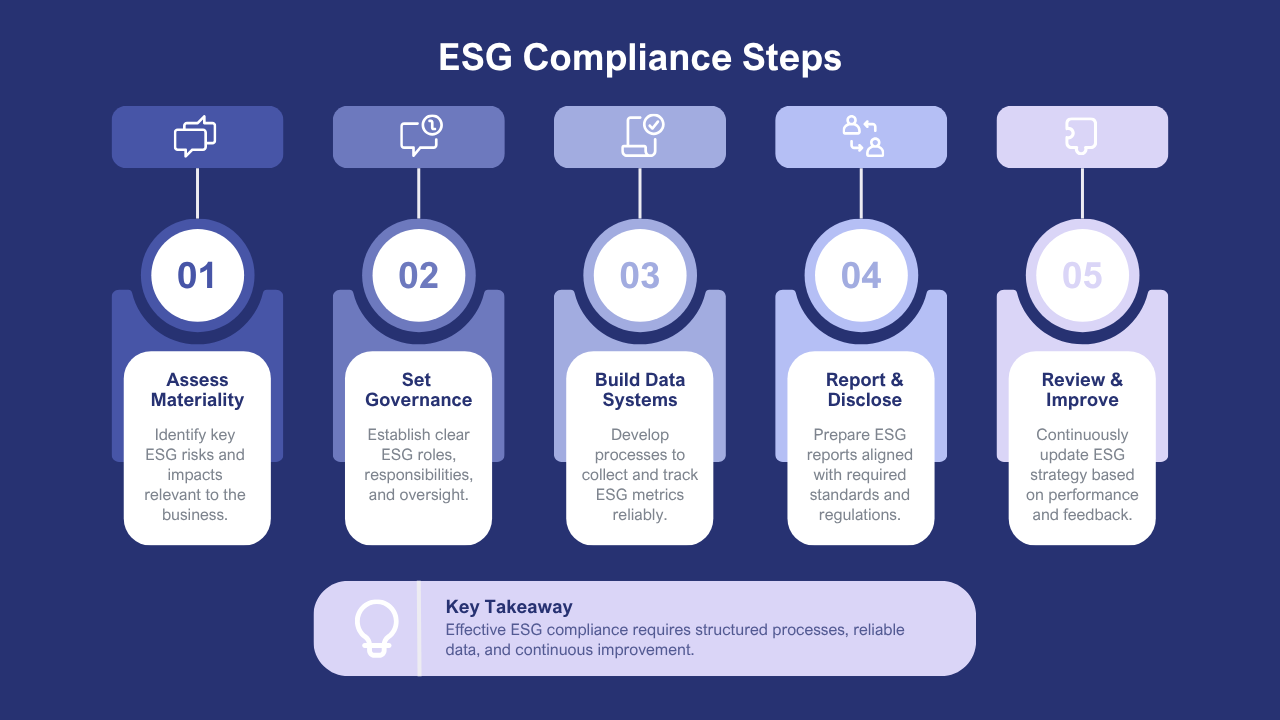
The ESG Compliance Policy Implementation process for most organisations follows a similar series of phases, and knowing where the bottlenecks lie at each stage will help prepare those in the compliance process to build or enhance their organisation’s compliance capability. The workflow below is the typical pattern of evolution of organisations with advanced ESG Compliance Australia capability.
Phase 1 | Phase 2 | Phase 3 | Phase 4 |
Baseline & Materiality | Governance & Policy | Data Collection & Systems | Reporting & Assurance |
Conduct a double materiality assessment; establish a current-state ESG performance baseline; identify mandatory Corporate Sustainability Requirements by entity size and sector; map the regulatory timeline under ESG Regulations 2026 | Establish board ESG oversight structure; assign management accountability; develop Corporate Responsibility Framework; draft ESG Policy Implementation documents aligned to Environmental Compliance Standards | Build data collection infrastructure for material ESG metrics; measure Scope 1, 2, and 3 emissions; assess ESG Risk Management across supply chain; validate data quality for Compliance Reporting ESG | Prepare sustainability disclosure meeting applicable standard (AASB S1/S2 or GRI); engage assurance provider for limited or reasonable assurance; integrate with financial reporting; plan continuous improvement cycle |
The phase that presents the most practical challenges of ESG Policy Implementation is Phase 3 – data collection and management, especially for organisations starting from a low level of capability. The measurement of Scope 3 greenhouse gas emissions is the most typical: Scope 3 includes indirect emissions across the value chain (purchased goods and services, business travel, employee commuting, use of sold products, end-of-life treatment of products, etc.), and data for this phase requires engagement with suppliers, customers and third-party data providers that most businesses have not until now managed. For businesses in the scope of mandatory ESG Compliance Reporting under AASB S2, Scope 3 must be disclosed if material, and the methodology used to measure it will be assured. Organisations that start planning Scope 3 measurement at the last minute often find themselves ill-prepared.
Another issue – common at all stages of ESG Risk Management implementation – is embedding sustainability into the business’s financial planning and risk management framework. It is common for organisations to start their ESG compliance journey by establishing a sustainability function that exists outside (rather than within) the existing business management structure. While this approach makes sense as an initial step, it tends to result in ESG reports that are not integrated with the financial reports, sustainability goals that are not reflected in the business planning or investment allocation process and governance oversight that is nominal at best. The companies that develop the most robust and sustainable Corporate Responsibility Frameworks are those that embed ESG into the enterprise’s governance, risk, and reporting systems, rather than treating it as a separate add-on.
The risk of greenwashing – making misleading, unsubstantiated, or inaccurate sustainability claims that are not consistent with business practices – is a significant legal risk under the existing Sustainability Regulations Australia regime. ASIC has actively enforced against misleading Sustainability Marketing, and under the mandatory ESG Compliance Regulations 2026, there are specific requirements for the veracity of climate disclosures. For advisors and compliance officers, this enforcement environment highlights the importance of a data-driven approach to ESG Compliance Reporting: claims must be backed by data, targets must be clearly benchmarked and measured, and comparative statements must be accurate and consistent over time.
5. Real Cases and What They Teach Practitioners
One example of the opportunity and challenge of supply chain ESG Risk Management is a large consumer goods company that, as part of its own Group 1 reporting, sent a questionnaire to the top 200 suppliers requesting their ESG compliance data. Some 60 per cent of suppliers could not provide the requested data in the requested format, either because they had not measured their emissions or because their environmental management systems were not documented. The company has undertaken a two-year programme of capacity-building with its suppliers, which has yielded significant Scope 3 data by the second reporting cycle and has improved its business relationships with major suppliers. The takeaway for firms managing supply chain ESG risk management is that improving data quality takes time and is not a one-off exercise for compliance purposes, so an early start offers a competitive edge.
The second case concerns a mid-market financial services company subject to mandatory Corporate Sustainability Requirements in Group 2. The firm’s voluntary sustainability report was reviewed against the AASB S2 standard and found deficient: it did not include scenarios for climate risk and opportunity, did not measure Scope 3 emissions, and did not disclose governance arrangements for a sustainability committee that did not meet in the previous financial year. An ESG strategy team was engaged to assess the firm’s sustainability performance, build a new data-collection system, and engage the board in climate risk governance for the first time. This reporting complied with regulatory requirements and, as a side benefit, uncovered two exposures to transition risk in the firm’s investment portfolio, which are now factored into credit risk pricing and investment decision-making, turning compliance into an opportunity to strengthen the firm’s risk management processes.
6. Conclusion: Actionable Insights for Businesses and Advisors
ESG Compliance Australia in 2026 is not an “and then” requirement that can be checked off the list – it is a continuous capability development process that needs to be integrated into the governance, strategy, operations and reporting of the business. The ESG Compliance Regulations 2026 framework has introduced mandatory disclosure obligations that now apply to the largest entities and are flowing through to mid-sized businesses via the staggered regulatory timeline and supply chain requests from those in scope. Organisations that are successfully meeting this challenge are those that have seen ESG Policy Implementation as an opportunity to invest rather than merely comply, that have real data quality and real governance responsibility, and that have financial planning and risk management practices that include sustainability considerations.
The most practical takeaway for business leaders in 2026 is to understand exactly where your entity is in the regulatory timeline and to begin developing the Corporate Responsibility Framework (CRF) in line with it. If your entity is already directly subject to the Compliance Reporting ESG requirements, the key priority is to ensure data quality, in particular the assessment of Scope 3 emissions and the climate scenario analysis required by AASB S2. If you are not yet directly subject to the mandatory requirements but are a key supplier to entities that are, it makes sense to start investing now in the Environmental Compliance Standards and measurement processes that your customers will require further down the track, so that you can be a supply chain partner, and not a liability.
For early- and mid-career professionals looking to develop their consulting skill set, the Australian ESG compliance environment is one of the fastest-changing and most lucrative business opportunities around. Those who can build the range of skills needed to bridge functions – regulatory, financial, governance advisory and Governance Best Practices – are increasingly scarce and therefore in demand. Working on actual ESG compliance engagements, learning the mandatory disclosure frameworks in detail, and gaining insight into the ESG Risk Management frameworks institutional investors use will be a great start to a career that is both technically challenging and commercially significant for many years to come.
In short, the move to mandatory ESG Compliance in Australia is a game-changer in how businesses account for their impact on and exposure to environmental, social, and governance risks. The companies that embrace this change as an opportunity to build stronger, more transparent and more resilient businesses – rather than as a regulatory compliance cost to be managed – will be well served for the long term in attracting new capital, retaining and attracting staff, and earning stakeholder trust, which is fast becoming a critical element of commercial success. The Corporate Responsibility Framework that businesses establish today will determine their future competitiveness.
Frequently Asked Questions
Q1. What is ESG compliance?
ESG compliance involves meeting Environmental, Social, and Governance standards through responsible business practices, sustainability reporting, and effective corporate governance.
Q2. Why is ESG compliance important for Australian businesses?
Strong ESG practices improve regulatory compliance, strengthen investor confidence, enhance corporate reputation, and support sustainable business growth.
Q3. What areas are covered under ESG?
ESG covers environmental impact, social responsibility, workforce management, ethical business conduct, governance, and risk management.
Q4. Which businesses should focus on ESG compliance?
Listed companies, large organisations, growing businesses, and companies with sustainability reporting obligations should prioritise ESG compliance.
Q5. How can ESG compliance benefit businesses?
Effective ESG practices improve stakeholder trust, reduce long-term risks, attract investment, and strengthen business resilience.
1 thought on “ESG Compliance in Australia: What Businesses Need to Do in 2026”