

Table of Content
1. Introduction to Top Business Risks Australian Companies Face in 2026
The risk environment in which Australian businesses will be operating by 2026 is more multifaceted and dynamic than at any time in recent history. Business Risks Australia 2026 is a range that would have appeared uncharacteristically wide barely half a decade ago: now mandatory climate disclosure obligations are now in force among large entities, cybersecurity incidents against mid-market firms have become so commonplace that they are unworthy of much discussion, and the regulatory burden across employment, privacy, and financial services is expanding, and the economic environment is testing the resilience of businesses that have never been called upon to manage their Financial Risk Exposure in Australia actively. To business leaders and their advisors, it is not a matter of establishing that these risks are real, but prioritising them, quantifying them, and developing Risk Mitigation Strategies that are proportionate and actually operational.
For junior and mid-level practitioners in advisory, finance, governance, and risk management Australia roles, knowledge of the current Australian risk environment has both commercial differentiating and practical importance. Both clients and employers are seeking out advisors who can not only translate the risk headlines into business implications specific to the organisation but also help organisations build Strategic Risk Planning capability that goes beyond documenting the possible risk eventualities to actively shaping what the organisation does about them.
This article identifies the top five most material areas of risk to Australian businesses in 2026, how each is likely to manifest, and the specific business impacts, along with a practical framework for how organisations can build and maintain effective Risk Mitigation Strategies across their aggregate risk exposure in Australia. Those cases and examples reflect the tendencies that risk advisors, compliance professionals, and governance practitioners face across a variety of sectors and business sizes.
2. The Current Risk Landscape for Australian Businesses
Why Emerging Risk Factors are more interconnected in 2026
The level to which risk categories that were once independently assessed are now intertwined is one of the defining features of the Business Risks Australia 2026 environment. A cybersecurity incident does not just disrupt the institution’s operations, but also requires notification under the Privacy Act, loss of customer and investor confidence, and the creation of Financial risk exposure in Australia through business interruption claims, regulatory fines, and remediation costs. An event of Regulatory Risk Changes in climate reporting would create compliance costs, reputational costs if the disclosures reveal poor management, and financial costs if transition costs are material. The 2026 Emerging Risk Factors are not events in time, but rather cascading disruptions that demand a corresponding response.
- The inter-relationship between modern risks means that the overall risk exposure of a business is always underestimated when using a point-by-point risk assessment that ignores second-order effects.
- Boards and executives who are aware of the interrelationships between risk categories make better resource-allocation decisions than those who manage each risk category separately.
3. Five Key Risk Categories and How to Manage Them
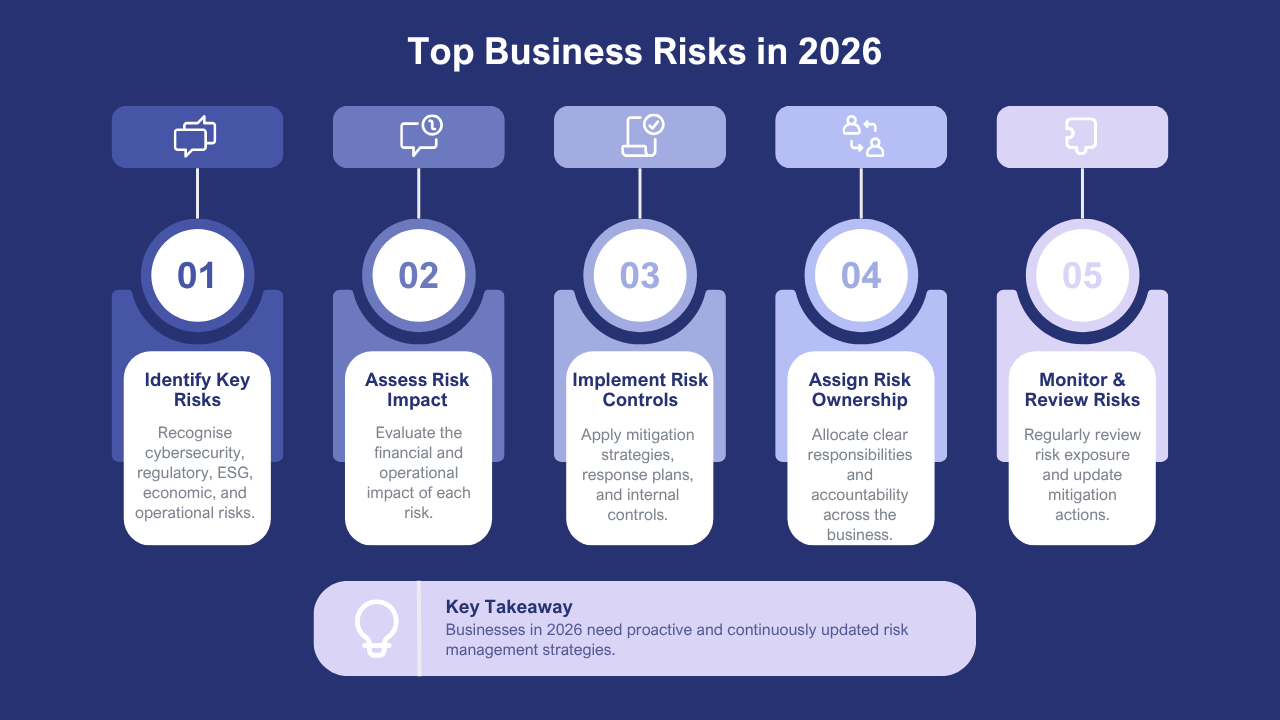
The five risk exposure in Australia listed below are the most actively debated, high-consequence risks facing Australian businesses in 2026. Each is evaluated on how it affects the business specifically, the key management reaction, and the most common failure mode at the mitigation level.
Risk Category | Specific Business Impact in 2026 | Primary Risk Mitigation Strategies | Most Common Management Failure |
Cybersecurity Risks | Ransomware, data breach, business email compromise, and supply chain cyber attacks are the most frequent incident types; mandatory notifiable data breach reporting creates reputational and regulatory exposure; costs include remediation, ransom consideration, legal fees, regulatory fines, and business interruption | Cyber insurance; endpoint detection and response (EDR) systems; multi-factor authentication (MFA) for all systems; staff phishing awareness training; tested incident response plan | No tested incident response plan; cyber insurance purchased without reviewing coverage adequacy; MFA not applied to financial systems or email; no third-party vendor security assessment |
Regulatory Risk Changes | Mandatory climate disclosure (AASB S1/S2) for large entities; privacy law reforms expanding individual data rights; expanded AML/CTF obligations for professional firms; employment law changes (wage theft criminalisation, casual conversion reforms) | Compliance calendar maintained and reviewed quarterly; legal advisory retainer; board-level oversight of regulatory change pipeline; proactive engagement with regulatory guidance | Regulatory changes identified but not actioned until enforcement action prompts remediation; no board-level visibility of the regulatory change pipeline; compliance managed reactively rather than proactively |
ESG Risk Factors | Climate-related physical and transition risk; supply chain sustainability exposure; greenwashing regulatory enforcement risk; ESG performance affecting access to capital and talent | Materiality assessment identifying specific ESG risks; climate scenario analysis; supply chain ESG assessment; board-level ESG governance; credible, data-driven sustainability disclosure | The ESG program exists as a document but is not operationally embedded; sustainability disclosures are aspirational rather than data-driven; no board accountability for ESG outcomes |
Economic Risk Management | Persistent inflation impacting input costs and wage demands; interest rate sensitivity for debt-carrying businesses; consumer spending weakness in discretionary sectors; trade uncertainty affecting export-dependent businesses | Cash flow forecasting with sensitivity analysis; fixed-rate debt hedging for material rate exposure; dynamic pricing review; working capital optimisation; supplier contract review for input cost management | Cash flow forecasting is conducted annually rather than dynamically; no scenario modelling for adverse economic conditions; pricing is not reviewed against cost inflation |
Operational Disruptions | Key-person dependency; supply chain concentration; critical system failure; natural disaster and climate-related physical events; talent shortages and workforce retention | Business continuity planning is tested annually; succession planning for key roles; supplier diversification; critical system redundancy; and workforce retention strategy. | A business continuity plan exists but has not been tested; key-person risk is acknowledged, but no succession plan has been implemented; supply chain single-source dependencies remain unresolved. |
Cybersecurity Risks have ceased to be a technology risk category and now represent a board-level business risk in the Australian context, due to the frequency of incidents affecting mid-market businesses and the increasing regulatory liability that accrues to incidents. The most consistently harmful management failure contributing to cyber incidents is the lack of a tested incident response plan: most businesses that have suffered a major ransomware attack find, during the incident, that their recovery plans are either undocumented, obsolete, or based on systems that have been encrypted. The annual value of the cyber risk mitigation strategies spend is the time spent testing the incident response plan, which is the most valuable such spend for most businesses.
4. Building a Strategic Risk Planning Framework for 2026
Connecting risk management Australia to business strategy
Strategic Risk Planning is best applied when integrated into the business strategy and planning processes, rather than managed as a distinct governance activity. Those risks that most frequently lead to the largest negative consequences are those identified on the risk register but not related to any particular strategic decision or resource allocation. The difference between the risk identification and the risk management Australia is reflected by the following: ESG Risk Factors that are identified but not allocated a budget before the effective date, Regulatory Risk Changes that are recognised but not addressed before the effective date, and Cybersecurity Risks that are rated as high priority but receive no budget before the effective date, etc.
- Strategic Risk Planning has the following requirements: each identified material risk has a named owner, a documented mitigation action, a deadline, and a reporting mechanism, all within the same accountability structure used in any other strategic initiative.
- The exposure to financial risk Analysis must be accompanied by all other material risk assessments: the understanding of the potential financial impact of a risk materialising should be the reason for promoting investment in mitigation and the reason for allowing the board to make informed risk acceptance decisions.
The Economic risk management Australia Challenge for 2026
In 2026, the Economic risk management Australia would be more dynamic than most Australian businesses have traditionally undergone. A combination of long-run input cost inflation, sensitivity to interest rates in financing growth with debt, and the variability of consumer demand creates a planning environment where the use of fixed annual budgets based on analysis of previous years is significantly less valuable than dynamic cash flow models with inbuilt sensitivity analysis. Businesses that model the effects of a 15 per cent increase in the cost of inputs, a 100 basis point change in the interest rate, and a 10 per cent fall in revenues all at the same time are much better equipped to respond to unfavourable conditions than are those that plan for the central case and react to variances as they arise.
Phase 1 | Phase 2 | Phase 3 | Phase 4 |
Risk Identification & Assessment | Mitigation Planning | Implementation & Monitoring | Review & Update |
Identify material risks across the five categories; assess likelihood and impact; prioritise for management attention; connect each risk to its potential Financial Risk Exposure; establish risk ownership | Design specific Risk Mitigation Strategies for each prioritised risk; assign named owners and deadlines; allocate budget; integrate mitigation actions into the business plan; document accountability | Execute mitigation actions; implement key risk indicators for highest-priority risks; establish a review cadence; integrate risk reporting into board and management reporting cycles | Conduct quarterly review of the risk register; update for Emerging Risk Factors and Regulatory Risk Changes; test Business Continuity Planning and incident response annually; report to board on risk posture |
How Regulatory Risk Changes require a different management approach
Regulatory Risk Alterations in the contemporary setting necessitate a future style of management which most enterprises have not traditionally required. The rate at which regulatory change is experienced in the areas of climate disclosure, privacy, financial services and employment law means that organisations that manage regulatory compliance reactively, that is, waiting until the effective date before they can assess the impact and develop the necessary capability, would always be either unprepared or in default. The bare bones of regulatory risk proactive management is a compliance calendar that tracks known regulatory changes (including the date of effect and the actions required by the organisation) and the schedule for taking those actions.
5. Real Cases and Lessons for Risk Professionals
Case 1: Cybersecurity Risks without a tested response plan
A ransomware attack occurred at a professional services firm with about 60 staff, resulting in the encryption of its primary file server and most of its client work files. The company was insured against cyberattacks and had installed basic endpoint protection, but had not exercised its incident response strategy. Recovery efforts revealed that the latest backup was only three days old and that it had itself been partially encrypted, that the firm had no record of the list of critical systems and their recovery priorities, and that the insurance policy required someone to notify within 24 hours of the incident – a requirement that was not met because no one knew that the insurance policy existed. The overall disruption cost, including business interruption, data recovery, client communication, and insurance excess, was approximated at 280,000. The three gaps would have been found before they became consequential through an annual incident response test at a cost of about $5,000. The Cybersecurity Risks were not unknown; the inability was the unwillingness to act in the face of a threat, not the lack of a strategy.
Case 2: ESG Risk Factors and the supply chain consequence
A consumer goods distributor did not have to comply with any mandatory climate disclosure requirements, but three of its largest customers were Group 1 entities under the AASB S2 mandatory reporting framework. The three customers sent their supplier ESG questionnaires, seeking Scope 3 emissions data, ethical sourcing statements, and evidence of modern slavery due diligence. The distributor lacked an emissions measurement programme, a modern slavery policy, and a formal supplier code of conduct. Answering the questionnaires was estimated to take three months of management time and involved the services of specialised ESG consultants. Two out of three customers noted that future supplier choices would be affected by SG performance. The ESG Risk Factors did not constitute a legal or regulatory requirement of the distributor; rather, they manifested as a business risk driven by supply chain demands on customers, who were in turn subject to mandatory requirements. This risk would have been identified much earlier had they planned the Strategic Risk Planning, which would have included the ESG requirements of major customers, rather than just the regulatory requirements of the business itself.
6. Conclusion
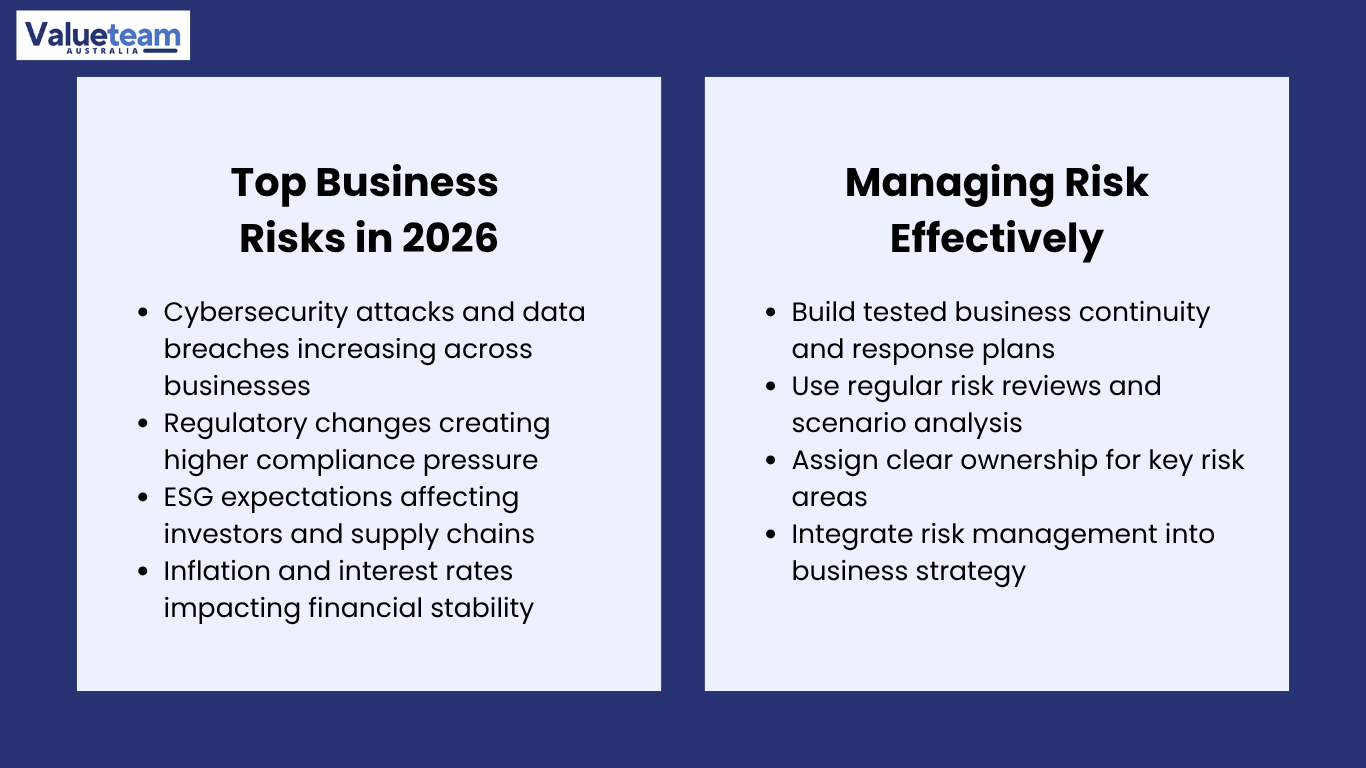
The Business Risks Australia 2026 landscape requires more proactive, more integrated, and more strategically connected risk management Australia than most businesses have traditionally managed. Each of them, Cybersecurity Risks, Regulatory Risk Changes, ESG Risk Factors, Economic Risk Management challenges, and Operational Disruptions, is material in its own right and is increasingly interconnected in its outcomes. Risk Mitigation Strategies that address each in isolation, without linking the mitigation to specific business decisions and resource allocations, will always be inadequate to meet the requirements of the current risk environment.
- And the most typical failure mode, which is the knowledge of a risk but a lack of preparation to handle it when it happens, is the most effective risk management Australia investment in most businesses in 2026.
- Businesses of all sizes and sectors feel the impact of ESG Risk Factors, not just those with direct regulatory obligations; the supply chain and commercial implications of ESG requirements imposed on major customers are already trickling down to suppliers who have not yet made ESG a priority.
- To professionals in the risk advisory space: Strategic Risk Planning that ties each identified risk to a specific financial impact estimate, a named mitigation owner, and a measurable outcome is the standard to which clients and boards are increasingly expectant – and it is the standard that is distinguishing between advisory contribution and documentation.
Frequently Asked Questions
Q1. What are the major business risks facing Australian companies?
Common risks include economic uncertainty, cybersecurity threats, regulatory changes, talent shortages, supply chain disruptions, and climate-related risks.
Q2. Why should businesses regularly assess risks?
Regular assessments help organisations identify emerging threats, respond proactively, and minimise operational and financial impacts.
Q3. How can companies manage business risks effectively?
Businesses can establish strong governance, implement internal controls, conduct regular risk assessments, and develop business continuity plans.
Q4. Who is responsible for managing business risks?
Business owners, executives, boards of directors, risk managers, and employees all play important roles in managing organisational risks.
Q5. How does proactive risk management support business success?
Effective risk management improves resilience, supports informed decision-making, and helps businesses achieve sustainable long-term growth.
1 thought on “Top Business Risks Australian Companies Face in 2026 and How to Manage Them”