

Understanding How Does Business Valuation Work With PPA?
Purchase price allocation (PPA) is the accounting process after virtually every acquisition that involves allocating the value of the acquired consideration to identifiable assets and liabilities acquired. In deal advisory, transaction services, and corporate development, finance professionals should have a working knowledge of business valuation and PPA to be able to accurately read the post-deal financial statements. The purchase price allocation valuation is a process of allocating the fair value of tangible assets, intangible assets (e.g. customer relationships and trademarks), and residual goodwill in accordance with IFRS 3/ASC 805 in a short reporting period. This article will explain the PPA valuation process, the PPA valuation methods that analysts use, some real world examples, and the practical issues that can impact allocation construction and argumentation.
What Is Purchase Price Allocation and How Does Business Valuation Work With PPA?
Purchase price allocation is an accounting process used by the acquirer when it combines a business. IFRS 3 and ASC 805 require the acquirer to determine all of the assets acquired and all of the liabilities assumed, measure each at fair value as of the date of the acquisition, and allocate the total consideration to the purchase as between the assets acquired and the liabilities assumed. These can consist of physical assets like inventory, equipment, real estate, and intangible assets like customer contracts, proprietary technology, or trade names, which may not have shown up on the target’s books, since they were created by the acquiring company. Any amount remaining in excess of the fair value of identifiable net assets is recorded as goodwill, and the rare opposite is a bargain purchase (when the fair value of the identifiable net assets exceeds the purchase price) and must be recognized as a single charge to earnings. This is where the valuation of the purchase price becomes different from the valuation of a stand-alone enterprise: the analyst is spreading the value of the enterprise—already agreed upon in negotiations—among dozens of components, with their own fair value logic, useful life and disclosure needs, which will be listed for years to come following the combined enterprise.
It is important to understand the workings of business valuation through PPA and to know who is present and what their motivations are. Typically, the technical exercise is led by valuation specialists, but they collaborate with the deal team, external auditors, and sometimes tax advisors; the allocation has implications that cascade into financial reporting and deferred tax positions with implications for future earnings per share and effective tax rates. In particular, auditors are trained to be skeptical of the file, as the lower the intangible allocation is, the higher the earnings are in the near term — and the valuation team must be careful not to rely on assumptions that make the results look good for investors. Standards normally give room for up to a year from the acquisition date to fill in figures, allowing teams to provide missing data but also forcing them to finalize entries before the next audit cycle or quarterly filing. Junior analysts starting to work in this space should do their best to spend the initial few weeks of a mandate on data collection and interviews with stakeholders rather than modeling – the quality of the eventual valuation is going to be almost entirely dependent on the quality of the inputs collected at the beginning.
What Are the Key PPA Valuation Methods Analysts Rely On?
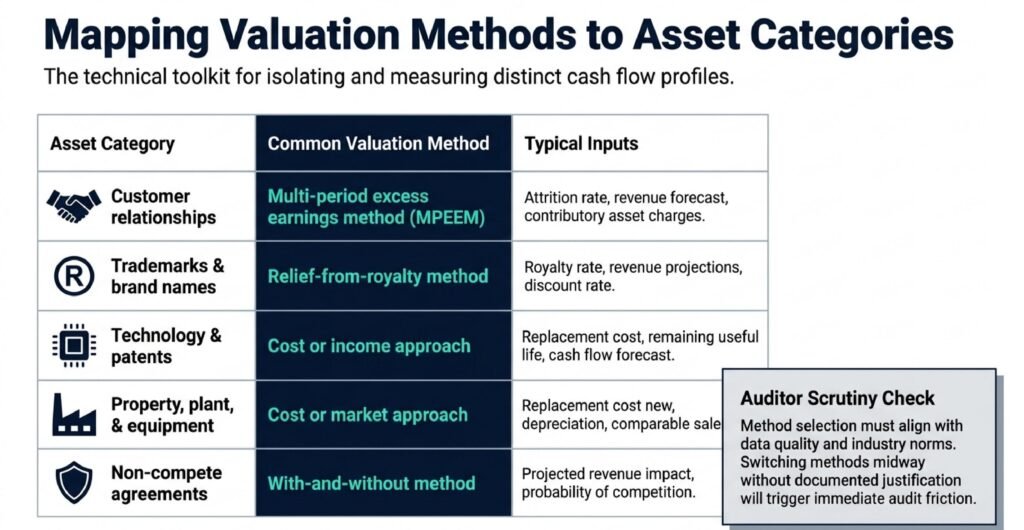
The PPA valuation methods that are applied to a specific asset are directly related to the asset and the data available to support that asset; making the right selection is one of the first technical decisions a valuation analyst makes on an engagement. Multi-period excess earnings method (MPEEM) is an income method that values the customer relationships and order backlogs by excluding the cash flows generated from other assets that contribute to the generation of the latter. These include assembled workforce, fixed assets and working capital. The relief from royalties method is widely used to value a trademark or brand, particularly when the royalty rate in the market is known, by calculating the amount of royalty the company would have paid a third party to license the trademark and discounting the savings back to present value. The valuation of technology and patents can be accomplished using either MPEEM or a cost approach, depending on the role technology plays for the generation of revenue and the time required to reproduce the technology in the market by a market participant, with a cost approach preferred in the case of early-stage technology or when the technology does not yet yield a clearly attributable revenue stream.
In addition to intangible assets, tangible fixed assets are usually valued on the cost or market approach; investments are usually valued using quoted market prices, if applicable, and on a discounted cash flow approach if not; and certain financial assets are valued on a discounted cash flow approach if market prices are not available, or on the cost approach. Another common PPA provision with a valuation component is a non-compete clause, which is typically valued by comparing the expected cash flows if the contract is in place with the cash flows if the seller reenters the marketplace and contends for customers. There is no random way to pick and choose which of these valuation methods to use – auditors will expect to see a clear reason for selecting the method, being related to the nature of the asset, industry and the inputs available, and the change of methods in the middle of an engagement will bring audit scrutiny to bear. The following table provides a summary of how these methods relate to the type of assets found in a typical purchase price allocation valuation project, and most junior analysts have it on their desktop to reference when starting a new project.
Table 1: PPA Valuation Methods by Asset Category – How Does Business Valuation Work With PPA?
| Asset Category | Common Valuation Method | Typical Inputs |
|---|---|---|
| Customer relationships | Multi-period excess earnings method | Attrition rate, revenue forecast, contributory asset charges |
| Trademarks and brand names | Relief-from-royalty method | Royalty rate, revenue projections, discount rate |
| Technology and patents | Cost or income approach | Replacement cost, remaining useful life, cash flow forecast |
| Property, plant, and equipment | Cost or market approach | Replacement cost new, depreciation, comparable sales |
| Non-compete agreements | With-and-without method | Projected revenue impact, probability of competition |
What Does the PPA Valuation Process Look Like From Kickoff to Reporting?
The typical PPA valuation process starts with a kick-off meeting where the valuation team reads through the purchase agreement, the opening balance sheet and any existing due diligence reports to determine which intangible assets to consider before beginning any spreadsheet work. The team then asks for the supporting data: customer contracts and churn history for relationship intangibles, trademark registrations and licensing precedents for brand assets, employment records, assembled workforce, and fixed asset registers, for tangible property. This is usually the longest portion of the assignment, as the data acquired from companies that are being bought are rarely in the format required for a valuation model and management teams are typically busy with their post-merger integration process, rather than requesting reports on historical data, and so the valuation lead often has to file a data request in several various departments at the acquired company before the valuation lead can be considered complete. At the same time, the team also verifies the structure of the transaction, as asset transactions and stock transactions can have different tax bases and so may have different consequences with regards to the distribution of the allocation in the end through deferred taxes. Many teams prefer to meet the target’s finance or ops managers within the first week and go over the intangible asset checklist point by point, because this is the one meeting where many context items may come up that would otherwise be missed in a generic data request – including such things as an informal customer contract, or an algorithm that the target developed internally, etc.
After obtaining the data, the team constructs the valuation models, checks the assumption against market data and comparable transactions, and totals up the individually valued assets and compares them against the total purchase consideration, with any excess amount attributable to goodwill. At this point, the useful life is also estimated for each of the intangible assets, as they will directly impact the combined company’s future amortization expense on the income statement for years following closing. The final piece of the PPA valuation puzzle is documentation on the formal report that explains all the methods used, all the inputs used, and all the judgements made – it will be reviewed by outside auditors and in many jurisdictions, be subject to regulatory review long after the deal team is on to the next transaction. There is a tendency to view this documentation as an afterthought, and then have to reconstruct the schedule under pressure when the auditors ask the next question weeks or months later, so it’s best to build this document as you build the schedule. Many valuation teams perform an internal quality review prior to submission to the client or auditor, with a second, independent reviewer to ensure that formulas connect correctly, the narrative correlates with the numbers, and there is an explanation, which is defensible, to accompany each material judgment.
What Five Steps Keep a PPA Valuation Process on Track?
- Confirm the framework. Early agree the accounting framework and acquisition date; IFRS 3 and its US equivalent ASC 805 differ in a number of details in the measurement, which will impact which assets are eligible for separate recognition and how the contingent consideration is treated.
- Make an intended list. Create an intangible asset checklist using the purchase agreement, management presentations, and due diligence reports prior to asking for information – don’t ask for data that can be overwhelming and open-ended or a presentation of the purchase price allocation valuation built from data that is collected as a general list.
- Convey Method to Asset. Consistently apply valuation methods recommended by industry and generally accepted in practice (GAAP) for the valuation of each asset, as the auditors and regulators expect to see these methods consistently applied to assets for which they are applicable, and explain why other valuation methods were considered, but not ultimately used.
- Reconcile continuously. Conduct continuous reconciliation of the total of identified values to the total consideration throughout the engagement, not just at its end, to bring into light modelling errors or double counted values and correct them early.
- Engage with auditors at the onset. Communicate any draft results and assumptions to the auditors BEFORE the file is completed, to avoid re-working as the reporting deadline nears, and avoid wasting hours and hours of time.
What Do Real-World Purchase Price Allocation Examples Reveal?
Take, for example, a medium-sized industrial manufacturer, Meridian Fabrication Group, which bought a smaller software analytics company to enable predictive maintenance features for its equipment portfolio. The purchase price allocation valuation recognized three intangible assets in addition to goodwill: developed technology, valued with the cost approach because the platform was pre-revenue and lacked an adequate standalone cash flow forecast; customer contracts, valued using MPEEM, with the customer contracts forecasted individually instead of as a group; and a trade name, valued using the relief from the royalty approach with a reliance on royalty benchmarks based on comparable software licensing agreements. The exercise uncovered that almost 40 per cent of the purchase price was in goodwill, demonstrating the premium that was paid for talent and technology, but not for any identifiable contractual asset, which is typical in its early acquisition stages where much of the value is realised in the future, not in the present. The valuation team was also required to closely coordinate with the engineering leads of the target to determine the extent to which the software was actually proprietary or comprised open source components, as this would have an impact on the inputs to the cost approach and useful life of the technology asset.
The second case is one in which a consumer products firm buys a regional brand that has been well known in the area for many years by consumers and independent retailers. The valuation of PPA in this case was driven more by the brand and customer-relationship intangibles, rather than with the technology, because the value of the acquired company was based on its trademark as well as its distribution network with local retailers in the region. The acquisition team’s finance team used that brand value to guide future marketing investment decisions, and a crucial purchase price allocation valuation can guide decisions beyond the accounting entry, as the relief from royalties revealed a significant brand value when benchmarked against similar beverage sector licensing agreements. In both cases, the deal teams realized they would ultimately use the intangible asset conclusions to drive the internal dialogue on the allocation of funds for postacquisition investment, and not just for compliance reasons. Both of the deals were not overly unusual in terms of the industry or the deal size, which is what makes them great teaching examples: the same basic idea, matching an asset to a method that best aligns with the cash flow and pieces of evidence, is true for both a niche software company and a 100-year-old regional brand.
What Challenges and Lessons Emerge From PPA Valuation Assignments?
A common issue in any PPA valuation process is that the customer base and its history of customer attrition is not available or does not exist, as is the allocation of costs within the business to identify specific intangible cash flows that are not part of the operating business. In some cases, especially those with smaller targets, the targets may not have the financial structure to provide the granular schedules needed in the valuation model, requiring analysts to make reasonable assumptions and be open about these assumptions in the end report. Contingent consideration structures, including earn-outs based on future performance, can be more complex and require them to be measured at fair value as of the acquisition date; they also can be remeasured at the acquisition date if there are significant differences between post-acquisition results and originally projected results, at which point they may have to be remeasured again in a subsequent reporting period. These combine with tight deadlines for reporting: Measurement period adjustments are allowed for up to 12 months, but auditors are extremely watchful for changes to the measurement period made at the last minute and repeated adjustments can lead to questions about the robustness of the initial measurement period analysis, and in some instances, raise broader questions about internal control over financial reporting.
The best takeaway from those with experience is that documentation discipline is the dividing line between a smooth and contentious PPA engagement. If the rationale is documented as the assumption is made, not many months after, by looking back at memory or through a series of emails, there will be fewer chances to rework the numbers when they’re audited months later, and the numbers will be more credible. Early involvement of auditors on methodology also helps to lower the chance of any dispute that might arise later in the engagement regarding the method chosen or the assumptions used for a discount rate, as it is much easier to tweak the approach in week two of an engagement than to unwind the completed approach in week eleven. Using sensitivity tables for the most judgemental inputs, like attrition rates and royalty rates, further cements the file by demonstrating to the reviewers how much the conclusion is subject to if the assumptions that they were presented with are reasonable alternatives, and this is one of the quickest ways for a junior analyst to earn credibility during a purchase price allocation valuation. It also shouldn’t be forgotten that PPA conclusions are not standalone affairs; they directly impact post-acquisition amortization expense, impairment testing baselines, and even management’s perspective on what parts of a deal truly provided the value that was presented to the board, in addition to the closing day entries.
Table 1: Common Challenges in the PPA Valuation Process and Practical Mitigations – How Does Business Valuation Work With PPA?
| Challenge | Practical Mitigation |
|---|---|
| Incomplete historical customer data | Request data at kickoff and build proxy assumptions where gaps exist |
| Contingent consideration uncertainty | Model earn-outs separately using probability-weighted scenarios |
| Tight measurement period deadlines | Set internal milestones well ahead of the 12-month regulatory limit |
| Disagreement on method selection | Align with auditors on methodology before finalizing models |
| Inconsistent management projections | Cross-check forecasts against historical performance and market data |
Conclusion: How Does Business Valuation Work With PPA?
Whether they are part of a corporate development team, an advisory firm or an audit practice, purchase price allocation professionals add value to any deal team, and that is precisely where they are needed. Understanding the PPA valuation process, which PPA valuation methods can be used for which assets, and how a PPA valuation process into the big picture of the deal, can be applied across industries, across the size of the deal, from the smallest bolt-on to the biggest cross-border combination. Once you have done this, the next step for anyone developing a career in this area is pretty easy: take a completed PPA report line by line; ask why that method was used instead of the other options; practice asset values being added back to total consideration; and become comfortable in defending the assumptions in an easy-to-understand way – which is the most important key in separating the strong valuation professional from the purely technical one.