

Table of Content
1. Introduction: Brand Value
In any M&A negotiation, the headline price always means much more than the earnings the business is currently generating. A large part of the majority of the prices of most privatised transactions incorporates the Brand Value in M&A -The cumulative market reputation, customer preference and competitive positioning that the acquiring party is paying to own. In the case of consumer businesses, professional services firms, and technology companies with strong market positions, brand may be the largest component of the Purchase Price Premium that a buyer is willing to pay over the tangible net asset value of the business. But brand value is also one of the most disputed and least well-documented factors of any negotiation.
The problem with sellers is not that buyers are willing to discount brand value, but that sophisticated acquirers know about it and are actively seeking it. The difficulty lies in the fact that brand value is a qualitative concept and must be subject to a rigorous, evidence-based process to be translated into a defensible quantitative position that withstands due diligence and negotiation. Sellers with the ability to provide a believable, independently supported brand valuation enter the negotiation with Intangible Negotiation Leverage, which sellers who solely rely on narrative simply lack. The result of the Brand Equity Negotiation will depend on the quality of the brand evidence used to reflect the brand’s true commercial value.
This article is composed for juniors and mid-level professionals in the M&A advisory, corporate finance, and brand strategy professions who want to understand how Brand Value in M&A is calculated, how it may affect the dynamics of negotiation, and what sellers need to do to translate brand strength into Deal Value Drivers that will buy at the point of transaction. It also comes in handy for business owners who want to know why that brand is worth anything to them.
2. How Brand Value Enters the M&A Negotiation
Why buyers pay a premium for a brand
Brand Value in M&A comes to the bargaining table because brand has proven commercial implications: it lowers the cost of customer acquisition, makes Pricing Power Brand that enables the company to keep its margin above generic competitors, creates a Customer Loyalty Value that may take a buyer years of investment to emulate organically, and generates a Competitive Positioning Value that may take a buyer years of investment to replicate organically. In particular, strategic acquirers are often more than willing to pay a large Purchase Price Premium to acquire a brand that fills a capability or market position gap they cannot bridge through internal development alone.
- Pricing Power Brand: a business that consistently prices higher than the market and retains its customers is subject to brand-driven margin protection, one of the most obvious indicators of authentic brand value to customers.
- Buyer Perception Value: the perception that the acquirer has of the brand strategic fit in their own portfolio is often the largest determinant of the premium that they are willing to pay – the same brand can be worth very different amounts to different buyer categories.
- A brand that occupies a defensible market position – especially in a niche where the acquirer has been unable to gain presence organically – can command a premium several times the brand’s standalone value.
Goodwill Allocation and the accounting of the brand in transactions
When accounting for an acquisition, the excess of the amount paid over the fair value of identifiable net assets is recognised as goodwill. But under IFRS 3 and AASB 3, acquirers are now required to separately recognise and value identifiable intangible assets, including brand names and trademarks, and not to include them entirely within goodwill. Goodwill Allocation in the purchase price allocation exercise thus has a direct bearing on how brand value will be reflected in the acquirer’s financial statements and on the amortisation charges that will flow through the acquirer’s income statements.
For practitioners, the distinction between residual goodwill and specifically identified brand intangibles is important to the negotiation process and to the reporting of post-acquisition intangibles. When a seller can provide a credible brand valuation supported by a recognised methodology, such as relief-from-royalty, it creates an anchor for the discussion on purchase price allocation, allocating more value to the brand and less to residual goodwill, with implications for the post-completion accounting treatment of both parties.
3. What Makes Brand Value Defensible in Negotiation
Evidence that converts narrative into Intangible Negotiation Leverage
Brand claims that are not provable are the ones buyers will discount. The failure mode most prevalent in Brand Equity Negotiation is that the seller is selling brand value in the form of a qualitative statement – we are a familiar name in our industry, or customers prefer to use us because of our reputation. Buyers who are not able to independently check the strength of the brand will use their own conservative estimate, which is nearly always lower than the judgement of the seller regarding what the brand is worth.
- Quantitative brand evidence: Net Promoter Score, unprompted brand awareness research, customer retention and renewal rates, pricing premium versus unbranded alternatives, and cost of customer acquisition trends.
- Contractual evidence: customer contracts stating the brand as the foundation of the relationship; licences or partnerships which recognise brand strength; any formal brand licensing revenue the business receives.
- Independent brand valuation: a formal brand valuation report prepared by a qualified valuer using a recognised methodology is the most defensible anchor for Brand Equity Negotiation and the most effective counter to a buyer’s conservative appraisal.
The transferability test — which brand value survives acquisition
Brand value is not always at par in an M&A scenario. Brand value that attracts a Purchase Price Premium is the value that will continue to exist once the acquiring entity takes ownership. Buyers evaluate transferability on a case-by-case basis: does the brand align with the founder’s personal identity rather than the entity itself, making it vulnerable to dilution if the founder exits? Are the trademarks recorded in the entity’s name and can be fully assigned? Does the brand rely on the founder’s continued presence in social media to secure brand recognition? All these influence the extent to which the claimed Brand Value in an M&A transaction a buyer will, in fact, credit in his offer.
Brand Characteristic | Buyer Perception Value | Impact on Purchase Price Premium |
Registered trademark in entity name, multi-year history, sector recognition | High: legally protected, institutionalised, independent of founder identity | Premium supported; the buyer can defend the brand allocation in the purchase price allocation |
Strong operational brand, but registered in the founder’s personal name | Moderate to low until transferred: legal ownership risk reduces the premium the buyer will pay | Premium discounted until IP transferred; seller must complete registration in entity name before closing |
Brand recognition is tied primarily to the founder’s public profile (author, speaker, public figure) | Low transferability: Pricing Power Brand may not survive if the founder is not retained | Significant discount applied; buyer may require an extensive transition period or decline to pay a brand premium |
Sub-brand or product brand with documented consumer loyalty and independent market presence | High if independently measurable: brand exists separately from the entity’s other activities | Full Brand Equity Negotiation premium available if supported by data and legal protection |
4. Five Steps to Negotiating Brand Value in an M&A Process
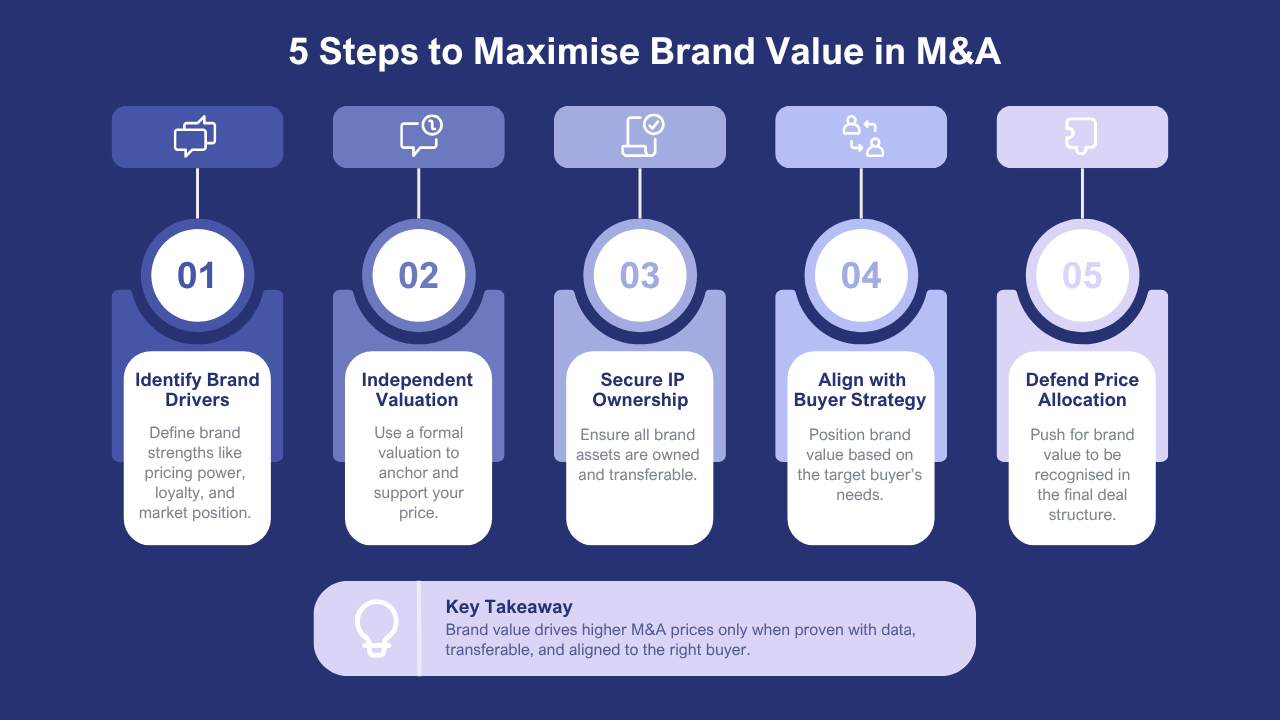
To convert Brand Value in M&A into a negotiated Purchase Price Premium, a systematic process is required that is comparable to the rigour applied to financial due diligence. The five steps below reveal how wise advisors organise the brand value negotiation from initial evidence gathering to the final price agreement.
Step | What It Involves | Negotiation Outcome | Common Mistake |
1. Assess and document Deal Value Drivers | Identify the specific brand attributes that create commercial value for the buyer: pricing power, customer loyalty, market recognition, licensing potential. Gather quantitative evidence for each attribute. | Creates an evidence-based brand narrative that frames the buyer’s analytical approach from the outset | Presenting brand value as narrative without data; buyers substitute their own conservative estimate |
2. Commission independent brand valuation | Engage a qualified valuer to apply a recognised methodology — most commonly relief-from-royalty — and produce a documented brand value range supported by comparable royalty data and market evidence | Establishes a specific, defended number that anchors the negotiation; buyer must produce a counter-analysis to challenge it rather than simply asserting a lower figure | Relying on internal estimates rather than an independent report, sophisticated buyers will not credit brand value that has not been independently supported |
3. Confirm brand IP transferability | Ensure all relevant trademarks, domain names, and brand-related IP are registered in the entity’s name and are assignable without third-party consent; address any founder-held registrations before going to market | Removes the discount buyers apply for IP transfer risk; demonstrates that the Competitive Positioning Value will survive the transaction | Discovering brand IP transferability issues during buyer due diligence, rather than addressing them proactively, by then the seller is in a weakened negotiating position |
4. Frame the Buyer Perception Value for the target acquirer | Articulate the brand value specifically in the context of the most likely buyer’s strategic position: why does this brand’s Strategic Brand Importance exceed its standalone value for this specific acquirer? | Moves the negotiation beyond generic brand value to strategic premium — the value to this buyer, in this context, is higher than the general market value | Generic brand narrative that applies to all buyers equally; strategic premium is only unlocked when the brand’s specific value to the acquirer’s situation is explicitly articulated |
5. Defend the Goodwill Allocation position | When the purchase price allocation is negotiated post-signing, advocate for allocating the maximum amount to specifically identified brand intangibles rather than residual goodwill; the accounting treatment has tax and financial reporting implications. | Produces a purchase price allocation that accurately reflects the brand’s contribution to the transaction price; avoids the under-attribution of brand value that can disadvantage the seller in earnout or adjustment calculations | Treating purchase price allocation as a post-completion accounting exercise rather than a negotiated element of the transaction |
Step 4 – framing Buyer Perception Value for the particular acquirer – is the step that unlocks the largest premiums in strategic transactions. The brand can be worth a standard multiple to a financial buyer and a transformational premium to a strategic acquirer who sees it as filling a specific gap in their market position. The advisory value that best translates brand quality into a premium offer price is identifying the acquirer category most likely to value the brand strategically.
5. Process, Real Cases, and Lessons for Practitioners
The brand value negotiation workflow
Brand Equity Negotiation in a live M&A transaction does not follow a separate track as compared to the overall deal process – it is integrated into the preparation, information memorandum, due diligence, and price negotiation process. The four-step workflow below is how experienced advisors ensure brand value is captured at each stage.
Phase 1 | Phase 2 | Phase 3 | Phase 4 |
Brand Evidence Gathering | Brand Valuation | Buyer-Specific Positioning | Negotiation & Allocation |
Compile quantitative brand evidence: NPS, retention data, pricing premium data, awareness research; confirm IP registration in entity name; identify Deal Value Drivers specific to the most likely buyer categories | Commission independent brand valuation using relief-from-royalty or income approach; prepare Goodwill Allocation analysis; integrate Brand Value in M&A into the overall information memorandum narrative | Tailor the Strategic Brand Importance narrative for each buyer category; prepare Competitive Positioning Value analysis showing the brand’s strategic premium for the target acquirer; present Buyer Perception Value case | Defend Purchase Price Premium with documented brand valuation; negotiate brand IP allocation in heads of terms; advocate for specifically identified brand intangible in purchase price allocation; finalise Intangible Negotiation Leverage position at close |
Case 1: The premium that was nearly left on the table
The sale of a consumer products company with a 14-year-old brand was primarily based on financial performance. The original information memorandum did not contain any brand analysis, and the original buyer offers were based on standard earnings multiples without a brand premium. The seller’s advisor commissioned a relief-from-royalty brand valuation based on similar royalty rates from publicly available licensing databases in the personal care category. The analysis yielded a range of brand value of $1.1 million to $1.6 million, which was presented alongside the financial materials in a second-round process. Those buyers who had originally treated the brand as a generic resource had to either address the methodology in their offer or indeed accept it as a floor. Two of the three binding offers made during the second round included a Purchase Price Premium for their brand, which they had not reflected in their indicative prices in the first round. Its final sale price was about 1.3 million more than the first-round bid average – a brand valuation analysis that was not included in the initial materials.
Case 2: Strategic Brand Importance, unlocking a different buyer
A professional services company that functions in the regulatory compliance consulting category had developed a strong brand in a particular vertical – financial services risk management – but had never quantified or formally presented the Competitive Positioning Value of such positioning. An accounting and advisory strategic acquirer realised the firm was a direct solution to a capability gap: the acquirer’s existing brand had zero recognition in the risk segment of the financial services market, and organic growth would have taken years of investment in reputation building, recruitment, and thought leadership. The offer made by the acquirer included a specified Purchase Price Premium of 40 per cent above what a financial buyer had offered to acquire the same business in a credible time frame. The Strategic Brand Importance premium was real, but it was only recognised because an advisor had found the right buyer and framed it correctly.
6. Conclusion
One of the most commercially important and least systematically acquired sources of Purchase Price Premium in private business transactions is Brand Value in M&A. The most defensible, most transferable, and most strategically relevant brands that can command the highest premiums are not always the most famous, but rather the ones that are most defensible, most transferable, and most relevant to the buyers who ultimately make the highest offers. Brand Equity Negotiation works best when it is based on evidence supported by independent valuation and framed specifically in terms of the Buyer Perception Value for the most strategically motivated acquirer category.
To the advisors: the brand analysis that opens a premium is not created during the negotiation – it is created during the preparation phase. Order the brand valuation, confirmation of the transferability of the IP, and creation of the Strategic Brand Importance narrative prior to the first buyer viewing the business. To sellers: the gap between a transaction, which reflects the full commercial value of your brand, and one which does not is nearly always an evidence gap – not a value gap. Develop the evidence, and the premium will follow.
Frequently Asked Questions
Q1. Why is brand value important in mergers and acquisitions?
A strong brand enhances customer loyalty, market recognition, and future earnings, often increasing the value of an acquisition.
Q2. What is a business valuation and an independent expert report?
Brand valuation considers market position, financial performance, customer perception, brand strength, and future income generation.
Q3. What are the circumstances in which an independent expert report is needed?
Yes. Buyers may pay a premium for businesses with established brands that provide sustainable competitive advantages.
Q4. What is the average length of a business valuation engagement?
Business owners, investors, acquirers, valuation professionals, and corporate finance advisers all benefit from understanding brand value.
Q5. What information is needed to start a valuation engagement?
It provides independent evidence of brand value, helping buyers and sellers negotiate fair acquisition prices.
1 thought on “How Brand Value Impacts M&A Negotiations and Purchase Price”