

Table of Content
1. Introduction to Risk Management Framework for Australian SMEs
In most small and medium-sized businesses, risk management is informal: experienced operators develop a sense of what might go awry and act accordingly, often without any formal structure or process of systematic oversight. This strategy works sufficiently in predictable, familiar environments – but fails when the business is growing, entering new markets, taking on complexity through acquisition, or when something unforeseen happens and reveals a gap that no one had previously thought to fill. One of the most prevalent sources of preventable business failure in the Australian market is SME Risk Management, which is informal and undocumented.
A Risk Framework Australia proportionate to the size and complexity of the business does not have to recreate the formal governance infrastructure of a large listed company. The one thing it does need to do is to determine the most important risks the business is exposed to, establish clear accountability for managing the risks, implement controls that actually work, and create a monitoring process that helps keep the risk picture up to date as the business advances. SME-level Enterprise Risk Management is more about discipline and consistency than bureaucracy.
The article is aimed at business owners and senior managers who wish to develop an effective Risk Framework in Australia, and at junior professionals in advisory, governance, or finance roles who would like to understand how risk management works in the SME context. It includes the main aspects of a successful framework, the five main steps of a Risk Assessment Process, the operational issues that keep occurring, and the practical lessons learned by businesses that have developed a successful risk management capability.
2. Why SMEs Need a Formal Risk Framework
The gap between risk awareness and risk management
Risk awareness does not mean risk management. Most business owners can explain to you what their business is exposed to, but very few have documented it. Still, very important to determine what those risks are, what a set of controls will look like when managing those risks, and what a regular review cycle would look like to keep the picture of risk current. The awareness without action is exactly what the gap between awareness and management entails: the data breach that was supposed to be addressed in the near future, the dependency on key suppliers that was not addressed but is manageable, and the regulatory obligation that was supposed to be addressed.
- Formalisation of SME Risk Management introduces accountability: the risk documented in a documented framework with an assigned owner becomes a manageable item that exists only in the mental model of the owner.
- Growing business-specific transition risk: what was a well-informed risk management approach that worked in a 10-employee business does not scale to a 50-employee business, and the failure to formalise the framework as the business grows creates structural exposure, which tends to surface at the worst possible time.
- Lenders, insurers, acquirers and high-end customers are also increasingly evaluating the quality of the business’s risk management – a well-documented Risk Framework. Ark Australia is a commercial assembly, a governance requirement.
What Enterprise Risk Management looks like for an SME
Small- or mid-sized businesses do not mandate a dedicated risk function or a complex governance hierarchy. It includes a governance hierarchy, risk identification process, a consistent approach to evaluating and prioritising risks, documented controls with named owners, and a regular cadence to review the effectiveness of controls. The most commonly consulted framework for this work in Australia is the ISO 31000 Risk Management Standard, and the principles thereof are sufficiently flexible to be implemented at any scale.
3. Key Risk Categories and How to Assess Them
Operational Risk Controls and the risks most SMEs underestimate
Operational Risk Controls address the risks associated with the daily running of the business, including dependency, supplier concentration, technology failure, fraud, data breaches, and process failure. These are the risks most SME owners know but are unlikely to have documented controls for. Operational risks (not strategic or financial risks) are the most probable cause of material loss in most businesses with fewer than 100 employees. With fewer dependencies, it is by far the most commonly identified type of operational risk in SME businesses. When a critical business function is performed by just one person whose departure would cause significant business disruption, the control is a documented succession or cross-training plan.
- Technology and data risks have become dominant for SMEs in the last five years, and cyber incidents against SMEs are currently the most prevalent category of operational risk event in the Australian insurance claims data.
- Compliance Risk Management – the risk of failing to comply with regulatory requirements – is underestimated by many SMEs who assume that compliance requirements are relevant only to large companies; in practice, they need to comply with employment law, privacy, consumer protection and industry-specific licensing requirements, regardless of the size of the business.
A structured approach to risk prioritisation
A risk register that compares each of identified risks to two dimensions, the probability of occurrence and the potential level of impact is the most practical tool to use in risk prioritisation of SMEs. It is these two dimensions that give rise to a risk priority score, to which the management attention and control investment should be directed. The table below presents a simplified risk matrix that can be used in majority of SME settings.
4. Five Steps to Build a Practical Risk Management Framework
Five steps in building risk management framework, which take time and discipline and are not complex, can be used to construct a functional Risk Framework for Australia in an SME. The following steps are the ones experienced risk advisors use when developing or enhancing risk management capacity in businesses at the SME level.
Step | What It Involves | Key Output | Common SME Gap |
1. Conduct the Risk Assessment Process | Identify all material risks across operational, financial, compliance, reputational, and strategic categories; rate each for likelihood and impact; prioritise for management attention and control investment | Risk register with prioritised risk list; initial view of uncontrolled vs. controlled risk exposure | Risk assessment conducted informally by the owner without structured methodology; no documentation of the assessment process or its outputs |
2. Design Operational Risk Controls | For each prioritised risk, define the specific control action that will reduce either the likelihood of occurrence or the severity of impact; assign a named owner for each control; document the control in the risk register | Control register with named owners and implementation timelines; clear accountability for each material risk | Controls described generically rather than specifically; no named owners; controls not actually implemented despite being documented |
3. Establish the Risk Governance Structure | Define how risk management will be overseen at the board or owner level; establish a regular review cadence; integrate risk reporting into the management reporting cycle | Risk governance terms of reference or meeting schedule; risk management as a standing agenda item | No formal oversight of risk management; risk register updated but never reviewed; no escalation pathway for emerging risks |
4. Implement Business Continuity Planning | Develop documented plans for the business’s most critical scenarios: key-person incapacitation, system failure, natural disaster, major customer loss; test plans annually | Business continuity plans for the top three to five scenarios; contact lists; recovery time, and objectives | N, and Business Continuity Planning until a crisis occurs; plans are not tested and discovered to be incomplete or outdated when needed |
5. Deploy the Risk Monitoring System | Establish a regular review cycle for the risk register; implement key risk indicators (KRIs) for the highest-priority risks; review and update the framework when material business changes occur | Quarterly or semi-annual risk register review; KRI dashboard for key risks; update protocol for business changes | Risk register created and then abandoned; no mechanism for identifying new or emerging risks between annual reviews |
The fourth step is Business Continuity Planning, which is one of the steps that most often occur in incidents. The most frequent occurrence in the course of a real crisis is that the business continuity plan either does not exist, has not been updated since it was written, or contains contact information and recovery procedures that no longer reflect the current situation in the business. A tested plan (even through a simple tabletop exercise rather than a full operational test) can help detect gaps that can be closed before they become consequential. The price charged at the hour of preparation is likely to be much lower than the price charged for an unplanned disruption, which will be managed without any structure.
5. Process, Real Cases, and Lessons for Practitioners
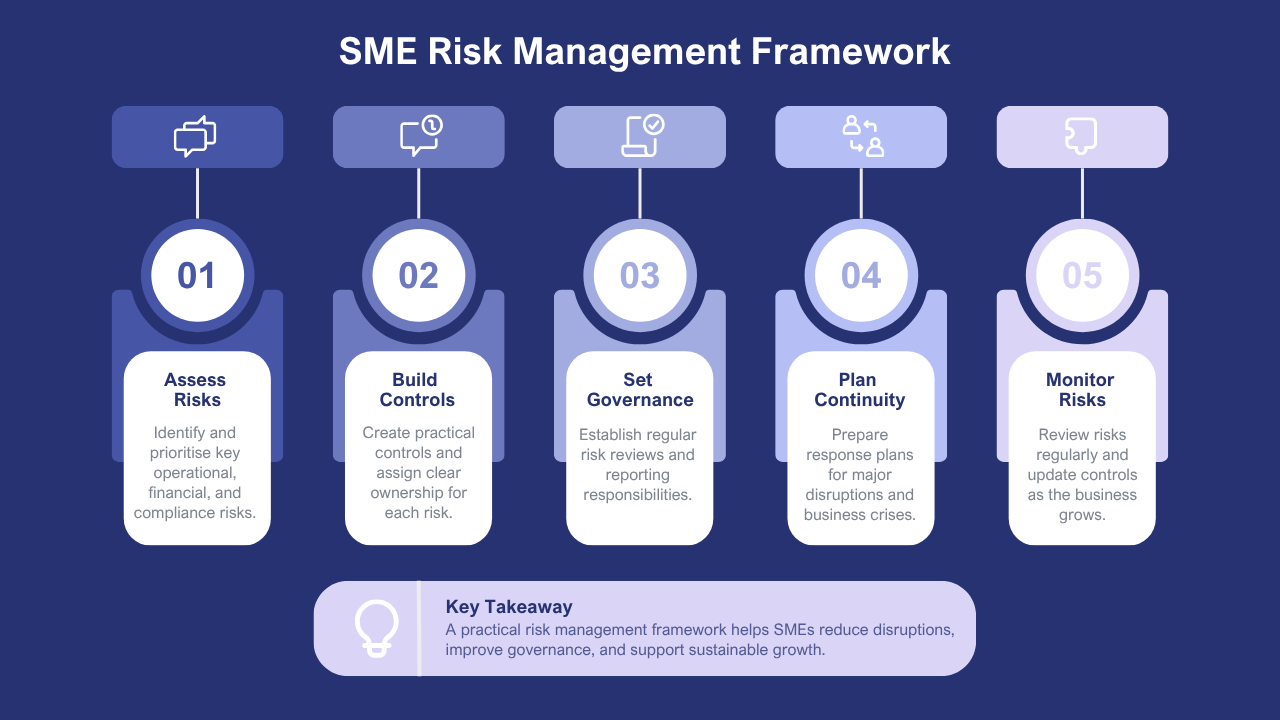
The risk framework implementation workflow
Construction and operation of a Risk Framework: Australia adheres to a four-stage approach, and the framework is integrated with the business’s current management and governance practices. This represents the way experienced advisors apply practical Enterprise Risk Management to SME clients.
Phase 1 | Phase 2 | Phase 3 | Phase 4 |
Risk Identification & Assessment | Control Design & Ownership | Governance & Monitoring | Continuous Improvement |
Conduct a structured Risk Assessment Process covering all risk categories; populate the initial risk register; prioritise risks by likelihood x impact score; identify existing controls and control gaps | Design specific Operational Risk Controls for prioritised risks; assign named owners; implement Risk Mitigation Strategy for top-priority risks; document controls in risk register | Establish Risk Governance Structure: review cadence, reporting line, escalation pathway; deploy Risk Monitoring System with key risk indicators; integrate risk reporting into management meetings | Review risk register quarterly or semi-annually; update for business changes; test Business Continuity Planning annually; review Compliance Risk Management obligations when the regulatory environment changes |
Case 1: Key-person dependency that became a crisis
A professional services firm of 22 personnel based its client relationships and intellectual relationships entirely on the founding partner, who was the primary contact with clients who generated 80 per cent of the revenues. The percents had re-evaluated key-person risk in an earlier planning exercise, but had not put any specific controls in place – the cross-training program. The process had been initiated and deprioritised, and there was then no succession documentation. Three of its key customers suspended their accounts when the partner, suddenly crippled by a medical condition, four months after a medical incident, despite the partner having not given any formal notice to the three major customers. Revenues decreased by about during the period. A Per cent Continuity Planning document that, 18 months earlier, had been dated to reflect the introduction of clients who already had a promise but had not yet been fulfilled. Oral: a yet had it that has been perceived and not addressed, but it is only recognised.
Case 2: Compliance Risk Management failure in a scaling business
The retail technology company experienced significant turnover among employees, with 12 to 85 employees. At this point, over 24 months since the start of employment law compliance, namely in the areas of casual employee classification, leave entitlements and enterprise agreement obligations, was handled informally by the operations manager without legal consideration. When a former employee filed a claim for unfair dismissal, this prompted a wider review of the Fair Work Act, which determined that there was a systemic underpayment of casual employees across a range of classification groups. The total cost of remediation, including back pay, was approximately $380,000. A review of the Compliance Risk Management at any stage during the growth phase would have helped identify the classification issues before they became unmanageable. The previously implemented Risk Monitoring System of the business was oriented toward financial and operational risks; the compliance of the business’s risks had been evaluated as a category.
6. Conclusion
A realistic Risk Framework Australia, on behalf of an SME, is not a compliance exercise or a governance formality, but a management tool to protect the business’s earnings, reputation, and continuity against the risks most likely to cause preventable disruption. A documented Risk Assessment Process, well-defined Operational Risk Controls with identifiable owners, a working Risk Governance Structure, and a regular Risk Monitoring System all result in better outcomes than the informal approach they replace.
- Most SMEs have the highest-paying risk management investments in the operational risk controls – especially, the key-person succession, the documented processes, and the Business Continuity Planning – as they help to safeguard the risks that are most likely to introduce material disruption in the near future.
- Compliance Risk Management is systematically underestimated by growing businesses; the minimum controls that must be undertaken to avoid the retrospective remediation costs that scaling without compliance controls always produces are a compliance calendar and an annual legal review.
- To advisors: the greatest risk management contribution may not be creating a risk register document, but a process that the business will, in fact, maintain. A quarterly, actually owned and managed by a named person, will perform better than a more complex framework sitting on a shared drive.
Frequently Asked Questions
Q1. What is a risk management framework?
A risk management framework provides a structured process for identifying, assessing, monitoring, and managing business risks.
Q2. Why is risk management important for SMEs?
It helps small and medium-sized businesses reduce operational disruptions, improve decision-making, and protect long-term business performance.
Q3. What are the key components of a risk management framework?
Common components include risk identification, risk assessment, control implementation, monitoring, reporting, and continuous improvement.
Q4. Which risks should SMEs consider?
Businesses should evaluate financial, operational, cybersecurity, legal, compliance, strategic, and reputational risks.
Q5. How does an effective framework benefit businesses?
It improves resilience, supports regulatory compliance, strengthens governance, and enables better strategic planning.
5 thoughts on “Risk Management Framework for Australian SMEs: A Practical Guide”