

Table of Content
1. Introduction
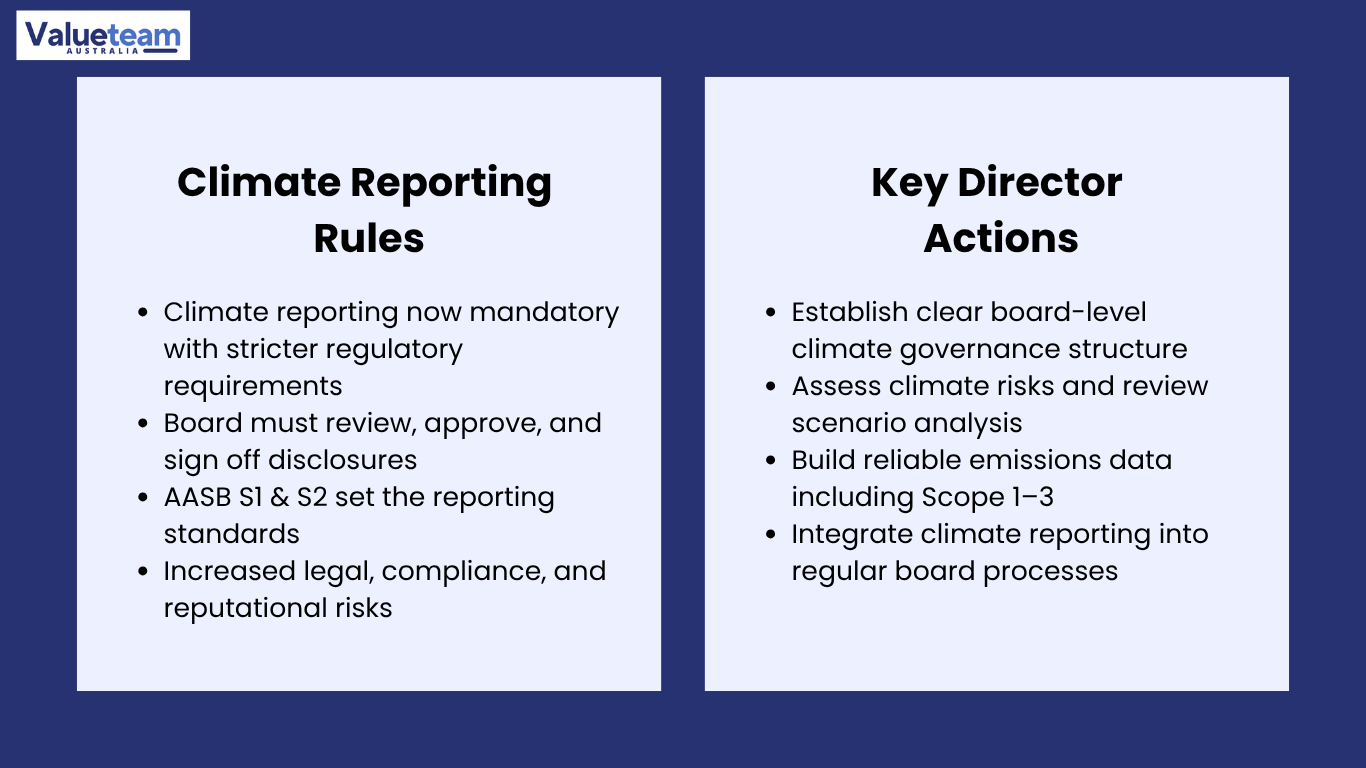
The Treasury Laws Amendment (Financial Market Infrastructure and Other Measures) Act 2024 has ushered in a new, significantly more rigorous chapter of the Climate Reporting Australia (CRA) framework. Large entities are, for the first time, subject to Mandatory Disclosure Requirements that go beyond best-practice voluntary guidance and are therefore mandatory, and therefore subject to the risk of regulatory, civil, and reputational scrutiny for boards that do not comply with their Director Responsibilities ESG. The days of climate disclosure as a voluntary showcase of corporate good intentions are gone; it is now as much a compliance issue as financial reporting and audit.
The impact on directors is profound and immediate. Under the new regime, Board Accountability ESG cannot be outsourced to a sustainability team or an external advisor. The new rules require climate-related financial information to be prepared, reviewed, approved, and signed off by the board, using the same processes and standards as the financial statements in the annual report. Directors who are unable to understand the nature of the disclosures they are making, or who have not participated in the climate risk reporting assessment activities that inform those disclosures, face a new personal risk of liability.
This article is for directors, company secretaries, and senior managers who want to understand the current requirements of Climate Risk Reporting Australia, the specific responsibilities of the board under the new regime, and how to implement the processes and capabilities required to meet them. It is also written for new entrants to the ESG advice, legal, and corporate governance professions who need to understand what the Mandatory Disclosure Requirements mean for directors in real terms. The approaches and examples in this article are based on how boards and their advisors are approaching the inaugural year of mandatory climate reporting compliance.
2. The Mandatory Framework: What AASB S1 and S2 Actually Require
Australia’s Corporate Climate Disclosure regime is based on two new Australian Accounting Standards Board standards. AASB S1 (General Requirements for Disclosure of Sustainability-related Financial Information) and AASB S2 (Climate-related Disclosures). These Australian standards are the national versions of the International Financial Reporting Standards (IFRS) Sustainability Disclosure Standards published by the International Sustainability Standards Board (ISSB). They are substantially equivalent to the Task Force on Climate-related Financial Disclosures (TCFD) Australia recommendations that many large entities have voluntarily adopted since 2017. The key distinction between voluntary, TCFD-aligned disclosure and the new mandatory climate reporting standards is that the latter require disclosures to be subject to an assurance and to be part of the entity’s annual report, thereby imposing legal responsibility for the veracity and completeness of the information.
In particular, AASB S2 requires entities to include disclosures on their Climate Risk Reporting along the four pillars of content: governance (how the board and management oversee and manage climate-related risks and opportunities), strategy (the actual and potential impacts of climate-related risks and opportunities on the entity’s business model and financial position), risk management (the processes used to identify, assess, and manage climate-related risks), and metrics and targets (the measures used to assess and manage climate-related risks and opportunities, including Scope 1, 2, and 3 greenhouse gas emissions). These four pillars are drawn directly from the TCFD framework, meaning that entities that have adopted TCFD-aligned reporting are well on their way – but the mandatory standard also introduces additional detail, in particular regarding scenario analysis and Scope 3 measurement, that has not been commonly reported in voluntary disclosures.
The Sustainability Reporting Standards in AASB S2 also require climate scenario analysis, which many boards may not have given adequate consideration to. Scenarios involve modelling the consequences of the entity’s strategy and financial outlook under various climate change scenarios – usually including a scenario that is consistent with a 1.5°C world (a “transition risk” scenario, involving substantial policy and market shifts) and a higher level of physical climate change. The results of this exercise must feed into the entity’s disclosure of material climate risk reporting and opportunities, and directors must have had access to and an understanding of the results, rather than just a report put together by management. Boards that have not previously worked through a climate scenario analysis exercise should be aware of the learning curve and ensure they allow enough time to address this knowledge gap.
3. Director Obligations and Governance Accountability Under the New Standards
Director Responsibilities ESG under the new mandatory scheme are more detailed than those under any previous voluntary disclosure. The Governance Obligations of the board cover four areas that must be disclosed explicitly under the AASB S2 governance pillar: the board’s oversight of climate-related risks and opportunities, how the board has considered climate-related risks and opportunities in its decision-making during the reporting period, the board committee or individual responsible for the oversight of climate-related issues, and the board’s monitoring of progress towards climate-related objectives. For many boards, this level of detail about the governance process (which they will need to have independently assured and disclosed) represents a step up in the required evidence, rather than mere assertion.
Board Accountability ESG applies to the accuracy of climate-related financial statements as it does to financial statements. Civil liability under the Corporations Act applies to directors who sign off on annual reports containing materially misleading information – and that now includes the sustainability report as well as the financial statements. ASIC has indicated through its enforcement actions on greenwashing that it will come after misleading climate disclosures, and the new mandatory framework provides a more specific framework against which ASIC will test the adequacy and accuracy of disclosures. Directors who recognise this enforcement context – and who take an active interest (and not just approval) in the preparation of climate disclosures – are much better off than directors who do not recognise the need to engage with the preparation of the sustainability report in the same way that they engage with the preparation of the financial statements.
The Climate Compliance Framework demanded by AASB S2 is not a one-off project. The scenario analysis needs to be reviewed in response to a material change in the entity’s exposure to climate risk reporting, or if new scientific or policy information significantly alters the likelihood of the scenarios used. The metrics and targets must be disclosed consistently year on year, and any material changes to them must be disclosed and justified. The recurring nature of the compliance requirement means boards need to establish ongoing governance arrangements (not just reporting processes) that embed climate risk reporting oversight into their regular governance practices. This is a system transformation, not a paper exercise.
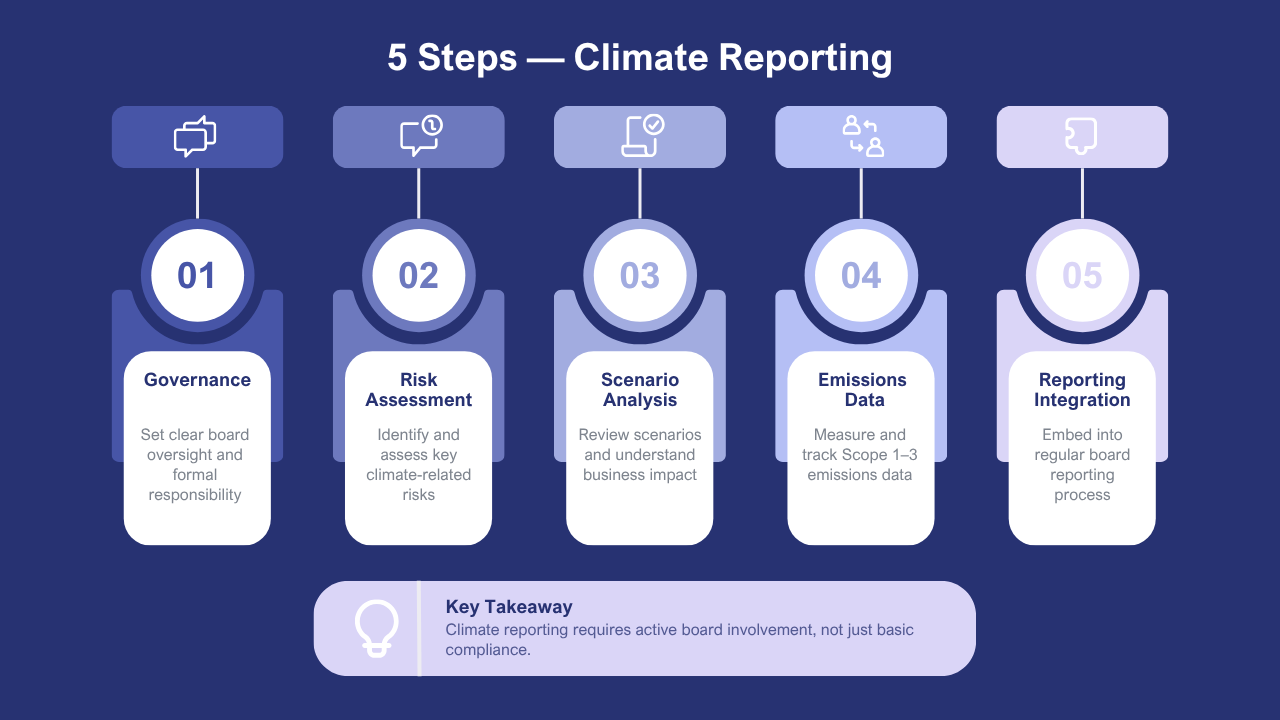
4. Five Steps Boards Must Take to Meet Mandatory Climate Reporting Obligations
As we have seen in the entities that have already gone through the first round of mandatory Climate Reporting Australia, five governance steps have been crucial in determining whether boards were ready to fulfil their responsibilities or were trying to catch up on the standard at the very last minute. The table below outlines the steps, actions and common failure points at each stage.
Step | What the Board Must Do | Most Common Failure Mode |
1. Establish formal board climate governance | Designate a board committee or full board responsibility for Corporate Climate Disclosure oversight; ensure terms of reference explicitly include climate risk; document the governance process for reviewing climate disclosures | Climate responsibility sits informally with the chair or CEO without a board committee mandate; the governance process is undocumented and cannot be evidenced in the Sustainability Reporting Standards disclosure |
2. Commission a climate risk and opportunity assessment | Engage management or external specialists to conduct a structured assessment of material climate-related risks and opportunities across the entity’s value chain; ensure assessment is reviewed and challenged at the board level | Assessment is prepared entirely by management or consultants without meaningful board engagement; directors cannot articulate the material risks identified or explain how they informed strategic decisions |
3. Conduct and review climate scenario analysis | Review and approve climate scenario assumptions and outputs; ensure at least two scenarios are assessed (transition and physical); understand the implications for the entity’s business model and financial position | Scenario analysis is treated as a technical modelling exercise delegated entirely to management; the board approves the output without understanding the assumptions or the sensitivity of the results to key variables |
4. Establish emissions measurement and the Scope 3 programme | Ensure Scope 1 and 2 emissions are measured and verified; begin Scope 3 measurement programme for material categories; align metrics with TCFD Australia and AASB S2 requirements | Scope 3 measurement is deferred; Scope 1 and 2 data quality has not been independently verified; emissions data is inconsistent with prior year disclosures without a documented explanation |
5. Integrate Climate Risk Reporting into board reporting cadence | Include climate risk reporting updates in regular board reporting; review progress against targets at least annually; ensure Director Responsibilities ESG are reflected in the board skills matrix and director induction | Climate reporting is a once-a-year disclosure exercise rather than an ongoing governance process; no climate metrics in management reporting to the board; Board Accountability ESG is not reflected in director performance frameworks |
The most significant gap between the technical understanding of the directors and the complexity of the task is at Step 3 – scenario analysis. A scenario analysis developed by a modelling team and then reviewed at a very high level by the directors is not the same as one that the directors well understand so that they can explain it to a shareholder, the media, or a regulator. The Governance Obligations in AASB S2 mandate active board engagement in the scenario analysis process: identifying which physical and transition risks are most relevant to the entity, which assumptions are most sensitive, and which strategic response options are available. When directors take the time to do this – through workshops, board briefings and consultations with external advisors – they get better disclosures. They are well served when the adequacy of their Corporate Climate Disclosure is questioned.
5. Process, Challenges, and What the First Reporting Cycle Teaches Directors
The first group of entities with mandatory Climate Reporting Australia obligations has yielded useful insights into what works and what does not in the process. This knowledge is helpful for directors of boards that are already in the mandatory regime or preparing for it in the Group 2 or Group 3 reporting cycles. The board governance cycle below shows how entities with well-established processes have managed the annual disclosure cycle.
Phase 1 | Phase 2 | Phase 3 | Phase 4 |
Governance Setup & Materiality | Scenario Analysis & Strategy | Metrics, Targets & Data | Disclosure Preparation & Assurance |
Board committee mandate established; material climate risks and opportunities identified through structured assessment; double materiality analysis reviewed and approved at board level; Climate Compliance Framework documented | Climate scenarios selected and assumptions approved by board; scenario outputs reviewed against entity strategy and financial projections; material risks and opportunities identified for Corporate Climate Disclosure; strategic responses documented | Scope 1, 2, and 3 emissions measured and independently verified; progress against Climate Risk Reporting targets assessed; Mandatory Disclosure Requirements data set compiled and quality-reviewed; Board Accountability ESG sign-off process engaged | AASB S2 disclosure drafted against Sustainability Reporting Standards requirements; limited assurance engagement conducted; board reviews and approves final disclosure; Director Responsibilities ESG fulfilled through formal sign-off |
Phase 1 – the first two items, setting up the governance structure and performing the materiality assessment – was where boards that struggled in the first year failed to invest sufficiently. The materiality assessment is not a report prepared by management and endorsed by the board. Under AASB S2, the board’s Governance Obligations require directors to have considered which risks and opportunities associated with climate change are material to the entity’s financial position, and this consideration is to be reflected in the governance disclosure. Boards that lacked processes for managing climate risk had to implement them quickly, resulting in more generic disclosures that were compliant but less specific than those from well-prepared boards.
The assurance requirement – which starts with limited assurance in the first year (and is expected to ramp up to reasonable assurance over time) – poses a particular data quality challenge. The limited assurance provided by assurance practitioners on Corporate Climate Disclosure is to a higher standard than many boards anticipated, based on their experience of voluntary disclosures. Data that may have been relied upon without independent verification, previously, were questioned; methodologies that may have been documented informally, previously, were found to be inadequate; and governance processes that were previously described in vague terms were found to be inadequate. Those directors who recognised that the assurance process would be rigorous and ensured management had been diligent in delivering high-quality emissions data and detailed methodology documentation well in advance of the assurance process typically had a more efficient process and fewer issues to resolve.
One lesson that has emerged from the first mandatory reporting year relates to the need for board climate literacy. They needn’t be climate scientists or emissions modellers. But they do need to be sufficiently informed about the entity’s material climate risks and opportunities so they can engage in a meaningful way with the disclosures they are signing off on; so they can ask the right questions of management; and so they can pick up when a proposed disclosure is not consistent with the risks the entity is facing. Boards that committed to educating their directors about climate risk reporting through briefings, speakers,s and board retreats on climate risk produced superior Climate Risk Reporting and were better placed to fulfil their Director Responsibilities ESG than boards that viewed the disclosure as a technical matter to be outsourced to experts and not requiring director expertise.
6. Real Cases and What They Reveal for Boards
One example of the governance impact of a lack of board engagement with the climate scenario analysis is a large infrastructure entity that provided its climate scenario analysis in its first mandatory report but faced a shareholder resolution arguing that the scenario analysis outputs were not linked to the entity’s investment decisions. It had approved the scenario analysis as reported by management, but had not specifically discussed how the analysis’s outputs should guide investment in high-emissions assets. The Board Accountability ESG gap – between the board’s understanding of the scenario analysis and its consideration of scenario implications for strategy – was evident in the misalignment between its risk disclosure and its announced capital investment program. This case reiterated that there is a problem with Corporate Climate Disclosure: it fails to highlight material transition risks while simultaneously approving capital expenditures that are inconsistent with managing those risks.
Another case illustrates the benefits of the board working with its Climate Reporting Australia obligations. A financial services company in the Group 2 mandatory category held a special board workshop six months before its first reporting period. It considered the draft report on scenario analysis, tested the key assumptions (with the help of an independent climate advisor) and explicitly discussed the relevance of the analysis to the entity’s credit book and investment portfolio. By the time the disclosure was finalised, the directors were familiar with the material risks identified, had signed off on the strategic plans, and could confidently respond to any questions analysts and investors posed about the disclosure. The Climate Compliance Framework developed through this process was reported in the governance disclosure to clearly demonstrate the board’s meaningful engagement, rather than rubber-stamping, and the entity’s first mandatory disclosure was cited as a positive example of a good governance process in a peer benchmarking report.
7. Conclusion: Actionable Guidance for Directors and Advisors
The Mandatory Disclosure Requirements of AASB S1 and S2 have transformed Director Responsibilities ESG in Australia. Climate-related financial disclosures are no longer a voluntary declaration of corporate sustainability intent – they are mandatory climate reporting, assured and subject to the same civil liability regime as financial statements. Those directors who take their governance obligations to this challenge as they do to their financial reporting obligations – by engaging substantively with the risk assessment, understanding the scenario analysis and ensuring the governance processes are in place that demonstrate effective oversight – will be meeting their Governance Obligations and will be well positioned if the adequacy of their Corporate Climate Disclosure is questioned. Directors who consider it to be a form that must be filled out by management will not.
The most tangible first steps for directors are to formalise the board’s mandate for overseeing climate risk, to engage in understanding the entity’s material climate risks rather than delegating understanding and process, and to invest in improving the board’s climate literacy before the next reporting round. The TCFD Australia framework continues to be a helpful conceptual approach, and knowledge of its four pillars (governance, strategy, risk management, metrics and targets) delivers the language for discussing what AASB S2 now requires in mandatory climate reporting form. For boards that have not reported before, the best value-for-money action in the time before the first reporting cycle is to engage a reliable ESG advisory firm to help the board understand the entity’s level of climate risk exposure and preparedness.
For corporate governance and ESG advisors who work with boards, the key action point is to familiarise directors with the reality that Climate Risk Reporting is not a technical reporting activity that is the preserve of sustainability professionals – it is a corporate governance task that demands the skill and attention of directors. The best value that ESG advisors can offer is not a better disclosure document produced on behalf of the board; it is helping the board to understand the substance well enough to produce their own disclosure. Directors who grasp and can explain the entity’s material climate risk reporting, who have engaged with and challenged the scenario analysis and who have designed governance processes that will withstand scrutiny are the directors who will best manage the compliance obligations under the Sustainability Reporting Standards – and be best prepared for the coming years of the Standards as they become more specific and higher assurance as the decade progresses.
Frequently Asked Questions
Q1. What is mandatory climate reporting?
Mandatory climate reporting requires eligible organisations to disclose climate-related risks, governance, emissions, and sustainability information within their financial reporting framework.
Q2. Why is climate reporting becoming mandatory?
Governments and regulators are introducing climate reporting requirements to improve transparency, support informed investment decisions, and address climate-related financial risks.
Q3. What information is commonly disclosed?
Businesses may disclose greenhouse gas emissions, climate risks, governance practices, sustainability strategies, and climate-related financial impacts.
Q4. Which organisations are affected by mandatory reporting?
Large companies and entities subject to regulatory reporting requirements are typically required to comply with mandatory climate disclosure standards.
Q5. How can businesses prepare for climate reporting?
Businesses should establish data collection processes, strengthen governance, assess climate risks, and implement reliable sustainability reporting systems.