
Table of Content
1. Introduction
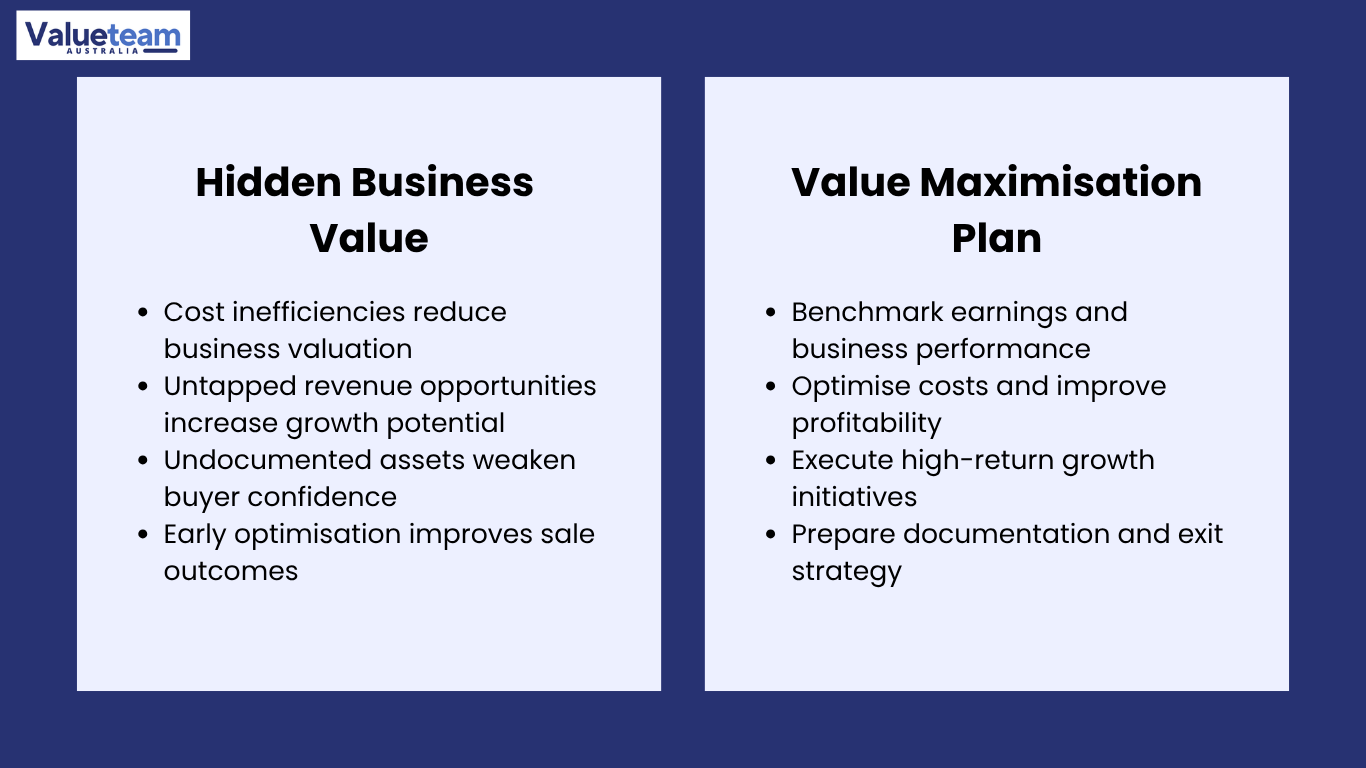
The majority of business owners have a better understanding of their business than anyone else – and that knowledge is both an asset and a weakness. Over the years of operation, practices that once were consciously developed become routine, and inefficiencies that might once have been consciously developed become invisible. Growth opportunities that once might have been identified with a new set of eyes have become part of the landscape. Hidden Business Value is the difference between what a business is currently producing and what it might produce with purposeful, directed improvement – and in the context of a planned sale, that difference is a difference in money which is being left on the table.
A Value Enhancement Strategy does not constitute cosmetic preparation. It is an ongoing programme of operational, financial, and commercial enhancements that transform the quality of earnings, risk exposure, and the business’s growth trend over the 12 to 24 months leading to a planned exit. The businesses with the best sales results are not necessarily the most profitable pre-programme; they are the ones whose owners identified their greatest areas of improvement early enough to do something about them, and whose advisors translated those improvements into a compelling, evidence-based sales story.
This article is directed to business owners who intend to exit their businesses in the future, and to advisors who help their clients create their own Exit Preparation Strategy. It identifies the most prevalent sources of Hidden Business Value, explains the five-step Value Maximisation Plan that seasoned practitioners use, and provides practical advice on where the highest-paying improvements are made and how they can be implemented within a realistic pre-sale timeframe.
2. Where Hidden Business Value Lives in Most Businesses
The three most common sources of Hidden Business Value
The Hidden Business Value is most likely to be found in three areas that long-tenured owners tend to forget: cost base structural inefficiencies, uncapitalised revenue growth opportunities, and undocumented or unprotected intangible assets. Each will be a type of value for which a buyer will either pay a premium if proven or apply a discount if not. Detecting and remedying all three is the underpinning of any plausible Value Enhancement Strategy.
- Profitability Improvement with cost discipline: most owner-operated businesses bear owner-specific, discretionary, or above-market-rate expenses as the cost of the services they provide. Removal of these before sale not only increases the normalised EBITDA but also minimises the risk that the buyer will challenge the sale during due diligence.
- Revenue Growth Opportunities that have been identified but not pursued: adjacent markets, underpenetrated customer markets, cross-sell or upsell programs, and pricing reviews, which the owner has not had time to implement due to managing daily operations.
- Undocumented Business Value Drivers: proprietary processes, customer loyalty metrics, data assets, and brand equity that do exist, but have never been formally quantified or presented to a buyer audience.
Why Pre-Sale Optimisation timing matters
Any improvement in the sale price will be affected by when it is made in relation to the transaction. The improvement, which increases EBITDA by $100,000 and is implemented 18 months before the sale, will be reflected in at least one year of accounts before the transaction, giving the buyer a track record supporting the normalisation claim. The identical improvement introduced two months before the sale is there only as a prospective projection, which the buyers will very severely discount or disregard. No precautions are taken in Pre-Sale Optimisation with an 18 to 24-month horizon, as it is not a precaution but rather the time frame it will take to see the benefits reflected in financial evidence that will determine the transaction multiple.
3. Profitability, Cost, and Operational Value Levers
Profitability Improvement: removing costs that do not belong
The most immediately impactful hidden business value in most SMEs is in the cost structure. Expenses based on the convenience or preferences of the owner, not on the actual operating needs of the business: above-market remuneration relative to the management role being performed, personal vehicle and travelling expenses, charitable contributions, family payroll and discretionary professional fees. The most mechanically simple type of Profitability Improvement is the removal of these costs from the normalised earnings base, but they must be recorded and justified.
- Every add-back to normalised EBITDA multiplies into the sale price at the transaction multiple: -1 = -100,000 of justified cost reduction at a 5x multiple generates 500,000 of added value to the sale.
- Improvements in profitability through price reviews are often underrated: many businesses have not reviewed their prices relative to the market in several years, and the incremental margin achieved 12 months earlier is recorded in the financial track record.
Operational Efficiency Gains: reducing cost without reducing capability
Pre-Sale Improvements before a sale are a two-pronged strategy: they enhance the normalised earnings basis directly, and they signal to buyers that the business can grow without an equal increase in costs. Automation of processes, renegotiating with suppliers, rationalising overheads, and removing redundant positions or systems are all part of a leaner and more credible cost structure that the buyer would consider when evaluating how the business being acquired operates following the acquisition.
An effective way to consider Operational Efficiency Gains is to compare the business’s cost structure with the industry: cost of goods sold (a percentage of revenue), wage cost ratios, and overhead as a ratio of gross profit. Differences with the sector average identify the greatest efficiency opportunity and provide the analytical basis for presenting a cost improvement story to buyers.
4. The Five-Step Value Maximisation Plan
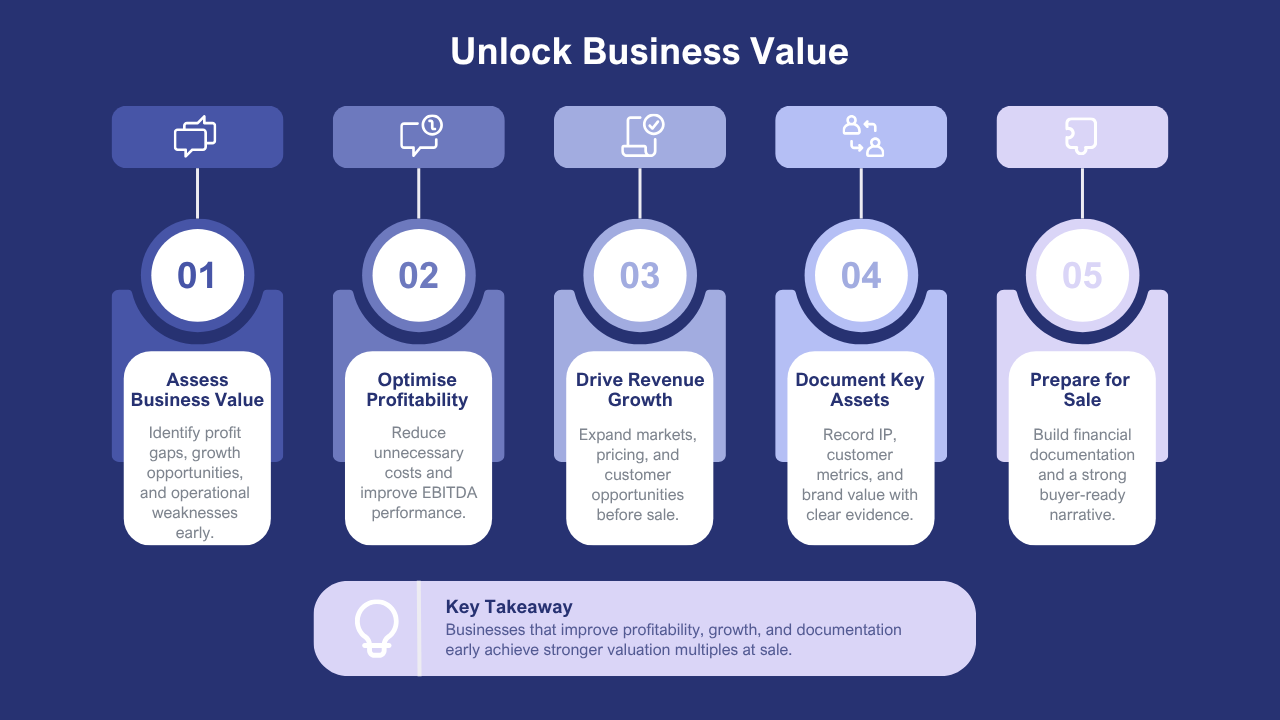
The identification of Hidden Business Value becomes a programmed sequence of activities with established owners, a schedule and quantifiable results. The following five steps are how experienced advisors perform this work in an 18-to 24-month pre-exit window.
Step | What It Involves | Value Creation Mechanism | Optimal Timing |
1. Commission a Value Enhancement Strategy baseline | Engage an advisor to conduct a structured assessment of the business’s current earnings quality, cost structure, growth opportunities, and risk profile; compare against sector benchmarks; quantify the improvement potential in each area | Creates the analytical foundation for the improvement programme; prioritises the highest-return opportunities; prevents effort being invested in areas that will not materially affect the transaction price | Immediately: the baseline must precede all other actions |
2. Implement Profitability Improvement and Cost Optimisation Strategy | Remove owner add-backs and non-arm’s-length transactions from the P&L; implement any pricing improvements; renegotiate major supplier contracts; benchmark overhead against the sector; eliminate redundant costs | Every dollar of defensible EBITDA improvement multiplies into the sale price at the transaction multiple; “discoverable” improvements made now save those dollars from being taken by a buyer’s due diligence adjustment | Months 1–6: immediate actions; structural changes require more lead time |
3. Execute Revenue Growth Opportunities | Identify and pursue the two to three highest-return revenue initiatives: new customer segments, pricing tier expansion, geographic extension, or cross-sell of underutilised services; ensure at least one reporting period of growth is visible before sale | Revenue growth trend demonstrated in the financial track record commands a higher multiple than revenue growth projected in a business plan; buyers pay for demonstrated performance | Months 3–12: initiatives must be implemented with sufficient lead time to generate measurable results before going to market |
4. Document Business Value Drivers | Formally identify, document, and, where possible, quantify the intangible value drivers: customer retention rates, brand equity, proprietary processes, IP, data assets; ensure all are transferable and legally registered where relevant | Converts qualitative value assertions into documented, buyer-verifiable claims; prevents buyers from substituting their own conservative assumptions for assets the seller describes but cannot evidence | Months 6–12: documentation is achievable within this window; IP registration may require longer |
5. Execute the Exit Preparation Strategy | Prepare the sell-side quality-of-earnings analysis; build and populate the virtual data room; commission an updated valuation; develop the information memorandum narrative around the documented improvement programme; engage an M&A advisor for the sale process. | Translates the improvement programme into a buyer-facing narrative that commands a premium; a well-documented improvement story reduces buyer risk perception and supports a higher multiple. | Months 12–18: sale process preparation commences once improvement initiatives have generated measurable results |
Step 3- executing Revenue Growth Opportunities- is the step that will create the most powerful pre-sale positioning because it will transform the financial narrative of this business, which will be this is what the business has earned, to this is the path the business has taken. Buyers will pay a premium to businesses that are provably growing, because such growth means they are not just acquiring existing earnings but entering an accelerating momentum. Revenue growth initiatives with 12 to 18 months of proven outcomes are worth significantly more than forward projections. This is not to commence these initiatives a month before attending the market.
5. Process, Real Cases, and Lessons Learned
The value enhancement workflow
A Value Enhancement Strategy programme operates in four phases over 18 to 24 months before the planned exit. The following workflow shows how the improvement programme would be incorporated into the process for the eventual sale.
Phase 1(Months 1–3) | Phase 2(Months 3–12) | Phase 3(Months 12–18) | Phase 4(Months 18–24) |
Baseline & Priority Setting | Implementation | Measurement & Documentation | Exit Preparation Strategy |
Commission Value Enhancement Strategy baseline; identify and quantify Hidden Business Value by category; prioritise Profitability Improvement, Operational Efficiency Gains, and Revenue Growth Opportunities by return on effort | Execute Cost Optimisation Strategy: remove owner add-backs, renegotiate suppliers, benchmark overhead; launch top Revenue Growth Opportunities; document Business Value Drivers; begin IP formalisation | Compile financial evidence of improvement: at least one full reporting period showing the cost and revenue improvements; complete Business Value Drivers documentation; build a data room | Prepare sell-side quality-of-earnings; develop information memorandum around improvement narrative; commission updated valuation; engage M&A advisor; implement Value Maximisation Plan for the sale process |
Case 1: Three initiatives, one transformative outcome
This is a Value Enhancement Strategy programme by a professional services firm that started 21 months earlier than the planned exit. The baseline showed that three sources of Hidden Business Value were significant: owner remuneration over and above the market cost of the founder playing the role of management was $180,000; a technology subscription utilized by less than 30 per cent of the staff was costing 95,000 per annum; and pricing review had not been done in the last four years even though there has been material inflation in delivery costs. The three were all discussed over the next 14 months. The normalised remuneration of $180,000 was recorded against market standards; the technology subscription was renegotiated to a usage-based model, saving $ 68,000; and a price uplift was implemented, reflected in 12 months of trading data. This increase or decrease in normalised EBITDA was some 310,000. At a transaction multiple of 5.5x, this was an approximation of the value of 1.7 million in additional sales value generated by a Pre-Sale Optimisation programme, which cost less than 50,000 in advisory fees to effect.
Case 2: Revenue growth that changed the buyer’s multiple
A distribution business was producing a flat revenue over three years – a profile that placed it on the low end of the sector multiple range. As part of its Exit Preparation Strategy programme in month 4, the management team introduced two initiatives: a regional expansion into an adjacent market and a cross-sell programme focused on the top 30 per cent of existing accounts. When the business was taken to market 18 months later, revenue had increased by 22 per cent over the period, with the new geographic market contributing 14 per cent of all revenue and the cross-sell programme increasing average revenue per account by 11 per cent. The financial story was no longer that of a mature, stable business but of one that has demonstrated and diversified growth. The multiplier the buyer applied was 0.8x higher than the pre-programme assessment estimated, which can be directly traced to evidence of revenue growth. The Revenue Growth Opportunities not only added to income but also altered the buyer’s view of the business’s future.
6. Conclusion
Hidden Business Value does not apply to businesses in distress or with an apparent operational issue. It can be found in virtually every business that has been operating for more than a few years: in the cost structures that have never been benchmarked; in the Revenue Growth Opportunities that have been identified but not pursued; and in the Business Value Drivers that exist but have never been documented. An excellent Value Enhancement Strategy programme, implemented with a true 18 to 24-month horizon, will always produce sales outcomes that are better than those achieved with an unprepared exit.
In the case of owners, today, they commission the assessment of the baseline and use it to develop a Value Maximisation Plan with specific initiatives, owners and timelines. To advisors: the best client service that you can offer is to identify Hidden Business Value early, when you still have time to convert it into a sale price. The distinction between a mere exit and a great one is nearly always a difference in preparation, and preparation starts here and now.