

Table of Content
1. Introduction: Value Intangible Assets
The most valuable assets in most contemporary businesses are those not on the balance sheet. A brand known throughout the world, a suite of patents protecting a key technology, a unique software system, and a customer list with an unusually high retention rate: all can be expected to generate significant value, but under generally accepted accounting principles, they are often recorded at zero or at their cost, which is often very different from their true value. The disconnect between book value and real economic value is why Intangible Asset Valuation has emerged as a technically complex and commercially important practice in advisory, transactional and financial reporting.
The four types of intangibles covered in this article – brands, intellectual property, software, and customers – are the most common and most valuable intangibles found in M&A transactions, in purchase price allocation, impairment and licensing deals. Each has a different approach to Intangible Asset Pricing, based on the economic drivers of value, the data inputs, and the standards of evidence that auditors, courts, and counterparties to a transaction will require to support the conclusion. Recognising these differences – and communicating them effectively – is a prime indicator of true professional advancement in the valuation business.
This handbook is intended for those who want to deepen their understanding of intangible valuation and gain technical proficiency. It describes the main methods used in each asset class, the five steps in a robust Intangible Asset Valuation process, the practical issues practitioners face in real-world engagements, and the lessons they learn from engagements in which the choice and execution of the valuation methodology had a significant impact on the results. Whether you’re helping with a post-merger purchase price allocation, helping a founder value their IP assets, or preparing to negotiate a license agreement, the models in this guide will help you think more effectively and better articulate your conversations.
2. Brand Valuation: Quantifying the Value of Market Reputation
Brand Valuation Methods have come a long way in the last couple of decades, from essentially being an opinion on a marketing plan to financially oriented approaches that can be justified to auditors, courts, and savvy buyers. The most common method used in practice – and arguably the most accepted method under IFRS 3 for the purpose of allocating the price of an acquisition – is the Relief-from-Royalty Method. The idea behind the approach is that a firm that owns a brand does not have to pay a royalty to license its use. The present value of these royalty payments over the brand’s useful life (discounted at an appropriate rate) is the brand’s fair value.
The key factors in a Relief-from-Royalty Method analysis are the royalty rate, the revenue subject to the royalty, the brand’s useful life, and the discount rate. All these items require technical and commercial acumen. The royalty rate, which is normally expressed as a percentage of the revenue base, should be supported by publicly available licensing agreements and royalty databases for similar brands operating in the same industry and market. A brand in a sector where licensing rates range from 1-3% of revenue should not be licensed at 5% just because the value is higher. Auditors and other experts will question rates that do not reflect arm’s-length comparable rates, and the entire valuation exercise hinges on this single variable.
Fair Value Measurement of a brand also involves a choice as to whether a brand is to be considered to have an indefinite life – and thus should not be amortised but tested for impairment each year – or a finite life over which the royalty savings should be discounted. Brands that are consumer-facing, have a strong market position, are well invested, and are not subject to obvious obsolescence are arguably indefinite. Industry- or product-specific brands that are likely to lose value as their underlying market develops should be given a finite useful life reflecting a reasonable expectation of the time the brand will continue to provide discernible economic benefits. This is an important consideration for financial reporting and requires professional judgement rather than a one-size-fits-all conservative approach.
3. Intellectual Property and Software: Valuing Innovation and Technology
The field of Intellectual Property Valuation encompasses many types of assets, including patents, trademarks, trade secrets, copyrights, and know-how, with varying economic characteristics and valuation methods. In the case of patents, for example, the income approach is most widely used: forecasting the incremental cash flows that result from the patented technology (either via licensing revenues or as a competitive advantage over non-patented alternatives), discounting those cash flows at a rate that accounts for the expected remaining term of protection and commercial risk, and reporting the result as a Fair Value Measurement based on the actual Economic Benefit Analysis of the patent. The cost approach – the cost to develop the IP anew – is sometimes applied as a sanity check on the value, but seldom as a primary valuation method, as the cost of development is not systematically related to the asset’s value.
Software Valuation raises particular issues. Software platforms that represent the operational platform of a business can potentially represent significant economic value – the replacement cost, competitive advantage and revenue generation opportunities that they support are all potentially significant – but they risk becoming obsolete very quickly, they require maintenance, and they are vulnerable to technological obsolescence. The Relief-from-Royalty Method is widely used when comparable software licensing rates are available. Still, for in-house proprietary software platforms, the cost approach (adjusting for functional and economic obsolescence) is generally preferred. The obsolescence adjustment is key: a software platform that is three years old in an industry with a five- to seven-year technology cycle is valued differently than a platform that is eight years old in the same industry, despite identical replacement cost.
A particular issue in Intellectual Property Valuation is the value of the IP as a standalone asset, as opposed to its value as part of a going-concern business. A patent that attracts licensing revenue from others has a clear independent value, which can be calculated based on anticipated licensing revenue. A patent that is principally used to protect a manufacturing process that is unique to the business has value in context – it may have a very different value to a prospective acquirer who does not operate that manufacturing process. Practitioners who understand this distinction – and clearly articulate this distinction in their valuations – generate valuations that are more relevant to negotiations and due diligence, and that better reflect the economic reality of the actual asset that is being sold.
4. Customer Relationship Value: The Economic Benefit of Loyalty
Customer Relationship Value is, for most service and B2B firms, the most significant intangible asset and the one most often under- or mis-valued. The conventional method applied in professional practice of Intangible Asset Valuation (IAV) is the Multi-Period Excess Earnings method, which identifies the portion of earnings attributable specifically to the customer relationship by deducting the required return on all other assets that contribute to earnings. The notion of contributory asset charges (CACs) – known also as the asset charge – is critical here: every tangible asset, intangible asset and working capital balance that is the source of a contribution to the stream of revenue from customers must be charged its fair return, and it is only the residual earnings left over that are ascribed to the customer relationship itself.
Under the Multi-Period Excess Earnings method, we are required to perform a comprehensive financial analysis over the life of the remaining relationship with the customer, based on an attrition rate – the percentage of the customer base that we expect to lose each year due to natural attrition, contract termination or competitive pressures. Attrition modelling is the most critical and most difficult factor in Customer Relationship Valuation. The vendor will be keen to achieve the lowest reasonable attrition rate, resulting in the longest projected customer relationship and the highest value. Buyers will test the attrition assumption with vigour, especially if customer relationships are concentrated, short-lived, or if there is evidence that the customer relationships being acquired are personal to the selling management team rather than institutional. Analysts who use three to five years of reported historical attrition data (rather than management opinion) to justify the attrition assumption are most credible.
The Economic Benefit Analysis supporting the customer relationship valuation must also address a subtler issue: are the customer relationships being valued transferable, or is their value contingent on the continued participation of some of the individuals in the selling business? A professional services company whose only client contact is through a founding partner who is not going to the acquiring entity has a different customer relationship value than one whose clients are managed by a team that will be moving to the new entity. This is not an attribute that is automatically reflected in the financial modelling; it requires the analyst to make and disclose a specific assertion about transferability, backed by evidence from the business’s actual structure.
5. Five Steps to a Rigorous Intangible Asset Valuation
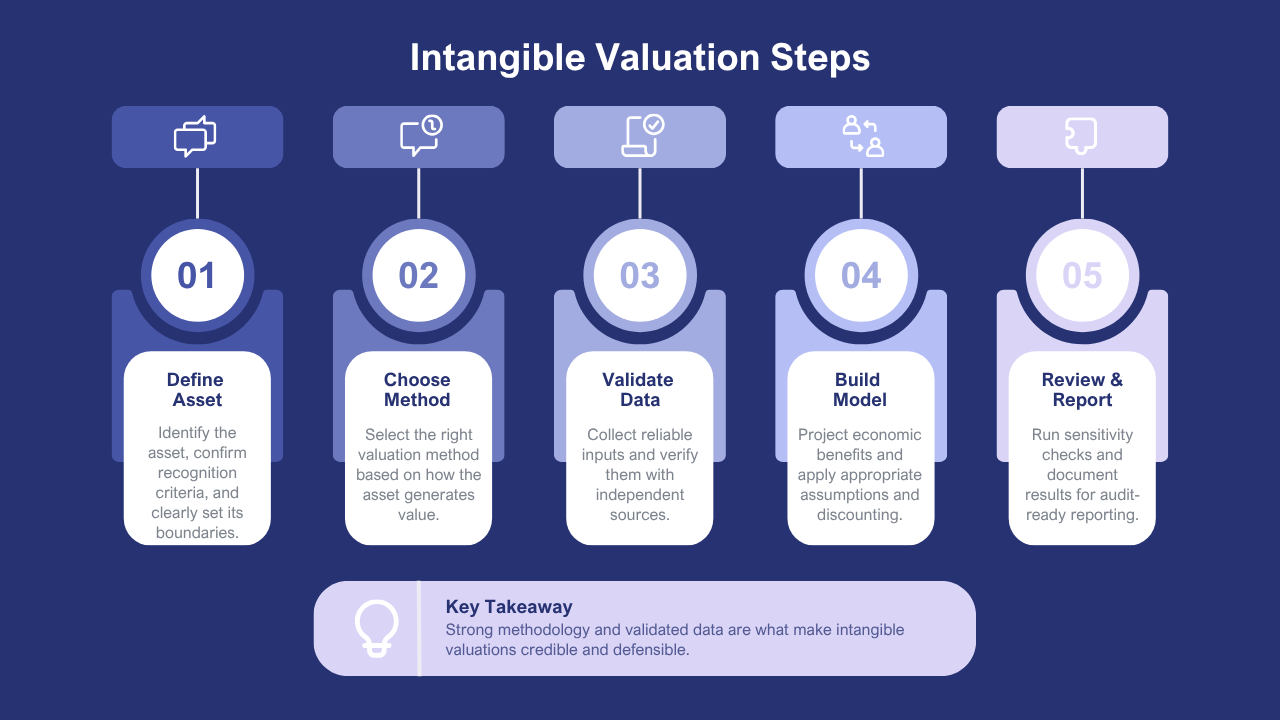
The Intangible Asset Valuation process, regardless of asset type, is rigorous. The following five steps reflect the way seasoned practitioners organise their work – from identification to a credible and properly documented Fair Value Measurement (FVM) result.
Step | What It Involves | Common Pitfall |
1. Identify and scope the asset | Confirm the asset meets recognition criteria (separable or arising from legal/contractual rights); define its boundaries precisely — what is included and what is excluded from the asset being valued; assess transferability and standalone nature | Over-broad scoping inflates value; conflating an asset with the going-concern business produces a valuation that double-counts value already captured in goodwill or the overall enterprise value |
2. Select the appropriate Intangible Asset Pricing method | Match the methodology to the asset’s economic mechanism: Relief-from-Royalty Method for brand and technology; Multi-Period Excess Earnings for customer relationships; cost approach for bespoke software and know-how; income approach for patents and licensed IP | Selecting the method that produces the highest value — rather than the most economically appropriate method — undermines credibility with auditors and counterparties and creates risk of challenge and revision |
3. Gather and validate data inputs | Source royalty rate benchmarks from licensing databases; compile attrition data from CRM or accounting systems; build contributory asset charge schedules; establish useful life based on sector evidence and asset-specific analysis | Relying on management-provided data without independent verification is the most common source of challenged assumptions; wherever possible, validate key inputs against independent third-party sources |
4. Build the Economic Benefit Analysis model | Project the economic benefits attributable to the asset over its useful life; apply CACs for Multi-Period Excess Earnings; apply tax amortisation benefit (TAB) adjustment where applicable; discount at an asset-specific rate reflecting the risk of the projected benefit stream | The tax amortisation benefit is a technically important but frequently omitted adjustment that understates asset fair value when excluded; practitioners should understand both why it applies and when it does not |
5. Sensitise, document, and disclose | Run a sensitivity analysis across key assumptions to establish the range of reasonable outcomes; document the methodology, data sources, and judgment rationale; and prepare a disclosure-ready analysis that meets the standard required by the engagement’s intended audience. | Point estimates without sensitivity analysis are vulnerable to challenge; a well-constructed sensitivity table shows both the robustness of the conclusion and the analyst’s awareness of where the key risks lie |
For those looking to improve their skills, Step 4 – the Economic Benefit Analysis model – is worth special mention. The tax amortisation benefit (TAB) arises because, by paying fair value for an identifiable intangible asset, an acquirer generally can amortise the asset’s cost for tax purposes over its useful life and enjoy a future stream of tax deductions. The value of those tax deductions is future economic benefit to the acquirer, and a Fair Value Measurement that fails to account for it will underestimate the amount that a market participant would pay for the asset. Knowing how the TAB adjustment works, when it applies, and how to calculate it is a practical way to help separate those who understand intangible valuation from those who are merely plugging in numbers.
6. Process, Real Cases, and Lessons Learned
One common issue in real Intangible Asset Valuation cases is the disconnect between the elegance and purity of the theory and the reality of the data. The Multi-Period Excess Earnings method, for instance, relies on a customer attrition analysis, assuming the business has kept accurate, time-stamped records of customer acquisition, revenue contribution, and attrition. Not all SMEs (and even some mid-market) businesses have their CRM systems (or their accounting systems) at a point of detail where this can be done purely retrospectively. In this situation, practitioners may either try to piece together the attrition picture from the data, with disclosure of the limitations, or proxy for the attrition assumption using industry benchmarks, with a discussion of the basis and the sensitivity of the results to the attrition assumption.
Phase 1 | Phase 2 | Phase 3 | Phase 4 |
Asset Identification & Scoping | Method Selection & Data Build | Modelling & TAB Adjustment | Documentation & Delivery |
Apply separability and contractual-legal criteria; define asset boundaries; assess transferability; gather historical financial data and operational records for Economic Benefit Analysis inputs | Select Relief-from-Royalty Method, Multi-Period Excess Earnings, or cost approach based on asset type; source royalty benchmarks, attrition data, and contributory asset schedules; validate inputs independently | Build Fair Value Measurement model; apply contributory asset charges for customer relationship assets; calculate tax amortisation benefit; run sensitivity analysis across key assumptions | Prepare Intangible Asset Pricing report with full methodology disclosure; document all assumptions and data sources; present sensitivity tables; deliver to the standard required by the intended audience (audit, transaction, litigation) |
An example of the effects of misapplying the method is a case in which a retail business was sold at a substantial premium to book value. The acquirer’s internal team used the cost approach to estimate the target’s brand value, treating marketing costs as a proxy for brand value. The auditor disagreed, correctly noting that the cost of creating a brand is unrelated to its economic value and that the Relief-from-Royalty Method is the primary method to be applied to value this type of brand. An external specialist valuer was appointed, the royalty rate was benchmarked against other consumer licensing deals, and the resulting Fair Value Measurement was significantly higher than the cost approach, leading to a higher intangible allocation, lower goodwill, and higher amortisation in future years. The external auditor’s remediation of the error – additional specialist fees and audit hours – far outweighed the cost of engaging a valuation specialist in the first place.
A better example is a technology licensing business that engaged an Intellectual Property Valuation firm to value its patent portfolio before negotiating a licensing agreement with a large industrial customer. This analysis highlighted that two patents – previously not viewed as significant assets by the business – produced a combined Fair Value Measurement under the income approach of $8.4 million (approximately), based on the anticipated royalty revenue stream from the proposed licensing arrangement. The fact-based valuation provided the business’s negotiating team with a basis for arguing for a minimum royalty figure during the licensing negotiations. The final royalty terms ended up being about 35 per cent higher than management’s original forecast of the value of the IP – a Return on Valuation that was earned in the first twelve months of the deal.
7. Conclusion: Building Capability in Intangible Asset Valuation
Intangible Asset Valuation is not a single capability – it is a collection of related skills, each based on a different methodology tradition and each demanding different data, different analytical skills, and a different understanding of the evidence that the relevant audience will require. The Relief-from-Royalty Method for brands and technology, the Multi-Period Excess Earnings method for customer relationships, and the income and cost approaches for Intellectual Property Valuation and Software Valuation each have their own rationale, data requirements, and opportunities for challenge. Those who understand the design of each method – not just how to plug numbers into the model – are better positioned to justify their work, and to respond when the data and assumptions are not textbook perfect.
For those starting in this field, the best way to learn is a combination of technical study and “living” cases. Studying the disclosed intangible asset valuation notes within public financial statements, notably as part of the Purchase Price Allocation disclosures following an acquisition, provides insight into the approach to scoping and reporting the work of seasoned practitioners, which has been subjected to audit scrutiny. Finding mentors working on real Intangible Asset Pricing engagements and asking questions about decision-making in method selection, key assumptions, and sensitivity analysis develops pattern recognition, allowing the practitioner to work on unfamiliar engagements rather than just repeating the same templates.
The take-out message from practice for colleagues who are advising clients on transactions, licensing or financial reporting is that the investment in quality Intangible Asset Valuation work – by a qualified specialist using documented and defensible methodology – is well worth the cost. A sound Economic Benefit Analysis of a portfolio of customer relationships that withstands due diligence strengthens a seller’s leverage. An Intellectual Property Valuation that demonstrates the cash flows attributable to a patent portfolio supports a licensing discussion. And a Fair Value Measurement of a brand or technology platform that withstands auditor scrutiny at the time of purchase price allocation avoids the much more costly regime of re-statement, repair, and extended auditing required to address a first-time attempt at this work that fails to meet the necessary standard.
Frequently Asked Questions
Q1. What are intangible assets?
Intangible assets are non-physical assets such as trademarks, patents, software, customer relationships, copyrights, and proprietary technology that contribute to business value.
Q2. Why is intangible asset valuation important?
Valuation supports financial reporting, mergers and acquisitions, licensing, taxation, litigation, and strategic business planning.
Q3. Which valuation methods are commonly used?
Professionals commonly apply the Income Approach, Market Approach, or Cost Approach depending on the characteristics of the asset.
Q4. Who requires intangible asset valuation?
Businesses, investors, accountants, auditors, legal professionals, and valuation specialists commonly require independent intangible asset valuations.
Q5. How does professional valuation improve decision-making?
Independent valuation provides reliable estimates that support financial reporting, commercial negotiations, regulatory compliance, and investment decisions.
4 thoughts on “How to Value Intangible Assets: Brand, IP, Software and Customer Relationships”